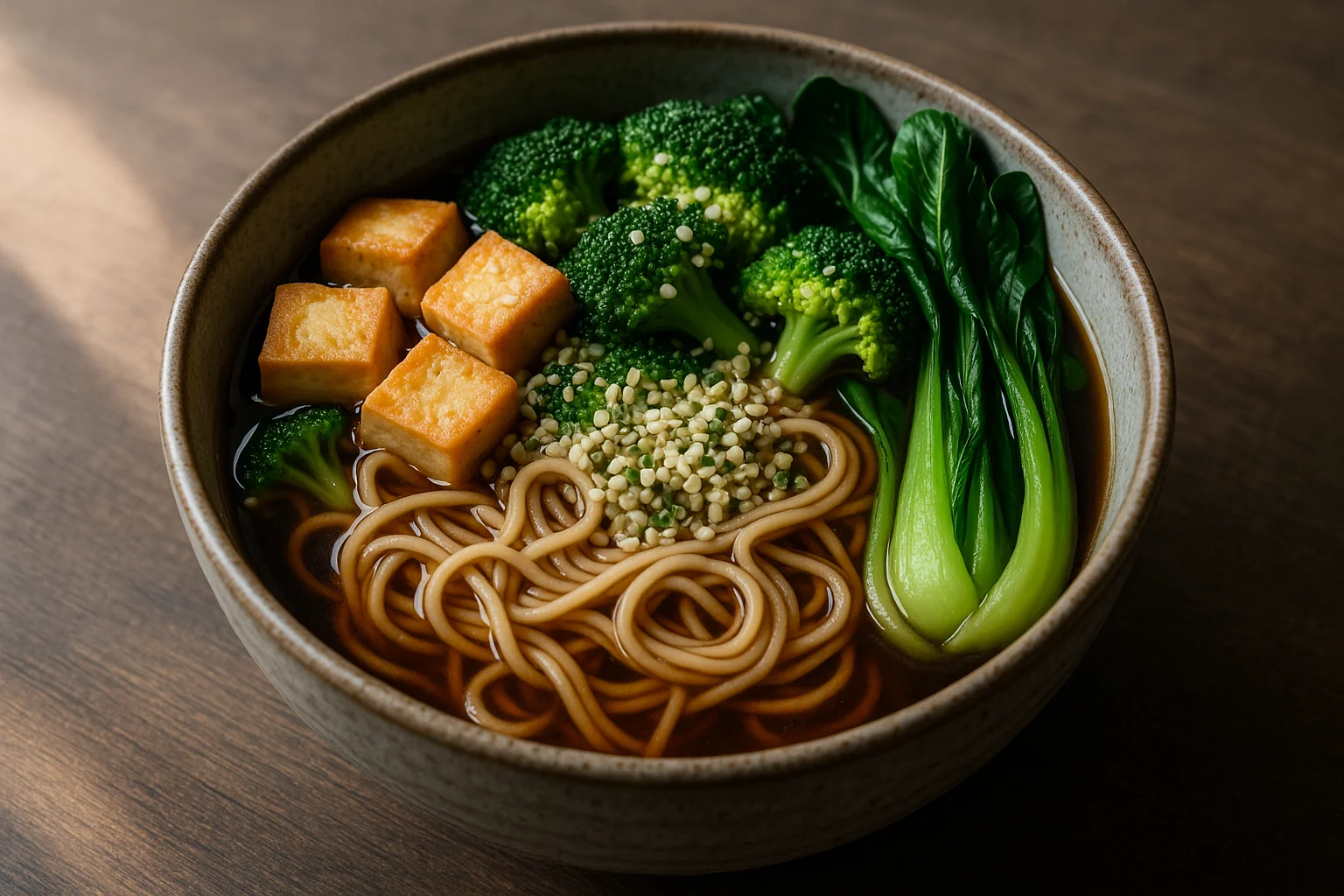

Ramen with hemp seeds and vegetables – vegan broth
Vegan ramen with hemp seeds and vegetables – a deep broth, noodles, and roasted hemp seeds as a topping. Step-by-step recipe and nutritional values.
Vegan ramen is not a compromise – it is a separate category. The depth of flavor is built here through umami from miso paste, soy sauce, and slow cooking with ginger, garlic, and onion. Hemp seeds sprinkled on top as a toasted garnish solve the problem that every meatless ramen faces: too little protein and omega acids. Three tablespoons of toasted seeds per bowl provide 9 g of protein with a complete amino acid profile – and the crunch that classic ramen lacks. Recipe below. Active time about 25 minutes, the rest is patiently cooking the broth.
KEY INFORMATION
• Hulled hemp seeds contain about 31 g of protein per 100 g and all 9 essential amino acids (House et al., Food Chemistry, 2010).
• Miso paste provides umami-building glutamates – vegan broth with miso matches the flavor of meat.
• The omega-6 to omega-3 ratio in hemp seeds is about 3:1 – close to the optimal level for humans (Callaway, Euphytica, 2004).
• 3 tablespoons of hemp seeds (30 g) provide about 166 kcal, 9 g of protein, 14 g of fat, and 1.2 g of carbohydrates (USDA FoodData Central, 2023).
Why hemp seeds in ramen?
Classic ramen with wheat noodles is rich in carbohydrates and sodium, but without protein and omega acids, it is not a complete meal. Tofu in ramen helps, but soy alone does not provide a complete amino acid profile as efficiently as hemp seeds. House et al. (Food Chemistry, 2010) confirm that hulled hemp seeds contain all 9 essential amino acids, including lysine and sulfur-containing amino acids, which grains provide in insufficient amounts.
Toasting the seeds before adding them to the ramen is crucial. In a dry pan for 3–4 minutes, the seeds become golden and intensely nutty – their flavor perfectly balances the saltiness of the miso and broth. Callaway (Euphytica, 2004) indicates that the omega-6 to omega-3 ratio in hemp seeds is about 3:1. Added as a garnish (not cooked in the broth), they retain this fat profile and crunch.
Our tests show that the key to a deep vegan ramen broth is sautéing the onion with the skin – a halved onion with the skin side up, sautéed on a dry or lightly oiled pan for 5 minutes, imparts a dark color and caramelized aroma to the broth, mimicking the effect of roasting bones in traditional ramen. The onion skin contains quercetin and other phenolic compounds that intensify flavor and color.
Nutritional values – what does this serving provide?
One serving of ramen (broth, 80 g of dry noodles, 75 g of tofu, bok choy, 10 g of hemp seeds) provides about 400 kcal, 20 g of protein, 12 g of fat, and 52 g of carbohydrates. The fiber from vegetables and seeds is about 4 g. Miso paste provides probiotics (if not cooked – add it to the broth after removing from heat to preserve the cultures).
Ingredients – what do you need?
Proportions for 2 servings. Broth cooking time: 30 minutes. Active time: about 25 minutes.
- 160 g of ramen noodles (or soba, udon, rice noodles)
- 4 tablespoons of shelled hemp seeds (about 40 g) for toasting
- 150 g of tofu (firm or semi-firm)
- 2 small bok choy or 150 g of baby spinach
- 1 large onion (with skin for the broth)
- 5 cm of ginger root
- 4 cloves of garlic
- 2 tablespoons of miso paste (aka or awase)
- 2 tablespoons of soy sauce or tamari
- 1 tablespoon of tahini (adds creaminess to the broth)
- 1 tablespoon of sesame oil
- 1.2 liters of water
- optional: shiitake mushrooms (fresh or dried), nori, chives
- optional: 1 tablespoon of chili oil for serving
How to cook vegan ramen with hemp seeds – step by step?
The secret to this ramen is a deep broth – cook it slowly and take your time. Cook the noodles separately. Toast the seeds just before serving.
Step 1. Build the broth. In a pot, heat the sesame oil. Cut the onion in half and place it cut side down – with the skin on. Sauté for 5 minutes without stirring. Add ginger and garlic. Sauté for 2 minutes. Pour in the water. Simmer for 25 minutes.
Step 2. Season the broth. Remove the pot from the heat. Take out the onion, ginger, and garlic. Add the miso paste, soy sauce, and tahini – mix until dissolved. Add miso after removing from heat, not to the boiling broth – this preserves the bacteria cultures and delicate flavor.
Step 3. Toast the hemp seeds. In a dry pan, toast the hemp seeds for 3–4 minutes over medium heat, stirring constantly. Remove when golden. Transfer to a plate.
Step 4. Prepare the toppings. Cut the tofu into cubes and sauté in a tablespoon of oil for 3–4 minutes until golden. Blanch the bok choy in the broth for 2 minutes. Cook the noodles in a separate pot and drain.
Step 5. Assemble the bowls. Pour the hot broth into bowls. Arrange the noodles, tofu, and bok choy. Sprinkle a tablespoon of toasted hemp seeds on top. Add nori, chives, and chili oil to taste. Serve immediately.
Tips and variations
Ramen with hemp seeds is very versatile. Here are a few tried-and-true variations:
Shoyu version. Instead of miso paste, use 3–4 tablespoons of soy sauce as the main flavor. The broth will be clearer and milder. Shiitake mushrooms (20 g dried soaked in broth) pair well with the shoyu version – their umami builds a depth comparable to miso.
Hemp protein version. Add a tablespoon of BIO hemp protein to the broth (hemp protein BIO 500 g) and mix – it will dissolve and enrich the broth with protein. Hemp protein has a digestibility of over 91% according to the IVPD method (Zahir et al., 2020).
A mistake to avoid. Do not cook pasta in broth – the starch from the pasta clouds the broth and alters its consistency. Cook the pasta separately in salted water and add it to the bowl just before pouring in the broth. Another mistake: adding miso paste to boiling broth – this destroys the bacterial cultures and changes the delicate flavor of the miso. Add it after removing from heat. Also, check out our recipe for miso soup with hemp seeds – a simpler Japanese soup with hemp seeds.
Frequently Asked Questions
Can vegan ramen with hemp seeds have a deep flavor?
Yes – the depth of the broth is built by the umami from the miso paste and soy sauce. Miso contains glutamates that trigger the umami receptor just like meat broth. Hemp seeds add a nutty note and protein. Onion with the skin sautéed dry gives the broth a dark color and caramelized aroma.
Why do hemp seeds pair well with ramen?
Ramen has a lot of carbohydrates, little protein, and omega acids. Shelled hemp seeds fill these gaps – about 31 g of protein/100 g with a complete amino acid profile (House et al., 2010). Roasted seeds retain their crunchiness and nutty flavor, contrasting with the soft pasta.
Which miso paste to choose for vegan ramen?
Aka miso (red) and awase miso (mixed) provide the deepest flavor for ramen – their intensity balances the nuttiness of the hemp seeds. Shiro miso (white) is milder and good for beginners. Do not cook miso in the broth – add it after removing from heat to preserve the flavor and any potential bacterial cultures.
How many kcal does vegan ramen with hemp seeds have?
One serving (broth, 80 g of dry pasta, tofu, vegetables, 1 tablespoon of seeds 10 g) provides about 400 kcal, 20 g of protein, 12 g of fat, and 52 g of carbohydrates. 3 tablespoons of seeds (30 g) provide about 166 kcal, 9 g of protein, and 14 g of fat (USDA, 2023).
Can ramen pasta be replaced with another type?
Yes – soba (buckwheat), udon, rice, or glass noodles work well. Soba has a lower GI and more protein than wheat ramen. Rice noodles are gluten-free. Always cook separately and add to the bowl – not to the broth, to avoid clouding the soup.
This article is for informational and educational purposes and does not replace consultation with a doctor. If you are pregnant, breastfeeding, taking medications, or have chronic conditions, consult the use of supplements or herbs with a specialist.
Author: Michał Waluk · Published: 2026-05-04 · Updated: 2026-05-04