
Adaptogens for libido: which ones support it and which do not
Four adaptogens have studies with placebo on sexual functions, while the rest have none. A table with verdicts, number of participants, and funding sources.
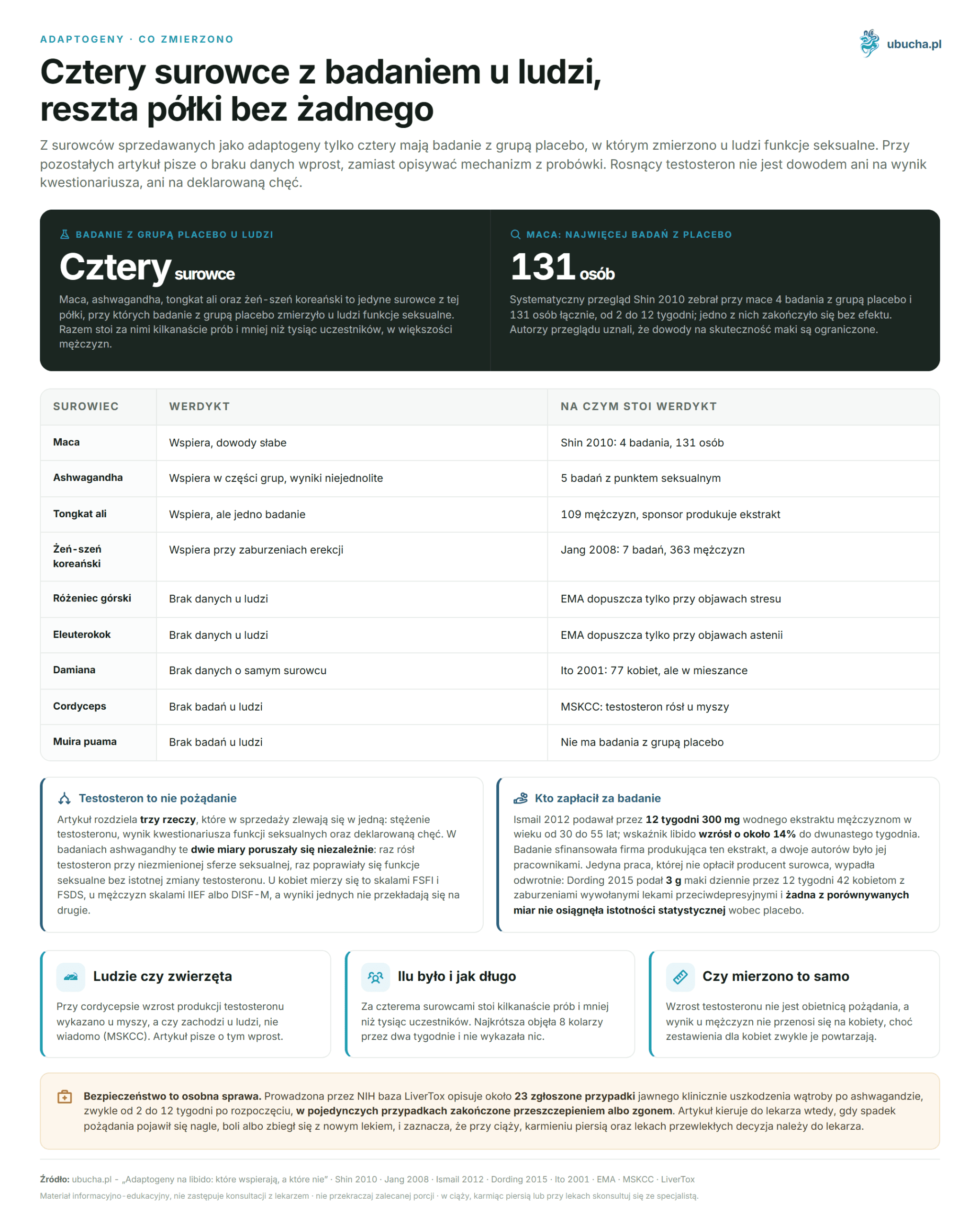
Among the raw materials sold as adaptogens, only four have studies with a placebo group that measured sexual functions in humans: maca, ashwagandha, tongkat ali, and Korean ginseng. The rest of this category, led by rhodiola, has not undergone a single such trial. Below is a table with the verdict for each raw material and the basis for the verdict: how many people, for how long, and who funded the study. We separate three things that are often conflated in sales: testosterone concentration, sexual function questionnaire results, and declared desire. Increasing testosterone is not evidence of the other two. Where there are no human studies, we state this explicitly instead of describing the mechanism from a test tube.
KEY INFORMATION
• Maca: 4 studies with placebo, 131 participants in total in the Shin 2010 review, authors' conclusion: limited evidence
• Tongkat ali: 1 study, 109 men, 12 weeks, libido increased by 14% (Ismail 2012), sponsor produces the extract
• Korean ginseng: 7 studies, 363 men with erectile dysfunction (Jang 2008), authors advise against definitive conclusions
• Ashwagandha: 5 studies with a sexual endpoint, results varied for women and men
• Rhodiola and eleutherococcus: zero studies with such an endpoint, EMA allows them only for fatigue and weakness
• Cordyceps: testosterone increased in mice, not tested in humans even once (MSKCC)
Which adaptogens have studies with a placebo group on sexual functions?
Four: maca, ashwagandha, tongkat ali, and Korean ginseng. Together, they are supported by several trials and fewer than a thousand participants, mostly men. The other raw materials in this category either lack studies with a sexual endpoint or have been tested only in multi-ingredient mixtures, from which the contribution of a single plant cannot be isolated.
| Raw material | Verdict | Basis for the verdict |
|---|---|---|
| Maca (Lepidium meyenii) | supports, weak evidence | Shin 2010: 4 studies, 131 people, from 2 to 12 weeks; one of them showed no effect |
| Ashwagandha (Withania somnifera) | supports in some groups, results inconsistent | 5 studies with a sexual endpoint: 2 positive for women, 2 positive and 1 zero for men |
| Tongkat ali (Eurycoma longifolia) | supports, but only one study | Ismail 2012: 109 men, 12 weeks, 300 mg; sponsor produces the extract |
| Korean ginseng (Panax ginseng) | supports in cases of erectile dysfunction | Jang 2008: 7 studies, 363 men, from 4 to 12 weeks |
| Rhodiola (Rhodiola rosea) | no data in humans | EMA: approved only for acute stress symptoms |
| Eleutherococcus (Eleutherococcus senticosus) | no data in humans | EMA: approved only for asthenia symptoms |
| Damiana (Turnera diffusa) | no data on the raw material itself | Ito 2001: 77 women, 4 weeks, but in a mixture with four other ingredients |
| Cordyceps | no studies in humans | MSKCC: testosterone increased in mice, not studied in humans |
Why does maca perform best in this comparison?
Because it has four studies with a placebo group, not just one, and because among them is a trial that ended with zero, which allows us to see the spread of results instead of just successes. The systematic review by Shin 2010 included 131 participants and concludes that the evidence for the effectiveness of maca is limited.
The distribution of these four trials looks like this. Zenico 2009 administered 2400 mg daily for 12 weeks to 50 men with mild erectile dysfunction and achieved improvement on the IIEF-5 scale. Gonzales 2002 administered 1500 or 3000 mg for 12 weeks to 57 healthy men and noted an increase in reported desire in the eighth and twelfth weeks, although the authors of the review describe this endpoint as poorly documented. Brooks 2003 included 16 postmenopausal women for 6 weeks. Stone 2009 included 8 cyclists for 2 weeks and showed no difference compared to placebo.
Additionally, there is a trial that has not yet been included in the review. Dording 2015 administered 3 g of maca daily for 12 weeks to 42 women with drug-induced sexual disorders. None of the compared measures reached statistical significance compared to placebo. The study was funded by a grant from the American NCCAM, not the raw material producer, and this is the only work in this comparison that can be said. More numbers are detailed in the text about the properties of maca.
What do studies on tongkat ali and Korean ginseng show?
One study on 109 men and a review of seven studies on 363 men. Both report improvement and both have serious reservations. The first was funded by the company producing the extract used, and the authors of the second state directly that there is not enough material to draw definitive conclusions.
Ismail 2012 administered 300 mg of aqueous Physta extract to men aged 30 to 55 for 12 weeks. The erectile domain score on the IIEF questionnaire was significantly higher than in the placebo group, and the libido index increased by about 14% by the twelfth week. The study was funded by Biotropics Malaysia, and two authors were its employees; Physta is their product. Dosage and composition are discussed separately in the text about tongkat ali and testosterone.
Jang 2008 gathered 7 placebo-controlled studies on red ginseng in men with erectile dysfunction, totaling 363 participants aged 24 to 70, treated for 4 to 12 weeks. The meta-analysis of three studies with available IIEF results favored ginseng. However, the concluding statement of this review is cautious: the number of studies, total number of participants, and methodological quality were too low to draw a definitive conclusion.
Which popular raw materials have no studies in humans on libido?
Rhodiola rosea, eleutherococcus, cordyceps, and muira puama. None of them has a placebo-controlled trial measuring sexual functions in humans. Damiana has such a study, but only as a component of a mixture, so its own contribution cannot be isolated.
The European Medicines Agency approves rhodiola root solely for the temporary relief of stress symptoms, such as fatigue and weakness, and eleutherococcus root for alleviating asthenia symptoms. Neither monograph mentions the sexual sphere, and both are based on traditional use, as the quality of clinical studies was deemed insufficient. Regarding cordyceps, Memorial Sloan Kettering states that increased testosterone production has been demonstrated in mice, but whether it occurs in humans is unknown.
Damiana was included in the study by Ito 2001 as one of five components of a preparation given to 77 women for 4 weeks. Sexual satisfaction improved in 73.5% of the active group compared to 37.2% of the placebo group, but the capsule also contained ginseng, ginkgo, L-arginine, and vitamins with minerals. Such a study says nothing about damiana itself. The situation is similar for muira puama, described in more detail in the entry about muira puama and catuaba.
How to read promises from labels and when to let go?
Three questions cover most packages. Was the study conducted on humans, not animals? How many participants were there and how long did it last? Was what the label promises measured accurately? An increase in testosterone is not a promise of desire, and results obtained in men do not translate to women.
Data for women usually repeat results from male trials, although in this category the data diverges the most: for women, it is measured using FSFI and FSDS scales, for men using IIEF or DISF-M scales, and the results of one do not translate to the other. This distinction is described in the context of raw material selection in the text about adaptogens for women.
A separate issue is safety. The NIH database LiverTox describes about 23 reported cases of clinically evident liver damage after ashwagandha, usually occurring 2 to 12 weeks after starting, with some cases ending in transplantation or death. A detailed breakdown of studies on this raw material is available in a separate text "Ashwagandha and libido: what exactly do scientific studies show?" If a sudden drop in desire occurs, is painful, or coincides with a new medication, it is a matter for a doctor, not a supplement: the Dording 2015 study shows how little the plant helps with problems caused by medication. We have gathered products from this group in the category adaptogens.
Frequently Asked Questions
Which adaptogen has the most research on libido?
Maca. The systematic review by Shin 2010 gathered four studies with a placebo group involving a total of 131 people, including one with no effect. However, the authors concluded that the number of studies and their quality are too limited to draw definitive conclusions.
Do adaptogens increase libido in women?
Data for women are rarer than for men. Ashwagandha has two eight-week studies showing improvement in the FSFI scale, maca has one small study in postmenopausal women and one that ended with no difference compared to placebo in 42 women taking antidepressants.
Does Rhodiola rosea affect libido?
There is no placebo-controlled study measuring sexual functions in humans after Rhodiola rosea. The European Medicines Agency approves it only for the temporary relief of stress symptoms, such as fatigue and feelings of weakness.
Does an adaptogen that raises testosterone also raise libido?
Not necessarily. In studies of ashwagandha, these two measures moved independently: sometimes testosterone increased while sexual function remained unchanged, and sometimes sexual functions improved without a significant change in testosterone. These are separate endpoints measured with different tools.
How long did the studies on adaptogens and libido last?
From 2 to 16 weeks. The shortest trial involved 8 cyclists over two weeks and showed nothing, while the longest lasted 16 weeks. None checked what happens after discontinuation, so nothing is known about the durability of the effect.
Do damiana and muira puama have studies on humans?
Damiana was included in the Ito 2001 study on 77 women, but as one of five ingredients in the preparation, so its individual contribution cannot be isolated. Muira puama does not have a placebo-controlled study on sexual functions in humans.
Are adaptogens for libido safe?
Not all and not for everyone. The LiverTox database maintained by the NIH describes about 23 cases of liver damage after ashwagandha, usually from 2 to 12 weeks after starting. In cases of pregnancy, breastfeeding, and chronic medications, the decision is up to the doctor.
When should you see a doctor instead of reaching for a supplement?
When a drop in desire occurs suddenly, is accompanied by pain, or coincides with a new medication. The Dording 2015 study showed that in cases of disorders caused by antidepressants, maca did not provide a significant difference compared to placebo.
The article is informational and educational in nature and does not replace consultation with a doctor. If you are pregnant, breastfeeding, taking medications, or have chronic conditions, consult the use of supplements or herbs with a specialist.
Author: Michał Waluk · Published: 2026-08-24 · Updated: 2026-08-24