
What the Realm of Caring and Johns Hopkins data show - quality of life and fewer medications
What the Realm of Caring and Johns Hopkins data show — explained based on clinical practice and research. u Bucha.
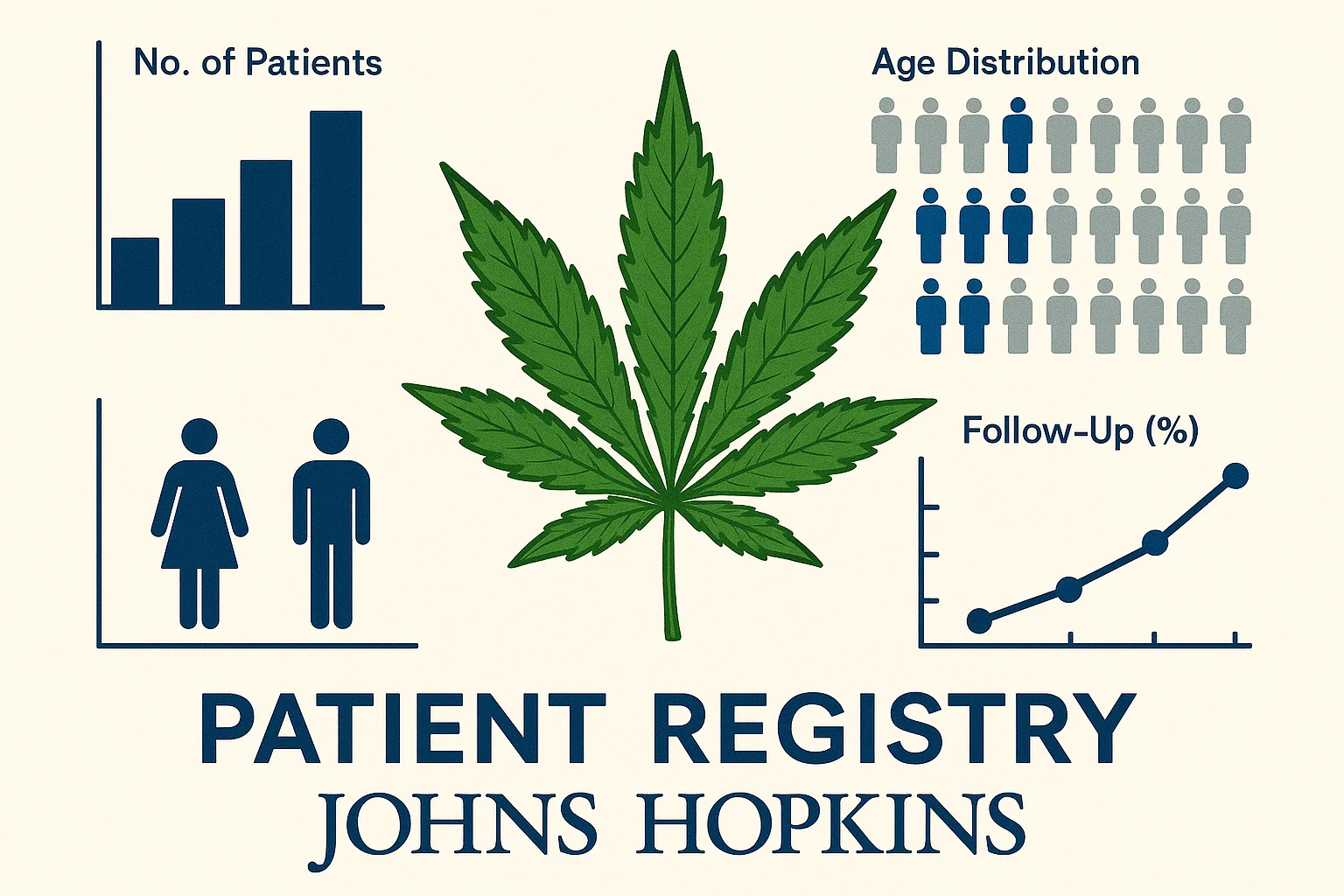
Randomized clinical trials (RCTs) are the gold standard in medicine, but they have one fundamental limitation: they study narrow populations over a short period. Realm of Caring - a non-profit organization running one of the largest CBD user registries in the world - in partnership with Johns Hopkins Bloomberg School of Public Health published data from thousands of patients observed over years in real-world conditions. In the study by Sexton et al. published in Frontiers in Pharmacology approximately 42% of participants reported a reduction in the number of medications, and 59% reported an improvement in quality of life after adding CBD to their daily routine (Sexton et al., Frontiers in Pharmacology, 2022). This article explains the methodology of these studies, what they reveal - and what they do not.
KEY INFORMATION
• Realm of Caring maintains an observational registry of over 100,000 CBD users - the largest of its kind in the world, analyzed by Johns Hopkins.
• Approximately 42% of participants reported a reduction in the number of medications, and 37% reported a reduction in dosages after adding CBD (Sexton et al., Frontiers in Pharmacology, 2022).
• 59% of participants reported an improvement in quality of life measured by standardized questionnaires (PROMIS).
• The most commonly reduced medications: opioids, NSAIDs, sleeping pills, and anxiolytics.
• The data is observational (real-world evidence), not RCT - correlation, not causation. Any change in medication requires medical supervision.
What is Realm of Caring and where did the registry come from?
Realm of Caring (RoC) was established in 2013 in Colorado when families of children with treatment-resistant epilepsy (especially those with Dravet syndrome) began to gather around Charlotte's Web oil - a high-CBD hemp extract. The organization quickly grew into an educational platform, and its natural extension was an observational registry: a systematic collection of data on symptoms, quality of life, and medication use by cannabinoid users in real-world conditions.
The RoC registry is conducted according to epidemiological standards: participants fill out validated questionnaires (PROMIS - Patient-Reported Outcomes Measurement Information System, WHOQOL - World Health Organization Quality of Life Scale) at regular intervals. The data is anonymized and analyzed by external academic researchers. A key partner is Johns Hopkins Bloomberg School of Public Health, where Dr. Ryan Vandrey - a specialist in cannabinoid pharmacokinetics - is one of the principal investigators collaborating with the registry.
What did the groundbreaking study by Sexton et al. from 2016 reveal?
The first major data compilation from the RoC registry - Sexton et al. in Frontiers in Psychiatry (2016) - described the characteristics of 2409 participants and their initial reasons for using CBD. The most common indications were: chronic pain (64%), anxiety (50%), depression (31%), sleep disorders (41%), and epilepsy (11%). This data provided the first systematic picture of "who and why uses CBD" in the general population, as opposed to clinical trials with a narrow diagnostic group (Sexton et al., Frontiers in Psychiatry, 2016).
Respondents generally described positive effects - 62% reported "very good" or "excellent" effectiveness of CBD in managing their primary condition. A key finding regarding medications: nearly 46% reported that they reduced or completely stopped using "traditional medications" after starting CBD. The most commonly reduced medications were prescription pain medications (opioids and others), sleeping pills, and psychiatric medications. The authors emphasized that the data is self-reported and does not control for confounding variables.
| Indication | % of users (RoC 2016) | % reporting improvement |
|---|---|---|
| Chronic pain | 64% | High (details in the appendix) |
| Anxiety | 50% | High |
| Sleep disorders | 41% | Moderate to high |
| Depression | 31% | Moderate |
| Epilepsy | 11% | Highest (due to population selection) |
Continuation from 2022 - quality of life and changes in medication patterns
The study by Sexton et al. published in Frontiers in Pharmacology in 2022 expanded the analysis to include longitudinal data (observation over time) and standardized measures of quality of life. This work analyzed data from 808 participants in the RoC registry observed for at least 3 months. Results: about 59% reported improvement in quality of life domains measured by the PROMIS questionnaire, about 42% reported a reduction in the number of medications used, and 37% reported a reduction in dosages. (Sexton et al., Frontiers in Pharmacology, 2022).
The most commonly reduced categories of medications were: opioids and other pain medications, benzodiazepines and other anxiolytics, sleeping pills (zolpidem, eszopiclone), and NSAIDs (non-steroidal anti-inflammatory drugs). The authors noted that the reduction occurred with or without medical supervision - and that the lack of a control group prevents causal conclusions.
A particularly interesting finding in the 2022 RoC data is that the greatest reductions in medications were reported by participants using CBD in combination with THC (full-spectrum or combined products), rather than CBD isolate. This aligns with Russo's entourage effect hypothesis (Frontiers in Plant Science, 2019) and suggests that real cannabis products may be more effective than pure CBD in real-world conditions.
Why are observational data important despite limitations?
RCTs are the gold standard - but they have their limits in studying CBD. First: ethical limitations. It is difficult to conduct a multi-month placebo study in patients with chronic pain or insomnia - exposure to prolonged lack of treatment is ethically problematic. Second: participant selection. RCTs recruit homogeneous groups that meet narrow inclusion criteria, which do not reflect the diversity of actual CBD users. Third: scale. The RoC registry with thousands of participants observed over years provides statistical power that is impossible to achieve in a typical grant-funded RCT.
Real-world evidence (RWE) - data from real-world conditions - is increasingly accepted by regulators (FDA, EMA) as a complement to RCTs, especially for new therapeutic categories such as cannabinoids. It does not replace RCTs, but sets research priorities: if 42% of registry participants report a reduction in opioids after CBD, that is a very strong signal justifying well-designed RCTs in this direction.
Co z tego wynika - granice interpretacji
The RoC/JH data is observational, self-reported, and without a control group. Survival bias (people who did not feel the effect are less likely to remain in the registry), confirmation bias (participants are motivated to use CBD and more likely to report positive effects), and lack of control for confounding variables (diet change, therapy, other interventions) - these are real limitations. One cannot conclude that "CBD reduces the need for medications" as a proven clinical fact.
From our experience, RoC data is often cited in popular articles without this methodological context - leading to overinterpretation. A fair discussion of this data sounds like: "a large observational study shows that some CBD users report a reduction in medications and improvement in quality of life - this is a strong signal that justifies further RCT research, but does not prove causation." This is less catchy than "CBD replaces opioids," but it is true.
How does RoC data compare to other observational registries?
Realm of Caring is not the only observational registry for CBD, but it is the largest and longest-running. For comparison: the Australian QUEST (Quality of Life Using Epilepsy Surgery or Medical Management) project and the Canadian MMIC (Medical Cannabis Registry) provide data from other populations and healthcare systems. The pattern is consistent across registries: medical cannabinoid users consistently report reductions in prescription opioids and sleeping medications and improvements in subjective quality of life - regardless of country and healthcare system.
This consistency among independent registries from different countries is methodologically important: it reduces the likelihood that RoC results are artifacts of the specificity of the American population or media effects (CBD enthusiasts in the USA are more motivated to report positive effects than, for example, patients in the Canadian registry, where access to cannabinoids is more regulated). Consistency among registries is a strong signal of credibility - even if no single registry replaces RCTs.
Frequently Asked Questions
What is Realm of Caring and how does it collect data on CBD?
Realm of Caring is an American non-profit organization running one of the largest observational registries of cannabinoid users - over 100,000 participants. Data is collected through validated online questionnaires (PROMIS, WHOQOL) regarding quality of life, symptoms, and medications used. The results are analyzed by Johns Hopkins Bloomberg School of Public Health and published in peer-reviewed journals.
What is the connection between Johns Hopkins and the Realm of Caring research?
Researchers from Johns Hopkins (including Dr. Ryan Vandrey, Dr. Marcel Bonn-Miller) analyze the RoC registry data and publish the results. Key publications include Sexton et al. (Frontiers in Psychiatry, 2016) and Garcia-Romeu et al. (Frontiers in Pharmacology, 2022), describing changes in quality of life and medication use among registry participants.
What did the RoC/JH studies show regarding medication reduction?
In the study by Sexton et al. (2022), about 42% of participants reported a reduction in the number of medications, 37% a reduction in dosages, and 59% an improvement in quality of life. The most commonly reduced medications were opioids, benzodiazepines, and NSAIDs. The data is self-reported from the observational registry - correlation, not causation (Garcia-Romeu et al., Frontiers in Pharmacology, 2022).
Why is data from observational registries important, even though they are not RCTs?
RCTs have ethical limitations (long placebo in pain) and selective limitations (narrow inclusion criteria). Observational registries provide real-world evidence with a sample size impossible in RCTs - FDA and EMA are increasingly accepting RWE as a complement to clinical research, especially for new therapeutic categories.
Do RoC/JH data mean that CBD replaces medications?
No. Registry data shows a correlation between CBD use and reported medication reduction - it does not prove causation. Survival bias, lack of a control group, and self-reporting are real limitations. Any change in medications taken - especially opioids, benzodiazepines, or psychiatric medications - must occur solely under the supervision of the attending physician.
This article is for informational and educational purposes and does not replace consultation with a doctor. If you are pregnant, breastfeeding, taking medications, or have chronic conditions, consult the use of supplements or herbs with a specialist.
Author: Michał Waluk · Published: 2026-05-04 · Updated: 2026-05-04