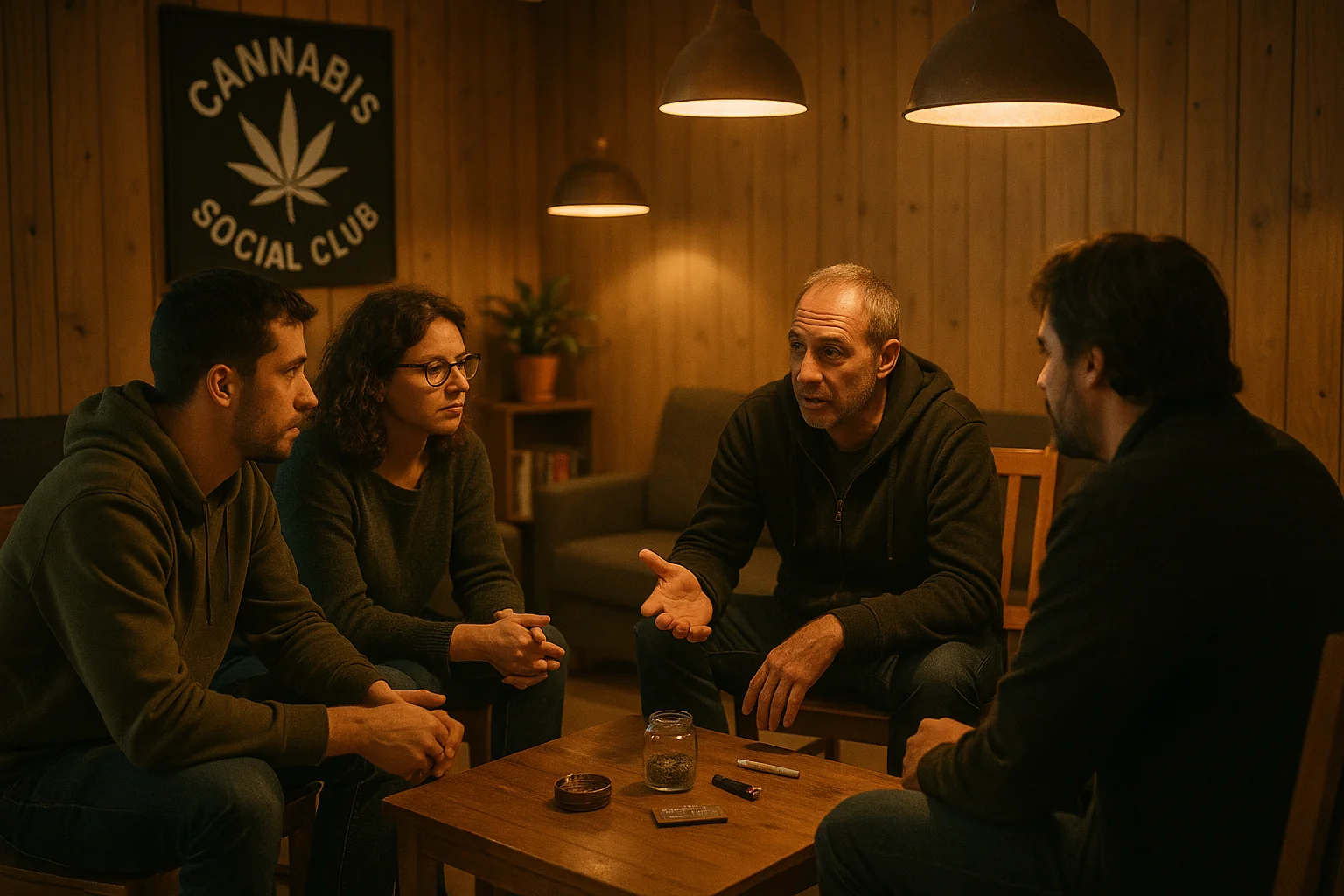

Marijuana in Spain - how cannabis social clubs operate (FAQ)
Marijuana in Spain: answers to frequently asked questions and what studies say. u Bucha.
Spain has long attracted interest as a country where marijuana is not fully legal, but is also not prosecuted as strictly as in Poland or many other EU countries. On the streets of Barcelona, one can smell marijuana, and hundreds of cannabis associations operate in a legal gray area. How is this possible? And what is actually allowed for a tourist visiting Barcelona or Madrid? This article explains the legal status, the mechanism of cannabis social clubs, and the practical consequences for those interested in the topic.
KEY INFORMATION
• Possession of marijuana in Spain is decriminalized - it is not a crime but an administrative offense (EMCDDA, 2024).
• Cannabis social clubs are private non-profit associations operating in a gray area - they cannot formally accept tourists without an invitation from a member.
• Consumption or possession in public places carries a fine ranging from 600 to 30,000 euros (Public Safety Act, 2015).
• By 2026, Spain has not passed a law for the full legalization of marijuana, although political debate continues.
Is marijuana legal in Spain in 2026?
Short answer: not fully, but decriminalized. Spain has not legalized recreational marijuana at the national level - there is no law that allows for the purchase, sale, or consumption of cannabis like alcohol. However, Spanish law has applied a dualistic approach for years: consumption of cannabis in private places is not subject to criminal sanctions, but administrative ones. This is a fundamental difference compared to Poland, where possession of a small amount can result in criminal proceedings.
The European Monitoring Centre for Drugs and Drug Addiction (EMCDDA) classifies Spain as a country with one of the most de facto tolerant policies towards cannabis in the European Union. At the same time, trade and distribution remain illegal - and this is where the cannabis social club model comes in, which attempts to circumvent this regulation by eliminating the commercial element.
Spanish criminal law - Article 20 of the Penal Code - contains an exception for "joint consumption without a commercial element and without causing harm to others." It is on this basis that legal arguments for CSC have been built for decades. This is not full legalization - it is an interpretation of a legal loophole that courts evaluate differently.
How the cannabis social club works - the "buying together" model
A cannabis social club (CSC) is a private association registered under the Associations Act (Ley Orgánica 1/2002). Theoretically, it operates like any other hobby association: it has a statute, a board, and a list of members. What distinguishes it from classical associations is the subject of its activity: collective cultivation and distribution of cannabis exclusively among registered members, without any profit and without selling to third parties.
Key principles of the CSC model, as described by EMCDDA in the report on cannabis clubs:
- Closed membership - entry is only possible by invitation from an existing member who vouches for the new one.
- No commercial element - distribution is treated as a division of cultivation costs, not as a sale.
- Quantity limit - each member receives a portion corresponding to their personal consumption, no more.
- Locality - cultivation and distribution must take place in the same geographical region where the members reside.
In Barcelona and other large cities in Catalonia, several hundred such associations have operated for years. Some adhered to the described principles, while others evolved towards de facto commercial sales points, which attracted the attention of law enforcement.
Turystyka konopna w Barcelonie - fakty i mity
Barcelona has gained a reputation over the years as the European capital of cannabis. The media wrote about "cannabis paradises," and many websites offered "guides" to Barcelona's CSC for tourists. The reality is more complicated - and legally risky for visitors.
Formally, a tourist cannot be a member of a CSC, as this requires permanent or temporary residence in Catalonia. In practice, many clubs have accepted tourists as "temporary guests" invited by local members for years. This practice has led to legal conflict: authorities argued that with mass cannabis tourism, the element of privacy and "community" disappears - and a de facto point of sale emerges.
It is worth noting that the Generalitat of Catalonia passed Decree 209/2017 in 2017, which was the first in Europe to introduce regional regulations for CSC - but at the same time tightened requirements and limited the activities of many clubs. Many associations that previously served mainly tourists had to change their profile or close down. The municipal police conducted hundreds of inspections and closed numerous CSC in Barcelona between 2016 and 2023.
For a tourist visiting Barcelona, one thing is crucial: consuming cannabis in public places is prohibited and punishable by a fine. Even if you enter a CSC as a guest, taking cannabis outside its premises and consuming it on the street, beach, or in a park risks an administrative fine. Fines range from 600 euros for minor violations to 30,000 euros in serious cases under the aforementioned Citizen Security Law.
Regional differences - Catalonia, the Basque Country, and the rest of Spain
One of the most common mistakes in discussions about cannabis law in Spain is treating the country as a monolith. Spain is a highly decentralized state - 17 autonomous communities have broad legislative powers, and cannabis regulations vary between regions.
The Basque Country is a pioneer: in 2017, it passed Law 1/2017 on cannabis associations, which formalizes CSC and imposes specific obligations: a limit of 120 members per association, a ban on advertising, and a registration requirement with the health department. This is the first regional cannabis law of its kind in the EU - although its scope is strictly regional and does not create preferences for tourists.
Catalonia took a different path: it attempted to implement the regulation passed in 2017 (Decree 209/2017) as a minimum standard for CSC, but the decree has been challenged in court multiple times. Madrid and Andalusia mainly apply national regulations. Navarra shows a similar liberal approach to the Basque Country. Before traveling to a specific region, it is worth checking the current state of the law at the destination - differences between provinces are real and have practical significance.
The situation of CBD in Spain and EU regulations
CBD in Spain has a status similar to that of other EU countries, but with some local nuances. CBD products with THC content below 0.2% can be sold as cosmetics, aromatherapy products, and themed items. Their sale as dietary supplements or food products is more problematic - EU regulations on novel foods (EU Regulation 2015/2283) classify cannabis extracts (including CBD) as new food requiring authorization since 2019.
The AEMPS drug agency issued a statement in 2022 confirming that CBD extracted from cannabis as a food product is subject to the novel foods procedure. This means that stores selling CBD oils as dietary supplements operate in a legal gray area. At the same time, the trade in cosmetic CBD is thriving in Barcelona and Madrid without intervention from authorities.
Medical cannabis in Spain is available only by prescription for strictly defined indications. The drug Epidiolex (high-concentration CBD) is approved by the EMA for treating severe epilepsy. Nabiximols (Sativex) is registered for multiple sclerosis. However, these are regulated medications - they have nothing to do with the CSC market or CBD supplements.
Frequently Asked Questions
Is marijuana legal in Spain in 2026?
Marijuana in Spain is not fully legalized. Possession and consumption in private spaces are decriminalized - there is no criminal penalty for this, but an administrative fine. Sale and trade remain illegal. Cannabis social clubs operate in a legal gray area, relying on the interpretation of Article 20 of the Penal Code regarding joint consumption without a commercial purpose (EMCDDA, 2024).
How does a cannabis social club work in Spain?
A cannabis social club is a private non-profit association registered under Spanish association law. Members gather to collectively cultivate and distribute cannabis exclusively among themselves, without any commercial element. Membership is closed - entry is only possible by invitation from an existing member. This model has operated for years, but regulations vary between autonomous regions.
Can a tourist enter a cannabis social club in Barcelona?
Formally no - membership in a CSC requires permanent or temporary residence in Catalonia and an invitation from an existing member. In practice, many clubs in Barcelona have accepted tourists as guests for years. Since 2017, the authorities in Catalonia have tightened regulations, and the police have closed numerous CSC. Tourists risk a fine if they consume cannabis in public places.
What is the penalty for possessing marijuana in Spain?
Possession of marijuana for personal use in Spain is an administrative offense, not a crime. Possession in public places can result in a fine ranging from 600 to 30,000 euros (the 2015 Citizen Security Law, known as the "ley mordaza"). In the case of possession in private places or consumption without witnesses, there is no criminal intervention, although the law does not explicitly grant permission for this.
Is CBD legal in Spain?
CBD in Spain is available as a cosmetic and aromatherapy product; however, its sale as a dietary supplement or food product still raises legal doubts. CBD products with THC content below 0.2% can be legally purchased as topical products, but health marketing is restricted by EU regulations. The AEMPS regulates cannabinoid-based medications (AEMPS, 2024).
What does the legalization of marijuana look like in the autonomous regions of Spain?
Regulatory powers regarding cannabis partially lie at the level of autonomous regions. The Basque Country was the first to pass regional regulations on cannabis clubs (Law 1/2017), introducing minimum standards for associations and a limit of 120 members. Catalonia, Navarre, and other regions have different approaches. The division of competencies means that the legal situation varies depending on the location in Spain (EMCDDA, report on CSC).
Co to jest „turystyka konopna” w Barcelonie i czy jest bezpieczna?
"Cannabis tourism" in Barcelona is an informal market based on invitations to CSC. There are no guarantees of legal safety for tourists - the risk of an administrative fine exists, especially in public places. In recent years, the police have closed hundreds of CSC for violating operational conditions. Visitors to Barcelona are advised to exercise caution and be aware of current local regulations before making any decisions.
Is Spain moving towards full legalization of marijuana?
The debate on marijuana legalization in Spain has been ongoing for years. The ruling coalition of PSOE and Sumar has announced a reform of drug laws, but as of mid-2026, no legalization law has been passed. Experts EMCDDA point to Spain as one of the EU countries with the most liberal de facto policy towards cannabis, despite the lack of full de jure legalization.
This article is for informational and educational purposes and does not constitute legal advice. The legal status described in the article is valid as of the publication date - regulations regarding cannabis may change. Consult a lawyer or current legal acts before making decisions.
Author: Michał Waluk · Published: 2026-05-04 · Updated: 2026-05-04