
Are Herbal Cigarettes Safe? The Complete Guide 2026
Herbal cigarettes without tobacco and nicotine are not safe. Check what emission measurements, biomarker studies, and data on vaporizing hemp flower say.
Herbal cigarettes are sold as a natural alternative to tobacco: nicotine-free, non-addictive, with chamomile and mint instead of chemicals. They are also found on shelves and in search engines under names like herbal tea cigarettes, balsamic cigarettes, or simply nicotine-free cigarettes, sometimes under brand names like Nirdosh. The promise sounds reasonable until one asks a simple question. Does tobacco harm, or does smoke harm? Answers were provided by an experiment using a water pipe, where a machine replicated the smoking method of 31 individuals, once with tobacco and once with its herbal, nicotine-free counterpart. Among all measured substances, only nicotine differed. Carbon monoxide, tar, aldehydes, and polycyclic aromatic hydrocarbons were present in both cases. Below you will find what can be said about herbal cigarettes based on measurements, not manufacturer claims, as well as a description of two paths that realistically reduce lung burden.
KEY INFORMATION
• In a study on a water pipe comparing tobacco-filled with tobacco-free herbal counterparts, the only significantly differing substance was nicotine. Carbon monoxide, tar, and PAHs were present in both (Shihadeh et al., Food Chem Toxicol, 2012).
• In 135 individuals smoking herbal cigarettes and 143 smoking regular ones, no difference was found in the concentrations of PAH markers or nitrosamines in urine (Gan et al., Tob Control, 2009).
• Individuals who switched to herbal cigarettes reported an increase, not a decrease, in the number of cigarettes smoked.
• Vaporization provided comparable concentrations of cannabinoids with a reduced level of carbon monoxide in exhaled air (Abrams et al., Clin Pharmacol Ther, 2007).
• Confirmed effectiveness in Cochrane reviews is attributed to nicotine replacement therapy, varenicline, and bupropion, not switching one smoke for another.
What are herbal cigarettes and what do they actually contain?
Herbal cigarettes are smoking products without tobacco and nicotine. Instead of Nicotiana tabacum leaves, they contain blends of dried plants: chamomile, peppermint, lavender, wild rose, red clover, or raspberry leaves. Some products also contain hemp with a tetrahydrocannabinol content below the legal threshold.
The marketing of this category is based on three promises. The absence of nicotine is supposed to mean the absence of addiction. The natural origin of the raw material sounds safer than synthetic additives. The names of herbs associated with tea, such as chamomile or mint, transfer associations of a drink that no one fears to the product. However, all three premises concern the plant before it is ignited, not the smoke that results from it.
When reading scientific literature, one must be cautious of a terminological trap. Chinese cigarettes referred to as herbal, studied in works cited worldwide, contain tobacco enriched with plant extracts. They are therefore not the same product as the European tobacco-free blend. This is clearly visible in the results: cotinine, a nicotine metabolite, was detected in the urine of smokers of both types at comparable concentrations.
The distinction is practically significant, as some criticisms of one product do not automatically transfer to the other. A herbal product without tobacco really does not contain nicotine and does not cause pharmacological addiction. All other criticisms, meaning everything that arises from combustion, transfer unchanged.
The declared composition can be vague. A description like a natural blend of herbs, without the percentage participation of individual plants, makes any assessment impossible. We have compiled a comparison of popular blends in terms of composition and purpose in the post about what to smoke instead of tobacco.
Herbal cigarettes, balsamic, nicotine-free: are they the same and can you buy them at the pharmacy?
This is mostly the same category under different trade names, and a pharmacy is not their typical point of sale. None of these names has a legal definition, so the content is determined solely by the ingredients listed on the packaging, not the name. Products without tobacco and nicotine are not medicines, so they are sold by regular commerce, mainly online stores.
| Nazwa rynkowa | Co realnie zawiera | Nicotine |
|---|---|---|
| Nicotine-free herbal cigarettes | a mixture of dried plants, most often chamomile, mint, lavender, wild rose, red clover, raspberry leaves | NO |
| Papierosy herbaciane | tea leaves as a base, sometimes with flowers and licorice; the name describes the base, not the category | NO |
| Papierosy balsamiczne | a marketing name without an established composition; read the ingredients solely from the packaging | NO |
| Nirdosh i podobne wyroby ajurwedyjskie | turmeric, holy basil, cloves, cinnamon, licorice, and other spices in tendu leaves | NO |
| Chinese herbal cigarettes from studies | tobacco enriched with plant extracts, meaning a different product than the European blend | Yes |
If you go to the pharmacy for something to help quit smoking, ask about nicotine replacement therapy, not herbal cigarettes. The first of these two has measured effectiveness, and its odds ratios are compared in the table below. Herbal cigarettes have no studies confirming their help in quitting and merely sustain the act of smoking.
Which herbs can you find in smoking blends, and are any of them safe?
None are safe in the form of smoke, as harm is determined by combustion, not the plant species. However, herbs differ in what they add beyond smoke: allergenic parts, sedative effects, or interactions with medications. Below are those that most often end up in blends sold in Poland.
| Herb | What they add beyond smoke | Temperatura waporyzacji w naszym przewodniku |
|---|---|---|
| Chamomile | cross-reactions in individuals allergic to asteraceae plants | 125-150 degrees |
| Lavender | strong aroma that masks the rest of the blend | 130-150 stopni |
| Lemon Balm | drowsiness, may enhance the effects of sedative medications | 140-160 stopni |
| Peppermint | cooling effect that masks throat irritation | 150-170 stopni |
| Wild rose and red clover | mainly flavor; clover contains isoflavones with estrogenic effects | brak danych |
| Raspberry leaves | neutral base, the most common fillers of unknown origin | brak danych |
The temperature column indicates only those herbs for which we provide a range in the herb vaporization guide. The absence of data does not mean that the herbs cannot be vaporized, only that we do not have a verified range for them and do not guess it.
What happens to the plant when you ignite it?
An ignited plant ceases to be that plant. The glowing end of the cigarette reaches temperatures in the hundreds of degrees Celsius, and under these conditions, cellulose, lignin, proteins, and fats break down into hundreds of new compounds that were not present in the raw material. For the lungs, only what arises from this breakdown matters.
The biological effects have been precisely described for tobacco smoke, and the mechanism does not depend on the species of the burned plant. Smoke carries reactive forms of oxygen and nitrogen that damage proteins and nucleic acids and oxidize cell membrane lipids, triggering oxidative stress and an inflammatory response. A loop is created in which damage drives inflammation, and inflammation produces further reactive forms of oxygen (Caliri et al., Int J Environ Res Public Health, 2021).
Among the products of incomplete combustion, polycyclic aromatic hydrocarbons occupy a separate place. Their best-described representative, benzo[a]pyrene, is listed in the monographs of the International Agency for Research on Cancer in group 1, meaning among agents with proven carcinogenic effects in humans (IARC Monographs, tom 100F).
The second product of incomplete combustion is carbon monoxide. It binds to hemoglobin and disrupts oxygen transport, but its effects do not end with hypoxia. A review dedicated to poisoning emphasizes the impact on mitochondrial respiration, cellular energy metabolism, inflammatory processes, and the production of free radicals (Rose et al., Am J Respir Crit Care Med, 2017).
This leads to a simple conclusion that runs throughout this text. The properties of the raw material before ignition, including the beneficial ones, have little to do with what reaches the lungs. The relaxing essential oil of lavender and vitamin C in wild rose fruit will not survive the process that releases them.
Are herbal cigarettes safer than tobacco ones?
In terms of combustion products, there is no basis to claim so. In an experiment where a machine replicated the inhalation method of 31 participants, tobacco-containing water pipe tobacco was compared with its tobacco-free herbal counterpart of the same flavor. Among the measured substances, only nicotine differed significantly (Shihadeh et al., Food Chem Toxicol, 2012).
The study's design avoids the most common criticism of emission comparisons. Participants smoked in clinical conditions, in a double-blind setup, once with their chosen tobacco and once with its herbal counterpart. Inhalation sequences were recorded and reproduced by machine, so emissions were compared under real, not normalized, smoking conditions.
One caveat must be made honestly. The water pipe heats the tobacco with charcoal, while the cigarette burns the raw material directly, so these are not identical thermal conditions. However, the study precisely answers the question posed by the marketing of herbal products: does removing tobacco from a smoking product purify the smoke? The answer is: it does not purify.
Carbon monoxide, nitrogen oxide, volatile aldehydes, nicotine, tar, and polycyclic aromatic hydrocarbons were measured. The smoke from both preparations contained significant amounts of toxic substances. The authors conclude with a statement that is hard to soften: the results contradict advertising messages presenting herbal products as a healthier alternative to tobacco products.
A second study examined the same from the body's perspective, not the device's. In 135 people smoking cigarettes labeled as herbal and 143 smoking regular ones, cotinine, 3-hydroxycotinine, PAH metabolites, and the nitrosamine NNAL were measured in urine. No significant difference was found between the groups for any of these four markers (Gan et al., Tob Control, 2009).
This work contains one more finding that is rarely mentioned. The concentrations of nitrosamine and the sum of PAH metabolites significantly correlated with the markers of nicotine intake, in all four comparisons. Thus, exposure to carcinogenic substances increased along with the intensity of smoking, regardless of how the product was labeled on the package.
The comparison of both studies provides a coherent picture. Measurement of emissions from the device and measurement of biomarkers in humans lead to the same conclusion: removing tobacco from a cigarette does not remove carcinogenic substances from the smoke. One thing changes, and it is indeed significant, but only one.
What does the absence of nicotine provide, and what does it not provide?
The absence of nicotine removes the mechanism of pharmacological addiction. This is a real benefit that should not be underestimated, especially in youth prevention. Nicotine reaches the brain within seconds of inhalation and strengthens the reward circuit, and without it, this loop does not form.
The acute cardiovascular reaction to nicotine itself also disappears: the acceleration of heart rate and increase in blood pressure following inhalation. However, the burden from carbon monoxide and fine smoke particles does not disappear, as these arise regardless of what is being smoked.
Nicotine is not the main carcinogenic factor in tobacco smoke. The mutagenic effects are primarily due to combustion products: polycyclic aromatic hydrocarbons, aldehydes, and nitrosamines. Therefore, removing nicotine from a cigarette does not address this part of the risk, as confirmed by the results of both studies described above.
Behavioral addiction remains. The ritual of reaching for a cigarette, lighting it, and inhaling can be reinforced regardless of the active substance. In practice, this means that a person smoking herbal products maintains a habit they were supposed to abandon, and they do so with unchanged exposure to smoke.
There is a certain paradox worth noting. The product category was created in response to health concerns related to tobacco, but herbal product manufacturers are not subject to the analytical obligations imposed on the tobacco industry. Thus, the consumer receives a product advertised with comparative data that no one has measured for this product.
Do herbal cigarettes help you quit smoking?
There is no evidence for this, and the only direct observations indicate the opposite effect. In a Chinese study, concern for health was the main reason for switching from regular cigarettes to herbal ones, and those who made the switch reported an increase, not a decrease, in the number of cigarettes smoked (Gan et al., 2009).
The mechanism of this increase is understandable. If a smoker perceives the product as less harmful, the brake that previously limited the number of cigarettes weakens. Since emissions remain comparable, an increased number of cigarettes simply means greater overall exposure to tar and carbon monoxide than before the change.
The logic of switching from one smoke to another is based on the silent assumption that only nicotine is harmful. Emission measurements and biomarker assessments show that this assumption is false. A smoker switching to a herbal product reduces the risk of addiction but does not reduce exposure to combustion products.
The literature also describes the phenomenon of transferring behavioral dependence from one product to another. A smoker then feels that they have quit smoking, even though they have only changed the source of the smoke. Maintaining the ritual makes it harder to break away from it in the next step, as extinguishing a habit requires breaking it, not maintaining it in a new form.
The practical conclusion is simple. If the goal is to quit smoking, herbal products are not a tool that leads to that goal. We describe tools with proven effectiveness in the next section, and none of them involve inhaling smoke.
Which smoking cessation methods have proven effectiveness?
The best-documented method is nicotine replacement therapy. A Cochrane review covering 133 studies and 64,640 participants found that any form of it increases the chances of maintaining abstinence by 50-60% compared to the control group, with a risk ratio of 1.55 (Hartmann-Boyce et al., Cochrane Database Syst Rev, 2018).
The effect persists regardless of circumstances. The authors emphasize that effectiveness does not depend on the intensity of additional support or the location where therapy is conducted. Individual forms performed similarly, as shown in the comparison below.
| Form of substitution | Iloraz ryzyka | Uczestnicy |
|---|---|---|
| Guma | 1,49 | 22 581 |
| Plaster | 1,64 | 25 754 |
| Tabletki i pastylki | 1,52 | 4 439 |
| Inhalator | 1,90 | 976 |
| Aerozol donosowy | 2,02 | 887 |
The comparison of medications was compiled in a separate review covering 267 studies and 101,804 participants. Nicotine replacement therapy had an odds ratio of 1.84 compared to placebo, bupropion 1.82, and varenicline 2.88. Varenicline proved to be more effective than single forms of substitution and bupropion, but not than combined substitution (Cahill et al., Cochrane Database Syst Rev, 2013).
The same review contains findings important for those concerned about side effects. The analysis of studies on varenicline found no difference in the frequency of serious adverse events compared to placebo, and subgroup analyses did not show an excess of neuropsychiatric or cardiovascular events.
In Poland, free support is provided by the Telephone Counseling Service for Smokers at the National Cancer Institute, at the number 801 108 108. Combining pharmacological therapy with behavioral support yields higher effectiveness rates than either method alone.
Does vaporization burden the lungs less than smoking?
Yes, and this is a measured difference, not a declared one. In a study involving 18 participants, a vaporizer was compared to a cigarette containing the same raw material. Peak cannabinoid concentrations in the blood and the area under the curve over six hours were similar, while the carbon monoxide level in exhaled air after vaporization was reduced (Abrams et al., Clin Pharmacol Ther, 2007).
The comparison of these two results is more important than each of them individually. The active substance reaches the bloodstream in comparable amounts, while the product of incomplete combustion is lower. The authors considered vaporization a safe and effective method of administration, and the study proceeded without adverse events.
The mechanism is physicochemical. The vaporizer maintains the raw material at a temperature set below the threshold at which thermal decomposition of the plant material begins. Volatile components evaporate, and the structure of the cell wall remains intact, so a full set of pyrolysis products does not form. The typical temperature range for dry herb devices is between 180 and 220 degrees Celsius.
However, vaporization is not a risk-free option. Inhaled vapor still reaches the lungs, and at higher temperature settings, we approach the range where thermal decomposition begins. The higher the temperature setting, the more volatile compounds are produced, but also the closer we get to what the vaporizer is meant to protect against.
It is also worth not confusing two different devices. A dry herb vaporizer evaporates plant material, while an e-cigarette vaporizes propylene glycol and glycerin with additives. These are different constructions with different risk profiles. We described the temperature selection for individual herbs in the text on herb vaporization.
What does smoking hemp flower do to the lungs?
Smoking hemp flower burdens the airways more than smoking the same amount of tobacco. In a study involving 15 habitual smokers of both raw materials, a fivefold increase in carboxyhemoglobin in the blood and about three times more inhaled tar was measured compared to a tobacco cigarette (Wu et al., N Engl J Med, 1988).
The reason lies not only in the raw material but also in the smoking method. Participants inhaled a volume of smoke that was two-thirds greater, took deeper puffs by one-third, and held the smoke in their lungs four times longer. There was one-third more inhaled tar remaining in the airways. The tetrahydrocannabinol content in the cigarette only slightly influenced these parameters.
Chronic effects were described in a review dedicated to the impact of cannabis smoking on the lungs. Regular smoking of cannabis alone causes visible and microscopic damage to the large airways, consistently associated with symptoms of chronic bronchitis, which subside after cessation of smoking (Tashkin, Ann Am Thorac Soc, 2013).
The damage also affects the lung's defense mechanisms. Regular cannabis smoking leads to the loss of cilia in the bronchial epithelium and impairs the ability of alveolar macrophages to kill microorganisms. Furthermore, isolated cases of pneumothorax and bullous lung disease associated with cannabis smoking have been described, although epidemiological studies have not confirmed a causal relationship.
The same review is cautious where the data is ambiguous. Habitual smoking of cannabis alone does not lead to significant lung function impairment, and the relationship with chronic obstructive pulmonary disease has not been established. Epidemiological evidence does not indicate an increased risk of lung cancer with light and moderate use, although it remains inconclusive with heavy and prolonged use.
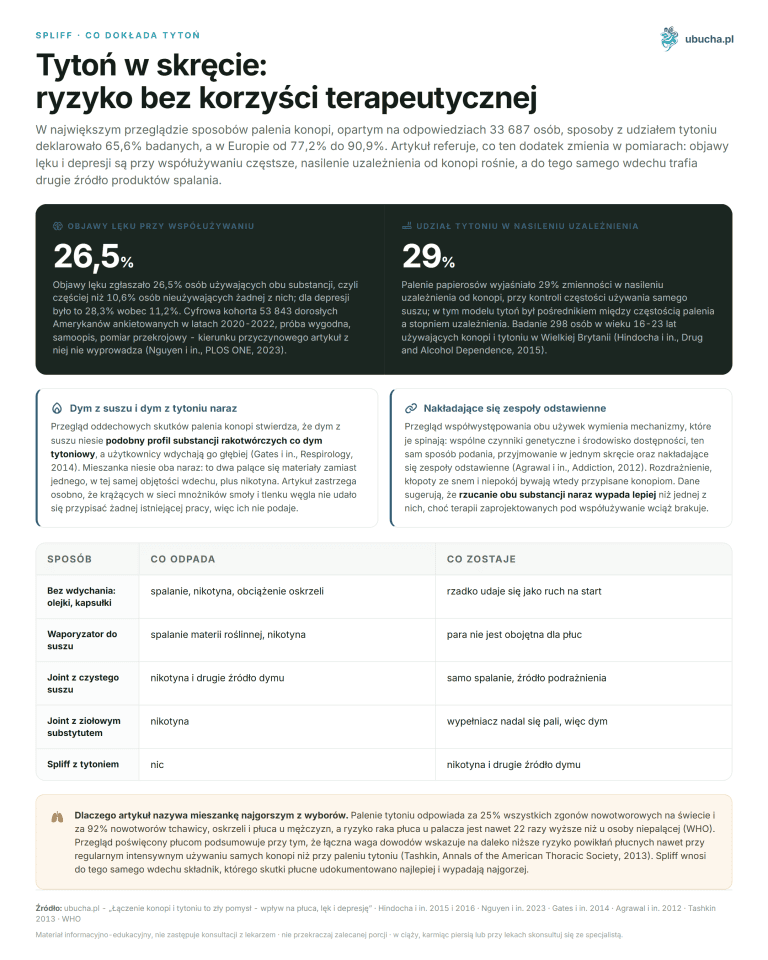
The author's conclusion is surprising for both sides of the debate: the accumulated evidence indicates a significantly lower risk of pulmonary complications even with regular intensive cannabis smoking compared to tobacco. However, this does not make a cigarette with flower a neutral form, and we described the combination of flower with tobacco separately in the entry on combining cannabis with tobacco.
What is the legal status of dried flower in Poland?
Hemp flower is legal as long as it meets the statutory definition of raw material. Hemp plants are those in which the sum of delta-9-THC and tetrahydrocannabinolic acid in the flowering and fruiting tops, from which the resin has not been removed, does not exceed 0.3% when calculated on a dry weight basis.
This definition contains two details that are usually lost in consumer texts. First, the threshold refers to the sum of two compounds, not just delta-9-THC, so the laboratory also counts the acidic form. Second, the sum is rounded to one decimal place. The basis is Article 4 point 5 of the Act on Counteracting Drug Addiction as amended by the act of March 24, 2022.
It is worth clarifying a misunderstanding repeated in many articles. The national threshold corresponds to the EU threshold in terms of value, but it does not derive from it. These are two separate regulations, adopted in different procedures and serving different purposes, which happen to operate with the same number.
Cannabidiol does not appear on the lists of controlled substances, so its presence in a product does not change the legal status of the raw material. Hexahydrocannabinol is a separate matter: it remains a controlled substance and should not be treated as a legal substitute.
Hemp flower is not registered either as a medicinal product or as a dietary supplement. Therefore, it cannot be attributed with therapeutic effects in commercial descriptions, and sellers usually label it as a raw material for aromatherapy or a collector's item. Forms intended for heating can be found in the category vaporizers.
Herbs alone, without rolling papers and fire, we collect in the herbs category; a comparison of the methods themselves, namely bong, vaporizer, and joint, we break down in osobnym zestawieniu.
Who should completely avoid herbal cigarettes?
The groups particularly at risk are determined not by the composition of the mixture, but by the presence of smoke. Since the emissions from herbal products are comparable to those from tobacco, any contraindications formulated against tobacco smoke apply here without change. The following summary organizes situations where the risk is disproportionate to any expected benefit.
| Group | What determines the risk |
|---|---|
| Astma, POChP, mukowiscydoza | Fine particles and aldehydes irritate the respiratory epithelium, and impaired clearance prolongs their retention. |
| Pregnancy and breastfeeding | Carbon monoxide reduces oxygen availability, and PAHs are mutagenic factors. |
| Children and youth | The respiratory system matures over the years, and exposure reinforces the habit of smoking. |
| Coronary artery disease, heart failure. | Carboxyhemoglobin decreases the oxygen reserve of the heart muscle. |
| Allergy to plants from the Asteraceae family | Chamomile and marigold belong to this family, and a reaction may occur despite thermal processing |
It is also worth mentioning carbon monoxide, as it is often underestimated as a problem that is only acute. A review dedicated to poisonings describes long-term neurological consequences in 15-40% of patients and cardiac function disorders in about one-third of those moderately and severely poisoned (Rose et al., 2017). The exposure from smoking is incomparably lower, but the mechanism is the same.
If you belong to any of the mentioned groups, the decision does not require an analysis of the mixture's composition. The principle is simple: smoke from any source is contraindicated, and there are alternatives that do not involve inhalation.
Does smoking a herbal cigarette harm the environment?
Yes, and this is directly derived from emission measurements. A study comparing tobacco with its herbal counterpart measured the amounts of substances released into the smoke, not their concentrations in the smoker's body. Since the emissions were comparable, what enters the air in the room is also comparable (Shihadeh et al., 2012).
A person standing nearby inhales the same carbon monoxide, the same aldehydes, and the same polycyclic aromatic hydrocarbons. However, they do not inhale nicotine, so they are not at risk of addiction. For assessing the harm of passive exposure, this is the least significant component of the smoke.
The argument that it’s just herbs does not change the emission profile by even one compound. However, it changes the behavior of the surroundings: with a product described as natural, requests to go outside are less frequent, and smoking indoors with children is sometimes considered acceptable. The result is greater, not lesser, exposure for bystanders.
For children, passive exposure to smoke is a documented risk factor for respiratory diseases, and the mechanism does not depend on the type of material being burned. Therefore, the sensible rule is the same as with tobacco: do not smoke in rooms where others are present, nor in the car.
Polish regulations limiting smoking in public places were created around tobacco products, and the status of herbal products is interpreted differently. Regardless of how the regulation resolves this, the health argument is the same for both categories.
How to reduce harm if you smoke anyway?
The most effective way is to reduce the number of cigarettes smoked, as exposure scales directly with the amount of material burned. This is why the reported increase in consumption after switching to herbal products in a Chinese study is significant: it negates some of the benefits the smoker wanted to achieve by changing the product.
The second thing is the declared composition in detail. A product with a full list of plants and their percentage allows you to check if it contains any raw material you are allergic to. A general description makes any assessment impossible, and synthetic additives, including flavors and moisture-retaining substances, create products with an untested profile when burned.
The third thing is to observe your own symptoms. Morning cough, wheezing, exercise-induced shortness of breath, and more frequent upper respiratory infections are signals that warrant a conversation with a doctor, rather than waiting. Dizziness and headaches after a smoking session may be a result of exposure to carbon monoxide, not the action of the herbs.
The fourth thing is to change the ritual itself instead of changing the source of smoke. If you care about the action rather than the substance, vaporization provides a similar session experience with a lower level of carbon monoxide in exhaled air, as measured in Abrams' study. This is the only change described here that has measurement on its side.
The last thing concerns expectations. Harm reduction is not the same as safety and does not replace the decision to quit smoking. If the reason for reaching for herbal products was to quit tobacco, more effective tools are described in the section on methods with proven efficacy.
Summary
A herbal cigarette without tobacco and without nicotine is not a safe product. It is a product that removes one of dozens of smoke problems, and it is not the one responsible for cancers. Emission measurements from a smoking machine and biomarker measurements in urine lead to the same conclusion independently.
The formulation 'safer than tobacco' does not mean safe, and in this case, it does not even mean safer in terms of combustion products. The only measured difference between tobacco and its herbal counterpart was the nicotine content, so the benefit pertains to addiction, not oncological or cardiovascular risk.
Two paths have data behind them. Vaporization delivers active substances at a reduced level of carbon monoxide, and oral forms completely bypass the lungs. Both are available and both have been described in studies, unlike the herbal product itself, for which manufacturers rarely publish any measurements.
If, however, the goal is to quit smoking, the choice is even simpler. Nicotine replacement therapy, varenicline, and bupropion have hundreds of studies involving over a hundred thousand participants. Switching one smoke for another has no backing, except for the observation that it leads to increased smoking.
Frequently Asked Questions
Are herbal cigarettes without nicotine safe for health?
No. In a study comparing tobacco-filled water pipe use with its tobacco-free herbal counterpart, only nicotine differed significantly, while carbon monoxide, tar, aldehydes, and PAHs were present in both (Shihadeh et al., 2012). The absence of nicotine removes addiction, not the toxins in smoke.
What is in the smoke of a herbal cigarette?
Products of incomplete combustion of plant material: carbon monoxide, nitrogen oxides, volatile aldehydes, tar, and polycyclic aromatic hydrocarbons. The latter group includes benzo[a]pyrene, classified by IARC as Group 1, meaning it is among the carcinogenic agents for humans.
Are herbal cigarettes less harmful than tobacco cigarettes?
Not in terms of combustion products. In 135 individuals smoking products labeled as herbal and 143 smoking regular cigarettes, no significant difference was found in the concentrations of PAH markers or nitrosamine NNAL in urine (Gan et al., 2009). The difference is only visible in the risk of addiction.
Do herbal cigarettes help you quit smoking?
There is no evidence, and direct observation indicates the opposite effect: individuals who switched to herbal products reported an increase in the number of cigarettes smoked (Gan et al., 2009). Methods with confirmed effectiveness include nicotine replacement therapy, varenicline, and bupropion.
How much does nicotine replacement therapy increase the chances of quitting smoking?
By 50-60% compared to the control group, with an odds ratio of 1.55. The result comes from a review encompassing 133 studies and 64,640 participants, and the authors assess the quality of evidence as high (Hartmann-Boyce et al., 2018). The effect does not depend on the intensity of additional support.
Is vaping safer than smoking?
It is less burdensome, though not neutral. In a study involving 18 individuals, vaporization provided comparable concentrations of cannabinoids in the blood with a reduced level of carbon monoxide in exhaled air (Abrams et al., 2007). The vapor still reaches the lungs, so the risk is not zero.
Can hemp flower be smoked like herbal cigarettes?
Technically yes, but it is the most burdensome form. Measurements showed a fivefold increase in carboxyhemoglobin and about three times more inhaled tar than after a tobacco cigarette of similar mass (Wu et al., 1988). Vaporization and oral forms burden the lungs less.
Is passive smoking of herbal products harmful?
Yes. The study measured the amounts of substances released into the smoke, not their concentrations in the smoker, so comparable emissions mean comparable air pollution in the room (Shihadeh et al., 2012). A person nearby inhales the same carbon monoxide and the same PAHs.
This article is for informational and educational purposes only and does not constitute medical advice. Before starting to use hemp or CBD for therapeutic purposes, consult your doctor, especially if you are taking other medications, are pregnant, or breastfeeding.
Author: Michał Waluk · Opublikowano: 2026-05-11 · Aktualizacja: 2026-08-24