
Taurine for endurance, blood pressure, and energy - what the studies say
Taurine for endurance, blood pressure, and energy: a reliable response based on research. u Bucha.
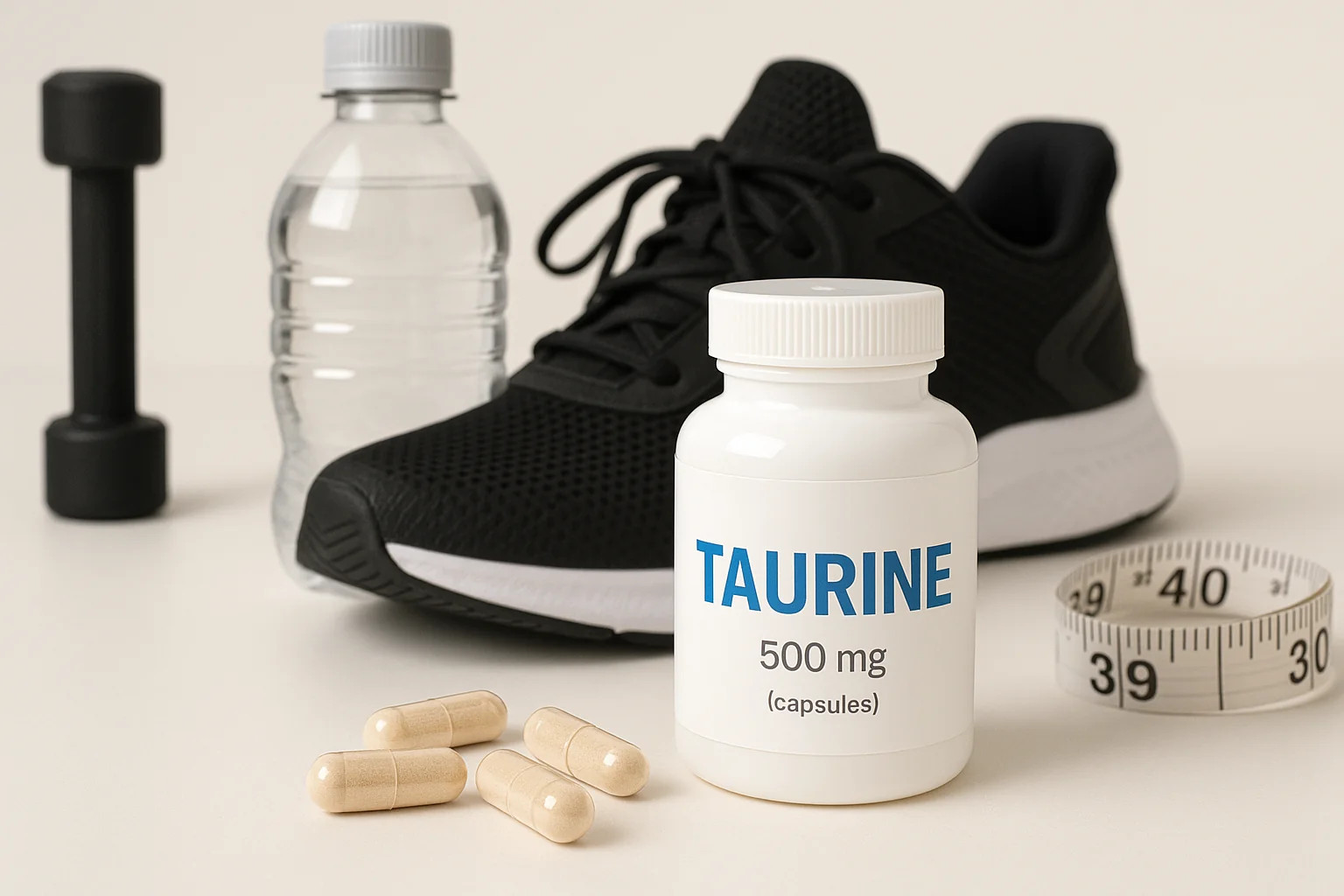
Taurine has been included in pharmacy energy and sports drink cans since the 1990s. For a long time, it was treated as a "mysterious ingredient" with an unclear role - and its image was burdened with the myth of the "bull from bull bile." Meanwhile, it is an amino acid produced by the body itself, present in the heart, brain, and skeletal muscles in very high concentrations. A meta-analysis by Waldron et al. published in Sports Medicine 2018 showed that taurine administered before exercise significantly improved aerobic endurance - on average by 1.7% in time to exhaustion compared to placebo (Waldron et al., Sports Medicine, 2018). The effect exists. But is taurine "energy"? Not in the sense that drinks advertise it. This article unravels myths from data.
KEY INFORMATION
• A meta-analysis of 10 RCTs showed an improvement in aerobic endurance of 1.7% after taurine 1-6 g before exercise (Waldron et al., Sports Medicine, 2018).
• Taurine 1.6 g/day for 12 weeks reduced systolic blood pressure by about 4.8 mmHg in individuals with prehypertension (Hu et al., Hypertension, 2016).
• Taurine does NOT act like caffeine - it is not a stimulant, does not block adenosine receptors.
• EFSA assessed safety up to 6 g/day as acceptable for adults (EFSA, 2009).
• The problem with energy drinks lies not in taurine, but in caffeine and sugar.
What is taurine - an amino acid that does not build proteins
Taurine (2-aminoethanesulfonic acid) differs from most amino acids in that it is not part of proteins - it has no genetic code and is not codon-directed. Instead, it performs osmotic functions (regulating the amount of water inside cells), neuromodulatory functions (modulating GABA and glycine receptors), and antioxidant functions (forming taurocholic acid, neutralizing hypochlorous radicals). The human body synthesizes taurine from cysteine with the help of vitamin B6 in the liver (Stipanuk et al., Journal of Nutrition, 2004).
Taurine concentrations in the body are exceptionally high - it is one of the three most abundant free amino acids in intracellular spaces. In the heart muscle, taurine accounts for about 50-60% of the free amino acid pool; in skeletal muscles, it accounts for about 19%. This same concentration suggests that taurine must play key roles in these tissues - and it does: it regulates calcium ion flow, which is important for muscle contraction.
Where does the myth of "bull bile" come from? Taurine was discovered in 1827 by Friedrich Tiedemann and Leopold Gmelin from bull bile (Taurus in Latin = bull). Animal bile is not used for the production of supplements - taurine is chemically synthesized from isoeethylthiosulfonate and ammonia or by enzymes from fermentation. It is vegan by definition as a supplement.
Taurine and endurance - what have clinical studies shown?
The review by Waldron et al. (2018) gathered 10 RCT studies with a total of 119 participants. The doses used in the studies ranged from 1-6 g of taurine, administered 1-2 hours before exercise. The improvement in aerobic endurance (time to exhaustion or VO2max) was on average 1.7% compared to placebo - a moderate effect, but consistent and statistically significant. The effects on maximal strength and anaerobic power (sprints, jumps) were insignificant or close to zero (Waldron et al., 2018).
Potential mechanisms explaining the endurance effect: first, taurine improves calcium concentration regulation in the sarcoplasmic reticulum of skeletal muscles, leading to better coordination of muscle contractions. Second, as an antioxidant, it may reduce exercise-induced oxidative stress, which accelerates fatigue. Third, taurine may modulate energy metabolism by affecting mitochondria - although this mechanism is less well documented in humans.
We have noticed that the effect of taurine on endurance is often cited together with caffeine - which obscures the picture. Most popular "energy" studies tested the combination of taurine + caffeine + sugar, not taurine in isolation. Waldron et al. (2018) is the first meta-analysis focusing solely on the isolated effect of taurine - and the results are more modest than what beverage manufacturers suggest. Taurine improves endurance, but the effect is in the range of 1-2%, not several percent.
Taurine and blood pressure - data from RCT
The clinical RCT by Hu et al. from 2016, published in Hypertension, randomized 120 individuals with prehypertension to receive taurine supplementation of 1.6 g/day or placebo for 12 weeks. Results: taurine lowered systolic blood pressure by 4.8 mmHg and diastolic by 2.9 mmHg more than placebo (Hu et al., Hypertension, 2016). A reduction in systolic blood pressure of about 5 mmHg is clinically significant - it is estimated that such a reduction decreases the risk of stroke by about 14% and coronary disease by about 9%.
The hypotensive mechanism of taurine: taurine improves endothelial function by increasing the availability of nitric oxide (NO). NO is a vasodilator - it expands blood vessels. Taurine may also act on the renin-angiotensin-aldosterone system (RAA), lowering renin activity. The diuretic effects of taurine (increased sodium excretion in urine) may further lower blood pressure.
| Indication | Dose (RCT) | Duration | Main effect | Strength of evidence |
|---|---|---|---|---|
| Aerobic capacity | 1-6 g before exercise | Single dose | +1.7% time to exhaustion | Moderate (meta-analysis of 10 RCTs) |
| Blood pressure (prehypertension) | 1.6 g/day | 12 weeks | -4.8 mmHg systolic, -2.9 mmHg diastolic | Moderate (1 RCT n=120) |
| Muscle strength / power | 1-6 g before exercise | Single dose | No significant effect | None (results not significant in meta-analysis) |
| Glycemia / HbA1c | 1.5-3 g/day | 8-24 tygodnie | Reduction in fasting glucose and HbA1c (not substantial) | Low (small RCT, heterogeneous) |
Taurine and "energy" - debunking the myth
Taurine is not a stimulant. It does not block adenosine receptors (which caffeine does), does not release dopamine or norepinephrine directly, and does not stimulate the nervous system. Paradoxically, taurine is more of an inhibitor than a stimulant - it modulates GABA and glycine receptors, which inhibit neuronal transmission. In animal studies, taurine shows anxiolytic effects (reducing anxiety), not stimulating.
So why do we feel energy after energy drinks? Caffeine (usually 80-150 mg per can), sugar (20-50 g per can), and the psychological effect of expectation. Taurine in an energy drink (about 400-1000 mg/can) provides a dose below the research range for performance effects (1-6 g) and does not "energize" in any measurable way. Its role in the drink's composition is likely marketing, not physiological - at least at typical concentrations.
We have noticed that among those asking about taurine, there are two distinct groups: athletes seeking measurable performance benefits and individuals interested in cardiovascular health (lowering blood pressure). For the former, taurine has moderate support at doses of 2-6 g before aerobic exercise - it is worth including in the protocol if aerobic efforts are a priority. For the latter: 1.5-3 g/day for 3 months is reasonably justified in prehypertension, but it does not replace antihypertensive treatment.
Frequently Asked Questions
What is taurine and where does it come from?
Taurine is a beta-amino acid produced endogenously by the body - synthesized in the liver from cysteine with the involvement of vitamin B6. It does not build proteins but performs osmotic, antioxidant, and neuromodulatory functions. Natural food sources: meat, fish, seafood. Vegans typically have lower taurine concentrations than meat-eaters, but this does not indicate clinical deficiency (Stipanuk et al., 2004).
Does taurine improve athletic performance?
Tak - ale efekt jest umiarkowany. Metaanaliza Waldron i in. (2018, Sports Medicine) encompassing 10 RCTs showed an improvement in aerobic endurance of 1.7% at doses of 1-6 g before exercise. Taurine does not improve strength or anaerobic power. The effect pertains to aerobic efforts (running, cycling) (Waldron et al., 2018).
Does taurine lower blood pressure?
In individuals with prehypertension - yes. RCT by Hu et al. (2016, Hypertension, n=120) showed a reduction in systolic blood pressure by 4.8 mmHg and diastolic by 2.9 mmHg at 1.6 g/day for 12 weeks (Hu et al., 2016). This is a clinically significant reduction, although it does not replace antihypertensive medications in stage two hypertension.
Is taurine in energy drinks dangerous?
Taurine itself is safe in doses up to 6 g/day (EFSA, 2009). The risk of energy drinks mainly comes from caffeine (arrhythmia with excessive consumption, interaction with medications) and sugar. Individuals with arrhythmia, heart diseases, or taking medications that affect heart rhythm should avoid energy drinks regardless of taurine.
How much taurine daily for athletic effect?
In endurance studies: 1-6 g 1-2 hours before aerobic exercise. For the hypotensive effect: 1.5-3 g/day for a minimum of 8 weeks. EFSA assessed safety up to 6 g/day as acceptable. Doses above 6 g have not proven additional benefits (EFSA, 2009).
Does taurine have an energizing effect like caffeine?
No - taurine is not a stimulant. It does not block adenosine receptors and does not directly stimulate the nervous system. Paradoxically, it modulates GABA (inhibitory) receptors and may have an anxiolytic effect. The feeling of "energy" after energy drinks comes from caffeine and sugar, not from taurine.
Is taurine safe long-term?
Short-term safety (up to 6 months) is well documented. Taurine is an endogenous amino acid present in large amounts in the heart and muscles. EFSA (2009) assessed the safety of 6 g/day as acceptable. Long-term data (over a year at supplementation doses) are limited - this is a gap in the current evidence base (EFSA, 2009).
Is taurine effective for diabetes or insulin resistance?
The data is promising but insufficient. A meta-analysis by Sun et al. (2016) showed a slight reduction in fasting glucose and HbA1c with taurine supplementation in individuals with diabetes, but the trials were small and heterogeneous. Taurine is not an approved hypoglycemic agent and cannot replace metformin or other medications (Sun et al., 2016).
This article is for informational and educational purposes and does not replace consultation with a doctor. If you are pregnant, breastfeeding, taking medications, or have chronic conditions, consult the use of supplements or herbs with a specialist.
Author: Michał Waluk · Published: 2026-05-04 · Updated: 2026-05-04