
CB1 and CB2 receptors - where they are located and what they are responsible for (guide)
Receptory CB1 i CB2 — co to, jak dziala i na co. Przewodnik u Bucha.
When you hear that CBD "works on the endocannabinoid system," it refers to the CB1 and CB2 receptors. These two proteins embedded in cell membranes create a network through which the body regulates pain, mood, inflammation, and dozens of other processes. Research identified CB1 in 1988, and CB2 five years later. Since then, it has been known that plant cannabinoids - including CBD and THC - are active molecules precisely because they fit these receptors like a key in a lock. This article explains where exactly CB1 and CB2 are located, what they do, and how CBD's action differs from THC at the receptor level.
KEY INFORMATION
• CB1 is one of the most abundant G protein-coupled receptors in the mammalian brain, with particular density in the hippocampus and prefrontal cortex (Howlett et al., Pharmacological Reviews, 2002).
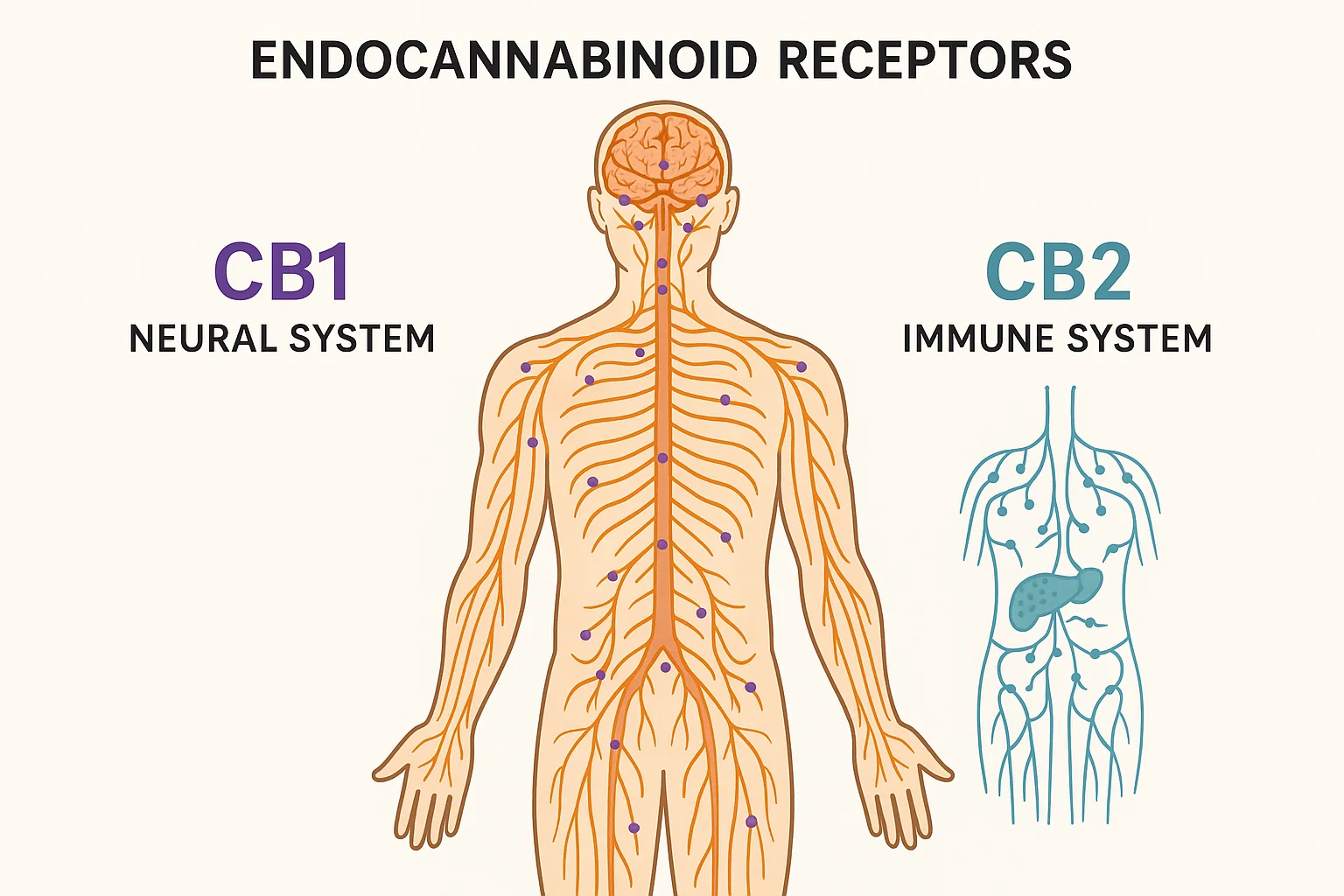
• CB2 is primarily located in immune system cells and peripheral tissues - not in the brain.
• THC binds directly and strongly to CB1, causing a psychoactive effect. CBD has minimal affinity for CB1 and acts differently.
• The body produces its own ligands for these receptors: anandamide and 2-AG.
What is a cannabinoid receptor and how does it work?
CB1 and CB2 receptors are G protein-coupled receptors (GPCR), meaning that upon binding with a ligand, they transmit signals inside the cell through a protein cascade. The term "cannabinoid receptor" is somewhat misleading - these structures were not created for cannabis plants to dock. The body produced them for its own ligands, the endocannabinoids, and plant cannabinoids simply "fit" into the same binding site.
When a ligand - whether an endocannabinoid or THC - binds to the receptor, the receptor changes shape and activates the G protein. This leads to a decrease in cAMP levels in the cell, which in turn inhibits neurotransmitter release. This is why the endocannabinoid system is often described as a "retrograde inhibition system" - endocannabinoids move from the postsynaptic cell to the presynaptic cell and dampen the signal when it is too strong. The CB1 receptor was discovered in 1988 by Allyn Howlett at Duke University (Howlett et al., Pharmacological Reviews, 2002).
Where in the body are CB1 receptors located?
CB1 is one of the most abundantly represented GPCRs in the central nervous system. It is particularly densely populated in the basal ganglia, hippocampus, cerebellum, prefrontal cortex, and amygdala. This anatomical map directly answers the question of why THC affects movement, short-term memory, emotions, and decision-making - it activates CB1 precisely in these areas.
Outside the brain, CB1 is also present in the spinal cord (pain pathways), peripheral nerve fibers, liver, adipose tissue, and intestines. This peripheral location explains the impact of cannabinoids on appetite, metabolism, and gut motility. It is worth noting that the density of CB1 varies between species and among individuals - genetic variations in the gene CNR1 can influence reactivity to THC and CBD in different people.
We have noticed that many questions about CBD concern whether the product "will reach the brain." The answer depends on the route of administration and form: sublingual oils are absorbed quickly, capsules more slowly, and transdermal patches differently. Each form affects how much CBD reaches CB1 in the central nervous system and in what time frame.
Where in the body are CB2 receptors located?
CB2 is a receptor with a completely different anatomical distribution than CB1. It predominates in immune cells: B and T lymphocytes, macrophages, monocytes, NK cells, and mast cells. It is also abundantly present in the spleen, lymph nodes, bone marrow, and tonsils. In a healthy brain, CB2 is virtually absent, although it is expressed in microglial cells during CNS inflammatory states.
Munro, Thomas, and Abu-Shaar identified the CB2 receptor in 1993, isolating it from spleen tissues, not the brain (Munro et al., Nature, 1993). This location immediately suggested an immunological role. Subsequent studies confirmed that CB2 activation inhibits pro-inflammatory cytokines TNF-α and IL-6 and slows the migration of inflammatory cells to the site of injury. This is why selective CB2 agonists are being studied as potential anti-inflammatory drugs - without the psychoactivity characteristic of CB1 agonists.
CB1 vs CB2 - a table of differences
Comparing both receptors in one place helps to understand why different cannabinoids produce different effects. THC acts strongly on CB1 in the brain - hence the intoxication. CBD acts more weakly on both receptors but modulates them and affects many other molecular targets.
| Feature | CB1 | CB2 |
|---|---|---|
| Year of discovery | 1988 (Howlett et al.) | 1993 (Munro et al.) |
| Main location | Brain, spinal cord, intestines | Immune cells, spleen, bone marrow |
| Natural ligand | Anandamide (AEA), 2-AG | 2-AG (mainly), anandamide (to a lesser extent) |
| THC affinity | Strong (full agonist) | Weaker (partial agonist) |
| CBD affinity | Minimal (allosteric modulator) | Low (inverse partial agonist) |
| Main function | Pain, mood, memory, appetite, movement | Modulation of inflammation, immunity |
| Effect of THC activation | Euphoria, altered perception, increased appetite | Anti-inflammatory effect (non-intoxicating) |
| Coding gene | CNR1 | CNR2 |
How does CBD interact with CB1 and CB2 receptors?
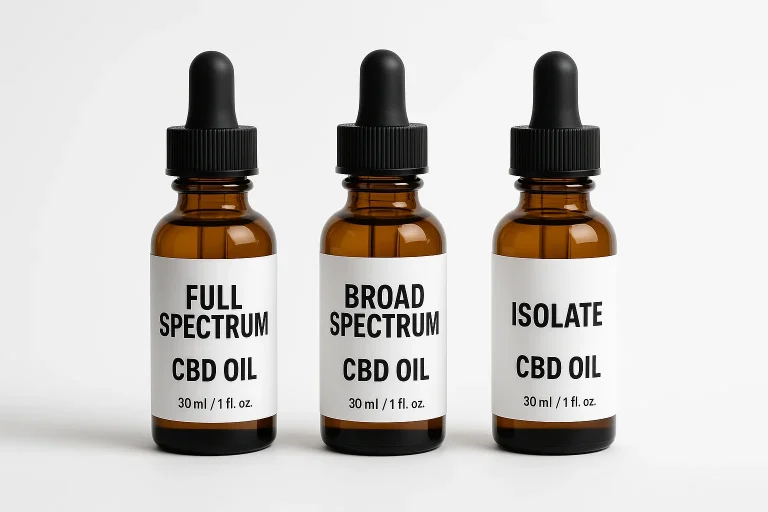
CBD is unique in terms of its mechanism of action - it is not a simple agonist of CB1 or CB2. Research by Mechoulam and Parker from 2013 shows that CBD acts as a negative allosteric modulator of CB1, meaning it binds to the receptor at a site other than the main active center and reduces the intensity of the response to THC (Mechoulam & Parker, Annual Review of Pharmacology, 2013). This explains why full-spectrum products containing both CBD and trace amounts of THC produce milder effects than pure THC.
Regarding CB2, CBD behaves like a partial inverse agonist - instead of activating the receptor, it partially blocks it. The anti-inflammatory effect of CBD largely results not from its action on CB2, but from other pathways: activation of the TRPV1 receptor, the serotonin receptor 5-HT1A, and PPAR-γ receptors involved in regulating inflammation. CBD also inhibits the FAAH enzyme, which breaks down anandamide - thus raising the levels of the body's own endocannabinoids, indirectly stimulating both receptors.
Endocannabinoids - the body's own ligands for CB1 and CB2 receptors
The body does not need cannabis to activate CB1 and CB2 receptors. It produces its own compounds: anandamide (AEA) and 2-arachidonoylglycerol (2-AG). Anandamide is a partial agonist of CB1 and to a lesser extent of CB2. 2-AG is a full agonist of both receptors and is found in the brain at concentrations 170 times higher than anandamide - it is responsible for most of the tonic endocannabinoidal tone (Bhattacharyya et al., Neuropsychopharmacology, 2012).
The synthesis of endocannabinoids differs from that of classical neurotransmitters. They are not stored in synaptic vesicles - they are produced "on demand" directly from membrane phospholipids. Once released, they act retrogradely: the postsynaptic cell sends endocannabinoids to the presynaptic cell, where they inhibit neurotransmitter release. This is a regulatory mechanism that dampens excessive synaptic activity. Physical activity, sleep, and a diet rich in omega-3 fatty acids support the production of endocannabinoids and indirectly modulate the activity of CB1 and CB2.
Frequently Asked Questions
What are CB1 and CB2 receptors?
CB1 and CB2 are the two main types of cannabinoid receptors that make up the endocannabinoid system (ECS). CB1 predominates in the central nervous system - the brain and spinal cord - and is responsible for regulating pain, mood, memory, and appetite. CB2 is primarily focused in immune cells and peripheral tissues, where it modulates inflammation (Pertwee, Pharmacological Reviews, 2010).
Where exactly in the body are CB1 receptors located?
CB1 is one of the most abundant G protein-coupled receptors in the brains of mammals. The highest density of CB1 is found in the basal ganglia, hippocampus, cerebellum, and prefrontal cortex. To a lesser extent, CB1 is also present in the kidneys, liver, and adipose tissue. This distribution explains why activation of CB1 by THC affects movement, memory, and mood (Howlett et al., Pharmacological Reviews, 2002).
Does CBD bind directly to CB1 and CB2 receptors?
CBD has very low affinity for CB1 and CB2 receptors compared to THC. It acts more as an allosteric modulator of CB1 and as a partial inverse agonist of CB2. The effects of CBD are primarily due to its interactions with other receptors: TRPV1, 5-HT1A, GPR55, and PPAR-γ (Mechoulam & Parker, Annual Review of Pharmacology, 2013).
What role does the CB2 receptor play in the immune system?
CB2 is abundantly expressed on B and T lymphocytes, monocytes, macrophages, and NK cells. Its activation inhibits the release of pro-inflammatory cytokines - TNF-α and IL-6 - and reduces the migration of inflammatory cells to the site of injury. Selective CB2 agonists are being studied as anti-inflammatory drugs without psychoactive effects (Munro et al., Nature, 1993).
Can CB1 and CB2 receptors be naturally stimulated without THC?
Yes. The endocannabinoid system has its own ligands: anandamide and 2-AG, which activate CB1 and CB2. Physical activity raises anandamide levels. CBD indirectly increases the levels of endocannabinoids by inhibiting the FAAH enzyme responsible for breaking down anandamide (Bhattacharyya et al., Neuropsychopharmacology, 2012).
Why does THC have a psychoactive effect while CBD does not?
THC is a full agonist of the CB1 receptor in the brain - it binds strongly and activates it directly, causing euphoria and changes in perception. CBD has minimal affinity for CB1 and does not activate it typically. Instead, CBD modulates the receptor allosterically and acts on other signaling pathways, resulting in effects without intoxication (Pertwee, Pharmacological Reviews, 2010).
This article is for informational and educational purposes and does not constitute legal advice. The legal status described in the article is valid as of the publication date - regulations regarding cannabis may change. Consult a lawyer or current legal acts before making decisions.
Author: Michał Waluk · Published: 2026-05-04 · Updated: 2026-05-04