
Contraindications and interactions - psychedelics, SSRI drugs, and MAOIs, as well as serotonin syndrome
Przeciwwskazania i interakcje: bezpieczenstwo, przeciwwskazania i interakcje. Edukacja u Bucha.
The increase in clinical research on psilocybin and ketamine has led to more people in Poland asking about the safety of psychedelics—especially in the context of psychiatric medications. This question is not academic: improper combinations can lead to serious complications, including life-threatening serotonin syndrome. This article gathers data from pharmacological literature to clearly show which combinations are dangerous, why, and what implications this information has for individuals considering participation in therapy or studies. The article is purely educational and does not encourage the use of controlled substances outside of a legal clinical context.
KEY INFORMATION
• The combination of MAO inhibitors (IMAO/RIMA) with serotonergic psychedelics can trigger serotonin syndrome—a life-threatening emergency state characterized by hyperthermia and seizures (Boyer & Shannon, NEJM, 2005).
• SSRIs can suppress or completely block the effects of psilocybin and LSD by desensitizing 5-HT2A receptors.
• Lithium and mood stabilizers are among the most serious contraindications—seizures have been reported when combined with LSD.
• A history of psychosis, schizophrenia, or bipolar disorder is an absolute contraindication in clinical trial protocols (MAPS, Compass Pathways).
How do psychedelics affect the serotonin system?
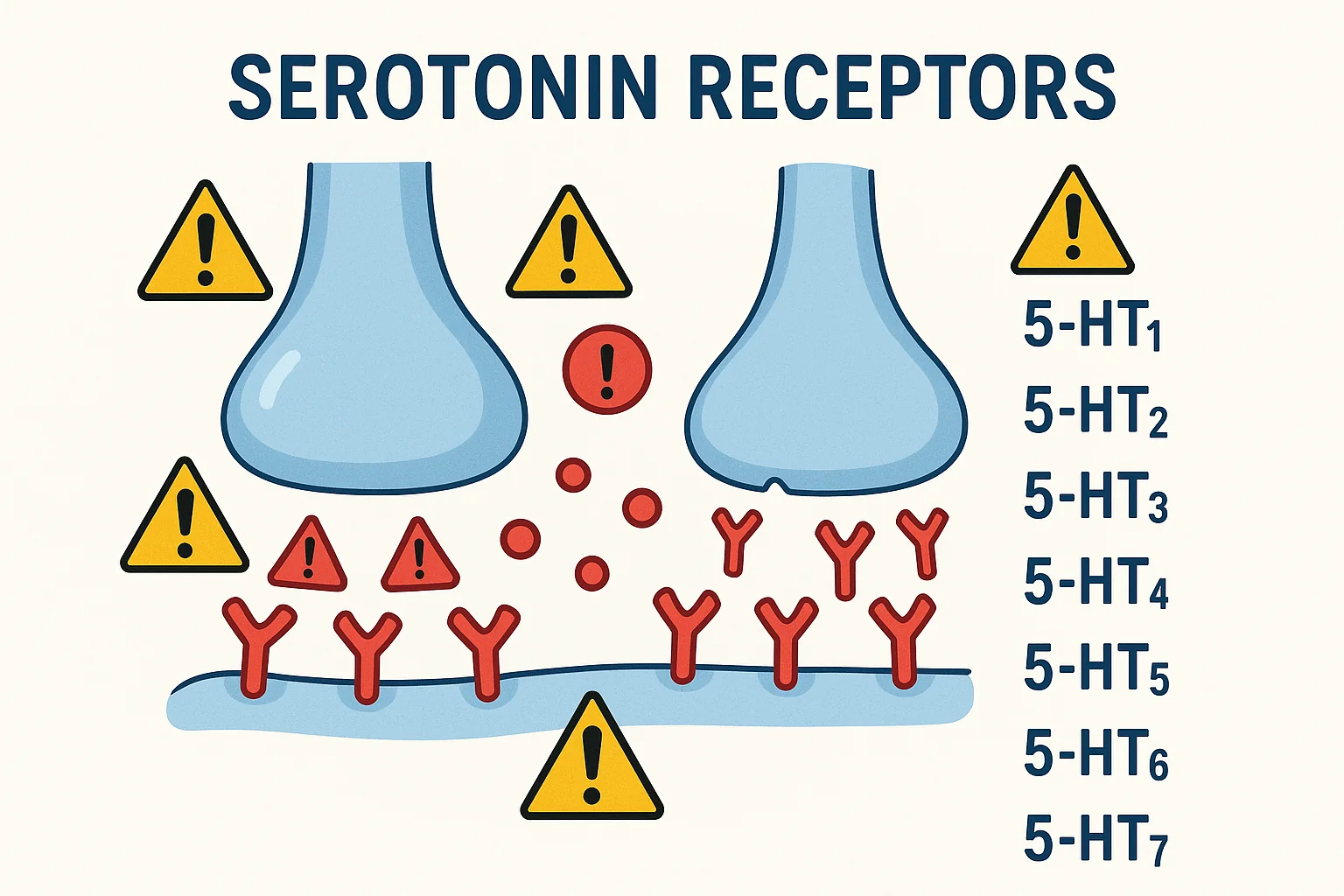
Classical psychedelics (psilocybin, LSD, DMT, mescaline) primarily act as agonists of the 5-HT2A receptor—a serotonin ionotropic receptor mainly located in the prefrontal cortex (Johnson et al., Neuropsychopharmacology, 2008). Activation of 5-HT2A by these substances leads to a signaling cascade that alters the function of neural networks and is responsible for perceptual and emotional effects.
It is important to distinguish: psychedelics do not raise serotonin levels in the blood or synapses in a way comparable to SSRIs. They do not block its reuptake. They act selectively on a specific receptor. This difference is crucial for assessing interactions with psychiatric medications—though it does not eliminate the risk entirely.
MDMA is an exception in this category: it is not a classical 5-HT2A agonist but a full stimulant of monoamine release (serotonin, dopamine, norepinephrine). This is a completely different mechanism and a completely different spectrum of interactions—particularly dangerous when combined with IMAO.
Interaction table: psychedelics and psychiatric medications
The table below collects the most important documented and potential interactions. The risk assessment comes from the clinical trial protocols of Johns Hopkins, MAPS, and pharmacological reviews. The table is for educational purposes only—clinical decisions are up to the physician.
| Drug / class | Psychedelic substance | Risk level | Mechanism / notes |
|---|---|---|---|
| Non-selective MAOIs (phenelzine, tranylcypromine) | Psilocybin, LSD, DMT, MDMA | CRITICAL | Risk of serotonin syndrome; potentially fatal |
| RIMA (moclobemide) | Psilocybin, DMT, MDMA | CRITICAL | Moclobemide + MDMA: reported fatal cases in Australia |
| SSRIs (sertraline, fluoxetine, escitalopram) | Psilocybin, LSD | UMIARKOWANE | Suppression of effects through desensitization of 5-HT2A; pharmacodynamic interaction |
| SSRIs (sertraline, fluoxetine, escitalopram) | MDMA | CRITICAL | Risk of serotonin syndrome; numerous cases in the literature |
| SNRI (venlafaxine, duloxetine) | Psilocybin, MDMA | WYSOKIE | Dual reuptake blockade increases serotonergic risk |
| Lithium (lithium carbonate) | LSD, psilocybin | WYSOKIE | Descriptions of seizures; modulation of GSK-3β |
| Tricyclic antidepressants (TCA) | LSD, psilocybin | UMIARKOWANE | Potential suppression of effects; limited data |
| Carbamazepine, valproate | Psilocybin, LSD | UMIARKOWANE | Possible weakening of effects; data from case reports |
| Atypical antipsychotics (olanzapine, quetiapine) | Psilocybin, LSD | LOW (interaction) | Block 5-HT2A → practically completely suppress psychedelic effects |
| Benzodiazepines (diazepam, lorazepam) | Psilocybin, LSD | NISKIE | Used in protocols as rescue - suppressing difficult experiences |
Serotonin syndrome - what is it and why is it dangerous?
Serotonin syndrome is a sudden, potentially life-threatening clinical state caused by excessive serotonergic activity in the CNS and peripheral nervous system (Boyer & Shannon, NEJM, 2005). The classic Sternbach triad includes: changes in mental status (agitation, disorientation, confusion), neuromuscular hyperactivity (clonus, tremor, hyperreflexia, ataxia), and autonomic instability (fever, tachycardia, excessive sweating).
Severe serotonin syndrome is a life-threatening condition. Hyperthermia above 41°C leads to rhabdomyolysis (muscle breakdown), disseminated intravascular coagulation (DIC), acute kidney failure, and death. Treatment requires intensive medical care, cyproheptadine (5-HT antagonist), and benzodiazepines. Time from exposure to symptoms: usually a few hours.
We have noted in the available literature that many cases of serotonin syndrome resulted from unconscious drug combinations: patients did not inform their doctors about all substances taken, and doctors did not inquire sufficiently. The National Poison Data System report indicates that about 85% of cases are associated with a combination of two or more serotonergic substances, not a single overdose.
Psychedelics and mental disorders - absolute contraindications
The clinical trial protocols of Johns Hopkins, MAPS, and Compass Pathways exclude participants with specific psychiatric diagnoses because psychedelics can destabilize certain conditions. This is not excessive caution—it is the conclusion from decades of psychiatric clinical observation.
Absolute contraindications in most research protocols include: schizophrenia and other primary psychoses, bipolar affective disorder (BAD) with a history of manic episodes, emotionally unstable personality (borderline) with an active tendency to dissociation, and active substance use disorder (except in addiction treatment protocols). Researchers also consider a significant family history—risk of revealing predisposed psychosis increases among first-degree relatives.
Why is BAD so special? Psilocybin and LSD can induce hypermania or a mixed episode in predisposed individuals, especially without mood stabilization. At the same time, lithium—often used in BAD—is one of the most serious inhibitors of psychedelic use due to reported seizures (Nishida et al., Psychiatric Research, 2012).
Interactions of SSRIs with psilocybin - suppression of effects and what it means clinically?
The paradox of using SSRI and psilocybin is that SSRIs can significantly weaken or completely block psychedelic effects through desensitization (down-regulation) of 5-HT2A receptors (Johnson et al., Neuropsychopharmacology, 2008). In clinical practice, protocols for psilocybin research typically require several weeks of SSRI discontinuation before a session—but such a decision must be made solely by a psychiatrist, never independently by the patient.
Importantly: mere suppression of effects by SSRIs does not eliminate the risk of interactions. Studies show that some patients taking SSRIs experience full psychedelic effects, while others have their effects completely blocked—the variance is enormous and unpredictable without individual assessment. There is no standard "safe break" for all SSRIs—fluoxetine with its active metabolite (norfluoxetine) has an elimination half-life of several weeks, while escitalopram is eliminated more quickly.
From our editorial observations, it appears that the topic of psilocybin-SSRI interactions is one of the most frequently asked by readers—and one of the most misunderstood. Many people mistakenly assume that "SSRIs suppress effects, so they are safe." Meanwhile, this suppression pertains to classical serotonergic psychedelics, not MDMA, which in combination with SSRIs can produce the opposite effect and dramatically increase risk.
Leki sercowo-naczyniowe i inne - mniej omawiane interakcje
Besides psychiatry, there are several classes of medications that interact with psychedelics and are less frequently discussed in popular literature. Triptans (migraine medications, 5-HT1B/1D agonists like sumatriptan) can interact with serotoninergic substances, although the clinical risk is lower than with MAOIs. Beta-blockers (propranolol) used by researchers as rescue may weaken vegetative responses but do not block perceptual effects. Cardiological medications that increase QTc (some antibiotics, haloperidol) should be evaluated by a physician - psychedelics themselves rarely prolong QTc, but ibogaine is a completely different story in this regard.
Frequently Asked Questions
Can psilocybin be combined with SSRI medications?
Combining psilocybin with SSRIs is discouraged for two reasons. First, SSRIs can significantly weaken or completely block psychedelic effects through desensitization of 5-HT2A receptors. Second, although the risk of serotonin syndrome is low with classic psychedelics, the combination with lithium and SSRIs carries unpredictable pharmacodynamic interactions (Johnson et al., Neuropsychopharmacology, 2008).
Why are MAOIs dangerous with psychedelics?
MAOIs (monoamine oxidase inhibitors) inhibit the breakdown of serotonin, dopamine, and norepinephrine. Combining MAOIs with serotoninergic substances (LSD, psilocybin) or sympathomimetics (MDMA, amphetamine) can trigger serotonin syndrome - a life-threatening condition with hyperthermia, seizures, and multi-organ failure (Boyer & Shannon, NEJM, 2005).
What is serotonin syndrome and what are its symptoms?
Serotonin syndrome is a triad: changes in mental state (agitation, disorientation), excessive neuromuscular activity (tremors, clonus, hyperreflexia), and autonomic instability (fever, tachycardia, sweating). In severe cases, it leads to rhabdomyolysis, DIC, and death. It requires immediate medical attention (Boyer & Shannon, NEJM, 2005).
Is lithium and psychedelics a safe combination?
Lithium used in bipolar disorder is one of the most serious contraindications for psychedelics. Cases reported in the literature indicate a risk of seizures when combining lithium with LSD or psilocybin. The mechanism is not fully understood, likely related to modulation of the GSK-3β pathway (Nishida et al., Psychiatric Research, 2012).
When should SSRI be discontinued before a session with psychedelics?
This issue pertains solely to the context of supervised clinical trials or medical therapy. Under no circumstances should one discontinue SSRI treatment without consulting a psychiatrist. The elimination time of SSRIs from the body is several weeks (5 half-lives), and fluoxetine, due to its active metabolite, may take even 5-6 weeks. The decision rests solely with the attending physician.
Practical conclusions for patients participating in clinical trials
For someone considering participation in clinical trials with psilocybin or MDMA, the crucial first step is to compile a complete list of all medications taken - both prescribed by a doctor and including supplements, OTC medications, and herbal preparations. Many substances commonly considered harmless (St. John's wort, 5-HTP, valerian) have serotoninergic activity and may interact. One should not assume that a 'natural supplement' is safe in combination with psychedelics.
Clinical protocols require participants to disclose their entire pharmacotherapy in the qualifying interview. Concealing information about medications taken is not only dishonest to researchers but primarily a threat to one's own health. The doctors conducting the study are obligated to maintain confidentiality - there is no reason to hide psychiatric medications or other substances.
Individuals who do not qualify for clinical trials due to psychiatric treatment may consider ketamine or esketamine - these substances have different interactions and are available in clinical settings regardless of SSRI use. The attending psychiatrist can individually assess whether ketamine infusion is safe with a specific treatment regimen.
Herbal substances and supplements - an underrated source of interactions
Besides prescribed medications, there are several popular supplements and plants that may have significant interactions with psychedelics. St. John's wort (Hypericum perforatum) is a serotonin and monoamine oxidase reuptake inhibitor - a mechanism similar to SSRIs and MAOIs. Regular use of St. John's wort before a psychedelic session may both weaken effects (like SSRIs) and potentially increase serotoninergic risk.
5-HTP (serotonin precursor) used as a mood and sleep supplement can enhance serotonin activity - particularly dangerous in combination with MDMA or in the presence of an SSRI. Valerian interacts with benzodiazepines and GABAergic sedatives, which may affect the response to ketamine. Ginseng and other adaptogens acting on the HPA axis may modulate the stress response during sessions, although clinical data on this topic is scarce.
This article is for informational and educational purposes and does not replace consultation with a doctor. If you are pregnant, breastfeeding, taking medications, or have chronic conditions, consult the use of supplements or herbs with a specialist.
Author: Michał Waluk · Published: 2026-05-04 · Updated: 2026-05-04