
Transdermal patch vs regular ointment - when the substance enters the bloodstream
Transdermal patch vs regular ointment: comparison and what to choose. Table from u Bucha.
The skin is the largest organ of the body and at the same time a very effective barrier against the penetration of substances from the outside into the body. Most ointments and creams work topically - the active substance reaches the target tissue directly through the skin, without entering the blood. A transdermal patch is something entirely different: it is a system specifically designed to break through this barrier and deliver the therapeutic substance into the bloodstream through the skin. A review study published in Advanced Drug Delivery Reviews showed that in 2022, there were over 35 approved transdermal medicinal products available on the market, and the market for transdermal drug delivery systems reached a value of $6.5 billion (Prausnitz & Langer, PMC, 2008). This article explains where the line is drawn between local and systemic action and what it means in practice for anyone reaching for skin products.
KEY INFORMATION
• An ointment acts locally - the active substance does not cross the skin barrier into the bloodstream without permeators (Prausnitz & Langer, PMC 2008).
• A transdermal patch is a TDDS system designed to deliver substances to the blood at a controlled rate over many hours.
• The time to reach peak blood concentration with a transdermal patch is 4-8 hours after application - it is not faster than tablets.
• The advantage of the patch is the consistency and continuity of delivery, not the speed of action.
How is the skin barrier constructed and why is it difficult to cross?
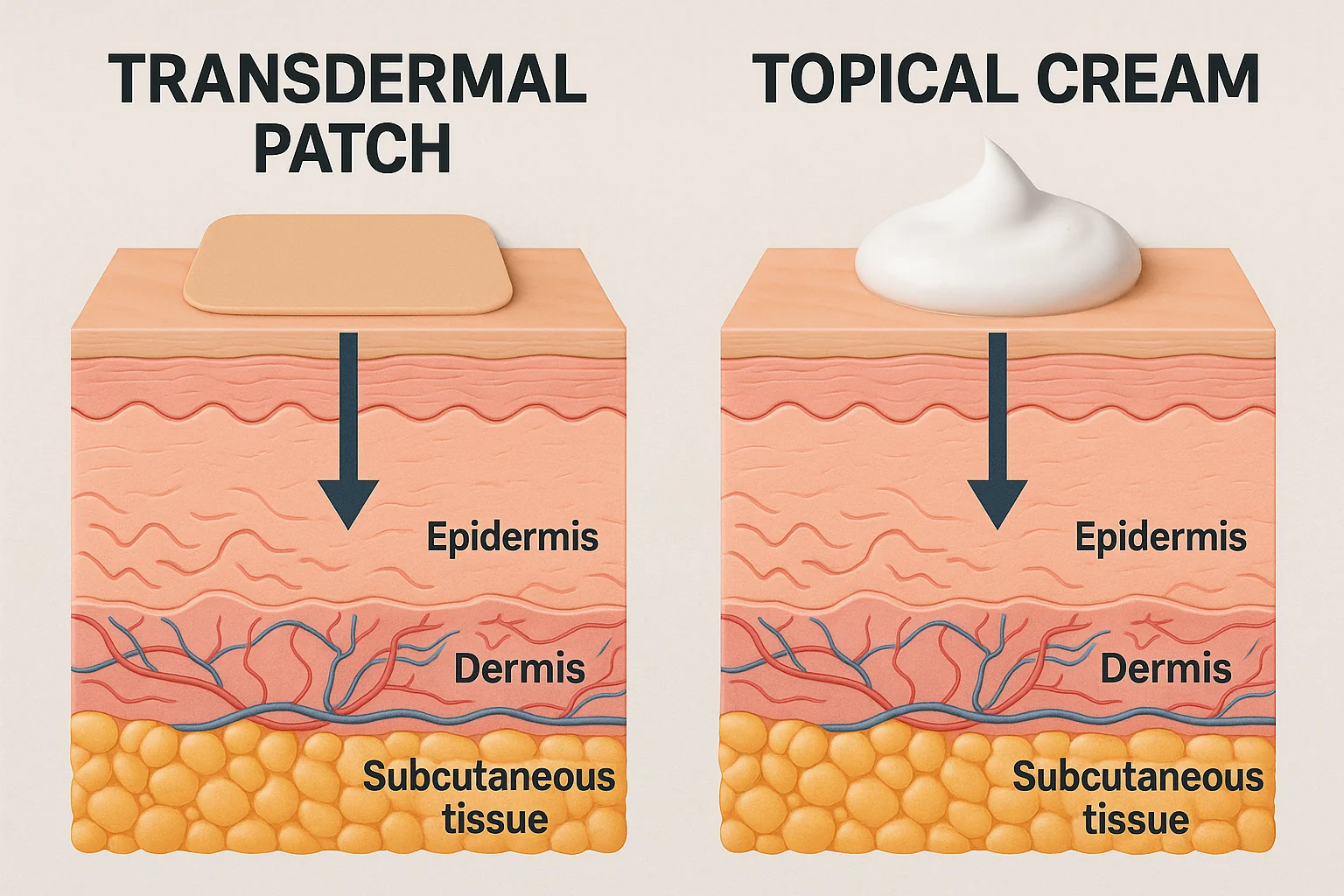
The skin consists of three main layers: the epidermis, the dermis, and the hypodermis. The outer layer of the epidermis - stratum corneum (horny layer) plays a key role in the barrier. It is only 10-20 µm thick but is an exceptionally effective barrier due to its structure: flat, dead keratinocytes arranged like bricks in a lipid matrix (ceramides, cholesterol, fatty acids). This "brick and mortar" structure is hydrophobic and hinders the penetration of both water-soluble substances and overly large lipophilic molecules.
For a substance to penetrate from the skin surface into the bloodstream, it must successively overcome: stratum corneum, the living layers of the epidermis (granulosum, spinosum, basale), and the dermis with a network of capillaries. The capillaries in the dermis are dense and well-perfused - if the substance reaches the dermis, it is absorbed into the blood relatively quickly. The problem is that the stratum corneum only allows substances that meet strict physicochemical criteria to pass through.
Transdermal patch vs regular ointment - table of key differences
The difference between an ointment and a transdermal patch is not only quantitative (how much substance enters the blood) but primarily qualitative - these are two different therapeutic goals and two different pharmaceutical designs.
| Parameter | Regular ointment | Transdermal patch |
|---|---|---|
| Therapeutic purpose | Local action | Systemic action |
| Penetration into the blood | Minimal (without permeators) | Designed and controlled |
| Skin permeators | None or cosmetic | Present (ethanol, DMSO, terpenoids, surfactants) |
| Time to peak blood concentration (Tmax) | Not applicable (local action) | 4-8 godzin od naklejenia |
| Duration of action | 2-6 godzin miejscowo | 12-168 hours (depending on the product) |
| First-pass effect through the liver | Not applicable | Skipped - the substance goes directly into the blood |
| Legal regulation | Cosmetic or OTC product | Medicinal product (requires EMA/URPL registration) |
| Examples | Arnica ointment, CBD cream, menthol gel | NRT nicotine patch, estradiol, fentanyl, nitroglycerin |
Which substances are suitable for transdermal administration?
Not every medicinal substance can be effectively administered through the skin. The physicochemical requirements for a good transdermal candidate are strict. Low molecular weight (below 500 Da) is a necessary condition - larger molecules simply do not pass through the lipid matrix pores of the stratum corneum. For comparison: CBD has a weight of 314 Da (a good candidate), insulin - 5808 Da (too large without advanced delivery technologies).
Moderate lipophilicity (octanol/water partition coefficient logP 1-3) is optimal - the substance must be sufficiently lipophilic to penetrate the lipid matrix of the stratum corneum, but not so lipophilic that it gets stuck in that layer without the possibility of further diffusion into the more aqueous environment of the dermis. High dosing potential (biological activity at doses ranging from micrograms to milligrams daily) is necessary because skin absorption is orders of magnitude lower than oral.
Classic substances in transdermal systems include: nitroglycerin (angina - patch on the chest or forearm, action for 24h), nicotine (NRT patches 16h or 24h, used for smoking cessation), estradiol and testosterone (hormone replacement therapy), fentanyl (strong opioid for chronic pain treatment - patch changed every 72h), scopolamine (prevention of motion sickness - patch behind the ear).
How do permeators work - substances that open the skin barrier?
Skin permeators (chemical penetration enhancers, CPE) are substances added to transdermal formulations that temporarily or permanently disrupt the lipid structure of the stratum corneum, allowing deeper penetration of the active substance. The mechanisms of action of permeators vary, but all lead to the same effect: increased permeability of the skin barrier.
Ethanol (ethyl alcohol) is one of the simplest and most commonly used permeators - lipid extraction from the stratum corneum and fluidization of lipid bilayers increase the diffusion of lipophilic substances. DMSO (dimethyl sulfoxide) is a stronger chemical permeator - it allows the transport of large molecules, but has a strong garlic-like odor and can cause irritation. Terpenoids (linalool, menthol, camphor, eucalyptol) are natural permeators - they work by disrupting the order of lipids in the stratum corneum without strong side effects. This is why natural essential oils improve the penetration of active substances through the skin.
We have noticed that labels on cosmetic and skin supplement products rarely inform about the presence or absence of permeators. Consumers buy products labeled as "transdermal" or "deep penetrating into the skin" without knowing whether the formula actually contains substances that enhance penetration through the epidermal barrier. A practical test: if a topical product contains ethanol, DMSO, dimethyl isosorbide, propanediol, or natural terpenoids in high concentrations (eugenol, linalool, menthol >5%) - it has real permeators. If the ingredients are water, glycerin, shea butter, and plant oil - it acts topically.
Pharmacology of transdermal patches - what happens after application?
After applying a transdermal patch, the active substance from the patch reservoir begins to diffuse towards the skin according to the concentration gradient. The stratum corneum acts as a "delaying reservoir" - the substance accumulates in this layer for several hours before diffusing further into the blood vessels. This explains why the time to peak blood concentration (Tmax) is 4-8 hours for most patches, not 30 minutes as with a tablet.
After removing the patch, the active substance continues to diffuse from the accumulating depot in the stratum corneum - the concentration in the blood decreases slowly, often over the next 6-12 hours. The depot effect in the skin is an important pharmacological mechanism: a 16-hour nicotine patch removed in the evening still delivers nicotine for several hours during the night before the concentration in the blood drops below the perceptible threshold. For substances with a narrow therapeutic index (e.g., fentanyl), this depot effect needs to be considered when changing patches.
Where to apply the transdermal patch and how to rotate sites?
The thickness and properties of the skin vary significantly depending on the location on the body. The stratum corneum on the sole of the foot is 400-600 µm thick (natural keratinization), while on the inner side of the forearm it is 10-15 µm. This 40-fold difference directly translates into the rate of transdermal absorption. Areas with thin, well-perfused hairless skin are the optimal choice for patches.
The best application sites: the inner side of the forearm (standard site for most patches), the upper arm (outer side), the shoulder area, the abdomen (below the navel - for hormones), the upper back, and the area behind the ear (scopolamine). Avoid areas with thick skin (hands, feet, elbows, knees) and heavily hairy areas. Rotate application sites with each patch change - applying in the same spot for several days leads to local irritation and may alter local absorption.
We noticed that body temperature and physical activity significantly affect transdermal absorption. Sauna, hot showers, or intense physical exertion dilate the skin's blood vessels and significantly accelerate the absorption of substances from the transdermal patch - which can result in a sudden increase in the concentration of the active substance in the blood. In the case of patches with strong substances (fentanyl, nitroglycerin), this can be dangerous. Even with CBD or nicotine patches, it's worth knowing that a hot bath after application speeds up the effect - both in a good and a bad sense.
Interactions and safety of transdermal systems
Transdermal patches delivering substances to the bloodstream are subject to the same drug interactions as oral forms of the same substance - because the active substance circulates in the blood and is metabolized by the same enzymes (mainly cytochrome P450). This is an important difference from topical ointments, where systemic interactions are minimal or nonexistent. If you are using a transdermal patch with a substance that interacts with your medications - the interaction occurs just like when swallowing the substance orally.
Skin safety: transdermal patches can cause local skin reactions - redness, itching, contact dermatitis. Ingredients in the patch other than the active substance (acrylic adhesives, permeators, fillers) are a more common cause of reactions than the medicinal substance itself. Skin reactions to the patch do not indicate an allergy to the active substance, but to the excipients. If persistent redness or blisters appear - remove the patch, wash the skin, and consult a doctor.
How to read the product composition - does your ointment really "penetrate deeply"?
Cosmetic ointment and cream manufacturers often use phrases like "deeply penetrating formula", "active penetration" or "transdermally active". These are marketing claims, not pharmacological. Cosmetic law does not require the manufacturer to prove the depth of penetration in clinical studies - it is enough that the product does not harm. The result is a semantic blurring of the boundary between topical ointments and actual transdermal systems.
How to assess whether the product has real permeators? Review the full list of ingredients (INCI) on the packaging or the manufacturer's website. The presence of ethanol (Alcohol Denat., Ethanol) among the first 5 ingredients suggests real permeator activity. Propanediol, butylene glycol, and dimethyl isosorbide (Dimethyl Isosorbide) are synthetic permeators used in products with a higher degree of penetration. Terpenoids in high concentrations (Menthol above 5%, Eugenol, Linalool) increase the penetration of lipophilic substances. On the other hand, a list containing only Aqua, Glycerin, Butyrospermum Parkii (Shea), Prunus Amygdalus Dulcis - is a classic cosmetic care formula that works cosmetically, without transferring active substances to the dermis.
It is worth noting that over-the-counter (OTC) transdermal patches - such as nicotine patches, patches with menthol/capsaicin for pain - still must meet the requirements of European regulations as medicinal products and undergo the EMA or URPL assessment process. Meanwhile, many products sold as "CBD transdermal cream" or "hemp transdermal patch" are cosmetic products registered without clinical evidence of actual bioavailability. EMA guidelines on drug quality clearly distinguish registered TDDS systems from cosmetic preparations - this boundary is significant for consumers.
Frequently Asked Questions
When does the ointment enter the bloodstream, and when does it only work topically?
A standard ointment without permeators works mainly locally - it penetrates the epidermis and subcutaneous tissue but does not cross the barrier of the dermis in pharmacologically significant amounts. It enters the bloodstream when the skin is damaged or when the formula contains permeators (ethanol, DMSO, terpenoids) designed for transdermal penetration.
How does a transdermal patch pharmacologically differ from an ointment?
A transdermal patch is a TDDS (transdermal drug delivery system) designed to transport substances through all layers of the skin into the bloodstream at a controlled rate. An ointment is a topical preparation - it acts directly on the tissue under the skin without the need or purpose of entering the blood. These are two different pharmaceutical products with different therapeutic goals.
Which substances are suitable for transdermal administration?
Ideal candidates have a low molecular weight (below 500 Da), moderate lipophilicity (logP 1-3), and potency in small doses. Classic examples: nitroglycerin, nicotine, estradiol, fentanyl, scopolamine, testosterone. CBD meets some of the criteria but requires permeators due to its higher molecular weight (314 Da).
Does a transdermal patch work faster than an ointment?
Not at the first application. Tmax (time to peak concentration in the blood) for a transdermal patch is 4-8 hours. Ointment acts locally faster (15-60 minutes). The advantage of the patch is the steady, even delivery of the substance over many hours - not speed, but continuity.
Can transdermal patches be used on damaged skin?
No - only on healthy, unbroken skin. Damaged epidermal barrier significantly accelerates absorption and can lead to uncontrolled overdose. This is particularly important with patches containing strong active substances (fentanyl, nitroglycerin, estradiol).
Where to apply the transdermal patch?
Best absorption occurs in areas with thin, well-vascularized skin without hair: the inner side of the forearm, the upper arm, abdomen, upper back, area behind the ear. Avoid hands, feet, and elbows (thick stratum corneum). Rotate sites with each patch change to avoid irritation.
This article is for informational and educational purposes and does not replace consultation with a doctor. If you are pregnant, breastfeeding, taking medications, or have chronic conditions, consult the use of supplements or herbs with a specialist.
Author: Michał Waluk · Published: 2026-05-04 · Updated: 2026-05-04