
Apple cider vinegar for joints and muscle pain: research and practical application
There is no confirmation in studies on humans that apple cider vinegar alleviates joint and muscle pain. Check what vinegar really does, what risks it poses, and what helps with joints.
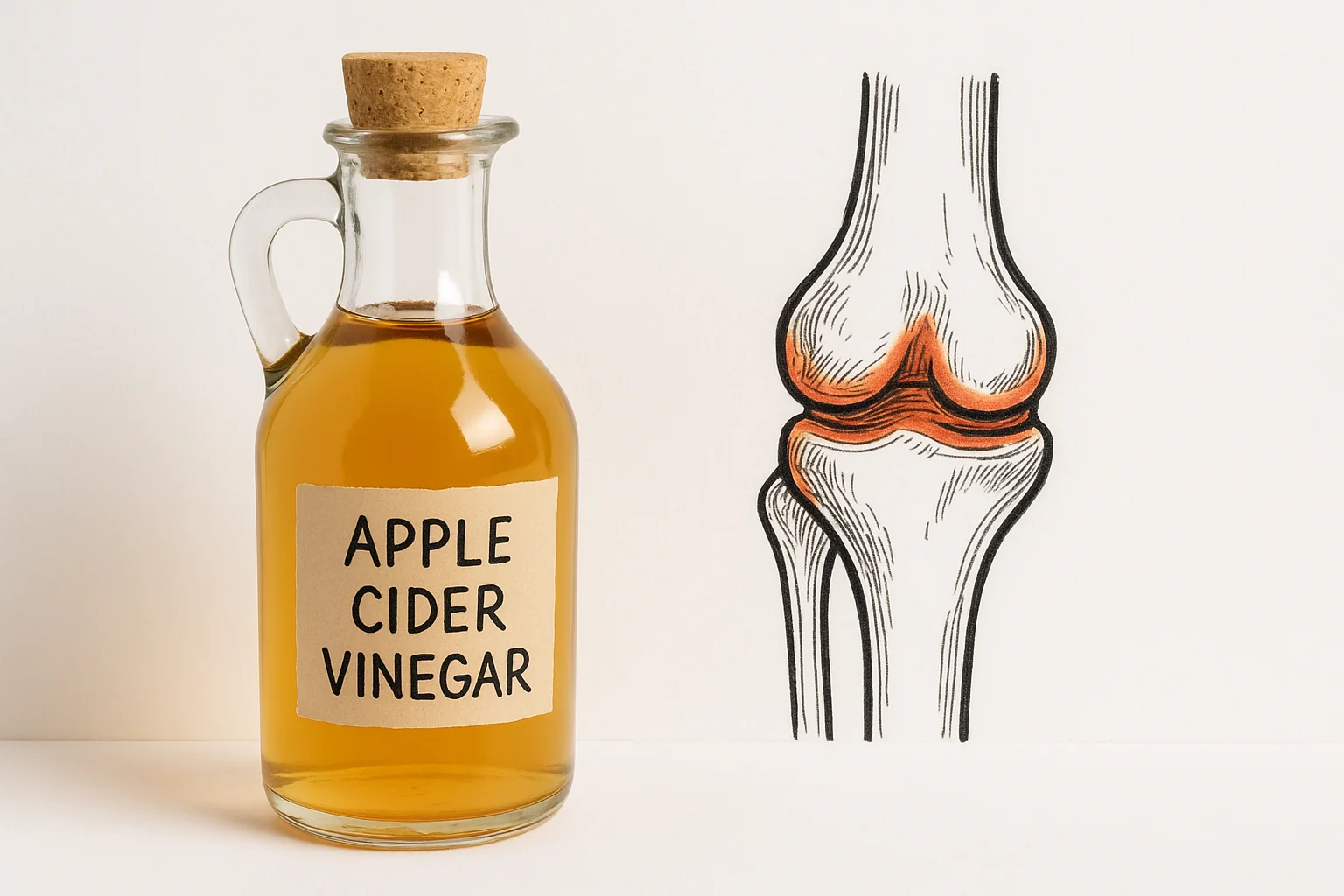
Apple cider vinegar reappears in guides as a remedy for sore knees, stiff fingers, and muscle soreness after exercise. The promises sound specific: it dissolves deposits, flushes out uric acid, alkalizes the body. We checked how much of this can be supported by medical literature. The answer is short and uncomfortable. There is not a single clinical study in scientific databases that has examined apple cider vinegar as a remedy for joint or muscle pain in humans. Vinegar has documented effects, but they pertain to a completely different area: blood glucose, body weight, blood pressure. Below you will find what research really indicates, a list of real risks associated with daily vinegar consumption, and methods that have confirmation in the guidelines of rheumatology societies.
KEY INFORMATION
• A 2026 umbrella review of 10 meta-analyses and 38 studies on vinegar (Shahmohammadi et al., Food Science and Nutrition, 2026) contains not a single joint-related outcome.
• Confirmed effects of vinegar are metabolic: postprandial glucose lower by 14.59 mg/dl, fasting glucose by 9.40 mg/dl, body weight by 1.06 kg.
• The thesis of alkalizing the body is biologically incorrect, as blood pH remains in the range of 7.35-7.45 regardless of diet.
• Real risks include enamel erosion, esophageal irritation, and potassium drop with diuretics.
Does apple cider vinegar help with joint pain?
There is no evidence for this in humans. In medical databases, you will not find a randomized clinical trial examining apple cider vinegar for osteoarthritis, rheumatoid arthritis, gout, or muscle pain. Claims about vinegar's effectiveness for joints circulate in guides, not in literature.
The scale of this gap is well illustrated by the latest summary of research on vinegar. Shahmohammadi et al. (Food Science and Nutrition, 2026) They gathered 10 meta-analyses covering 38 randomized studies and compiled all the endpoints that have ever been measured. This list includes glucose, insulin, glycated hemoglobin, cholesterol, body weight, and blood pressure. There is no pain, morning stiffness, joint swelling, or any fitness scale. This is not an oversight by the authors of the review. There is simply nothing to sum up.
The absence of evidence does not automatically mean that something does not work. It means, however, that anyone who claims a number like "40 percent reduction in joint pain after 8 weeks" should be able to point to a study identifier. We checked a dozen such numbers repeated in Polish guides on vinegar, and none led to an existing study. If you encounter a similar result without a reference, treat it like advertising, not science.
What proven effects does apple cider vinegar have, since it does not work on joints?
It lowers post-meal glucose, and to a lesser extent, fasting glucose and glycated hemoglobin. The mentioned umbrella review provides averaged effect sizes: postprandial glucose decreases by 14.59 mg/dl, fasting glucose by 9.40 mg/dl, and HbA1c by 0.70 percentage points. The certainty of the evidence was rated as moderate.
A separate meta-analysis of nine clinical studies, Hadi i in. (BMC Complementary Medicine and Therapies, 2021), gives a similar picture: fasting glucose lower by 7.97 mg/dl, HbA1c by 0.50, total cholesterol by 6.06 mg/dl, with no impact on LDL, HDL, or fasting insulin. The mechanism was described earlier: Johnston i in. (Diabetes Care, 2004) they showed that vinegar given with a carbohydrate-rich meal improves insulin sensitivity in the following hours.
It is worth noting how fragile this area can be. A prominent randomized study on apple cider vinegar and weight loss in young overweight individuals, published in BMJ Nutrition, Prevention and Health, was retracted by the editorial board in 2025. If you come across a reference to it, it is already outdated. The effect on body weight remains real in meta-analyses, but minor: about 1 kg.
Why does "alkalizing the body" explain nothing about joints?
Because blood pH does not depend on what you eat. The kidneys and lungs maintain it within the range of 7.35-7.45 with a precision that is unaffected by vinegar, lemon, or baking soda. If a food product actually shifted blood pH, it would be a condition requiring hospital treatment, not a health benefit.
Acetic acid, once absorbed, converts to acetate and then to bicarbonate, so it may slightly raise urine pH. However, urine is not joint tissue, and there is no direct correlation between the two. In gout, the entire theory is based on this single jump: since urine becomes less acidic, urate is easier to excrete. No one has measured this. There is no human study that checked urate levels in serum before and after drinking vinegar.
In gout, boring and well-documented measures work. A diet limiting red meat, offal, and seafood. Abstaining from alcohol, especially beer. Hydration at a level of 2-3 liters per day. Allopurinol or febuxostat for recurrent attacks, and in acute attacks, a non-steroidal anti-inflammatory drug or colchicine. Vinegar can be a component of a sensible diet, but it does not replace anything in this puzzle.
Where do reports come from that joints hurt less after vinegar?
From several phenomena that can easily be mistaken for the action of the product. Joint pain has a natural rhythm of exacerbations and remissions, so improvement after a week can also occur without any intervention. Additionally, there is the placebo effect, which is one of the strongest in all of medicine.
The second mechanism is regression to the mean. You reach for a home remedy at the worst moment, at the peak of discomfort. Statistically, the next measurement almost always turns out better, regardless of what you do in the meantime. The third reason is the most mundane: vinegar rarely enters life on its own. It is usually accompanied by a larger amount of water, less alcohol, less processed food, and a few kilograms down. With knees, just reducing body weight relieves the joint with every step.
We noticed while organizing this text something worth repeating. The previous version of the article was based on four scientific papers with provided PubMed numbers. Upon checking in Europe PMC, it turned out that those numbers corresponded to: a study on caterpillars from the family Noctuidae, a paper on peripheral artery resonance, a report on heart contusion during resuscitation, and a review on intestinal bacteriophages. None of these identifiers led to the work that the text described.
What are the risks of drinking apple cider vinegar on your own?
Three things that have been documented better than any effect on joints: enamel erosion, esophageal irritation, and potassium deficiency. Culinary vinegar contains 5-6 percent acetic acid, so when consumed daily and undiluted, it affects tissues like any acid at that concentration.
| Risk | Co opisano w literaturze | How to limit them |
|---|---|---|
| Erozja szkliwa | Extensive enamel loss in a young person drinking apple cider vinegar daily (Gambon i in., Nederlands Tijdschrift voor Tandheelkunde, 2012) | Dilute in a glass of water, drink through a straw, rinse your mouth, and wait half an hour before brushing your teeth. |
| Esophageal damage | Esophageal injury from apple cider vinegar tablets that got stuck in the esophagus (Hill i in., Journal of the American Dietetic Association, 2005) | Do not drink undiluted vinegar, take tablets with a full glass of water while standing. |
| Potassium deficiency | Hypokalemia, hyperreninemia, and osteoporosis in a person consuming large amounts of apple cider vinegar for years (Lhotta i in., Nephron, 1998) | Exercise caution with diuretics, and monitor potassium levels in blood tests with long-term use. |
| Interaction with diabetes medications | Vinegar delays gastric emptying in people with type 1 diabetes (Hlebowicz i in., BMC Gastroenterology, 2007), while simultaneously lowering postprandial glycemia | With insulin, sulfonylurea derivatives, and gastroparesis, establish usage with the attending physician |
| Skin burn | Chemical burn from applying undiluted apple cider vinegar to the skin (Bunick i in., Journal of the American Academy of Dermatology, 2012) | Do not apply vinegar to the skin without dilution and never under an occlusive dressing |
Case descriptions do not indicate how often such complications occur. However, they show that acetic acid at these concentrations can damage tissue, so dilution is not an excessive precaution.
How to distinguish inflammatory pain from overload pain?
By the time of day and the response to movement. Inflammatory pain wakes you up in the early morning, is accompanied by stiffness lasting longer than 30 minutes, and clearly subsides after moving around. Overload pain increases throughout the day with exertion, and rest alleviates it.
Additional signals indicating an inflammatory background include joint swelling with skin warmth above it, symmetrical involvement of the small joints of the hands, low-grade fever, and fatigue disproportionate to exertion. Overload usually causes localized pain related to a specific movement, without swelling and without morning stiffness lasting for hours.
This difference has practical consequences. EULAR recommendations regarding early arthritis (Combe et al., Annals of the Rheumatic Diseases, 2017) state that a person with persistent joint swelling should see a rheumatologist within 6 weeks of symptom onset, as early treatment can significantly change the course of the disease. Every week spent experimenting with vinegar is a week lost.
See a doctor without delay if the joint is red, hot, and painful with the slightest movement, especially with fever. The same applies to pain after an injury that prevents weight-bearing, pain that wakes you at night, unintended weight loss, and when morning stiffness lasts more than an hour for more than two weeks.
What really helps with joint pain according to the guidelines?
Movement and weight loss. The American College of Rheumatology guidelines (Kolasinski i in., Arthritis Care and Research, 2020) prioritize exercise and weight loss first for knee and hip osteoarthritis, before any supplement or procedure.
This recommendation is backed by solid data. A Cochrane review Fransen i in. (2015) included 54 randomized studies and showed that land-based exercises reduce pain and improve function in knee osteoarthritis, with effects lasting for months after the program ends. Topical non-steroidal anti-inflammatory drugs are the second strongly recommended option, with a better safety profile than oral forms.
Supplements perform significantly worse than their sales suggest. A network meta-analysis Wandel i in. (BMJ, 2010) included 10 studies with nearly 3800 patients and found no clinically significant effect of glucosamine or chondroitin on joint pain. The situation looks better for inflammatory joint diseases: Goldberg i Katz (Pain, 2007) in a meta-analysis of 17 studies, they described a moderate reduction in pain and morning stiffness after omega-3 fatty acids, and Sköldstam i in. (Annals of the Rheumatic Diseases, 2003) noted improvement in rheumatoid arthritis activity after three months on a Mediterranean diet. Curcumin has only a pilot study involving 45 people (Chandran i Goel, Phytotherapy Research, 2012), so consider it promising but not confirmed.
What helps with muscle pain after exertion?
Time and light movement. Delayed onset muscle soreness, commonly known as DOMS, peaks within the first day and resolves spontaneously within 3-5 days. No one has studied apple cider vinegar in this context, so there are no results to summarize.
The most commonly recommended method has weaker foundations than believed. A Cochrane review Bleakley i in. (2012) gathered 17 studies on cold water immersion and found a slight reduction in soreness within the window of 24 to 96 hours post-exercise, with low-quality evidence and very small samples. This is still more than what vinegar has, but far from certainty.
Prevention works best. Gradually increasing loads instead of jumping by 50 percent in one week, warming up before sessions, gentle activity the next day instead of complete rest, sleep, and adequate protein intake. Magnesium makes sense when cramps and excessive muscle tension are the issues, not just post-exercise soreness. We wrote about the differences between its forms in the text Magnesium for stress and sleep: differences between forms.
Frequently Asked Questions
Does apple cider vinegar help with joint pain?
There is no evidence for this in humans. No randomized clinical trial has tested vinegar for osteoarthritis, rheumatoid arthritis, or gout. An umbrella review of 10 meta-analyses from 2026 includes only metabolic endpoints, without a single outcome related to joints.
Does apple cider vinegar lower uric acid in gout?
There are no studies in humans measuring urate concentration in serum after vinegar. The theory of alkalizing the body is incorrect, as blood pH remains in the range of 7.35-7.45 regardless of diet. For gout, a low-purine diet, hydration, and allopurinol are effective during flare-ups.
Do apple cider vinegar compresses work on a painful joint?
They have not been studied. The relief felt comes more from the cooling and moisture of the compress than from the vinegar itself, as acetic acid does not penetrate the skin to the joint in significant amounts. Undiluted vinegar on the skin poses a risk of chemical burns (Bunick et al., 2012).
How much apple cider vinegar can be safely consumed daily?
In studies on glycemia, 15-30 ml per day was usually used, which is 1-2 tablespoons diluted in a glass of water. Drink through a straw, rinse your mouth with water, and wait half an hour before brushing your teeth. Undiluted vinegar irritates the esophagus and damages enamel.
Who should not drink apple cider vinegar?
Caution is advised with diuretics, insulin, and other antidiabetic medications, as well as in cases of peptic ulcer disease and gastroparesis due to diabetes. Individuals with advanced enamel erosion should completely avoid vinegar. In each of these cases, make the decision together with your doctor.
Does apple cider vinegar help with muscle soreness after exercise?
There are no studies on this. Delayed onset muscle soreness resolves spontaneously within 3-5 days. Immersion in cold water provides a slight reduction in soreness with low-quality evidence (Cochrane review, 2012). Gradual load increases, light movement, and sleep are most effective.
We discuss the metabolic effects of vinegar, which are supported by research, in more detail in the texts Apple cider vinegar for diabetes and glycemia and Apple cider vinegar for reflux and heartburn.
You can find omega-3 supplements, turmeric, and ready-made joint kits in the section supplements in the u Bucha store.
This article is for informational and educational purposes and does not constitute medical advice. Before starting supplementation, consult your doctor, especially if you are taking medications regularly, are pregnant or breastfeeding, or have a chronic illness.
Author: Michał Waluk · Opublikowano: 2026-06-22 · Aktualizacja: 2026-08-08