
Natural nootropics: ranking of 5 supplements for concentration and memory in 2026
Ranking of 5 natural nootropics available at u Bucha: composition, store prices, and daily portion costs ranging from 0.70 to 4.97 PLN. Status as of August 8, 2026.
A ranking that promises five supplements should list five products that can be purchased. It sounds trivial, yet most compilations in this category fail to do so: they describe active substances and cite studies, but end without a single item that the reader could actually reach for. We built this text in reverse. First, we checked what is actually on the shelf at u Bucha, then calculated the cost of one day's use for each item, and only at the end did we arrange them in order. All prices come from the store and have a stated date. Here you will find a table of five products for concentration and memory, a daily cost chart, and an honest list of what is not available in the offer and why it is not there.
KEY INFORMATION
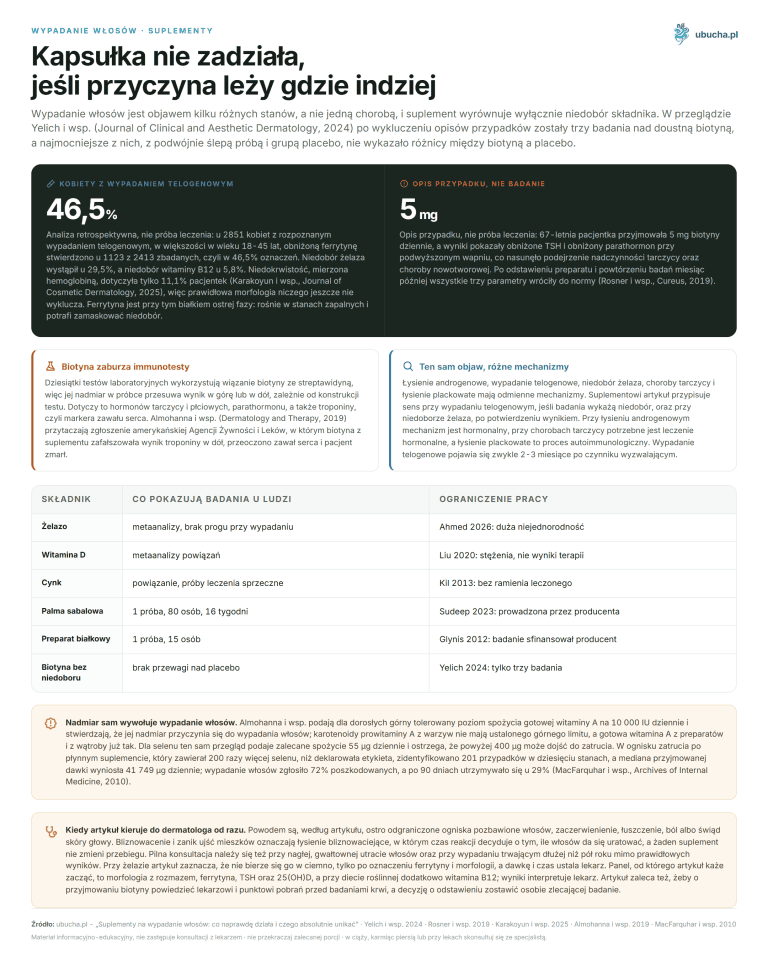
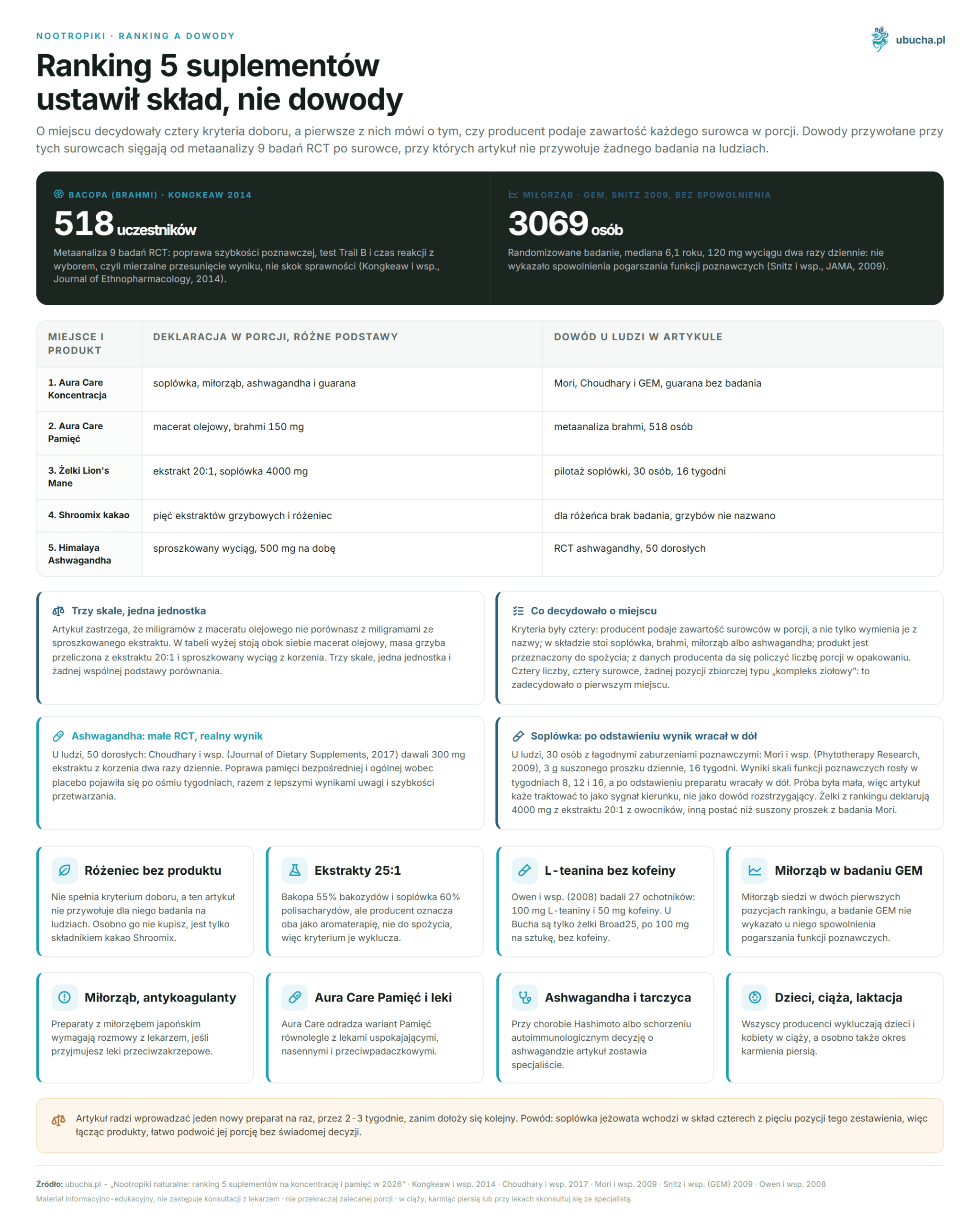
• A meta-analysis of 9 RCT studies with 518 participants showed that bacopa monnieri improved cognitive speed (Kongkeaw et al., Journal of Ethnopharmacology, 2014).
• The cost of supplementation per day in this ranking ranges from 0.70 PLN to 4.97 PLN.
• You cannot compare milligrams from oil macerate with milligrams from powdered extract.
• Rhodiola rosea is not available for purchase at u Bucha separately; it is only an ingredient in Shroomix cocoa.
What are natural nootropics and what can you expect from them?
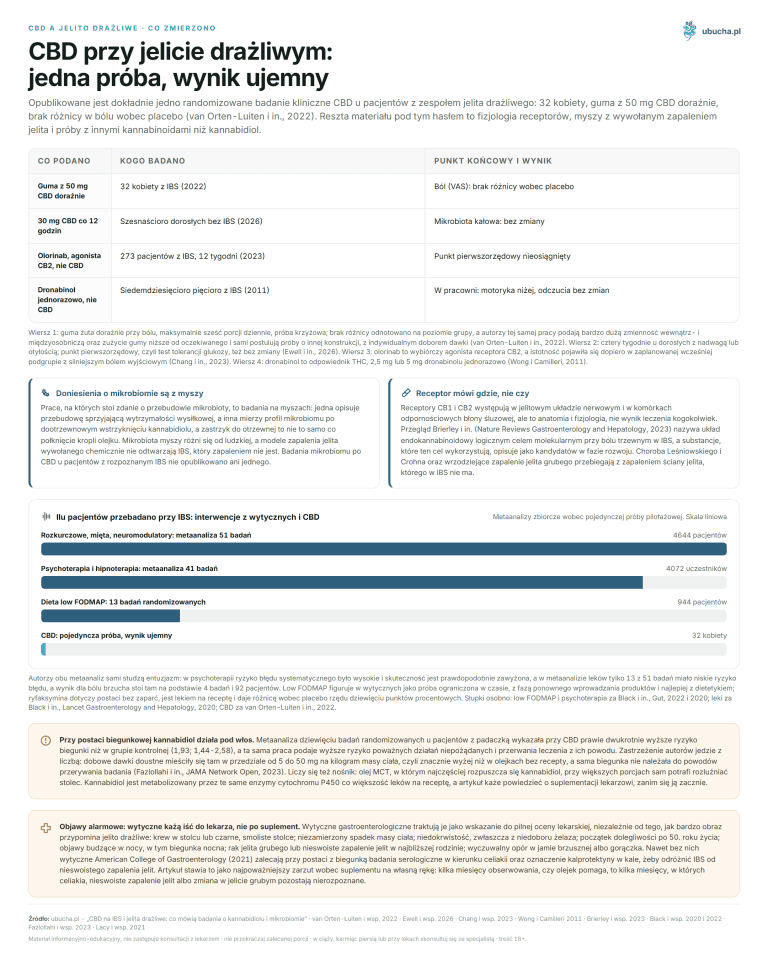
Natural nootropics are plant and mushroom raw materials that, in studies, show improvements in attention measurements or information processing speed. The scale of this improvement is moderate. A meta-analysis of nine randomized studies, involving 518 participants, showed that bacopa monnieri improved cognitive speed measured by the Trail B test and reaction time with choice (Kongkeaw et al., Journal of Ethnopharmacology, 2014). There is no mention of a leap in performance, only a measurable shift in the result.
This distinction determines whether you will be satisfied with supplementation. The most common cause of disappointment with nootropics lies not in the product, but in the expectation: a person takes a capsule, feels nothing after an hour, and concludes that the product is worthless. Meanwhile, none of the raw materials in this ranking is supposed to work within an hour. Ashwagandha in the cited study needed eight weeks, lion's mane also needed eight weeks, before the cognitive test result diverged from placebo.
The second thing worth establishing at the start: a nootropic is an addition to the conditions in which the brain operates, not a substitute for them. A person sleeping five hours and reaching for a memory supplement is addressing the effect rather than the cause. Sleep, movement, and regular meals do more for attention than any item in the table below. A supplement adds to this background, and only against such a backdrop can its impact be noticed.
How was this ranking created and what did we check in the compositions?
The ranking was created from a list of products actually available in the store, not from a list of popular substances. We reviewed the entire category of supplements and items outside of it that thematically fit concentration and memory. A total of 20 items emerged in the entire catalog, of which 15 are in the supplement category itself. From these twenty, we selected five.
There were four criteria. First, the manufacturer must provide the content of raw materials per serving, not just list them by name. Second, the composition must include a raw material with documented cognitive effects: lion's mane, brahmi, ginkgo biloba, or ashwagandha. Third, the product must be intended for consumption, which sounds obvious until you look at the labels. Fourth, the manufacturer's data must allow for the calculation of the number of servings in the package, because without this, there is no way to compare prices.
We noticed something that is not visible in a typical comparison: the two most concentrated extracts in the entire catalog, a 25:1 extract of bacopa and a 25:1 extract of lion's mane, are marked by the manufacturer as aromatherapy products and explicitly described as not intended for consumption. They appear to be ideal ranking positions but are not. A separate section will return to them below, as this is one of those pieces of information you won't find in the marketing description.
Which five supplements made it to the ranking?
The table below compares five preparations based on how directly and transparently their composition targets concentration and memory. Price did not determine the ranking position, but it is provided alongside, along with the cost of one day's use calculated from the manufacturer's recommendations.
| Place | Product | What distinguishes the composition | Price | Koszt doby |
|---|---|---|---|---|
| 1 | Aura Care Concentration, 60 capsules | Lion's mane 223 mg, ginkgo 223 mg, ashwagandha 179 mg, and guarana 75 mg per daily serving | 119.00 PLN | 3.97 PLN |
| 2 | Aura Care Adaptogens Memory, 15 ml | Brahmi 150 mg, plus lion's mane and ginkgo at 112.5 mg each, all caffeine-free | 99.00 PLN | approx. 3.81 PLN |
| 3 | Lion's Mane Mushroom Vegan Gummies, 60 pcs. | 4000 mg of lion's mane per serving, from a 20:1 extract of fruiting bodies, plus B vitamins | 78.97 PLN | 2.63 PLN |
| 4 | Shroomix, kakao funkcjonalne 240 g | Five mushroom extracts, alongside maca and rhodiola | 149.00 zł | 4.97 zł |
| 5 | Himalaya Ashwagandha, 60 tabletek | 250 mg of root extract in a tablet, which is 500 mg per day | 20.99 PLN | 0.70 PLN |
Prices come from the u Bucha store, status as of August 8, 2026. The catalog rotates, so check the current value on the page of the specific item in the category before purchasing. supplements.
How much does a day of such supplementation really cost?
The range is sevenfold: from 0.70 PLN to 4.97 PLN per day. This is the only number that allows for the comparison of capsules, drops, gummies, cocoa, and tablets in one row, as each of these forms has a different serving size and a different number of servings in the package.
The numbers were derived by dividing the price by the number of servings declared by the manufacturer. For capsules and tablets, this is straightforward: 60 pieces at a serving of two daily gives 30 days. For Aura Care Memory drops, the manufacturer states about 400 drops in a bottle and a ceiling of 15 drops per day, which gives just under 26 days at the highest allowed serving. If you take the lower recommended 6 drops, the package will last for over two months, and the cost per day will drop below two zlotys. That’s why the word "approx." is used in the table.
Why did multi-ingredient compositions take the top two spots?
Because both provide the content of each raw material separately, rather than hiding it under the name of a blend. Aura Care Concentration declares in the daily serving 223 mg of extract from lion's mane, the same amount of extract from ginkgo biloba, 179 mg of ashwagandha, and 75 mg of guarana seeds. Four numbers, four raw materials, no collective position like "herbal complex." This is rare in this category and it decided the first place.
Guarana is the only source of caffeine here, and it gives this preparation a daytime character. The manufacturer recommends one capsule in the morning and one in the early afternoon, or both at once during prolonged mental work. If you drink coffee, factor that caffeine into your daily balance, rather than treating the capsules as neutral.
The second place, Aura Care Adaptogens Memory, is built around brahmi in a dose of 150 mg, supplemented with lion's mane and ginkgo biloba at 112.5 mg each, along with sage and gotu kola. The entire formula is caffeine-free, which distinguishes it from its sister variant and makes it sensible for those who do not want caffeine in their supplement. Brahmi is the same as bacopa monnieri, for which a meta-analysis showed an improvement in cognitive speed, so the core of this composition is supported by research.
Practical note for both: the carrier is oil, so you cannot dissolve the drops in a drink. You hold them under your tongue for a minute, then swallow. The bottle needs to be shaken before use, as oil macerates separate, and a drop from the top of the bottle does not carry the same content as a drop from the middle.
When is it better to reach for gummies, cocoa, or tablets?
When the formula should fit the day, not the day to the formula. Lion's Mane Mushroom Vegan gummies took third place because they declare the highest dose of lion's mane in the entire ranking: 4000 mg per day, calculated from a 20:1 extract obtained from fruiting bodies, not from mycelium grown on grain. With functional mushrooms, this difference weighs more than the number itself.
Study Mori et al. (Phytotherapy Research, 2009) involved 30 people with mild cognitive impairments who took 3 g of dried lion's mane powder daily for 16 weeks. Cognitive function scores increased at weeks 8, 12, and 16, and after discontinuation of the preparation, they returned downwards. The trial was small, so treat this as a directional signal, not as conclusive evidence. The practical conclusion is clear: this is a preparation for continuous use, not for taking before an exam.
Shroomix in fourth place stands out for another reason: it is the only item in the entire catalog where you will find rhodiola rosea, alongside five mushroom extracts and maca. It costs the most per day, but replaces the morning drink rather than adding to it. Himalaya Ashwagandha closes the ranking and is a sensible choice here: one raw material, 500 mg of root extract per day, and a daily cost of 0.70 PLN. For starters, when you don't yet know how you react, a single-ingredient preparation tells you more than a mixture of five raw materials.
How to match a nootropic to your own goal?
Choose according to what you want to change, not according to the ranking position. The first position is first because it has the clearest and broadest composition, which does not mean it will be right for you. The following matches are based on declared compositions and manufacturer recommendations.
- Mental work during the day and you accept caffeine: Aura Care Concentration, 119.00 PLN, guarana in the composition.
- Memory and learning, without stimulation: Aura Care Adaptogens Memory, 99.00 PLN, caffeine-free formula based on brahmi.
- The highest dose of lion's mane and a convenient form: Lion's Mane Mushroom Vegan gummies, 78.97 PLN, 4000 mg per day.
- A substitute for morning coffee with adaptogens: Shroomix, 149.00 PLN, cocoa with five mushroom extracts.
- Affordable start and chronic stress: Himalaya Ashwagandha, 20.99 PLN, 500 mg of root extract daily.
For none of these goals should you choose a preparation for a week. Study Choudhary et al. (Journal of Dietary Supplements, 2017) involved 50 adults taking 300 mg of ashwagandha root extract twice daily. Improvement in immediate and overall memory compared to placebo appeared after eight weeks, along with better attention and processing speed results. Eight weeks is the minimum period after which assessment makes sense.
What you won't find in this ranking and why?
Four things that typical rankings remain silent about. The first is rhodiola rosea as a separate preparation. There is not a single product with rhodiola sold independently in the entire catalog: it only appears as an ingredient in Shroomix cocoa, alongside mushrooms and maca. A ranking that recommends rhodiola from this store recommends something that is not there.
The second is the two strongest extracts in the offer. The 25:1 extract of bacopa monnieri for 59.90 PLN and the 25:1 extract of lion's mane for 99.90 PLN have a standardization that the rest of the ranking can only dream of: 55% bacosides in the first, 60% polysaccharides in the second. However, the manufacturer marks both as products for aromatherapy and explicitly states that they are not intended for consumption. They have no place in the supplement ranking, although at first glance they appear to be its winners.
The third is L-theanine. The classic set of L-theanine with caffeine, tested by Owen et al. (Nutritional Neuroscience, 2008) on 27 volunteers with 100 mg of L-theanine and 50 mg of caffeine, improved speed and accuracy in a task of switching attention. At u Bucha, L-theanine is only found in Broad25 herbal gummies at 100 mg per piece, for 45.00 PLN, without caffeine in the composition. You can read more about the set itself in the post L-teanina i kofeina razem.
The fourth is honesty towards ginkgo biloba, which sits in the top two positions of the ranking. The GEM study (Snitz et al., JAMA, 2009) involved 3069 people taking 120 mg of extract twice daily for a median of 6.1 years and did not show a slowdown in cognitive function decline. You can find details in a separate post about ginkgo biloba.
How to safely combine these preparations?
The first rule sounds trivial and is often broken: one new preparation at a time, for 2-3 weeks, before adding a second. Without this, you cannot attribute either the effect or the ailment to a specific product. The second rule concerns the duplication of raw materials. Lion's mane is included in four out of five items in this ranking, so when combining two products, it is easy to double its dose without conscious decision.
Cautions provided by manufacturers are specific and worth knowing before purchase. Products with ginkgo biloba require a conversation with a doctor if you are taking anticoagulant medications. Aura Care advises against the Memory variant alongside sedatives, sleeping pills, and anticonvulsants. Ashwagandha modulates the work of the thyroid axis and the immune system, so in the case of Hashimoto's disease or an autoimmune condition, leave the decision to a specialist. All manufacturers exclude children and pregnant women, and separately also breastfeeding.
From our observations when comparing labels, one more thing emerges: the most common mistake is not a bad combination, but discontinuing supplementation in the fourth week. All studies cited in this text measured the effect after eight weeks or later. If you buy one package and assess its effectiveness, you are evaluating half the period in which anything was supposed to happen. Plan for two packages or don't start.
Frequently Asked Questions
Do natural nootropics really work?
Some of them have evidence from randomized studies, but the effects are moderate. A meta-analysis of nine RCT studies with 518 participants showed that bacopa monnieri improved cognitive speed, mainly reaction time with choice (Kongkeaw et al., Journal of Ethnopharmacology, 2014). This is a real measurable change, not a sudden boost in mental performance.
Which product from this list should you choose to start?
If you're starting and don't know how you react, begin with one raw material instead of a composition. Himalaya Ashwagandha costs 0.70 PLN per day and provides 500 mg of root extract daily, so a mistake is inexpensive. Leave multi-ingredient compositions for when you know your own reaction.
How long do you need to take a nootropic before you notice anything?
It depends on the raw material. Ashwagandha in the study by Choudhary et al. (2017) improved memory after 8 weeks at 300 mg twice daily. Lion's mane in the study by Mori et al. (2009) showed a measurable effect only in the 8th week and lost it after discontinuation. Plan for a quarter, not a week.
Why can't you compare these products by milligrams?
Because milligrams describe different things. 1500 mg of oil macerate is a raw material extracted in fat, 4000 mg from a gummy is the mass of the mushroom converted from a 20:1 extract, and 250 mg from a tablet is powdered root extract. Three scales, one unit, and no common basis for comparison.
Can you combine two products from this list?
Yes, but not from the first day and not blindly. Introduce one product for 2-3 weeks before adding a second. Be careful about duplicating raw materials: lion's mane is part of four out of five items in this ranking, so it's easy to accidentally double your dose.
Who should avoid these supplements?
Manufacturers exclude children, as well as pregnant and breastfeeding women. Products containing ginkgo biloba require a conversation with a doctor if you are taking anticoagulants. Aura Care Memory's manufacturer also advises against combining it with sedatives, sleeping pills, and antiepileptics. If you have thyroid disease or an autoimmune condition, leave the decision about ashwagandha to a specialist.
You can find the full range of products described in this ranking, along with current prices and compositions, in the category supplements, a szerszy kontekst o samych grzybach adaptogennych w osobnym wpisie o lion's mane.
This article is for informational and educational purposes and does not constitute medical advice. Before starting supplementation, consult your doctor, especially if you are taking medications regularly, are pregnant or breastfeeding, or have a chronic illness.
Author: Michał Waluk · Opublikowano: 2026-05-22 · Aktualizacja: 2026-08-08