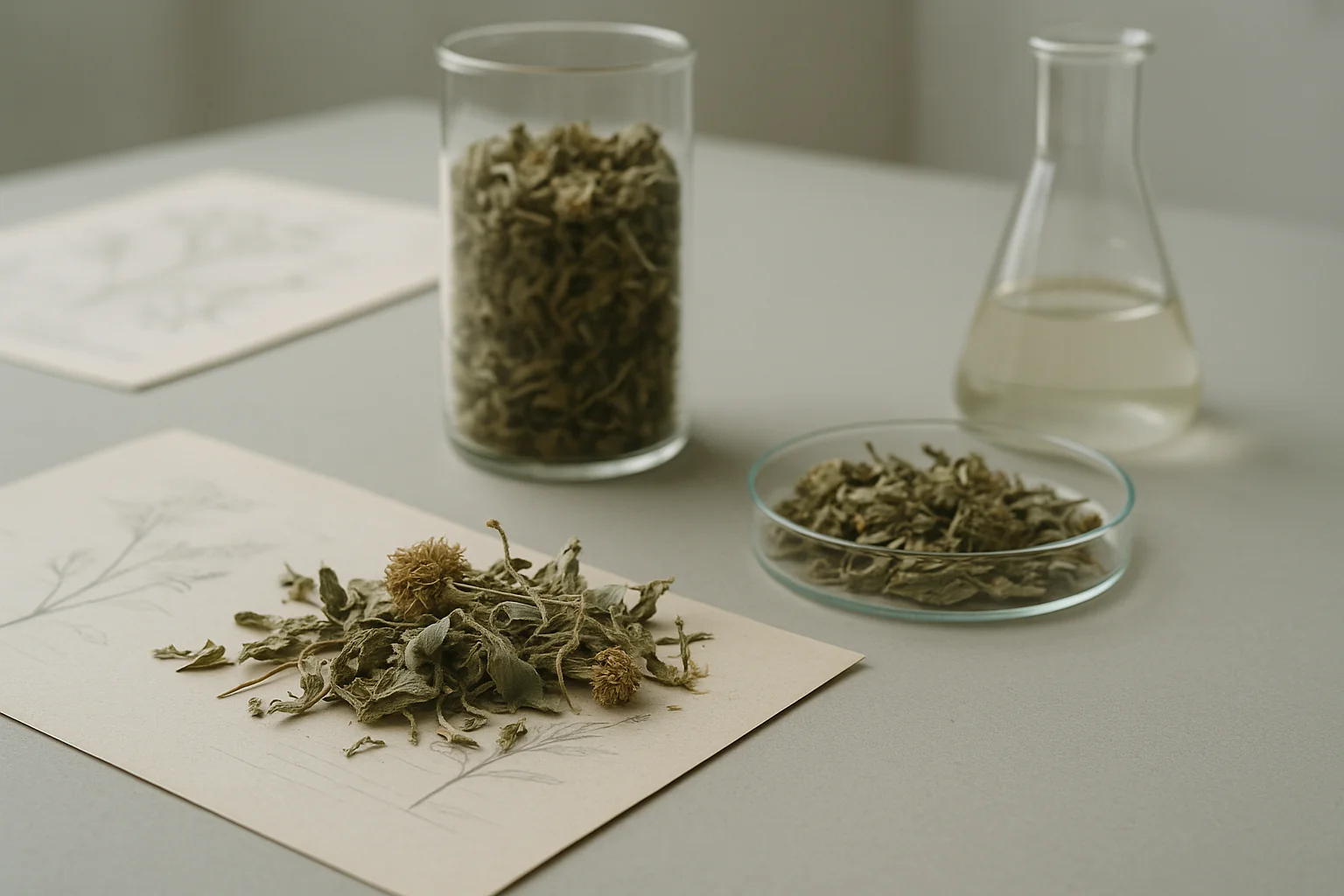

Masterpiece (Cannabis flos Four 20 Pharma): lineage from Cap Junky and a controversial profile
Masterpiece is a hybrid from Cap Junky and Platinum, which is managed by one producer in Polish pharmacies. Two sources provide different profiles for it. We describe the lineage, the declared concentration range, and what studies on limonene have not shown.
What is Masterpiece and where does this strain come from?
Masterpiece is a hybrid developed by the American breeder In House Genetics from a cross of Cap Junky and Platinum. The lineage has been established from the seed database, so the strain belongs to that part of the catalog where the parents can be identified by name, rather than just inferred from aroma similarity.
Two Polish services organizing the pharmaceutical catalog describe the same entry differently: one records it briefly as a hybrid, while the other adds an emphasis on indica-type strains. The difference concerns the label, not the measurement, as neither shows an analysis from which such an advantage would arise. Therefore, we leave both versions side by side and do not choose between them.
A lineage recorded by intuition creates false relationships, which is why we stick to what someone has published. In our compilation, we track 85 cultivars currently available in the Polish pharmaceutical market, and for 25 of them, no one knows the parents except the breeder. Masterpiece belongs to the opposite group: the cross is directly provided by the breeder and indexed in the seed database. Inferring from the name alone, for example, searching for relatives among entries with a similar component, leads nowhere.
Such a lineage record comes from the breeder's catalog, not from genetic testing of the batch that reaches the pharmacy. Between the seed described by the breeder and the dried flower in the package stands an entire cycle of cultivation and selection, which no one publicly documents. Therefore, the lineage indicates where the name came from and what cross stands behind it, but does not confirm that each batch corresponds to this description in terms of genetics.
Which producers supply Masterpiece to Polish pharmacies?
One. In the Polish pharmaceutical market, the entry under this name is exclusively handled by Four 20 Pharma, so there is no second version to compare it with. Four out of six strains from this producer in our compilation have no other supplier, and Masterpiece is one of them.
| Producer | Registered name without a numerical component | Declared THC content as a range | How does this version differ |
|---|---|---|---|
| Four 20 Pharma | Cannabis flos Four20 Pharma | 24,3-29,7% | the only version of this strain on the market, so there are no comparisons between producers |
One line here is the entire answer and carries information in itself. For strains handled by several producers, it is possible to compare declarations and see where they diverge. For this entry, there is nothing to compare, so every number in the table comes from a single data chain.
We provide the registered name without the numerical part intentionally. The number that the producer enters into the name is a declared value and is valid with an allowable deviation of ten percent in either direction, so quoted alone suggests a precision that does not exist. Hence the notation 24.3-29.7% instead of a single number, and what the label itself means is explained in the text about deklarowanej mocy suszu.
The composition of this table is not permanent. Licenses expire, wholesalers change supplies, and the producer can withdraw a single entry without notice, so a strain available in the pharmacy on Tuesday may be unavailable a month later. Those checking availability should look at the current overview of available strains, and not as of the date of this text. What else is listed in the catalog by the producer itself is described separately in the text about Four 20 Pharma.
How does this strain smell and taste?
Catalog descriptions adhere to three terms: sour, floral, and sweet. These are entries from a service organizing pharmaceutical assortments, not results from sensory evaluation, so they speak more about how the seller wants to set expectations than about what the patient will actually perceive upon opening the package.
The leading terpene in the description of this entry is limonene, the same compound responsible for the detectable citrus peel note in orange oils. However, the scent is not evidence of the composition in the other direction. The nose recognizes compounds present in trace amounts, while missing those that are most abundant in the dried flower, as some of them have no distinct aroma.
The taste during vaporization diverges from the scent from the package, as individual components evaporate at different temperatures, and the first draw carries a different set than the last. Therefore, the aroma description is often the least repeatable part of the strain's characteristics: it changes with the batch, with storage conditions, and with the equipment settings.
One thing cannot be inferred from the aroma description, namely the strength of effect. The citrus note does not predict either a milder or stronger experience, and attributing such a role to the scent is a mental shortcut that repeats in store descriptions without measurement backing.
How long does it take for the strain to take effect and how long does the effect last?
Just like any other dried flower of a similar form, as the course is determined by the method of administration, not the strain name. After vaporization, it counts in minutes; after ingestion, in hours. For Masterpiece itself, no one has measured this separately, and no publication provides such a measurement.
The route of administration determines the course more than the variety itself. After vaporization, the substance passes from the lungs to the blood almost immediately, so the first sensations appear after a few minutes, the intensity increases for another ten to thirty minutes, and the whole effect lasts for two to four hours. After ingestion, the raw material first passes through the intestine and liver, so the first sensations are awaited from half an hour to two hours, and the episode can last six, sometimes eight hours. Hence the most common mistake with oral administration: anyone who thinks nothing is happening after thirty minutes and takes another dose will receive both doses at once. The above ranges describe the route of administration, not this variety; pharmacokinetic studies for a single cultivar have not been published.
The declared THC content range of 24.3-29.7% is higher than the median upper limits in this catalog, which is around twenty-four percent. This does not change the moment when anything begins, nor does it extend the episode. However, it does change the amount of substance taken in the same volume of vapor, meaning it affects the intensity of the experience, not its duration.
What is known, and what is not known about the effects of this strain?
Not much, and not about the strain itself. No one has studied Masterpiece as a product, so the available evidence pertains to a single aromatic compound, limonene, and comes from studies on rodents. The rest of the description, including terms like relaxing, is catalog material, not a measurement result.
The profile composition is described for this item by two sources, and they differ in how many compounds they see in it. One lists four compounds: limonene, caryophyllene, linalool and myrcene. The second source only notes limonene. They agree on the leading component but differ on the rest of the profile, and we do not average this discrepancy.
We do not provide percentage shares because the bases calculate them relative to different totals: the sums in the same comparisons close at one time at forty-six percent, another time at eighty-three. Without a denominator, such a number looks like a measurement, but it is not.
The first of the studies collected in the evidence base for this project concerns mice (Vale et al., Phytomedicine 2002, PMID:12587690). Limonene administered intraperitoneally to mice showed muscle relaxant effects (rota-rod test) from a dose of 50 mg/kg and prolonged sleep induced by pentobarbital at a dose of 200 mg/kg (approximately 2.6 times); in the elevated plus maze test, already at a dose of 5 mg/kg, it reduced the number of entries into the open arms, which the authors described as an anxiogenic effect, not anxiolytic.
The second, much newer study includes pain and inflammation models (Fakhri et al., Behavioural Pharmacology 2025, PMID:40622197). Limonene reduced paw swelling induced by carrageenan in rats and pain responses in the formalin test in mice; the effect was associated with the l-arginine/nitric oxide/cGMP/KATP channel pathway and the involvement of opioid and benzodiazepine receptors.
The weight of this data is equal to its result. No anxiolytic effect of limonene has been demonstrated in humans. It has also not been shown that isolated limonene has anxiolytic effects in animals; the only available data from the elevated plus maze test showed an opposite effect in mice, reducing the number of entries into the open arms even at a low dose.
What side effects have been reported for this strain?
None, at least not in a form that could be attributed to the name. Polish pharmacotherapy safety supervision links reports to specific packaging and batch numbers, so there is no separate compilation for Masterpiece, and none will be created as long as data is collected in this manner, rather than by strain name.
Reports of adverse effects are collected for medicinal products with a batch number, not for the strain name, so the following pertains to hemp dried flower as a group of raw materials. The most frequently reported symptoms are dry mouth, red eyes, and increased heart rate. Dizziness upon rapid standing, daytime drowsiness, and temporary worsening of short-term memory are less frequently described, as well as anxiety that increases with dosage. A separate issue is medications taken concurrently, especially sedatives and those affecting coagulation: their assessment requires knowledge of the entire list of preparations, not just the description of the plant. We do not provide the frequency of these symptoms numerically, as public compilations for hemp dried flower in Poland do not separate them by individual products.
For this entry, there is a circumstance visible in the data itself: the range of 24.3-29.7% lies in the upper part of the catalog, and the aforementioned anxiety has been described as increasing with dosage. This does not change the nature of the symptoms. It changes the probability of someone encountering them with the same inhalation volume.
This list has one more limitation. It does not include rare events, as these only reveal themselves with a large number of reports, and public compilations for dried flower do not show such numbers broken down by individual entries. The absence of an entry is therefore not evidence that something does not exist.
What vaporizer setting is suitable for the limonene profile?
There is no single number that could be given as correct here. Limonene boils around 176 degrees Celsius, but the value on the vaporizer display describes the heating element or chamber, not the dried flower itself, so two devices set the same way may release a different set of components from the same portion.
The boiling temperature records for limonene collected in public chemical databases range between 175 and 178 degrees, depending on whether the measurement was converted from Fahrenheit and under what pressure it was taken. This discrepancy is small, but it shows how tables circulating on forums are created: different measurements of the same compound, compiled without citation.
From physics, it follows that components with lower boiling points evaporate earlier, while heavier ones remain in the chamber for higher settings. However, it does not follow that at 176 degrees anyone receives limonene in its pure form. The dried flower releases a mixture, and the proportions change with each subsequent inhalation from the same portion.
Where the differences between temperature tables come from and why the device setting is not the temperature of the dried flower, we break down in texts about the evaporation of terpenes oraz o tym, what the vaporizer really measures. A separate matter is dried flower available without a prescription, which is a different material than the pharmaceutical raw material described above.
Which strains are related to it?
None of those that are currently available in Polish pharmacies. Cap Junky and Platinum do not appear in the lineage of any other cultivar from our list, so the list of related strains is empty and remains empty even after checking both parents separately, not just the entire cross.
An empty list can be a valid result, not a gap in the data. Siblings arise when two cultivars share an identified parent. Broad style families, like haze or og kush, do not create such kinship because they are a category, not a single plant. Adding relatives based on intuition would create a graph that looks rich but corresponds to nothing.
Similarity in name does not replace lineage, as seen in the same list: the term kush is used by positions with completely different origins, some with established parents, some without any. Masterpiece has nothing to confuse with, as its name does not repeat in the catalog in any combination.
Instead of kinship, for this strain, we can show the proximity of composition. The leading limonene shares with it sixteen out of eighty-five items we manage, and that is a completely different relationship: a common aromatic component does not mean common parents. What has been demonstrated about limonene itself, and what has not, is collected in the text dedicated to this compound.
Frequently asked questions about the Masterpiece strain
Can Masterpiece be purchased in a pharmacy without a prescription?
No. Dried flower is issued only by a doctor's prescription, in the Rpw category, and the pharmacy fulfills the prescription for a specific registration position, not just the name of the strain.
How many producers supply Masterpiece to Polish pharmacies?
One. The strain under this name is handled in the Polish pharmaceutical market exclusively by Four 20 Pharma, so there is no second version to compare declarations.
What THC content does the producer declare for this strain?
The declared THC content is given as a range of 24.3-29.7%. The value on the label applies with an allowable deviation of ten percent in either direction, so a single number from the registration name is the midpoint of the range, not the result of measuring a specific batch.
Does limonene have anxiolytic effects in humans?
This has not been demonstrated. Available studies concern rodents, and in the elevated plus maze test, isolated limonene produced an effect opposite to calming in mice, even at a low dose.
Does Masterpiece have siblings among the strains available in Poland?
No. Cap Junky and Platinum do not appear in the lineage of any other cultivar from this list, so the list of related strains is empty, and an empty list is a result here, not a lack of data.
Why do descriptions of this strain differ between services?
Because they are based on different foundations. One service records the genetics as a hybrid, another adds indica dominance, and the terpene composition lists only one of them. None publish the raw analysis result, so it cannot be resolved from the outside.
Dried flower is a pharmaceutical raw material dispensed by prescription in the Rpw category, and this material is for informational purposes only and does not replace medical consultation. The editorial text was prepared by u Bucha editorial.