
Industrial hemp (fiber) - applications in industry and ecology
Industrial hemp — what it is, how it works, and its uses. A clear guide from u Bucha.
Hemp has been cultivated for thousands of years before it nearly disappeared from fields and factories for several decades due to anti-drug regulations in the 1930s and 1940s. Today, it is making a comeback - as a raw material for the textile, construction, automotive, cosmetics, and regenerative agriculture industries. Industrial hemp is not the same plant as marijuana in chemical and agronomic terms: it contains trace amounts of THC and is grown solely for fiber, seeds, and biomass. Below, we explain exactly what industrial hemp is, how it differs from drug cannabis, and what role it plays in modern industry and ecology.
KEY INFORMATION
• Industrial hemp (Cannabis sativa L.) contains less than 0.3% THC - the limit set by EU regulation 1307/2013 (EUR-Lex) - and has no intoxicating potential.
• One hemp plant provides three raw materials simultaneously: bast fiber (from the outer layer of the stem), hurds (from the inner layer), and seeds (from the flower clusters).
• Hemp absorbs an estimated 8-15 tons of CO₂ per hectare in one growing season, more than typical deciduous forests when calculated per unit area and time (EIHA, Hemp - a Real Green Deal).
• Cultivation of industrial hemp in Poland is legal after obtaining permission from the provincial marshal and using varieties from the EU list of certified varieties.
What are industrial hemp and how do they differ from marijuana?
Industrial hemp and marijuana belong to the same botanical species - Cannabis sativa L. The difference between them is chemical, not biological in a taxonomic sense. Industrial hemp is varieties selected over decades for low THC content (below 0.3%) and high fiber or seed productivity. Marijuana consists of varieties bred for high THC content - sometimes 20-30% or more in the dry mass of flower buds.
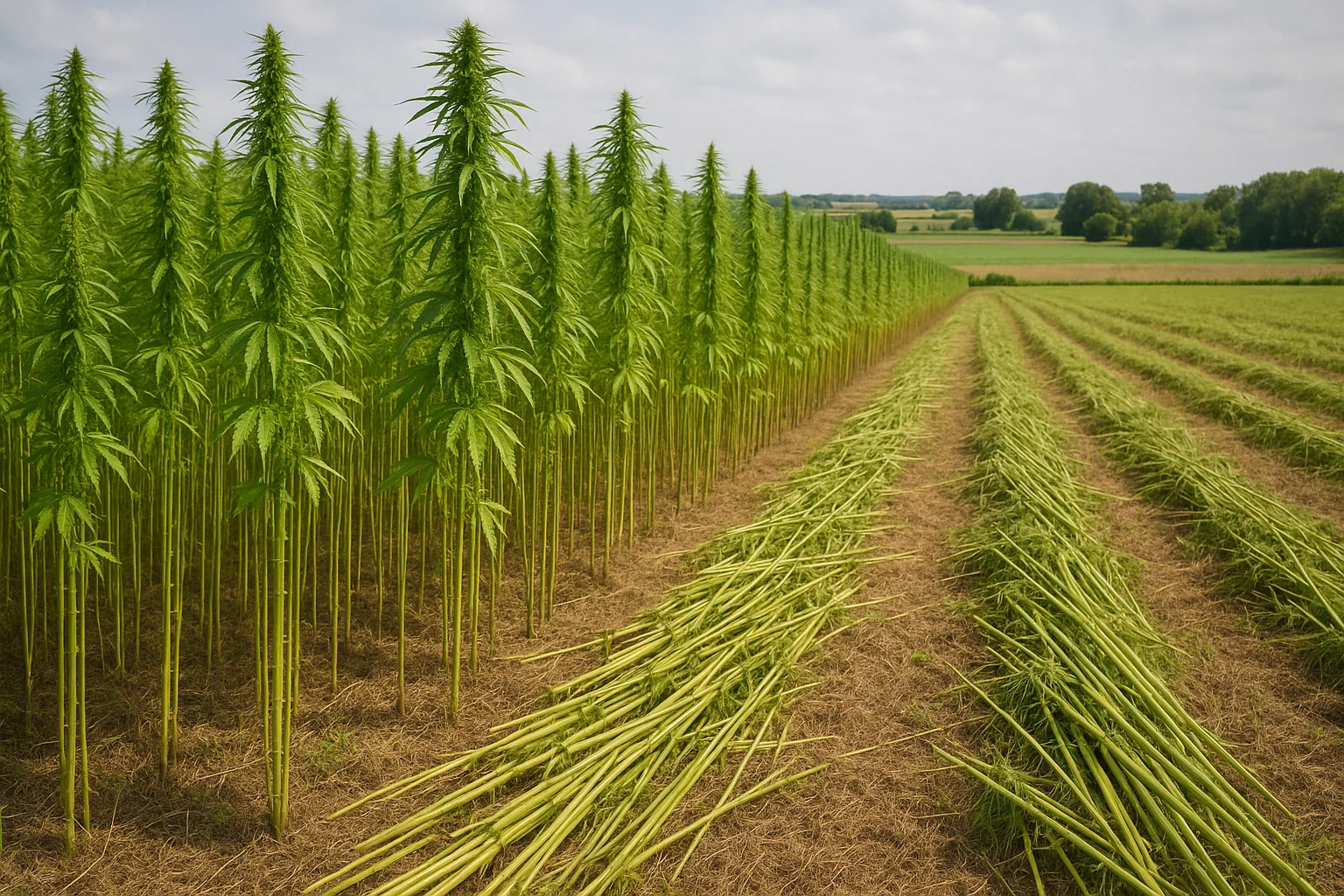
Morphologically, industrial hemp is usually taller (up to 4-5 meters), slimmer, and less branched than drug varieties. It is grown densely - several dozen plants per square meter - which promotes vertical growth and the production of long, straight fibers. Drug cannabis is grown with large spacing to stimulate flowering and the production of THC-rich resin. These different agronomic strategies are visibly apparent in the field.
In the EU legal system, industrial hemp is subject to Regulation 1307/2013, which allows its cultivation provided that certified varieties from the EU list are used and the 0.3% THC limit is met. Poland implements these regulations through the Act on Counteracting Drug Addiction, which requires the registration of plantations with the provincial marshal. Unregistered cultivation or cultivation with varieties not on the list is illegal regardless of THC content.
Three raw materials from one plant: fiber, hurds, and seeds
The uniqueness of industrial hemp lies in the fact that one plant simultaneously provides three useful raw materials with different applications. This makes hemp one of the most efficient raw material crops.
Bast fiber comes from the outer layer of the stem - the bark. It is long (up to several dozen centimeters), durable, and flexible. It is used to produce fabrics (clothing, bedding), ropes, bags, fishing nets, geotechnical mats, and composite materials. Hemp fiber is stronger than cotton and linen while requiring less water and pesticides in cultivation.
Hurds are the woody inner part of the stem, remaining after the extraction of bast fiber. They have a spongy structure, with high porosity and water absorption capacity. They are used as bedding for livestock, raw material for producing hempcrete, building insulation, and bioplastics. Hurds also have potential as a raw material for producing cellulose for paper.
Hemp seeds (technically: seeds) are rich in protein (about 25% by weight), omega-3 and omega-6 fatty acids in a favorable 3:1 ratio, as well as vitamins and minerals. From the seeds, hemp oil is pressed (used in cooking and cosmetics) and hemp flour, hemp protein powder, and other food products are produced. The seeds and products made from them do not contain significant amounts of THC - they are safe and legal throughout the EU.
| Part of the plant | Raw material | Main applications |
|---|---|---|
| Stem - outer layer | Bast fiber | Fabrics, ropes, composite materials, geotextiles, paper |
| Stem - inner layer | Hurds | Hempcrete, building insulation, animal bedding, bioplastics |
| Flowering tops and leaves | Biomass, CBD (hemp varieties) | CBD extraction, biogas, green fertilizer |
| Seeds (grain) | Grain, oil, protein | Food, edible oil, cosmetics, supplements |
| Roots | Biomass, phytoremediation | Improvement of soil structure, removal of heavy metals from soil |
Hemp in construction: hempcrete and insulation
One of the most promising applications of industrial hemp in recent years is eco-friendly construction. The key product is hempcrete - a bio-composite building material created by mixing hemp hurds with hydraulic lime and water. The mixture is relatively easy to mold - it can be poured into forms or pressed into ready blocks.
Hempcrete is not a load-bearing material - walls made of hempcrete require a wooden or steel frame structure. However, as a filling and insulation, it offers several advantages: it regulates humidity (breathes), is resistant to mold and fungi, has a low thermal conductivity (good thermal insulation), and actively absorbs CO₂ during the mineralization of lime. It is estimated that hempcrete walls can absorb more CO₂ over decades of building use than was emitted during the production of the materials (Ip, Miller, Construction and Building Materials, 2012).
In addition to hempcrete, hurds are used to produce insulation mats (instead of mineral wool or polystyrene), pressed bricks, and acoustic panels. Hemp fiber is used as reinforcement in cement composites and as insulation for roofs and floors. Several European building material manufacturers - particularly in France, Germany, and the UK - offer ready-made building systems based on hemp.
Hemp in automotive and industry - lightweight composite materials
The automotive industry has discovered hemp as an alternative to fiberglass in composite materials. Hemp fiber mats are used to reinforce interior panels, dashboards, trunk components, and door casings. Manufacturers such as BMW, Mercedes-Benz, Volkswagen, Ford, and Audi have been using natural fibers - including hemp - in their vehicles since the late 1990s.
The advantages of hemp fiber over fiberglass in automotive applications include: lower weight (an important factor for fuel efficiency), comparable or higher mechanical strength per unit weight, a lower carbon footprint in production, and the possibility of biodegradation or composting at the end of the vehicle's life cycle. At the same time, hemp is easier to process mechanically and does not pose issues with silica dust, which is a health hazard when working with fiberglass.
Beyond automotive, hemp-resin composites have found applications in boat manufacturing, sports equipment (e.g., surfboards), musical instruments, and industrial packaging. Bioplastics made from hemp fiber and biodegradable resins represent a growing niche for applications where mechanical strength is required alongside the ability to dispose of without burdening the environment with microplastics.
Ecological role of hemp: CO₂ sequestration and phytoremediation
Industrial hemp is increasingly viewed as a tool in the fight against climate change and environmental degradation. Two mechanisms are particularly significant here: carbon dioxide sequestration and soil phytoremediation.
Hemp grows very quickly - it reaches full height in four to five months and produces huge amounts of biomass. Estimates from the European Industrial Hemp Association (EIHA) indicate an absorption of 8-15 tons of CO₂ per hectare in one growing season. This is comparable to the absorption by young, rapidly growing deciduous forests, achieved much faster and on agricultural soils that can simultaneously be farmed (EIHA, Hemp - a Real Green Deal). When hemp is processed into hempcrete or durable wood products, the absorbed carbon is stored in them for decades.
Phytoremediation is the ability of plants to absorb pollutants from soil and water. Hemp has shown the ability to accumulate heavy metals - lead, cadmium, nickel - from contaminated soil. The most dramatic example is the use of hemp for the remediation of areas after the Chernobyl disaster in the 1990s: hemp plantations were planted in contaminated fields to absorb radioactive cesium and strontium. The plants were disposed of as radioactive waste after harvesting, and the soil showed a reduced level of contamination. This method, although costly in disposal, demonstrates the potential of hemp as a tool for environmental cleanup.
Frequently Asked Questions
What are industrial hemp and how do they differ from marijuana?
Industrial hemp (Cannabis sativa L.) refers to varieties cultivated for fiber, seeds, or biomass, containing less than 0.3% THC in dry mass according to the requirements of EU Regulation 1307/2013 (EUR-Lex). Indian and drug varieties of Cannabis sativa are cultivated for high THC content. The difference is chemical and agronomic - the same species of plant, different cultivation goals, and different cannabinoid profiles.
What is hemp fiber used for?
Hemp fiber is used for the production of fabrics, ropes, bags, geotextiles, paper, and fiber-reinforced composite materials (in the automotive and construction industries). BMW, Mercedes-Benz, and Volkswagen use hemp mats in vehicle interior panels due to their favorable strength-to-weight ratio and lower carbon footprint compared to fiberglass.
What is hempcrete and how is it used?
Hempcrete is a bio-composite building material made from hemp hurds, hydraulic lime, and water. It is used as an insulating and filling material in frame constructions - not as a load-bearing material. Hempcrete regulates humidity, is resistant to mold, and actively absorbs CO₂ during the mineralization of lime for decades of use (Ip, Miller, Construction and Building Materials, 2012).
How much CO₂ do industrial hemp plants absorb?
Industrial hemp absorbs an estimated 8-15 tons of CO₂ per hectare during one growing season lasting four to five months. This makes it one of the most efficient plants for carbon dioxide absorption among cultivated plants. When materials made from it (hempcrete, composites) are durable, the absorbed carbon is stored in them for decades (EIHA, Hemp - a Real Green Deal).
Do industrial hemp plants improve soil structure?
Yes. Hemp has a deep and strong root system that aerates the soil and improves its structure. A large biomass of leaves and small branches left after harvesting enriches the soil with organic matter. Hemp is also used in phytoremediation - absorbing heavy metals from contaminated soil, as confirmed by experiences from the Chernobyl area in the 1990s.
Is industrial hemp cultivated in Poland?
Yes. The cultivation of industrial hemp in Poland is legal after obtaining permission from the provincial governor and using certified varieties from the EU list with THC below 0.3%. The area of industrial hemp cultivation in Poland is steadily increasing, driven by the demand for CBD, technical fiber, and hemp seeds. Poland has a tradition of cultivating fiber hemp that dates back hundreds of years.
This article is for informational and educational purposes and does not replace consultation with a doctor. If you are pregnant, breastfeeding, taking medications, or have chronic conditions, consult the use of supplements or herbs with a specialist.
Author: Michał Waluk · Published: 2026-05-04 · Updated: 2026-05-04