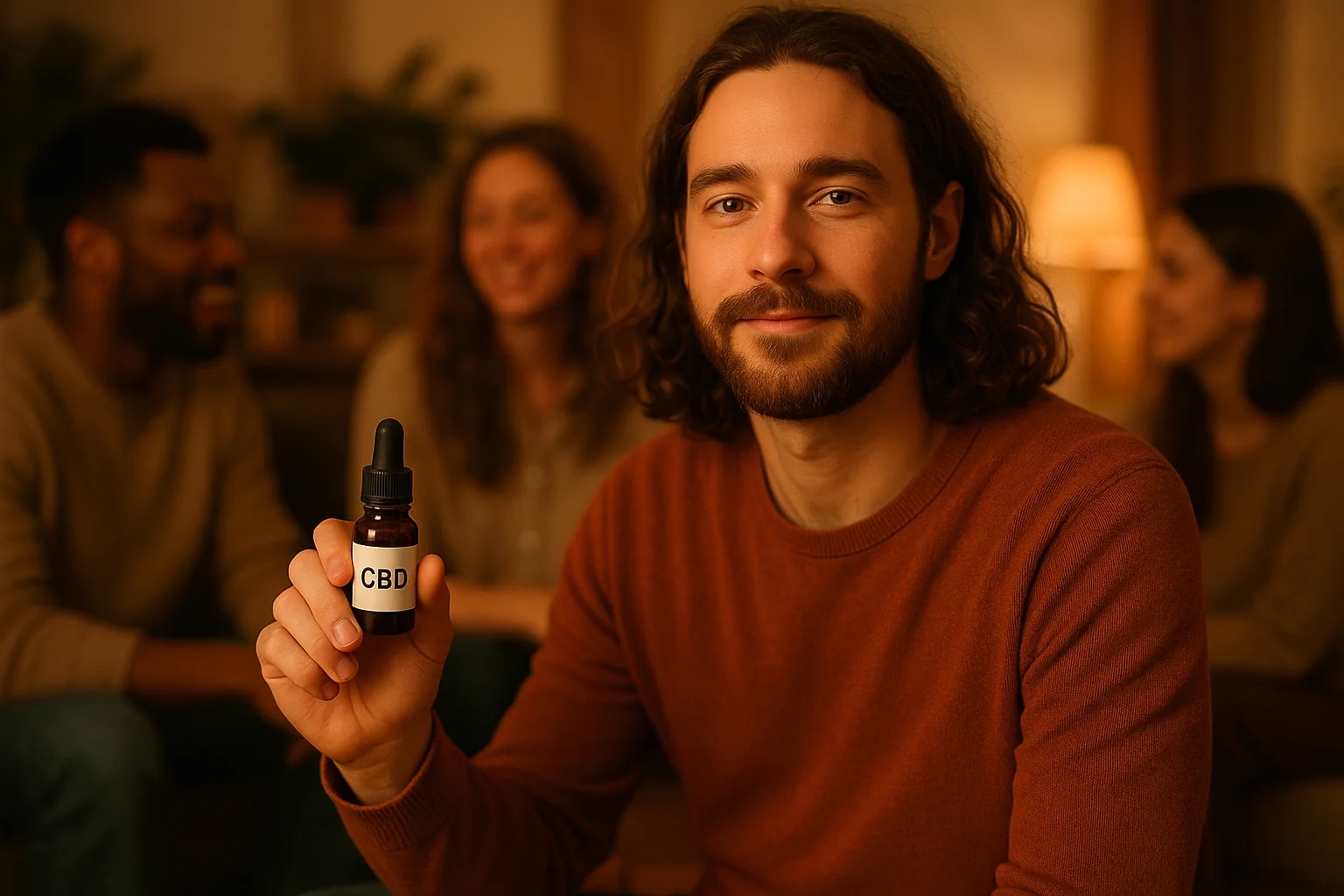

CBD and social phobia and social anxiety - what does research say (FAQ)
CBD and social phobia and social anxiety: answers to frequently asked questions and what research says. u Bucha.
Social Anxiety Disorder (SAD) is one of the most common anxiety disorders - affecting about 7% of the population during their lifetime and ranking third among the most common mental disorders in the world (Stein et al., Dialogues in Clinical Neuroscience, 2017). Individuals with SAD avoid social situations or experience them with intense fear of judgment, humiliation, and criticism. Research on CBD in the context of social anxiety provides promising results - with important caveats that we explain below.
KEY INFORMATION
• The Bergamaschi study (2011, Neuropsychopharmacology) showed that 600 mg of CBD significantly reduced anxiety during a simulated public speaking task in individuals with SAD compared to placebo.
• The Linares study (2018) confirmed the strongest anxiolytic effect at a dose of 300 mg - both lower and higher doses were less effective (U-shaped curve).
• CBD is not an approved medication for social phobia - standard treatment for SAD is CBT and SSRIs.
• CBD modulates the activity of the amygdala and the 5-HT1A receptor - key structures for regulating anxiety.
• CBD may interact with psychotropic medications (SSRIs, benzodiazepines) - medical consultation is necessary.
What is social phobia and why is it difficult to treat?
Social phobia is more than just shyness. It is an anxiety disorder in which social situations - conversations, presentations, eating in public, meeting new people - provoke an disproportionate fear of negative evaluation. The amygdala, brain structures responsible for the fear response, shows hyperactivity to social stimuli in individuals with SAD (Fusar-Poli et al., Neuropsychopharmacology, 2009).
The standard treatment for SAD is a combination of cognitive-behavioral therapy (CBT) and pharmacotherapy - usually SSRIs (e.g., escitalopram, sertraline) or SNRIs (venlafaxine). CBT therapy is effective but requires significant commitment and access to a qualified therapist. SSRIs take effect only after 2-6 weeks of regular use and have a profile of side effects (nausea, sexual dysfunction, insomnia in the first weeks). Many patients seek complementary methods - and it is in this context that CBD has gained interest.
What do clinical studies say about CBD and social anxiety?
Research on CBD in the context of SAD is promising but still limited in scale and methodology. Here are the key findings:
The study by Bergamaschi et al. from 2011 (Neuropsychopharmacology) is one of the groundbreaking ones. They assessed the effect of a single dose of 600 mg of CBD or placebo in 24 patients diagnosed with SAD, who were to perform a simulated public speech. The CBD group showed significantly lower subjective anxiety, lower cognitive tension, and less physiological discomfort compared to the placebo group - and comparable results to the group of healthy volunteers (Bergamaschi et al., Neuropsychopharmacology, 2011).
The study by Linares et al. from 2018 (Frontiers in Pharmacology) went a step further - comparing doses of 150, 300, and 600 mg of CBD with placebo in healthy volunteers subjected to the Trier Social Stress Test. The results showed that the 300 mg dose reduced anxiety most effectively - both lower (150 mg) and higher (600 mg) doses yielded weaker results, suggesting a complex, non-linear dose-effect relationship (Linares et al., Frontiers in Pharmacology, 2018).
An important methodological note: both study groups used single very high doses of CBD (300-600 mg) in laboratory conditions. Most CBD supplements available on the market contain 10-50 mg daily. Extrapolating results from high-dose studies to daily supplementation with low doses is methodologically incorrect - and often overlooked in popular articles about CBD for stress.
What is the mechanism of CBD's action on anxiety - what happens in the brain?
CBD is not a drug with a single, simple mechanism of action. In the context of social anxiety, three main pathways are significant:
5-HT1A serotonin receptor
CBD acts as a partial agonist of the 5-HT1A receptor - the same one that buspirone (an anxiolytic) and partially SSRIs act on. Activation of 5-HT1A has anxiolytic and antidepressant effects. This is one of the main mechanisms through which CBD may reduce anxiety without direct sedative action (Blessing et al., Neurotherapeutics, 2015).
Amygdala and the fear response
The neuroimaging study by Fusar-Poli et al. (2009) showed using fMRI that CBD reduces amygdala activation in response to emotionally charged images, particularly those expressing fear and anger. In individuals with SAD, the amygdala is hyperactive - CBD may dampen this hyperactivity (Fusar-Poli et al., Neuropsychopharmacology, 2009).
The Endocannabinoid System and Fear Extinction
The ECS plays a key role in the process of extinguishing fear memory - a therapeutic mechanism of CBT. CBD, by inhibiting the FAAH enzyme (which breaks down anandamide), indirectly increases the level of anandamide, which enhances the fear extinction process. This suggests that CBD may act synergistically with psychotherapy (Rabinak et al., Neuropsychopharmacology, 2013).
| Study | CBD Dose | Outcome | Limitations |
|---|---|---|---|
| Bergamaschi et al. (2011) | 600 mg in a single dose | Reduction of anxiety during public speaking vs placebo | Small sample (24 people), single dose |
| Linares et al. (2018) | 150, 300, 600 mg | Najsilniejszy efekt przy 300 mg - krzywa U | Healthy volunteers, not SAD patients |
| Fusar-Poli et al. (2009) | 600 mg in a single dose | Reduction of amygdala activity (fMRI) | Only neuroimaging, no clinical symptoms |
| Crippa et al. (2011) | 400 mg in a single dose | Reduction of subjective anxiety and changes in brain perfusion | Small pilot study |
CBD interactions with medications used for SAD
Social phobia is often treated pharmacologically - SSRIs, SNRIs, and in short-term situations, benzodiazepines. CBD inhibits the CYP3A4 and CYP2D6 enzymes, which metabolize many of these medications. In practice, this means that CBD may raise or lower the concentration of the drug in the blood, altering its effect and side effect profile (Brown & Winterstein, Pharmacy, 2019).
Examples of particularly significant interactions: escitalopram and sertraline (SSRIs) - CBD may increase their concentration, enhancing side effects. Alprazolam and diazepam (benzodiazepines) - CBD may enhance their sedative effects. Aripiprazole and quetiapine (atypical antipsychotics used as adjuncts) - CBD may increase their concentration to potentially dangerous levels.
Combining CBD with psychotropic medications requires consultation with a psychiatrist - not a pharmacist at the checkout. Changes in drug concentration can lead to a relapse of anxiety or a paradoxical intensification of symptoms if the drug concentration decreases, or to side effects if the concentration increases.
Frequently Asked Questions
Can CBD reduce social anxiety?
Clinical studies suggest that yes - at appropriate doses. Bergamaschi et al. (2011) showed that 600 mg of CBD significantly reduced anxiety during a simulated public speaking event in patients with SAD vs placebo (Neuropsychopharmacology, 2011). Note: the doses used in studies (300-600 mg) are significantly higher than typical supplements (10-50 mg/day).
What doses of CBD were used in studies on social anxiety?
Studies used single doses of 150-600 mg. The Linares study (2018, Frontiers in Pharmacology) showed the strongest anxiolytic effect at 300 mg - lower (150 mg) and higher (600 mg) doses were less effective, suggesting a U-shaped dose-response relationship. Typical daily CBD supplements contain 10-50 mg and have less well-documented clinical efficacy.
How does CBD affect the brain during social situations?
CBD reduces the activity of the amygdala and the anterior cingulate gyrus - brain structures responsible for the fear response. Fusar-Poli et al. (2009) demonstrated this using fMRI: CBD suppresses the hyperreactivity of the amygdala to emotional stimuli (Neuropsychopharmacology, 2009). In individuals with SAD, this hyperactivity is one of the biological underpinnings of the disorder.
Can CBD be used for social phobia instead of medication?
No - CBD is not an approved medication for SAD and should not replace therapy. Standard treatment is CBT and SSRIs with proven clinical efficacy. CBD may only be considered as a supplement, after consultation with a psychiatrist. Self-treating social phobia with CBD instead of proven therapy delays effective treatment and may intensify isolation.
How quickly does CBD work for social anxiety?
With sublingual oil, the first anxiolytic effects may appear after 15-45 minutes. SSRIs require 2-6 weeks of regular use. However, taking CBD "before the event" is a strategy less well-documented than regular supplementation - clinical studies mainly concerned single high doses in the lab, not daily low supplementation in real social situations.
Can CBD increase anxiety?
In some individuals, yes - especially at excessively high doses or products with trace amounts of THC. The Linares study (2018) suggested that the 600 mg dose was less effective than 300 mg, indicating a possible paradoxical effect at excessive doses. THC, even in low concentrations, can increase anxiety in predisposed individuals - choose broad-spectrum products or CBD isolate if you are sensitive to THC.
CBD and SSRIs - how do they differ in the context of social anxiety?
SSRIs (escitalopram, sertraline) are approved medications for SAD with numerous studies confirming clinical efficacy. CBD does not have the status of a drug for SAD. SSRIs take effect after 2-6 weeks, have a side effect profile. CBD acts faster, has fewer interactions, but less well-documented efficacy. These are not interchangeable products - CBD does not replace SSRIs, it can only complement them after consultation with a doctor.
Who should not use CBD for social phobia?
CBD requires special caution or is contraindicated in: individuals taking psychotropic medications metabolized by CYP450 (SSRIs, benzodiazepines, antipsychotics), during pregnancy and breastfeeding, under 18 years of age, and with a history of psychosis or strong predisposition to psychosis (THC in full-spectrum products may exacerbate psychotic symptoms). Always consult with a psychiatrist before incorporating CBD into SAD treatment.
This article is informational and educational in nature. It contains internal links to products available in the u Bucha store. Prices and specifications may change - please check the current data on the product page before purchasing.
Author: Michał Waluk · Published: 2026-05-04 · Updated: 2026-05-04