
Coenzyme Q10 and male fertility - improves semen, but does it affect pregnancies?
Coenzyme Q10 and male fertility: a reliable answer based on research. u Bucha.
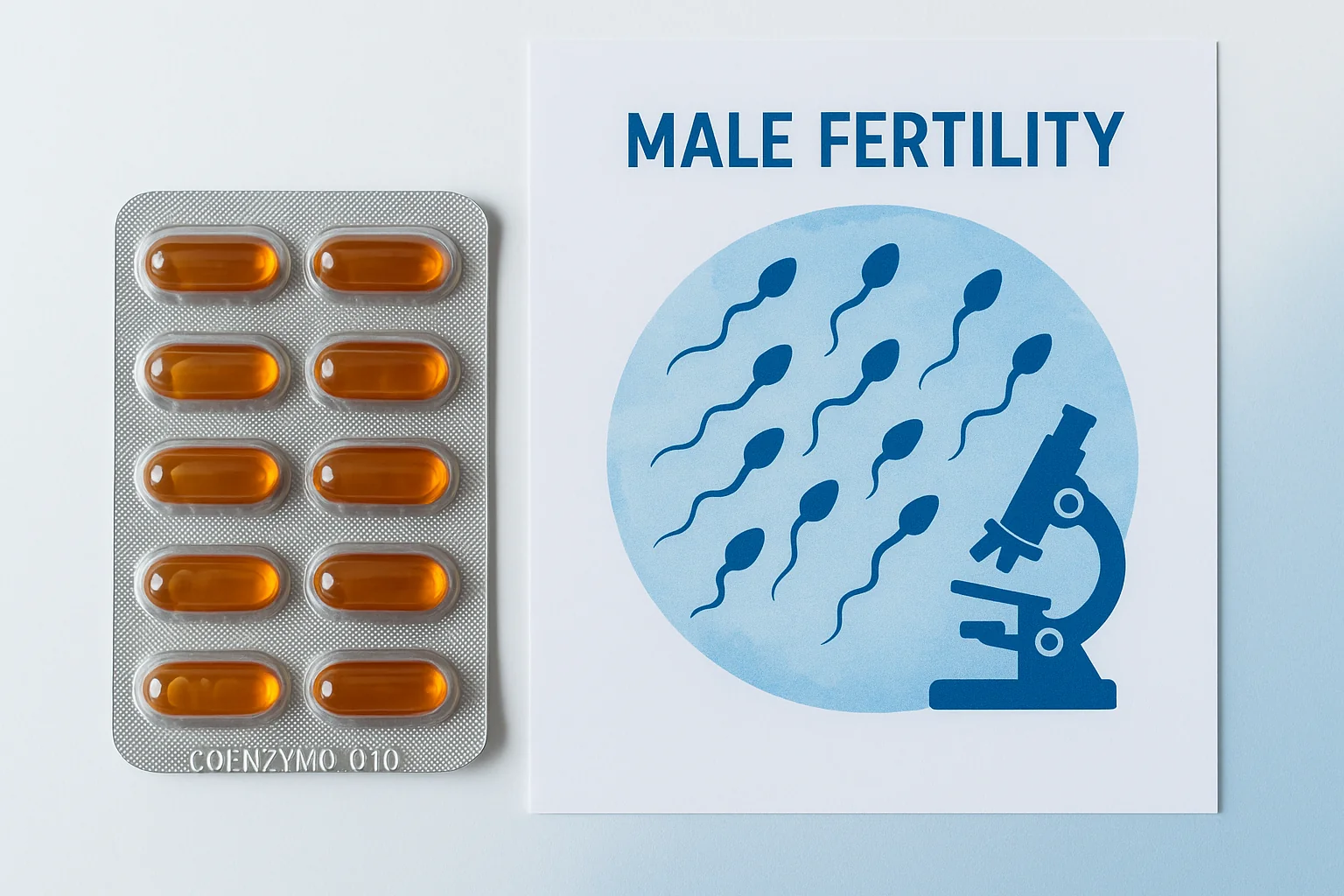
Coenzyme Q10 regularly comes up in discussions about male infertility - and not without reason. A meta-analysis of six randomized controlled trials showed a significant improvement in sperm motility and concentration after Q10 supplementation (Lafuente et al., Andrologia, 2013). This is promising. However, there is a significant "but": most of these studies measured semen parameters in the lab, not what really interests couples trying to conceive - whether pregnancies occur. This article honestly separates these two levels of evidence.
KEY INFORMATION
• A meta-analysis of 6 RCTs (Lafuente et al., 2013) showed a significant improvement in sperm motility and concentration with Q10 200-300 mg/day.
• Oxidative stress in semen affects 30-80% of infertile men - Q10 acts as a mitochondrial antioxidant in sperm.
• Effects on semen parameters appear after at least 3 months - this is how long a full spermatogenesis cycle takes.
• There is a lack of large RCTs with pregnancy as the primary endpoint - this is a key gap in the evidence base.
• Ubiquinol (reduced form) is better absorbed than ubiquinone - particularly important for men over 40.
Why does Q10 have a biological rationale in the context of male fertility?
Sperm is a cell with an exceptionally high energy demand. The movement of the tail - responsible for active motility - directly depends on ATP production in mitochondria located in the midpiece of the sperm. Coenzyme Q10 is an essential cofactor in the respiratory chain (transfers electrons between complexes I/II and III) and is also the only lipophilic antioxidant of mitochondrial membranes (Balercia et al., Fertil Steril, 2009).
Oxidative stress in semen is one of the best-documented mechanisms of idiopathic male infertility. Reactive oxygen species (ROS) damage the lipid membranes of sperm, the DNA of spermatocytes, and flagellar proteins, reducing motility and fertilization capacity. It is estimated that elevated levels of ROS in semen affect 30-80% of infertile men, depending on the diagnostic criteria (Agarwal et al., Hum Reprod, 1994).
Q10 is naturally present in sperm at high concentrations - higher levels of Q10 in semen correlate with better motility parameters. This suggests that replenishing its levels in case of deficiency may unlock mitochondrial bioenergetics of the flagellum. Therefore, it is not about 'sperm doping', but about removing energy constraints.
What do clinical studies say about semen parameters?
The most important synthesis of evidence is the meta-analysis by Lafuente and colleagues published in Andrologia (2013), including 6 RCTs with a total of 251 men with oligoasthenospermia or idiopathic asthenozoospermia. Results: Q10 supplementation (200-300 mg of ubiquinone or 100-200 mg of ubiquinol daily) significantly improved progressive motility and total sperm concentration compared to placebo. The effect on morphology was smaller and statistically inconsistent between studies (Lafuente et al., 2013).
The longest and largest single RCT in this meta-analysis is the Balercia study (2009, n=60, 6 months, 300 mg/day). It showed a significant increase in Q10 in semen, an improvement in motility of about 15-20%, and a reduction in oxidative stress markers compared to placebo. The effects reversed after discontinuation of supplementation, suggesting that Q10 must be used continuously during the attempt to conceive.
We noted that studies on Q10 and fertility are small and last 3-6 months, while a full assessment of the supplement's effectiveness on fertility requires tracking couples for at least a year or until pregnancy. Researchers choose semen laboratory parameters as endpoints because they are quicker and cheaper to measure. This is methodologically justified but clinically disappointing - as a couple trying to conceive wants to know about pregnancies, not motility.
Does the improvement in semen parameters translate to pregnancies?
This is a fundamental question - and here the evidence base clearly falls short. Semen parameters are surrogate endpoints, not clinical ones. An improvement in sperm motility of 15% may or may not translate into a higher pregnancy rate, as fertilization depends on dozens of factors: egg quality, fallopian tube function, endometrium, ovulation precision, and female factors.
The only study attempting to directly answer the question about pregnancies is the study by Safarinejad and colleagues (2012, n=212). It showed a higher clinical pregnancy rate in the Q10 group (34.1%) vs placebo (20.7%) after 26 weeks of supplementation (Safarinejad et al., Arch Med Sci, 2012). However, pregnancy was not the primary endpoint of the study, and the methodology has limitations - including a lack of blinding in pregnancy assessment. The result is encouraging but requires confirmation in well-designed RCTs with pregnancy as the primary outcome.
Currently, two larger European studies are underway with pregnancy as the primary endpoint. Until their completion, the fair answer is: Q10 consistently improves laboratory parameters of semen - but direct evidence of a higher pregnancy rate is still incomplete.
Q10 form matters: ubiquinone vs ubiquinol
Coenzyme Q10 exists in two redox forms. Ubiquinone (CoQ10) is the oxidized form - cheaper and more common in supplements. Ubiquinol (CoQH2) is the reduced form - biologically active and better absorbed. A pharmacokinetic study showed that after administering 150 mg of ubiquinol, the concentration of Q10 in plasma increased 3-4 times faster than after the same dose of ubiquinone in middle-aged men (Hosoe et al., Regulatory Toxicology and Pharmacology, 2007).
Practical implication: for men under 35, the difference in bioavailability is smaller - the enzymes converting ubiquinone → ubiquinol work efficiently. Above 40, the conversion ability decreases, and ubiquinol has a clear advantage in absorption. If you are choosing a Q10 supplement for fertility and are over 40 - the ubiquinol form is a justified choice.
How long and when to use Q10 when trying to conceive?
Spermatogenesis - the complete cycle of creating a new sperm - takes about 72-90 days. Therefore, the minimum sensible supplementation time is 3 months before the planned attempt at fertilization or assisted reproductive procedure (IUI, IVF/ICSI). Studies lasting 6 months yield more consistent results than 3-month ones, suggesting that longer supplementation provides better cumulative effects.
The supplement should be taken with a meal containing fats - Q10 is lipophilic and absorbs significantly better with fat than on an empty stomach. Daily regularity is more important than precise timing throughout the day.
Q10 in the context of a comprehensive supplementation protocol for fertility
Q10 is rarely used in isolation for male infertility - it is most often part of a broader antioxidant protocol. Oxidative stress in semen is multifactorial, and no single antioxidant addresses all its sources. Therefore, researchers are increasingly testing combinations of supplements.
Zinc and selenium are cofactors of superoxide dismutase (SOD) and glutathione peroxidase - antioxidant enzymes active in sperm. Zinc deficiency correlates with low concentration and motility of sperm in population studies. Vitamin E is a lipophilic membrane antioxidant - it protects polyunsaturated fatty acids of the flagellum from lipid peroxidation. Vitamin C (hydrophilic) neutralizes ROS in the liquid fraction of semen. Folic acid (B9) is essential for DNA synthesis in spermatocytes - its deficiency increases sperm DNA fragmentation (Boxmeer et al., Fertil Steril, 2009).
How does Q10 fit into this ecosystem? Its role is primarily mitochondrial and membrane-related - it protects mitochondrial membranes of the flagellum and fuels ATP production. It is complementary, not replaceable by other antioxidants. The Safarinejad study (2012) used Q10 in monotherapy and showed an effect - suggesting that Q10 alone has real value - but combined protocols (Q10 + vitamin E + selenium + zinc) may provide a broader effect through synergy of mechanisms.
An important note regarding total dosage: when using multiple antioxidants simultaneously, there is a risk of a paradoxical pro-oxidative effect at very high doses - excess antioxidants can oxidize each other, creating radicals. The principle of 'more = better' does not apply in antioxidantology. Clinically studied doses (Q10 200-300 mg, vitamin E 400 IU, selenium 200 µg, zinc 66 mg) are safe - but doubling or tripling these doses without medical indications is not recommended.
Frequently Asked Questions
Does coenzyme Q10 improve semen parameters?
Yes - a meta-analysis of 6 RCTs (Lafuente et al., Andrologia, 2013) showed a significant improvement in progressive motility and concentration with 200-300 mg of Q10 daily for 3-6 months. The improvement in morphology was smaller and less consistent. The effect mainly concerns men with idiopathic asthenozoospermia or elevated oxidative stress in semen (Andrologia, 2013).
Does the improvement in semen parameters after Q10 translate into pregnancies?
Direct evidence is incomplete. One study (Safarinejad et al., 2012) showed a higher pregnancy rate (34% vs 21%) with Q10, but pregnancy was not the primary endpoint. Most RCTs measured laboratory parameters of semen - not pregnancies. The lack of large studies with pregnancy as the main outcome is a key gap (Safarinejad et al., 2012).
What dose of Q10 is used in fertility studies?
Studies used 200-300 mg of ubiquinone or 100-200 mg of ubiquinol daily for 3-6 months. Ubiquinol absorbs 3-4 times better - particularly significant in men over 40. Take the supplement with a fatty meal. Effects appear after a minimum of 3 months (the full spermatogenesis cycle).
Why is Q10 important for sperm?
Q10 is a cofactor of the mitochondrial respiratory chain in the sperm flagellum - without it, ATP production decreases and motility declines. At the same time, as an antioxidant, it protects lipid membranes and DNA from oxidative stress, which affects 30-80% of infertile men (Balercia et al., 2009).
Is Q10 safe for men planning to have a child?
Yes - a good safety profile up to 1200 mg/day. Occasional side effects: nausea, headache. Interaction with warfarin (may weaken its effect) - consultation with a doctor is necessary when using anticoagulants. No evidence of teratogenicity. Standard doses of 200-300 mg are safe for men planning parenthood.
This article is for informational and educational purposes and does not replace consultation with a doctor. If you are pregnant, breastfeeding, taking medications, or have chronic conditions, consult the use of supplements or herbs with a specialist.
Author: Michał Waluk · Published: 2026-05-04 · Updated: 2026-05-04