
Caffeine tolerance - does it stop working and how to reset it
Caffeine tolerance: a reliable answer based on research. u Bucha.
Do you remember your first espresso? Now you drink three coffees and barely feel a difference. It's not your imagination - it's neurochemistry. Regular caffeine consumption causes adaptation of adenosine receptors in the brain, gradually weakening the stimulating effect (Fredholm et al., Pharmacol Rev, 1999). The good news: tolerance is reversible. The bad news: resetting involves several difficult days of withdrawal symptoms. This article explains the mechanism of tolerance, how to conduct an effective reset, and how to maintain sensitivity after returning to caffeine.
KEY INFORMATION
• Caffeine loses its effect due to upregulation of A1 and A2A adenosine receptors - the brain compensates for the blockage by creating more receptors (Fredholm et al., 1999).
• Resetting tolerance requires 9-14 days of complete abstinence from caffeine.
• WHO has recognized caffeine withdrawal syndrome as a diagnostic unit (ICD-11, F15.03) - symptoms last 2-9 days.
• Gradual dose reduction before quitting alleviates withdrawal symptoms, especially headaches.
• Cyclical use (e.g., 5 days with caffeine, 2 without) helps maintain sensitivity after a reset.
How does the brain build tolerance to caffeine?
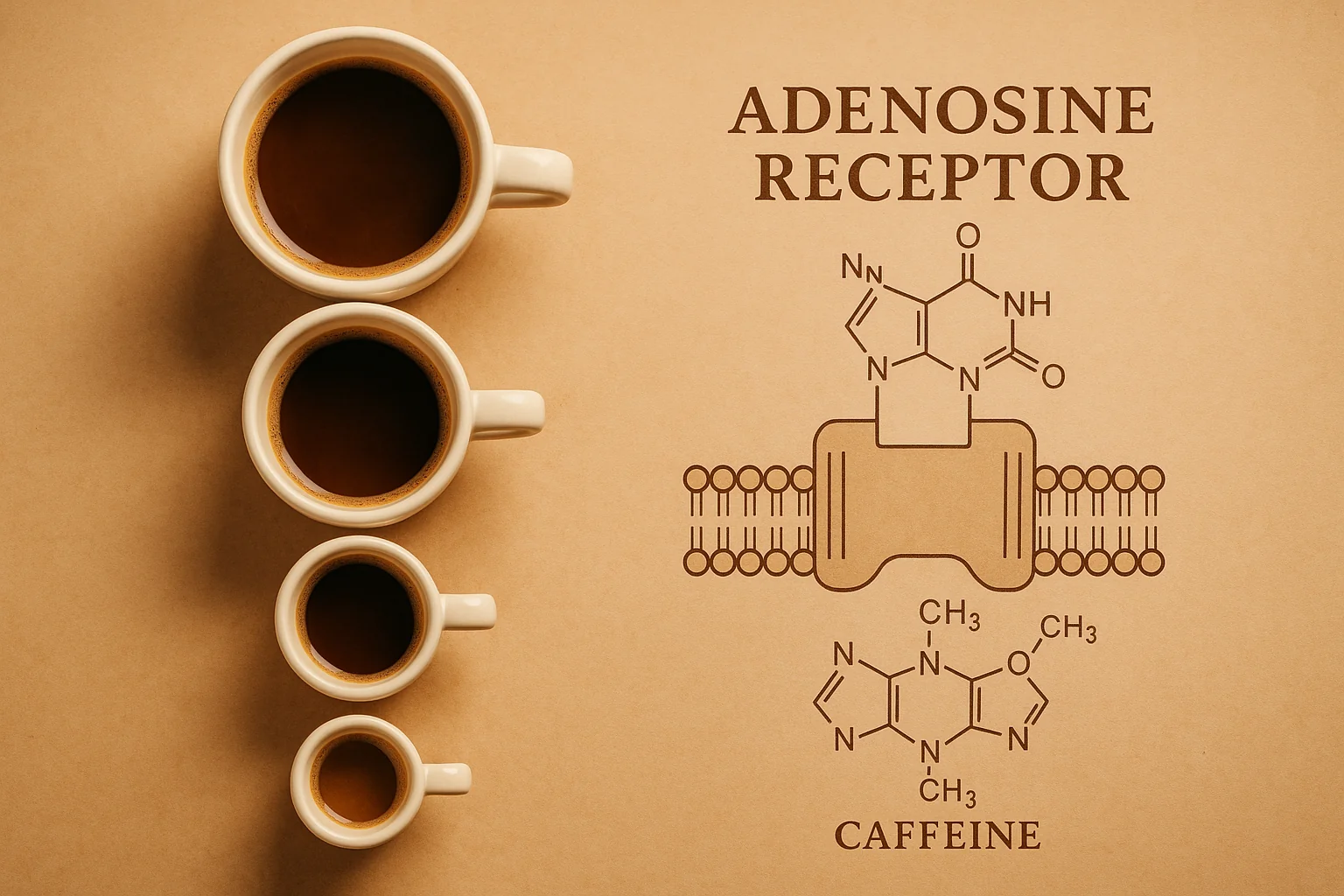
Caffeine is an antagonist of adenosine receptors - it blocks them instead of activating them. Adenosine is an endogenous 'fatigue' neurotransmitter that accumulates in the brain during wakefulness and induces drowsiness. Caffeine, by binding to the same receptors (mainly A1 and A2A), prevents adenosine from acting - hence the feeling of stimulation and alertness.
The problem arises with regular use. The brain is an adaptive organ. When adenosine receptors are chronically blocked by caffeine, neurons interpret this as a 'deficit of adenosine' and compensate by increasing the number of adenosine receptors - a phenomenon known as upregulation or sensitization (Fredholm et al., Pharmacol Rev, 1999). After upregulation, the same dose of caffeine blocks a smaller percentage of receptors - the stimulating effect weakens. At the same time, when caffeine is absent (e.g., in the morning before coffee), the excess adenosine receptors are now all available for adenosine - hence the strong morning drowsiness and the 'need for coffee' to function normally.
This distinguishes caffeine tolerance from tolerance to opioid-like substances. With caffeine, it's not about down-regulating the receptors of caffeine itself, but about up-regulating adenosine receptors. The mechanism is more subtle - and that's why the reset is relatively quick (days, not months).
How quickly does tolerance build?
The rate of tolerance development depends on the dose and frequency of consumption. Studies show that partial tolerance to the stimulating effects of caffeine appears after just 1-4 days of regular high-dose consumption (400-600 mg daily) (Evans & Griffiths, Psychopharmacology, 1992). With moderate consumption (200-400 mg daily, typical for the average European), full tolerance to stimulating effects and mood impact develops within 1-2 weeks of regular use.
Importantly: tolerance is not uniform across all effects of caffeine. The effect on blood pressure and heart rate diminishes relatively quickly (2-4 days). The diuretic effect habituates after about 4 days. However, the improvement in focus and cognitive effects retain some effect even with established tolerance - although they are weakened compared to individuals who consume caffeine infrequently.
In practice, we have noticed that individuals 'addicted' to caffeine often no longer feel any stimulation from coffee - they drink it solely to eliminate withdrawal symptoms and 'feel normal'. This is a classic paradox: caffeine has ceased to provide benefits and only offers normalization after a previous deficit caused by the last dose. The reset breaks this cycle.
Caffeine withdrawal syndrome - what to expect during the reset?
The WHO included caffeine withdrawal syndrome as a separate diagnostic unit in the ICD-11 classification (effective since 2022) (F15.03), reflecting the prevalence and clinical significance of symptoms (WHO ICD-11, 2022). Symptoms typically appear 12-24 hours after the last dose of caffeine and include:
Headache - the most common symptom, affecting 40-80% of individuals withdrawing from caffeine. Mechanism: adenosine acts vasodilatorily in the brain - its sudden unopposed activity causes dilation of cerebral blood vessels and pulsating pain. Fatigue and drowsiness - the effect of unblocking excess adenosine receptors. Irritability, difficulty concentrating, and low mood - cognitive effects and mood-modulating effects of caffeine. Nausea - less common, with withdrawal from very high doses.
Peak symptoms occur 20-51 hours after the last dose. Complete resolution: usually 2-9 days, less often up to 14 days with very long and high consumption (Juliano & Griffiths, Psychopharmacology, 2004). If symptoms last longer than 14 days - it is advisable to consult a doctor and rule out other causes.
| Withdrawal Phase | Time | Typical symptoms | What helps |
|---|---|---|---|
| Early | 12-24 h po ostatniej dawce | Headache, fatigue, irritability | Hydration, ibuprofen/paracetamol for headache, rest |
| Peak | 20-51 h | Severe headache, drowsiness, low mood | Good sleep, avoiding mental effort, magnesium |
| Waning | 3-9 dni | Gradual alleviation of symptoms, better sleep quality | Regular sleep schedule, caffeine-free tea |
| Full reset | 9-14 dni | Normalization of caffeine sensitivity | Pierwsza kawa po resecie - efekt jak dawniej |
How to conduct an effective caffeine reset?
There are two main strategies: abrupt withdrawal and gradual reduction. Abrupt withdrawal is quicker - the reset ends after 9-14 days. However, the symptoms are stronger, especially headaches in the first 2-3 days. This method works well for individuals with moderate consumption (up to 3 coffees a day) and strong motivation.
Gradual reduction involves decreasing the daily caffeine dose by about 10-25% every 7 days until reaching about 50 mg (one small coffee or weak green tea), followed by complete withdrawal for 7-10 days. Symptoms are significantly milder. This method is preferred for high consumption (4+ coffees a day), a strong history of migraines, and for those whose work requires full mental capacity every day.
In both cases: stay well-hydrated (dehydration exacerbates headaches), ensure regular sleep, and plan the reset during a less intense work period - the first 2-3 days are not a good time for an important presentation or exam.
How to maintain caffeine sensitivity after the reset?
After a successful reset, the first coffee tastes and works like it did in school days. How to avoid going back to square one? The answer lies in cyclicity. A study by Griffiths et al. showed that individuals consuming caffeine cyclically (5 days a week, 2 breaks) maintain higher sensitivity than those consuming it daily over a 10-week observation period (Griffiths et al., J Pharmacol Exp Ther, 1990).
Practical protocols for maintaining sensitivity: weekend abstinence (Mon-Fri with caffeine, Sat-Sun without), a monthly mini-reset (3 weeks with caffeine, 1 week without), or the "stop when the effect fades" principle - when you notice that coffee stops working, take a 3-day break instead of reaching for another cup.
Frequently Asked Questions
Why does caffeine stop working the same way over time?
Caffeine blocks adenosine receptors A1 and A2A. With regular use, the brain compensates for this blockade by increasing the number of adenosine receptors (upregulation). The same dose of caffeine now blocks a smaller percentage of receptors - the stimulating effect weakens. This is a neurochemical adaptation, not tolerance like with opioids - which is why the reset is relatively quick (Fredholm et al., 1999).
How long does it take to reset caffeine tolerance?
Caffeine sensitivity returns within 9-14 days of complete abstinence. 7 days is the minimum threshold for subjective improvement; 14 days provides a safe margin. Gradual dose reduction before complete withdrawal extends the reset by 1-2 weeks but significantly alleviates withdrawal symptoms (Juliano & Griffiths, 2004).
What are the symptoms of caffeine withdrawal and how long do they last?
The WHO recognized caffeine withdrawal syndrome as a diagnostic unit (ICD-11, F15.03). Symptoms appear after 12-24 hours and include headaches (40-80% of individuals), fatigue, irritability, and difficulty concentrating. Peak: 20-51 hours. Complete resolution: 2-9 days. Paracetamol/ibuprofen and good hydration alleviate headaches.
Can tolerance be reset without complete abstinence?
Yes - gradual reduction of 10-25% every 7 days to about 50 mg daily, followed by complete withdrawal for 7 days. The reset effect is similar, and withdrawal symptoms are significantly milder. Particularly recommended for migraines, high consumption (4+ coffees a day), and important professional commitments during the reset.
How to maintain caffeine sensitivity after the reset?
Cyclic use: weekend abstinence (Sat-Sun without caffeine), monthly mini-reset (3 weeks with caffeine, 1 week without), or a 3-day break at the first signs of a fading effect. Griffiths' study (1990) showed that regular breaks maintain higher sensitivity in a 10-week observation compared to daily consumption (Griffiths et al., 1990).
This article is for informational and educational purposes and does not replace consultation with a doctor. If you are pregnant, breastfeeding, taking medications, or have chronic conditions, consult the use of supplements or herbs with a specialist.
Author: Michał Waluk · Published: 2026-05-04 · Updated: 2026-05-04