
Peptydy kolagenowe vs kolagen: czy jest różnica (tabela)
Peptydy kolagenowe to kolagen hydrolizowany do 2000-5000 Da. Tabela porównuje cztery formy oraz siedem preparatów ze sklepu i koszt 10 g kolagenu.
Peptydy kolagenowe, kolagen hydrolizowany, kolagen natywny, UC-II. Na etykietach stoją cztery nazwy, a tylko dwie z nich opisują to samo. Metaanaliza 26 badań z randomizacją obejmująca 1721 osób wykazała, że hydrolizowany kolagen poprawia nawilżenie i elastyczność skóry wobec placebo (Pu i in., Nutrients 2023). Kolagen natywny takiego zaplecza nie ma, bo cząsteczka o masie 300 000 Da nie przechodzi przez ścianę jelita w całości. Różnica między tymi dwiema nazwami sprowadza się do jednego zabiegu technologicznego, a rozstrzyga o tym, czy preparat w ogóle ma szansę zadziałać. Poniżej znajdziesz tabelę czterech form, drugą tabelę z siedmioma preparatami kolagenowymi dostępnymi w sklepie u Bucha, koszt 10 g kolagenu w każdym z nich oraz sprawdzone źródło przy każdej liczbie.
KLUCZOWE INFORMACJE
• Metaanaliza 26 badań z randomizacją (1721 osób) potwierdza poprawę nawilżenia i elastyczności skóry po hydrolizowanym kolagenie (Pu i in., Nutrients 2023).
• Peptydy kolagenowe i kolagen hydrolizowany to dwie nazwy tego samego surowca: fragmentów o masie 2000-5000 Da.
• Wszystkie siedem preparatów kolagenowych w katalogu sklepu to hydrolizat, żadnego UC-II ani kolagenu natywnego tam nie ma.
• Koszt 10 g kolagenu rozpina się od 3,97 zł do 45,02 zł, czyli ponad jedenastokrotnie.
• Kolagen jest białkiem wyłącznie zwierzęcym, więc wersja wegańska nie istnieje.
Czym różnią się peptydy kolagenowe od zwykłego kolagenu?
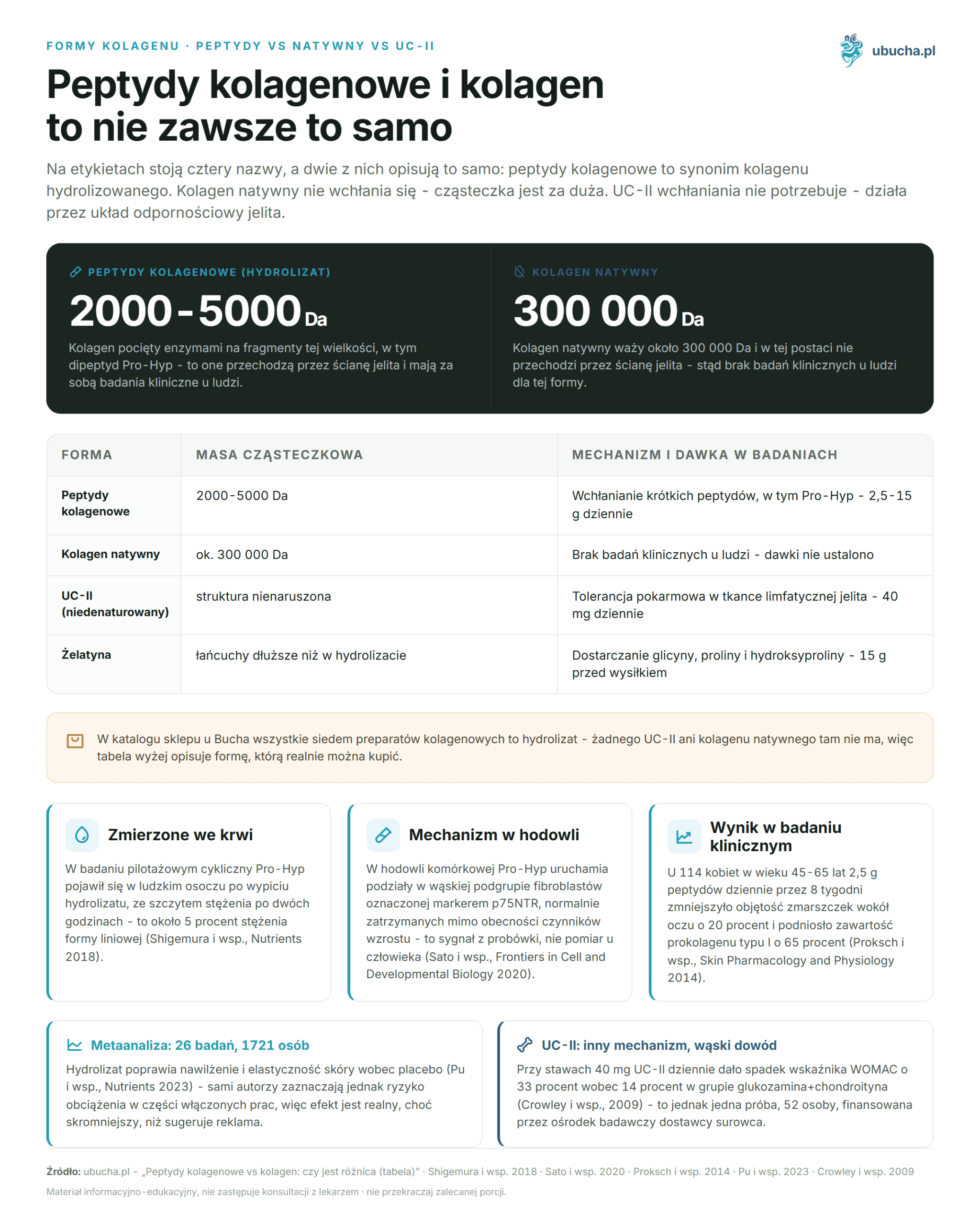
Peptydy kolagenowe to ten sam kolagen, pocięty enzymami na fragmenty o masie 2000-5000 Da. Kolagen natywny waży około 300 000 Da i w tej postaci nie przechodzi przez ścianę jelita. Hydroliza jest jedyną różnicą w surowcu, a zmienia wszystko, co dzieje się z preparatem po połknięciu.
Nazwy handlowe mieszają się na etykietach do tego stopnia, że producent wypisujący obok siebie „kolagen hydrolizowany” i „peptydy kolagenowe” nie podaje żadnej dodatkowej informacji. To synonimy. Żelatyna jest kolagenem rozłożonym termicznie, o łańcuchach dłuższych niż w hydrolizacie. Osobno stoi UC-II, czyli kolagen typu II celowo pozostawiony w formie niezdenaturowanej, bo jego działanie opiera się na rozpoznaniu przez układ odpornościowy, nie na wchłanianiu aminokwasów.
Tabela poniżej zestawia cztery formy według cech, które da się sprawdzić na etykiecie.
| Forma | Masa cząsteczkowa | Na czym opiera się działanie | Dawka w badaniach |
|---|---|---|---|
| Peptydy kolagenowe (hydrolizat) | 2000-5000 Da | Wchłanianie krótkich peptydów, w tym Pro-Hyp | 2,5-15 g dziennie |
| Kolagen natywny | około 300 000 Da | Brak badań klinicznych u ludzi | nie ustalono |
| UC-II (niedenaturowany typ II) | struktura nienaruszona | Tolerancja pokarmowa w tkance limfatycznej jelita | 40 mg dziennie |
| Żelatyna | łańcuchy dłuższe niż w hydrolizacie | Dostarczanie glicyny, proliny i hydroksyproliny | 15 g przed wysiłkiem |
Który preparat kolagenowy ze sklepu ma najwięcej kolagenu w porcji?
Najwięcej deklaruje Aura Care Collagen Moc Piękna: 12 000 mg peptydów kolagenu rybiego w porcji 25 ml. Najmniej ma Esencja Kolagenowa, czyli 733 mg w porcji liczonej na 40 kropli. Wszystkie siedem preparatów w katalogu to hydrolizat, bo natywnego kolagenu ani UC-II sklep nie prowadzi.
Same miligramy nie wystarczą do porównania, bo opakowania mają różną liczbę porcji. Dlatego obok ceny stoi w tabeli koszt jednej porcji dziennej oraz koszt 10 g czystego kolagenu, przeliczony z deklaracji producenta.
| Preparat | Co wyróżnia | Kolagen w porcji | Cena | Koszt porcji | Koszt 10 g kolagenu |
|---|---|---|---|---|---|
| Boski Kolagen, 315 g | bydlęcy grass-fed typu I i III z tremellą | 10 000 mg | 118,99 zł | 3,97 zł | 3,97 zł |
| Collagen Moc Piękna, 500 ml | kwas hialuronowy i krzem z bambusa | 12 000 mg | 139,00 zł | 6,95 zł | 5,79 zł |
| Collagen Moc Młodości, 500 ml | 1000 mg MSM plus pięć wyciągów roślinnych | 11 000 mg | 139,00 zł | 6,95 zł | 6,32 zł |
| Kolagen PREMIUM Aktywność, 200 g | glukozamina, chondroityna i MSM | 5500 mg | 129,00 zł | 4,30 zł | 7,82 zł |
| Kolagen PREMIUM Piękno, 200 g | krzem organiczny w dawce 100 mg | 5500 mg | 129,00 zł | 4,30 zł | 7,82 zł |
| Kawa Kolagenowa Arabica, 220 g | kolagen w kawie rozpuszczalnej | 2000 mg | 99,00 zł | 2,75 zł | 13,75 zł |
| Esencja Kolagenowa, 50 ml | sześć witamin z grupy B, dawka w kroplach | 733 mg | 99,00 zł | 3,30 zł | 45,02 zł |
Ceny pochodzą ze sklepu, stan na 8 sierpnia 2026 roku. Zawartość kolagenu w porcji to deklaracja producenta z karty produktu, a nie wynik pomiaru. Cały ten zestaw znajdziesz w kategorii suplementy, a osobna półka kolagen zbiera na razie jedną pozycję.
Dlaczego koszt 10 g kolagenu różni się jedenastokrotnie?
Bo cena opakowania nic nie mówi o dawce. Boski Kolagen kosztuje 118,99 zł i wychodzi po 3,97 zł za 10 g kolagenu. Esencja Kolagenowa jest tańsza w zakupie, bo 99,00 zł, ale te same 10 g kosztują w niej 45,02 zł. Ceny dzieli jedna piąta, a przelicznik jedenaście razy.
Rozstrzyga o tym rola, jaką kolagen pełni w recepturze. W proszkach jest trzonem, więc porcja liczy 5,5 g albo 10 g. W esencji w kroplach i w kawie funkcjonalnej stanowi dodatek do witamin lub do kofeiny, a porcja spada do 0,73 g i 2 g. Oba typy preparatów mają sens, tylko odpowiadają na inne pytanie. Jeśli chcesz dawki zbliżonej do tych z badań klinicznych, przelicznik z ostatniej kolumny odsiewa kandydatów szybciej niż cena na półce.
Co badania mówią o peptydach kolagenowych i skórze?
Najmocniejsze dane dotyczą zmarszczek i elastyczności, nie nawilżenia. W badaniu z podwójnie ślepą próbą 114 kobiet w wieku 45-65 lat przyjmowało 2,5 g bioaktywnych peptydów kolagenowych dziennie przez 8 tygodni. Objętość zmarszczek wokół oczu spadła o 20 procent wobec placebo, a w biopsjach zawartość prokolagenu typu I była wyższa o 65 procent (Proksch i in., Skin Pharmacology and Physiology 2014).
Drugie badanie tego zespołu objęło 69 kobiet w wieku 35-55 lat, które dostawały 2,5 g albo 5,0 g hydrolizatu przez 8 tygodni. Elastyczność skóry poprawiła się istotnie statystycznie w obu grupach dawkowych. Nawilżenie i utrata wody przez naskórek wypadły na korzyść kolagenu tylko w analizie podgrup i nie osiągnęły istotności statystycznej (Proksch i in., 2014).
Zestaw wszystkich takich prób daje obraz spójniejszy niż pojedyncze badanie. Metaanaliza 26 prób z randomizacją i 1721 uczestnikami wykazała istotną poprawę zarówno nawilżenia, jak i elastyczności skóry po hydrolizacie wobec placebo, przy czym autorzy sami zwracają uwagę na ryzyko obciążenia w części włączonych prac (Pu i in., Nutrients 2023). Efekt jest realny, ale skromniejszy, niż sugeruje marketing.
Jak fragment kolagenu trafia z jelita do skóry?
Przez dipeptyd Pro-Hyp, czyli prolilohydroksyprolinę. Krótkie peptydy zawierające hydroksyprolinę pojawiają się we krwi po wypiciu hydrolizatu i to one, a nie wolne aminokwasy, odpowiadają za sygnał docierający do tkanek. Sam kolagen po drodze przestaje istnieć jako białko, bo enzymy trawienne rozkładają go na fragmenty krótsze niż trzy aminokwasy.
Badanie pilotażowe wykryło w ludzkim osoczu również cykliczną postać Pro-Hyp. Jej stężenie rosło po spożyciu hydrolizatu kolagenowego, osiągało szczyt po dwóch godzinach i stanowiło około 5 procent stężenia formy liniowej. W hodowli ta sama cząsteczka przyspieszała wzrost mysich fibroblastów skóry rosnących na żelu kolagenowym (Shigemura i in., Nutrients 2018).
Mechanizm ma sensowne wyjaśnienie. Fibroblasty przyczepione do włókien kolagenowych normalnie przestają się dzielić, nawet gdy w pobliżu są białkowe czynniki wzrostu. Pro-Hyp uruchamia podziały w wąskiej podgrupie tych komórek, oznaczonej markerem p75NTR, i pojawia się naturalnie w miejscu gojenia rany (Sato i in., Frontiers in Cell and Developmental Biology 2020). Suplementacja hydrolizatem dostarcza tę samą cząsteczkę drogą pokarmową.
Czy niedenaturowany kolagen UC-II działa inaczej?
Tak, i dlatego wystarcza mu dawka mierzona w miligramach. UC-II dociera do jelita z nienaruszoną potrójną helisą i wywołuje tolerancję pokarmową w tkance limfatycznej przewodu pokarmowego. Układ odpornościowy uczy się nie atakować kolagenu typu II we własnej chrząstce. Aminokwasy budulcowe nie mają z tym nic wspólnego.
W badaniu z randomizacją u osób z chorobą zwyrodnieniową kolana porównano 40 mg UC-II dziennie z połączeniem 1500 mg glukozaminy i 1200 mg chondroityny przez 90 dni. Wskaźnik WOMAC spadł o 33 procent w grupie UC-II wobec 14 procent w grupie porównawczej, ocena bólu w skali wzrokowo-analogowej o 40 wobec 15,4 procent, a wskaźnik Lequesne’a opisujący ból przy codziennych czynnościach o 20 wobec 6 procent (Crowley i in., International Journal of Medical Sciences 2009).
Trzeba przy tym pamiętać o skali tej pracy: jedna próba, 52 osoby, finansowanie z ośrodka badawczego dostawcy surowca. To za mało, żeby przesądzać wybór, choć wystarczy, by traktować UC-II jako osobną kategorię, a nie odmianę hydrolizatu. Co numeracja typów kolagenu obiecuje na etykiecie, a czego nie, rozkładamy w tekście o typach kolagenu I, II i III. W katalogu sklepu u Bucha nie ma na razie żadnego preparatu UC-II, więc jeśli szukasz właśnie tej formy, nie znajdziesz jej wśród siedmiu pozycji z tabeli powyżej.
Ile kolagenu brać przed treningiem?
Protokół, który realnie przebadano, opiera się na żelatynie, nie na hydrolizacie. Ośmiu zdrowych mężczyzn w układzie krzyżowym wypijało 5 g albo 15 g żelatyny wzbogaconej witaminą C na godzinę przed sześcioma minutami skakania na skakance, trzy razy dziennie przez trzy dni.
Po dawce 15 g stężenie propeptydu prokolagenu typu I we krwi podwoiło się, co wskazuje na zwiększoną syntezę kolagenu. Surowica pobrana godzinę po spożyciu żelatyny zwiększała też zawartość kolagenu i wytrzymałość mechaniczną więzadeł hodowanych w laboratorium (Shaw i in., American Journal of Clinical Nutrition 2017).
Dwie rzeczy warto z tego wyjąć ostrożnie. Próba liczyła osiem osób, więc wynik jest przesłanką, nie zaleceniem. Bodziec stanowiła aktywność przerywana z obciążeniem ścięgien, a nie trening oporowy z ciężarami. Sama godzina wyprzedzenia ma uzasadnienie mechanistyczne, bo aminokwasy pochodzące z kolagenu osiągają szczyt we krwi mniej więcej w tym czasie. Kolagen pozostaje przy tym białkiem niepełnowartościowym, ubogim w tryptofan, więc nie zastępuje odżywki białkowej po treningu. Samą porę przyjmowania i to, z czym warto porcję łączyć, rozbieramy w tekście o kolagenie na noc i rano.
Po co witamina C przy suplementacji kolagenem?
Bez niej organizm nie zbuduje stabilnego kolagenu, choćby aminokwasów było pod dostatkiem. Hydroksylacja proliny i lizyny, czyli reakcja nadająca potrójnej helisie trwałość, zachodzi przy udziale enzymów wymagających askorbinianu jako kofaktora. Zdrowa skóra utrzymuje wysokie stężenie witaminy C właśnie dlatego, że stale syntetyzuje kolagen (Pullar i in., Nutrients 2017).
Praktyczny wniosek jest prosty: przy suplementacji kolagenem zadbaj najpierw o pokrycie zapotrzebowania na witaminę C, zanim zaczniesz szukać droższego kolagenu. Część producentów rozwiązuje to za Ciebie. Esencja Kolagenowa dokłada sześć witamin z grupy B, a Kolagen PREMIUM Piękno cynk i biotynę, natomiast samą witaminę C znajdziesz raczej w osobnych preparatach z kategorii suplementy, od kapsułek po sproszkowany owoc dzikiej róży.
Warto też zauważyć, czego witamina C nie robi. Nie zwiększa wchłaniania peptydów kolagenowych z jelita ani nie podnosi ich stężenia we krwi. Działa dopiero na etapie, na którym komórka składa nową cząsteczkę kolagenu z gotowych aminokwasów. Dlatego pora przyjmowania obu składników nie musi się pokrywać co do godziny, liczy się stałe pokrycie zapotrzebowania w skali doby.
Czy istnieje kolagen dla wegan?
Nie w sensie dosłownym. Kolagen powstaje wyłącznie w organizmach zwierzęcych, więc każdy preparat z tym słowem na etykiecie pochodzi z ryb, z bydła albo z drobiu. Wszystkie siedem pozycji w katalogu sklepu potwierdza tę regułę: sześć opiera się na kolagenie rybim, jedna na bydlęcym z hodowli trawiastej. Czym te dwa surowce różnią się w praktyce, porównujemy w tekście o kolagenie grass-fed i morskim.
To, co sprzedaje się jako „wegański kolagen”, jest zestawem substratów i kofaktorów: wolnej proliny, lizyny i glicyny razem z witaminą C oraz cynkiem. Taki preparat nie dostarcza Pro-Hyp, czyli tej cząsteczki, która w badaniach pobudza fibroblasty. Bezpośrednich porównań z hydrolizatem po prostu brakuje, więc uczciwa odpowiedź brzmi: nie wiadomo, czy działa równie dobrze, i nie należy zakładać, że tak.
Dla osób na diecie roślinnej sensowniejsza wydaje się droga okrężna. Zamiast szukać zamiennika kolagenu, zadbaj o pokrycie zapotrzebowania na witaminę C, cynk oraz miedź i o odpowiednią podaż białka roślinnego. Endogenna synteza kolagenu nie zatrzymuje się z powodu diety, tylko zwalnia z wiekiem, a tego żaden suplement nie odwraca.
Najczęściej zadawane pytania
Czym różnią się peptydy kolagenowe od kolagenu niehydrolizowanego?
To ten sam surowiec po innej obróbce. Kolagen natywny ma masę około 300 000 Da i nie przechodzi przez ścianę jelita w całości. Peptydy kolagenowe powstają z niego przez hydrolizę enzymatyczną i mają 2000-5000 Da. Badania kliniczne u ludzi dotyczą prawie wyłącznie tej drugiej postaci.
Ile kolagenu mają porcje preparatów dostępnych w sklepie u Bucha?
Od 733 mg do 12 000 mg na porcję dzienną, według deklaracji producentów. Najniżej wypada Esencja Kolagenowa w kroplach, najwyżej płynny Collagen Moc Piękna. Koszt 10 g kolagenu waha się przy tym od 3,97 zł do 45,02 zł, czyli różni się ponad jedenastokrotnie.
Czy kolagen rybi działa inaczej niż bydlęcy?
Nie ma badań, które rozstrzygałyby to na korzyść jednego źródła. Metaanaliza 26 badań z randomizacją nie wykazała różnicy między źródłami kolagenu w efekcie na elastyczność skóry (Pu i in., Nutrients 2023). Wybór źródła ma za to znaczenie przy alergii na ryby oraz przy dietach wykluczających wieprzowinę lub wołowinę.
Po jakim czasie badanie pokazało spłycenie zmarszczek?
Po czterech tygodniach, z utrzymaniem efektu po ośmiu. W badaniu z podwójnie ślepą próbą 114 kobiet w wieku 45-65 lat przyjmowało 2,5 g bioaktywnych peptydów kolagenowych dziennie, a objętość zmarszczek wokół oczu spadła o 20 procent wobec placebo (Proksch i in., 2014).
Czy peptydy kolagenowe wpływają na barierę jelitową?
Dane pochodzą na razie z hodowli komórkowych, nie od ludzi. Peptydy z kolagenu skóry mintaja łagodziły uszkodzenie bariery wywołane TNF-alfa w monowarstwach komórek Caco-2 i chroniły białka połączeń ścisłych (Chen i in., Food and Function 2017). To przesłanka do dalszych badań, a nie podstawa do obietnic.
Czy peptydy kolagenowe są bezpieczne?
W badaniach klinicznych nad skórą nie odnotowano działań niepożądanych przez cały okres suplementacji przy dawkach 2,5 g i 5,0 g dziennie (Proksch i in., 2014). Ostrożność dotyczy głównie alergii: preparaty rybne odpadają przy uczuleniu na ryby, a bydlęce przy dietach wykluczających wołowinę.
Jeśli chcesz porównać dostępne hydrolizaty na własnych warunkach, pełna półka z opisami składu i aktualnymi cenami stoi w kategorii suplementy w sklepie u Bucha.
Artykuł ma charakter informacyjno-edukacyjny i nie zastępuje konsultacji z lekarzem. Jeśli jesteś w ciąży, karmisz piersią, przyjmujesz leki lub masz schorzenia przewlekłe, skonsultuj zastosowanie suplementów lub ziół ze specjalistą.
Autor: Michał Waluk · Opublikowano: 2026-07-31 · Aktualizacja: 2026-08-08