
Ketamina i esketamina - jedyny legalny psychodelik w terapii depresji
Ketamina i esketamina — co to, co mowia badania i status prawny w Polsce. u Bucha.
In 2019, the FDA approved esketamine (Spravato) - a derivative of ketamine - as the first registered psychedelic drug used in psychiatry in over 50 years. This is a breakthrough that has changed the approach to treating treatment-resistant depression. While psilocybin and MDMA are still awaiting registration, ketamine and esketamine are the only substances with a dissociative-psychedelic mechanism legally used in psychiatric therapy in Poland and worldwide. In this article, we explain how they work, what research says, who can benefit from therapy, and what availability looks like in Poland in 2026.
KEY INFORMATION
• Esketamine (Spravato) has FDA (2019) and EMA registration for the treatment of treatment-resistant depression - after the ineffectiveness of at least two antidepressants (Feder et al., JAMA Psychiatry, 2021).
• Ketamine works by blocking NMDA receptors and stimulating synaptic plasticity, not through serotonin - the effect appears within hours, not weeks.
• In Poland, private ketamine clinics have been operating since 2022; reimbursement from the NFZ is very limited.
• The risk of addiction and ketamine uropathy requires strict clinical supervision - therapy is safe only under the care of a specialist.
What is ketamine and how does it differ from classic psychedelics?
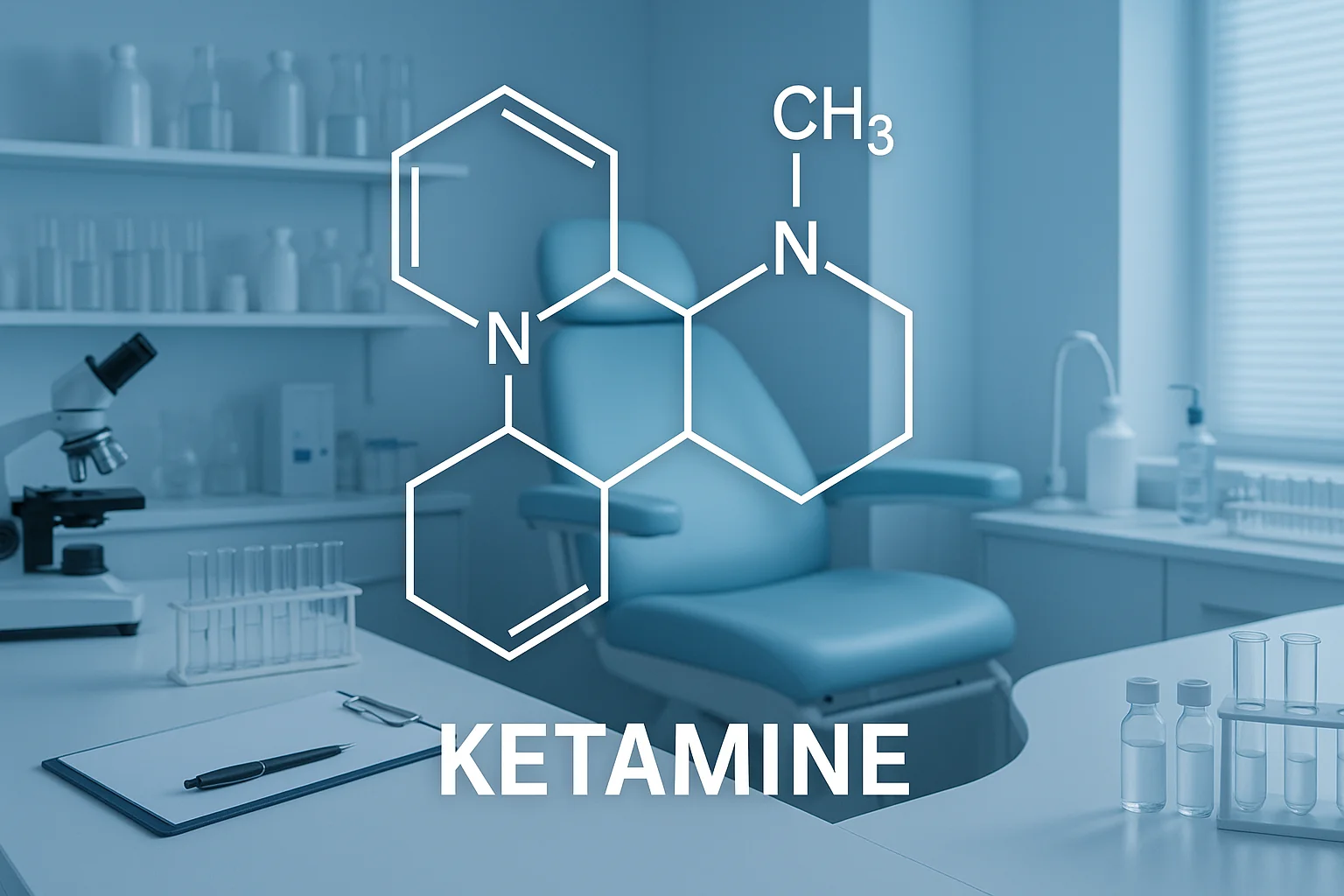
Ketamine is not a classic serotoninergic psychedelic like psilocybin or LSD. It is a dissociative agent - an NMDA (N-methyl-D-aspartate) receptor antagonist in the glutamate system. It has been used in anesthesiology since the 1960s as a safe anesthetic, particularly in field and pediatric settings. The discovery of its antidepressant properties was largely accidental - psychiatrists observed that patients after procedures with ketamine reported mood improvements.
The mechanism of action of ketamine in depression fundamentally differs from that of SSRIs. Classic antidepressants work by blocking the reuptake of serotonin and take several weeks to show effects. Ketamine blocks NMDA receptors and stimulates the release of BDNF (brain-derived neurotrophic factor) within hours, activates the mTOR pathway, and leads to a rapid increase in synaptic connection density in the prefrontal cortex (Zanos et al., Nature, 2016). The effect is literally a "repair" of damaged neural connections resulting from chronic stress and depression.
Esketamine is the S-enantiomer of ketamine - one of the two mirror forms of the molecule. It has about twice the affinity for NMDA receptors compared to R-ketamine, allowing for the use of smaller doses while maintaining efficacy and reducing dissociative effects.
What do clinical studies say - efficacy in numbers?
The groundbreaking TRANSFORM-2 study published in Lancet Psychiatry showed that intranasal esketamine combined with a new antidepressant achieved remission in 52.5% of patients with TRD within 4 weeks, compared to 31.0% with the antidepressant alone (Popova et al., Lancet Psychiatry, 2019). This is a significant difference for a population that previously did not respond to treatment.
Studies with IV ketamine infusions show even faster effects. In a meta-analysis of 24 randomized controlled trials (RCTs), ketamine demonstrated an antidepressant response in 67% of patients after a single infusion, with a median time to response of 24 hours (Feder et al., JAMA Psychiatry, 2021). In comparison - standard antidepressants require 4-6 weeks.
The critical point, however, is as follows: the effect of ketamine is not permanent. Without supportive pharmacological treatment or psychotherapy, the effect fades after 1-3 weeks. Hence, clinical protocols assume a series of infusions (typically 6 over 2-3 weeks) followed by maintenance therapy.
| Parameter | IV Ketamine (infusion) | Nasal Esketamine (Spravato) |
|---|---|---|
| Route of administration | Intravenous infusion (40 min) | Intranasal aerosol (self-administered, under supervision) |
| Typical dose | 0.5 mg/kg over 40 minutes | 56-84 mg dwa razy w tygodniu (faza ostra) |
| Time to effect | 2-4 hours | Kilka godzin - kilka dni |
| Duration of effect | 1-3 tygodnie (bez podtrzymania) | 1-3 tygodnie (bez podtrzymania) |
| Registration | Off-label (as an anesthetic) | FDA 2019, EMA 2019 - TRD i ryzyko suicydalne |
| Supervision during sessions | Anesthesiologist or psychiatrist | Medical staff for 2 hours after the dose |
| Availability in Poland 2026 | Private clinics, cost 400-800 PLN/session | Selected clinical centers, limited NFZ |
What does ketamine therapy look like in practice?
The standard protocol for IV ketamine infusion in treatment-resistant depression consists of 6 sessions conducted over 2-3 weeks (usually every two days). Each session lasts about 40-60 minutes. The patient lies in a comfortable position with monitoring of blood pressure, heart rate, and saturation. A typical dose is 0.5 mg/kg of body weight - significantly lower than in anesthesia, where 1-2 mg/kg is used.
During the infusion, most patients experience dissociative effects: feelings of floating, distortions of spatial perception, and sometimes hallucinations. These effects are temporary and subside within 30-60 minutes after the infusion ends. Clinical protocols typically recommend psychological preparation before the series and integration after the session - although formal integration therapy is less structured than with psilocybin.
Nasal esketamine (Spravato) is self-administered by the patient under the supervision of staff in a medical office - the patient cannot drive for at least a few hours after the dose. Protocol: twice a week for 4 weeks (induction phase), then once a week for 4 weeks, then once a week or every two weeks as maintenance.
We have noticed that in Polish discussions about therapeutic ketamine, the question of private availability dominates over clinical availability. This is understandable - the clinical centers conducting ketamine therapy under the NFZ can be counted on one hand in Poland in 2026. The private cost of a series of 6 infusions is 2,400-4,800 PLN, which places this form of treatment out of reach for many patients with severe depression.
Who qualifies for ketamine therapy - and who does not?
The main indication is treatment-resistant depression (TRD) - defined as a lack of response to at least two different antidepressants used at appropriate doses for a sufficient duration. An additional indication approved by the FDA is depression with active suicidal risk - here, ketamine can act as a "bridge" in a crisis before other treatments take effect.
Contraindications for ketamine therapy include: active psychosis or schizophrenia, uncontrolled hypertension, severe cardiovascular disease, pregnancy and breastfeeding, active substance use disorder (except alcohol - here ketamine is being studied therapeutically), and a history of ketamine bladder pathology. Patients with bipolar affective disorder require individual assessment - ketamine may induce hypomania.
From our editorial observations, it appears that questions about therapeutic ketamine most often come from individuals who have been "jumping" between SSRIs and SNRIs for years without effect. For this group, ketamine may be the first substance that brings real relief - although not lasting without further treatment. Many Polish psychiatrists still view it as a last-resort option, although international guidelines increasingly shift it to earlier lines of TRD treatment.
Frequently Asked Questions
What is ketamine and how does it work for depression?
Ketamine is an NMDA (glutamate) receptor antagonist that, at low doses, produces a rapid antidepressant effect - noticeable within a few hours. The mechanism differs from SSRIs: ketamine does not act on serotonin but stimulates synaptic plasticity through increased BDNF and activation of mTOR. The effect lasts from a few days to several weeks (Zanos et al., Nature, 2016).
What is esketamine (Spravato) and is it available in Poland?
Esketamine (Spravato) is the S-enantiomer of ketamine in the form of a nasal spray. In 2019, the FDA approved it for the treatment of treatment-resistant depression (TRD), and the EMA issued a similar decision for Europe. In Poland, Spravato is registered, but access through the National Health Fund (NFZ) is limited to selected psychiatric centers. It is privately available in several psychiatric clinics.
Who may qualify for ketamine therapy in Poland?
Ketamine therapy is intended for patients with treatment-resistant depression (TRD) - after the ineffectiveness of at least two different antidepressants at appropriate doses and duration. Qualification requires psychiatric assessment. Private ketamine clinics have been operating in Poland since 2022, and the cost of a series of 6 infusions is 2,400-4,800 PLN (Popova et al., Lancet Psychiatry, 2019).
What are the side effects of ketamine used in therapy?
The most common side effects of ketamine infusions are: transient dissociation (a feeling of detachment from the body), dizziness, nausea, and increased blood pressure during the infusion. Symptoms subside within 1-2 hours. With regular use, there is a risk of ketamine uropathy - mainly related to abusive use in high doses (Morgan et al., BJA, 2012).
Does ketamine cause addiction?
Ketamine has addictive potential, especially with recreational use at high doses. In therapeutic settings (low dose, supervised infusion, infrequent sessions), the risk is significantly lower, though not zero. Clinical protocols limit the frequency of sessions and monitor patients for increasing tolerance (Feder et al., JAMA Psychiatry, 2021).
Ketamine vs. other psychedelic substances in therapy - what sets it apart?
Ketamine is one of the few studied therapeutic-psychedelic agents that has full registration in psychiatry and is used in clinical settings. Psilocybin has received Breakthrough Therapy status from the FDA, but is still undergoing phase 3 trials. MDMA for PTSD was denied FDA registration in 2024 and requires further research. Ibogaine is in the earliest stages of clinical trials. Thus, ketamine is currently the only available tool in this class.
Mechanistically, ketamine fundamentally differs from the rest: it acts through glutamate (NMDA), not through serotonin (5-HT2A like psilocybin and LSD) or the release of monoamines (like MDMA). This means a different profile of drug interactions, different contraindications, and different risks. The lack of 5-HT2A activation is why SSRIs do not need to be discontinued before ketamine infusion - unlike psilocybin protocols. The dissociative effects of ketamine (detachment from the body, distortions of space) also phenomenologically differ from classic psychedelic visions and emotions.
The duration of action is shorter: a ketamine infusion lasts 40-60 minutes plus a few hours of observation, while a full psilocybin session takes 6-8 hours. From a clinical perspective, this is a significant difference - both for the patient and for the costs of the protocol. A shorter duration of action also means a lower risk of a prolonged difficult experience requiring psychological intervention.
The future of ketamine therapy - what will the coming years bring?
Several research directions are particularly promising. First, the combination of ketamine with psychotherapy - studies on "ketamine-assisted psychotherapy" (KAP) are testing whether integrating psychotherapy sessions around ketamine infusions prolongs the durability of effects. Preliminary results suggest that it does - similar to psilocybin studies (Feder et al., JAMA Psychiatry, 2021).
Second, oral ketamine and new forms of administration. IV infusion requires a clinic and medical supervision - which limits availability and increases costs. Researchers are testing oral and sublingual forms of ketamine as a cheaper alternative to maintain the effect between sessions. Preliminary data is promising for selected doses, although oral bioavailability is significantly lower than IV. Third, R-ketamine - an enantiomer with antidepressant effects without dissociative effects - is being studied as a potentially better-tolerated alternative to S-ketamine (esketamine).
This article is for informational and educational purposes and does not replace consultation with a doctor. If you are pregnant, breastfeeding, taking medications, or have chronic conditions, consult the use of supplements or herbs with a specialist.
Author: Michał Waluk · Published: 2026-05-04 · Updated: 2026-05-04