
Drug-checking and substance testing - how harm reduction is implemented in Europe
Drug-checking i testowanie substancji: rzetelne odpowiedzi oparte na badaniach. Edukacja u Bucha.
Every year in Europe, dozens of people die after consuming substances that turn out to be something completely different than they thought. Tablets sold as MDMA contain PMMA - a compound causing deadly hyperthermia. Cocaine is mixed with levamisole, which destroys the immune system. Synthetic opioids masquerade as heroin and kill at a fraction of the usual dose. Drug-checking - anonymous testing of substance composition - is the harm reduction community's response to this problem. This article explains what it is, where it operates, and what research says about its effectiveness.
KEY INFORMATION
• 48% of individuals who learned about the dangerous composition of a substance through drug-checking decided not to use it (Palamar et al., International Journal of Drug Policy, 2019).
• Energy Control (Spain) in 2023 detected adulterations in about 28% of MDMA samples and 41% of cocaine - EMCDDA data 2024.
• The Netherlands, Spain, Switzerland, and Austria have been operating legal, publicly funded drug-checking services since the 1990s.
• In Poland, there are no legal institutional services - the article discusses the European context educationally.
What exactly is drug-checking?
Drug-checking is a harm reduction service in which the user anonymously provides a small sample of a substance, and the service conducts a chemical analysis and informs about the composition - regardless of the result, without legal consequences for the user. The philosophy behind this service is pragmatic: if part of the population will use psychoactive substances anyway, it is better for them to do so with full knowledge of what they are actually taking.
EMCDDA (European Monitoring Centre for Drugs and Drug Addiction, renamed EUDA in 2023) has published guidelines for drug-checking services in Europe and regularly collects data on detected substances and trends in adulterations (EMCDDA, Drug Checking Services, 2022). Services operate at music festivals, in harm reduction clinics, and as permanent outpatient points.
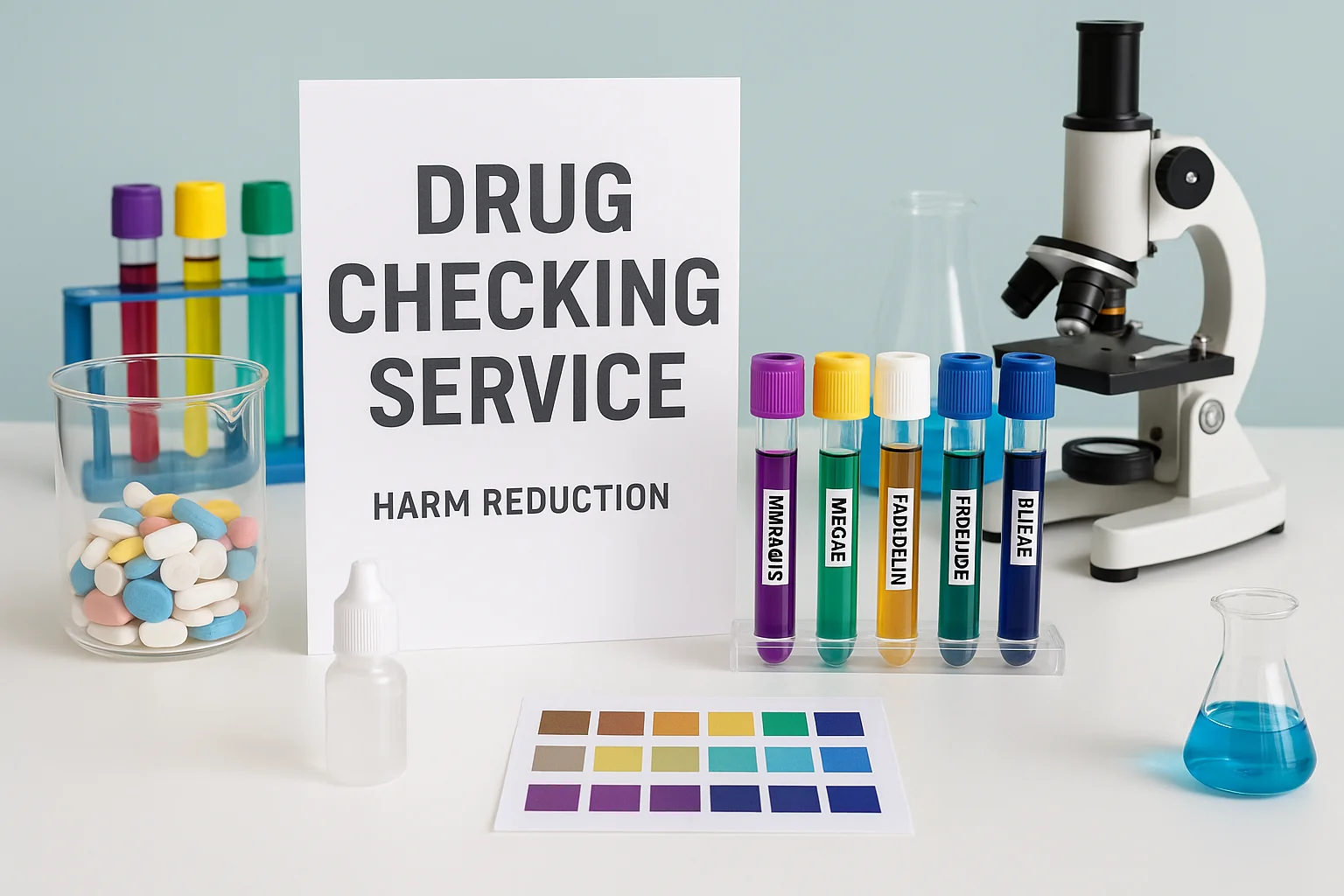
The analytical methods used by services vary in quality. Simple colorimetric tests (Marquis, Mecke, Simon's) are cheap and quick, but only detect classes of compounds - they do not provide information about purity. The gold standard is mass spectrometry (GC-MS or LC-MS/MS) and FTIR spectroscopy, which identify specific substances and their concentration, as well as detect small impurities.
Where in Europe does drug-checking operate and how?
The Netherlands has the longest-running drug-checking system in Europe. Jellinek and Unity Amsterdam operate permanent analytical points where users can bring substances for free testing. Results are anonymous, and aggregate data is sent to the national early warning system. When a new dangerous substance appears, the service sends alerts to the media and user communities within 24-48 hours.EMCDDA, 2022).
Spanish Energy Control (operating under Asociación Bienestar y Desarrollo in Barcelona) is one of the most well-known services in Europe. It offers testing both on-site at festivals and via mail (the user sends a sample by post and receives the result online). In 2022, Energy Control tested over 4000 samples, detecting adulterations in nearly one-third of them (Energy Control, 2023).
It is worth noting that drug-checking services serve as an early warning system for the entire community, not just for direct users. When ChEck iT! in Vienna detected a series of tablets containing deadly PMMA sold as MDMA in 2016, the information reached the European harm reduction network within days - potentially preventing many deaths before the batches reached other countries.
What does research say about the effectiveness of drug-checking?
The most frequently cited study comes from Palamar et al., published in the International Journal of Drug Policy. The authors examined the behaviors of individuals using drug-checking at music festivals in the USA: 48% of those who learned that their substance contained a dangerous ingredient decided not to use it - which is a statistically and clinically significant result.Palamar et al., International Journal of Drug Policy, 2019).
A systematic review by Maghsoudi et al. (Drug and Alcohol Dependence, 2017) covering 10 studies from Europe and Australia confirmed that drug-checking effectively changes behaviors: users abandon substances after receiving a negative result, engage in conversations with harm reduction staff, and share information with others in their environment (Maghsoudi et al., Drug and Alcohol Dependence, 2017).
Citation capsule - effectiveness of drug-checking: A systematic review by Maghsoudi et al. (Drug and Alcohol Dependence, 2017) covering 10 studies showed that drug-checking services effectively change user behaviors: after receiving information about the dangerous composition of a substance, a significant percentage decides not to use it or to use a smaller dose. The services also serve as a point of contact with the support system.
Table: Drug-checking methods - comparison of capabilities
The following summary shows the available analytical methods, their sensitivity, and practical applications.
| Method | What it detects | Sensitivity | Availability |
|---|---|---|---|
| Colorimetric tests (Marquis, Mecke) | Classes of substances (MDMA, amphetamine, opioids) | Low - only class, not composition | Available online; inexpensive |
| FTIR spectroscopy | Main ingredient, some impurities | Average - good for pure samples | Festival services; mobile |
| GC-MS / LC-MS | Full composition, concentration, trace impurities | High - gold standard | Laboratories of stationary services |
| Fentanyl test strips | Presence of fentanyl and analogs | High for fentanyl; inexpensive method | Widely available in the USA; less common in Europe |
Drug-checking and synthetic opioids - the key context for 2024
In recent years, drug-checking has become particularly important in the context of the opioid crisis. Fentanyl and its analogs (carfentanil, acetylfentanyl) are tens to hundreds of thousands of times stronger than heroin and can be deadly in microscopic doses. In the USA, where the fentanyl crisis is most severe, fentanyl test strips have become part of harm reduction programs provided for free at addiction treatment centers.
In Europe, the scale of the fentanyl crisis is smaller than in the USA, but EMCDDA/EUDA reports a growing presence of synthetic opioids in samples sold as heroin or opioid medications (EUDA, European Drug Report 2024). Drug-checking services in the Netherlands and Germany have routinely included fentanyl testing in their protocols since 2022.
A review of European harm reduction reports reveals a clear trend: drug-checking services are increasingly identifying substances from entirely different chemical classes sold as "classic" drugs - not just adulterants, but complete substitutions. This means that simple knowledge about "what one is taking" is becoming harder to access without professional chemical analysis.
Frequently Asked Questions
What is drug-checking and how does it work?
Drug-checking is a harm reduction service involving the anonymous examination of the chemical composition of substances provided by the user. Services use methods such as mass spectrometry, FTIR, and colorimetric tests. The user receives a result and advice, allowing them to make an informed decision. EMCDDA monitors drug-checking services across the EU (EMCDDA, 2022).
In which European countries does drug-checking operate?
Legal services operate in the Netherlands (Jellinek, Unity), Spain (Energy Control), Switzerland (DIZ), Austria (ChEck iT!), Germany, and Belgium. The Netherlands has had the longest-running system since the 1990s. EUDA coordinates a network of European services and collects standardized data on adulteration trends.
Does drug-checking reduce the number of overdoses?
Research indicates significant effectiveness. 48% of individuals informed about the dangerous composition of substances chose not to use them (Palamar et al., International Journal of Drug Policy, 2019). A systematic review by Maghsoudi et al. (Drug and Alcohol Dependence, 2017) confirmed a change in behavior among users after receiving results.
Is drug-checking legal in Poland?
In Poland, there are no legal institutional drug-checking services. Possession of testing reagents (Marquis, Mecke) is permitted, but anonymous substance testing services do not operate within a regulated legal framework. Polish harm reduction organizations (e.g., Tranzyt) conduct education on harm reduction but do not offer chemical analysis of substances.
How does the Marquis test work and is it reliable?
The Marquis test is a colorimetric test: one drop of reagent on a sample gives a characteristic coloration for different classes of compounds (purple-black for MDMA, orange for amphetamine). It is a preliminary test - it does not identify purity or detect all adulterations. The gold standard is GC-MS or HPLC available only in professional services.
What does drug-checking most commonly detect in MDMA samples?
EMCDDA data indicates that the most common adulterants in MDMA are synthetic cathinones (mephedrone, alpha-PVP), methylone, amphetamine, and cutting agents. Particularly dangerous PMMA (causing fatal hyperthermia) has been detected in tablets sold as MDMA for years. More about the regulatory context of psychedelic therapy in the article on the FDA decision regarding MDMA.
What substances are most commonly adulterated?
According to EUDA data for 2022-2023, the highest rates of adulteration are noted with cocaine (about 40-60% of samples contain levamizole), MDMA (about 20-30% misidentified or adulterated), hashish (synthetic cannabinoids), and opioid tablets (fentanyl and analogs). The report is available on the website EUDA, 2024.
This article is for informational and educational purposes and does not replace consultation with a doctor. If you are pregnant, breastfeeding, taking medications, or have chronic conditions, consult the use of supplements or herbs with a specialist.
Author: Michał Waluk · Published: 2026-05-04 · Updated: 2026-05-04