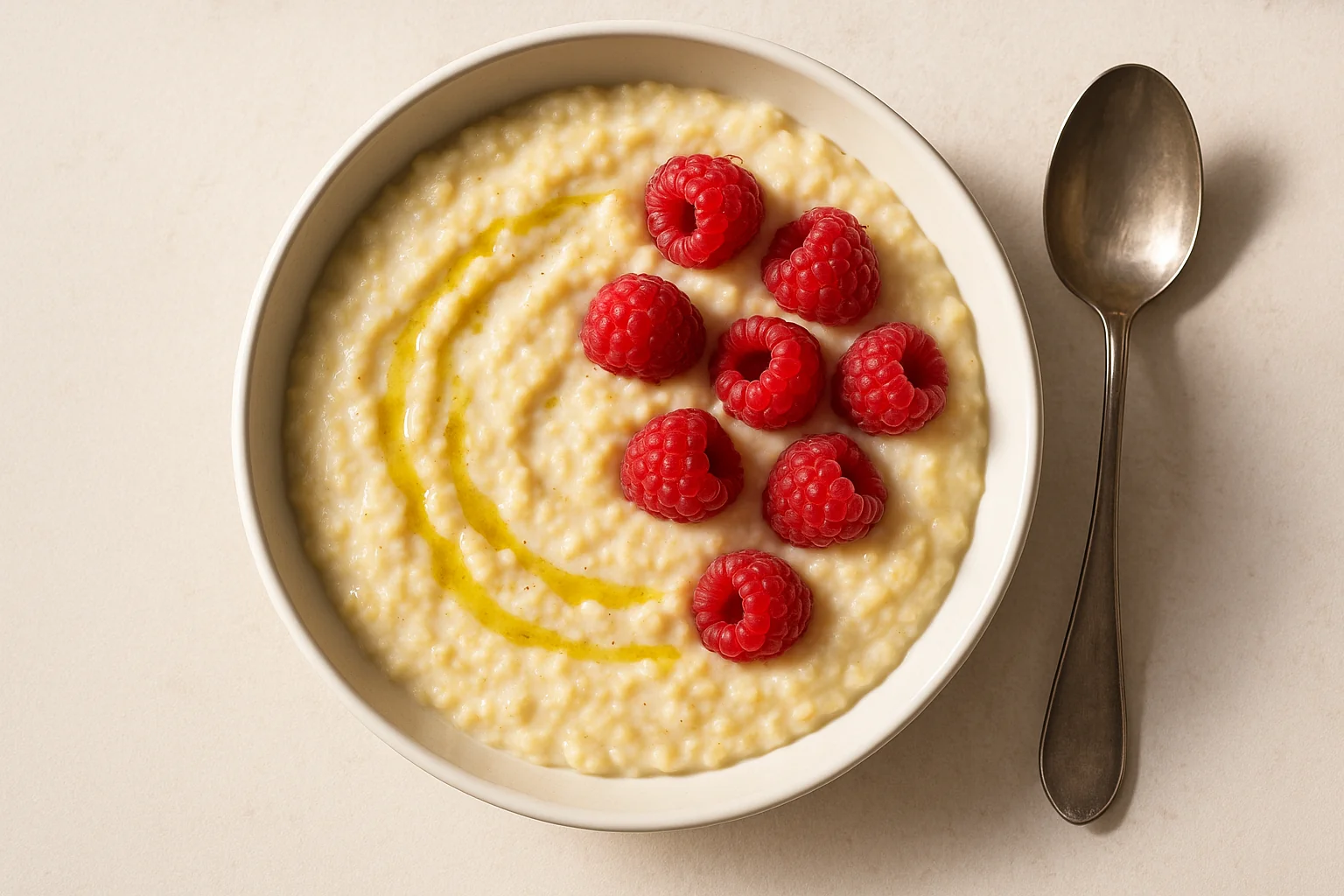

Millet porridge with hemp oil and raspberries – a creamy gluten-free breakfast
Millet with hemp oil and raspberries – creamy gluten-free breakfast. Step-by-step recipe, nutritional values, and tips. Fit millet with omega acids for a good morning.
Millet is one of the few gluten-free grains with a glycemic index of about 54 and a protein content of 11 g/100 g. It is delicate when cooked in coconut milk. A teaspoon of hemp oil added after cooking transforms it into a breakfast rich in omega fatty acids – hemp oil contains about 76–80% polyunsaturated fatty acids, one of the highest levels among plant oils. Raspberries add a tart freshness and anthocyanins. In this recipe, I will also show you how to eliminate the bitter taste of millet – a problem that can be solved in 60 seconds of rinsing.
KEY INFORMATION
• Millet: GI about 54, 11 g protein/100 g – a natural gluten-free breakfast base (USDA FoodData Central, 2020).
• Hemp oil: about 76–80% PUFA – one of the highest levels among plant oils (Callaway, Euphytica, 2004).
• The smoke point of hemp oil is about 165°C – add only to the finished millet, not during cooking.
• The omega-6 to omega-3 ratio in hemp oil: about 3:1 – close to the optimal recommended by WHO (max 4:1).
Why is millet with hemp oil a valuable gluten-free breakfast?
Millet stands out with several features that make it a valuable alternative to oatmeal. First and foremost, it is naturally gluten-free – USDA FoodData Central (2020) confirms a glycemic index of about 54 and a protein content of 11 g/100 g. Combined with hemp oil, which provides omega fatty acids that slow down carbohydrate absorption, the GI of the entire breakfast decreases even further.
Cold-pressed hemp oil is a concentrate of polyunsaturated fatty acids. Callaway (Euphytica, 2004) showed that hemp oil contains about 76–80% PUFA – one of the highest levels among commonly available plant oils. The omega-6 to omega-3 ratio is about 3:1, close to the optimal for humans (WHO recommends max 4:1). A teaspoon of oil on warm millet is a simple way to provide your body with omega fatty acids every morning without supplements.
We noticed in tests that full-fat canned coconut milk gives millet a consistency closer to cream than oatmeal – smooth, thick, and very filling. The version with almond milk is lighter and more neutral. If you want the hemp oil flavor to be prominent, choose almond milk – its neutrality does not overwhelm the nutty aroma of hemp oil.
Nutritional values – what does one serving of millet provide?
One serving (50 g of raw millet cooked in 200 ml of coconut milk, with 1 teaspoon of hemp oil and 60 g of raspberries) provides about 360 kcal, 8 g of protein, 15 g of fat, and 48 g of carbohydrates. The fiber from millet and raspberries is about 5 g/serving – Threapleton et al. (BMJ, 2013) demonstrated in a meta-analysis of 22 studies that regular fiber intake reduces the risk of cardiovascular diseases by 9–29%. A teaspoon of hemp oil (5 ml) contributes about 42 kcal and about 4.3 g of PUFA.
Ingredients – what do you need?
Proportions for 2 servings of millet. All ingredients are gluten-free:
- 100 g of millet (dry)
- 400 ml of plant milk (canned coconut or almond)
- a pinch of sea salt
- 1 teaspoon of honey or maple syrup
- a pinch of ground cinnamon
- 2 teaspoons of cold-pressed hemp oil (1 per serving)
- 120 g of fresh or frozen raspberries (about a handful per serving)
- optional: a teaspoon of hulled hemp seeds as a topping, coconut flakes, lemon zest
How to prepare millet porridge with hemp oil – step by step?
The most important step is rinsing the millet before cooking – without this, the porridge will be bitter. The rest is very simple and takes about 5 minutes of active work.
Step 1. Rinse the millet. Pour 100 g of millet into a sieve and rinse under cold running water for a full minute, stirring the grains with your hand. The water will first run cloudy, then clear – this is a sign that the saponins have been removed. Don’t skip this step, as it’s the main reason people give up on millet porridge.
Step 2. Boil the milk. Pour 400 ml of plant-based milk into a pot with a pinch of salt. Bring to a boil over medium heat. Use a larger pot than you think – the millet expands and rises significantly while cooking.
Step 3. Cook the millet covered. Add the rinsed millet to the boiling milk. Reduce the heat to low, cover with a lid, and cook for 15 minutes, stirring every 3–4 minutes. Do not cook on high heat – the milk will boil over. The millet is ready when it has absorbed almost all the milk and has a thick cream-like consistency.
Step 4. Season. Remove the pot from the heat. Add a teaspoon of honey or maple syrup and a pinch of cinnamon. Mix well. If the porridge is too thick, add 2–3 tablespoons of warm milk and mix again. The right consistency is a thick cream – not a mush and not a soup.
Step 5. Serve and add raspberries. Divide the porridge into two bowls. On top of the hot porridge, place a handful of raspberries (about 60 g per serving). The raspberries will gently warm from the heat of the porridge and release an intense red juice – a visual and flavor effect in one. Frozen raspberries work just as well as fresh.
Step 6. Drizzle with hemp oil. Just before serving, drizzle each portion with 1 teaspoon of cold-pressed hemp oil. Do not pour the oil during cooking – the smoke point of about 165°C is the threshold at which omega acids begin to degrade. Oil on the finished, warm (not hot) millet retains its full nutritional profile. Optionally, sprinkle with a teaspoon of hulled hemp seeds. You can find more recipes with fresh fruits in our article about smoothie bowl with hemp seeds.
Tips and variations
Millet porridge with hemp oil is a recipe with many faces. Here are a few variations we tested:
Version with vanilla and pear. Replace the raspberries with diced pear and add a bit of vanilla extract during cooking. The pear slightly dissolves while cooking and naturally sweetens the porridge – the result is a dessert-breakfast with a creamy consistency that doesn’t need honey.
Version with turmeric (golden millet). Add 1/2 teaspoon of turmeric and a pinch of black pepper to the cooking millet. Piperine from the pepper increases the bioavailability of curcumin. The color is golden, the taste subtly spicy – with hemp oil and honey, it creates a warming breakfast for winter mornings.
Nut version. After removing from heat, add a handful of chopped walnuts or almonds. The nuts complement the fats from the hemp oil with vitamin E and magnesium, and also increase satiety with more fat and protein.
Overnight millet. Place the cooked millet in a glass jar and put it in the fridge overnight. In the morning, take it out, add plant-based milk to achieve the desired consistency, heat it for 1 minute in the microwave, drizzle with hemp oil, and add fruits. Perfect if you don't have time to cook in the morning.
Frequently Asked Questions
Why is millet bitter and how can I fix it?
The bitter taste comes from saponins naturally present on millet grains. Simply rinse the millet under cold water for 1 minute before cooking – saponins are water-soluble and can be easily removed. Additional toasting in a dry pan for 2 minutes after rinsing enhances the nutty flavor.
When should I add hemp oil to the millet?
Always after removing it from the heat. The smoke point of hemp oil is around 165°C according to PMC (2020) – cooking millet may exceed this threshold and oxidize omega acids. A teaspoon of oil on warm, cooked millet preserves the full PUFA profile.
How many calories are in millet with hemp oil and raspberries?
One serving (50 g of millet + 200 ml of coconut milk + 1 teaspoon of oil + 60 g of raspberries) provides about 340–380 kcal, 8 g of protein, 14 g of fat, and 48 g of carbohydrates. Millet has a GI of about 54 according to USDA (2020) – with hemp oil, the overall GI decreases due to the fat effect.
Can millet be made with water instead of milk?
Yes – millet made with water is lighter in calories and has a more neutral taste. The version with coconut milk is creamier and more filling. A compromise is a mixture of 200 ml of plant-based milk with 200 ml of water. Add hemp oil regardless of the liquid base – it is a key nutritional element of the recipe.
What can replace raspberries in millet with hemp oil?
Blueberries (anthocyanins), strawberries (vitamin C), blackberries, or diced pear. In winter, frozen raspberries work well – their nutritional value is identical to fresh ones. Dried apricots or figs add sweetness without the need for additional sweetening.
This article is for informational and educational purposes and does not replace consultation with a doctor. If you are pregnant, breastfeeding, taking medications, or have chronic conditions, consult the use of supplements or herbs with a specialist.
Author: Michał Waluk · Published: 2026-05-04 · Updated: 2026-05-04