
CBD for Parkinson's and hand tremors: what does neurology say and is it safe?
Does CBD help with Parkinson's and hand tremors? A review of clinical studies: how many people, for how long, what improved, what did not, and interactions with medications.
Parkinson's disease is progressive and currently incurable. This makes patients and their families a grateful target for promises that no one has verified. CBD appears in such promises very often, usually accompanied by a statement about hand tremors. However, there are very few clinical studies involving people with Parkinson's, they are small, and their results are far from conclusive. Some of the most cited works, referred to by sellers, are case reports without a control group. Below you will find what has really been measured: how many people participated in each study, how long, what improved, and what did not. You will also find the most commonly overlooked aspect, which is interactions with anti-Parkinson's medications.
KEY INFORMATION
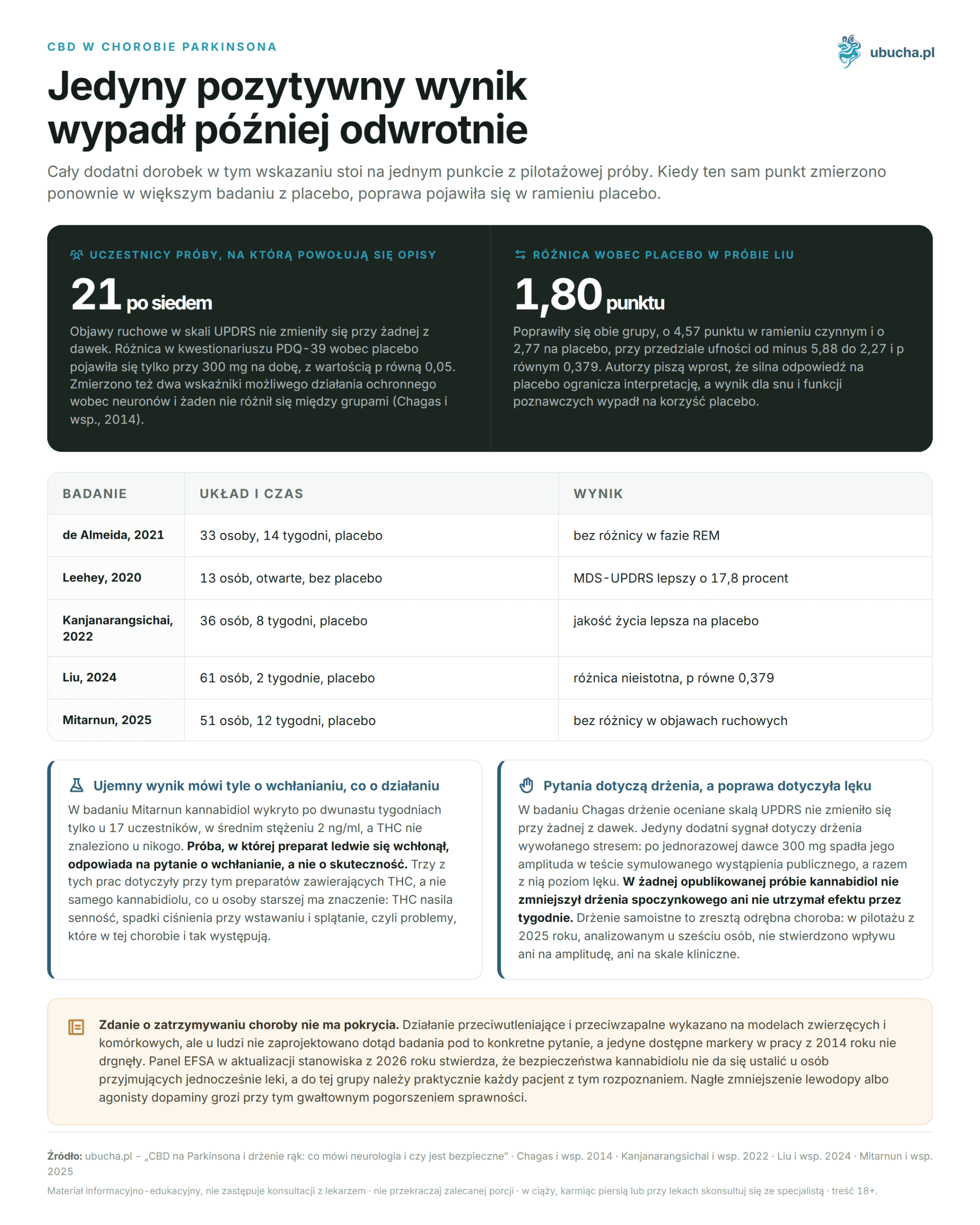
• In the study by Chagas et al. (J Psychopharmacol, 2014), 21 individuals with Parkinson's received placebo, 75 mg, or 300 mg of CBD per day for 6 weeks. Motor symptoms on the UPDRS scale did not change.
• Improvement concerned the quality of life score PDQ-39 at a dose of 300 mg, at the threshold of statistical significance, with seven individuals in the group.
• Essential tremor is a separate condition. A pilot crossover study from 2025, with a preparation containing 5 mg of THC and 100 mg of CBD, showed no effect on tremor amplitude.
• CBD inhibits CYP enzymes, so it may increase the concentration of ropinirole, rasagiline, or clozapine. Any change in treatment is decided by a neurologist.
• Studies on neuron protection have been conducted on animals. There are no studies in humans showing that CBD slows the progression of the disease.
How does Parkinson's disease differ from essential tremor?
These are two different diseases, and mixing them up is the most common mistake in texts about CBD. In Parkinson's disease, dopaminergic neurons in the substantia nigra die, and tremors occur at rest and diminish with purposeful movement. Essential tremor is not associated with dopamine loss and behaves the opposite: it intensifies during activities, such as lifting a cup or writing.
The difference also pertains to treatment. In Parkinson's, the basis of therapy is levodopa and medications acting on the dopaminergic system, and the clinical picture includes bradykinesia, muscle rigidity, and postural disturbances. In essential tremor, propranolol or primidone is used, there is no bradykinesia, and the disease often runs in families and starts earlier.
For assessing CBD, this has very practical implications. Research on cannabinoids has been conducted separately for both diseases, on different groups and with different endpoints. The result obtained in a person with Parkinson's does not transfer to essential tremor and vice versa. A sales page that simply writes about "hand tremors" combines two unrelated data sets.
In Parkinson's, non-motor symptoms can be more burdensome than the tremor itself. Depression, anxiety, sleep disturbances, and psychosis occur in a large portion of patients, and they are treated less effectively than motor symptoms. This is where most research on CBD is focused, not on tremors.
What exactly did the Chagas study from 2014 show?
It showed improvement in one quality of life indicator and no changes in everything else. It involved 21 individuals divided into three groups of seven, treated for 6 weeks. Motor symptoms measured by the UPDRS scale did not improve, and the difference in the PDQ-39 questionnaire compared to placebo appeared only at a dose of 300 mg per day, with a p-value of 0.05.
Participants were selected from 119 individuals assessed at a movement disorders clinic. To badania Chagas i wsp. (J Psychopharmacol, 2014) only patients without dementia and without coexisting mental disorders were qualified, which in itself narrows the conclusions to a narrow group of patients. Placebo, CBD 75 mg per day, and CBD 300 mg per day were compared.
Besides the scales, the authors measured two indicators of possible neuroprotective action: BDNF concentration in plasma and the result of magnetic resonance spectroscopy. None of them differed between groups. The researchers themselves wrote in the conclusion that the result indicates a possible impact on quality of life and that further studies on larger samples are needed before any conclusions can be drawn.
How to read this? PDQ-39 is a questionnaire in which the patient assesses their own well-being and functioning. If the preparation reduces anxiety or improves mood, the score increases, even though the disease progresses the same way. Seven people in the group is a pilot scale, where a single participant shifts the average. From this study, one cannot conclude that CBD works for Parkinson's.
Does CBD reduce hand tremors?
There is no convincing evidence for this. In the Chagas study, tremor assessed by the UPDRS scale did not change at any dose. The only positive result concerned stress-induced tremor: after a single dose of 300 mg, its amplitude decreased in a simulated public speaking test. This is a laboratory situation, not everyday functioning.
W pracy de Faria i wsp. (J Psychopharmacol, 2020) 24 individuals with Parkinson's underwent two sessions in a crossover design with placebo. After CBD, anxiety levels decreased on the VAMS scale, and an accelerometer recorded a smaller amplitude of tremor during a stressful task. The simplest explanation is that an anxiolytic effect occurred, as Parkinsonian tremor intensifies under stress. In no published trial did CBD reduce resting tremor or maintain the effect for weeks.
Essential tremor was checked separately. In a pilot crossover study Longardner i wsp. (Tremor Other Hyperkinet Mov, 2025) a pharmaceutical preparation containing 5 mg THC and 100 mg CBD was used, so not just CBD. Seven people were qualified, analysis was conducted for 6, one withdrew after a serious adverse event. No effect was found on tremor amplitude in the digital spiral test or on clinical scales. The authors stated directly that their data do not support the claims circulating on the internet.
What did newer clinical studies from 2020-2025 show?
Most did not confirm earlier hopes. Four studies with a control group, conducted on 33, 61, 60, and 40 individuals, showed no advantage over placebo in the main endpoints. The only study with a clear improvement in motor function was open and without placebo.
| Study | Design and duration | Osoby i dawka | Outcome |
|---|---|---|---|
| de Almeida i wsp., Movement Disorders, 2021 | Double-blind with placebo, 14 weeks | 33 people, CBD 75-300 mg per day | No difference in the number of nights with REM phase symptoms. Transient improvement in sleep satisfaction |
| Leehey i wsp., Cannabis Cannabinoid Res, 2020 | Otwarte, bez placebo, 10-15 dni na dawce docelowej | 13 people, pharmaceutical preparation 5 to 20-25 mg per kg of body weight | Improvement in MDS-UPDRS by 17.8 percent in 10 individuals completing the study. Elevated liver enzymes in 5 out of 13, exclusively at the highest dose. |
| Kanjanarangsichai i wsp., J Neurosci Rural Pract, 2022 | Randomizowane z placebo, 8 tygodni | 36 individuals in the analysis, sublingually averaging 15.6 mg of CBD and 0.6 mg of THC per day. | No difference in the UPDRS scale, in walking tests, or in anxiety and depression. Quality of life improved in the placebo group. |
| Liu i wsp., Movement Disorders, 2024 | Randomizowane z placebo, 2 tygodnie | 61 people, hemp extract, averaging 191.8 mg CBD and 6.4 mg THC per day | Difference compared to placebo not significant. Sleep and cognitive functions performed better in the placebo group |
| Mitarnun i wsp., Parkinsonism Relat Disord, 2025 | Randomizowane z placebo, 12 tygodni | 51 people in the analysis, sublingually an average of 26 mg of CBD and 1.2 mg of THC per day | No difference in delayed memory, motor symptoms, and mood. Improvement in one MoCA subtest |
Three of these studies concerned products containing THC, not just CBD. This distinction matters for older individuals: THC increases drowsiness, blood pressure drops upon standing, and confusion, which are precisely the problems that occur in Parkinson's. The most instructive result is from the trial. Kanjanarangsichai i wsp. (2022): quality of life on the EQ-5D-5L scale significantly improved in the placebo group, not in the active group. Thus, the point at which the only positive result in Chagas occurred later turned out to be the opposite.
Why are these results so difficult to interpret?
Because in each of these trials, something disturbs the reading: sometimes it is a strong placebo response, sometimes a product that barely absorbed, sometimes a dose incomparable to anything on the shelf. A negative result does not always mean "does not work," just as a positive does not always mean "works."
In the study Liu i wsp. (2024) Both groups improved, by 4.57 points in the active arm and by 2.77 on placebo, with a difference of 1.80 points and a confidence interval from minus 5.88 to 2.27 and p equal to 0.379. The authors state directly that a strong placebo response limits interpretation, and the result for sleep and cognitive functions favored placebo.
It is also worth looking at what in these trials actually reached the bloodstream. In the study. Mitarnun i wsp. (2025) cannabidiol was detected after twelve weeks in only 17 participants, at an average concentration of 2 ng/ml, and THC was not found in anyone. Thus, a negative result from such a trial says as much about absorption as it does about efficacy.
Doses remain. In the study. Leehey i wsp. (2020) up to 20-25 mg per kilogram of body weight was used, which means about one and a half thousand milligrams daily for a person weighing 75 kg. This is the dose of the registered drug Epidiolex, administered under the supervision of the investigator. Three out of thirteen participants discontinued due to intolerance, and all reported adverse effects, most commonly diarrhea in 85% and drowsiness in 69%. Elevated liver enzymes occurred in five individuals and exclusively at the level of 20-25 mg per kilogram, with symptoms reported by one.
For balance: a systematic review of thirteen clinical trials (Varshney i wsp., Cannabis and Cannabinoid Research, 2023) mentions improvement in motor symptoms over placebo. However, it also includes nabilone and cannabis, not just cannabidiol, and was published before the trials of 2024 and 2025.
Does CBD help with psychosis and sleep disorders in Parkinson's?
These are the two most mechanistically justified applications, but the evidence remains weak. Psychosis was studied in six individuals in an open trial, without placebo. Behavioral disturbances in REM phase were described in four patients, and a later study with a control group of 33 individuals did not confirm this result. No published trial with placebo has yet verified the result for psychosis.
W pracy Zuardi i wsp. (J Psychopharmacol, 2009) six patients with psychosis lasting at least three months received CBD at a flexible dose, starting from 150 mg per day, for 4 weeks, alongside their previous treatment. The BPRS scale results and the Parkinson's psychosis questionnaire scores decreased, and the total UPDRS score not only did not worsen but decreased. No adverse effects were reported. Mechanistically, this makes sense: typical antipsychotic medications increase rigidity in Parkinson's, which is why clozapine and pimavanserin are mainly used there. However, six individuals without blinding and without a comparison group is a hypothesis, not a conclusion.
Sleep illustrates this problem even more clearly. Chagas i wsp. (J Clin Pharm Ther, 2014) described four patients treated for six weeks, three at a dose of 75 mg per day and one at a dose of 300 mg, in whom the number of episodes of dream enactment quickly decreased. Seven years later. de Almeida i wsp. (Movement Disorders, 2021) they examined 33 individuals over 14 weeks in a placebo-controlled design and found no difference in any of the primary endpoints. Only subjective sleep satisfaction improved, temporarily, between the fourth and eighth weeks.
What drug interactions with Parkinson's medications pose real risks?
The real risk is the increase in the concentration of drugs metabolized by cytochrome P450, which CBD inhibits: most strongly on the CYP2C19 pathway, less so on CYP3A4 and CYP1A2. A person with Parkinson's usually takes several preparations at once, so the potential for such interaction is broad. Levodopa does not belong to this list, but the rest does.
Levodopa with carbidopa or benserazide is processed through decarboxylase and COMT, rather than through cytochrome P450, so a metabolic interaction with CBD is unlikely. Ropinirole is primarily metabolized by CYP1A2, the same enzyme responsible for rasagiline, while selegiline is broken down by CYP2B6 and CYP3A4. Inhibition of these pathways increases the concentration of the drug in the blood, which manifests as drowsiness, nausea, and drops in blood pressure upon standing. Pramipexole is an exception, as it is excreted by the kidneys in practically unchanged form.
Medications used for Parkinson's psychosis require separate attention. Clozapine is a substrate of CYP1A2. Quetiapine and pimavanserin follow the CYP3A4 pathway. These are precisely the preparations for which advertisements often suggest CBD as a "natural alternative." In a review Brown i Winterstein (J Clin Med, 2019) nearly half of those using CBD reported dose-dependent adverse effects, including elevated aminotransferases and drowsiness. However, this number comes from the characteristics of registered medications containing cannabidiol, meaning from patients on therapeutic doses, not from supplement buyers.
To what extent does CBD increase the concentration of medications in human studies?
The scale of this inhibition was measured, revealing something that warnings regarding Parkinson's usually overlook: the enzyme that is most affected is not mentioned in those warnings. Bansal i wsp. (Clinical Pharmacology and Therapeutics, 2023) They administered to eighteen healthy adults, in a crossover design, a cookie with an extract containing 640 mg of CBD and 20 mg of THC, and half an hour later a set of marker medications. Exposure to omeprazole, a CYP2C19 marker, increased by 207%. For losartan (CYP2C9) it was 77%, for midazolam (CYP3A) 56%, for caffeine (CYP1A2) 39%, and for dextromethorphan (CYP2D6) there was no change at all. The extract containing only THC did not inhibit any of the five enzymes. Therefore, CYP1A2, which is the basis for most warnings regarding anti-Parkinson medications, is the least inhibited among this group, while CYP2C19 is most strongly affected, which is the pathway for proton pump inhibitors and clopidogrel. One caveat: 640 mg is a dose many times higher than what is found in over-the-counter supplements, so do not directly translate percentages to a few milligrams.
One rule is non-negotiable: do not discontinue or reduce any Parkinson's medication on your own. Sudden reduction of levodopa or dopamine agonists risks a rapid decline in function, and with agonists, withdrawal syndrome as well. Doses are determined by the treating neurologist, who sees the entire history of the disease.
What should you ask your neurologist before trying CBD?
Regarding three things: whether any of your medications follow the CYP2C19, CYP3A4, or CYP1A2 pathways, how often to monitor liver enzymes, and how to recognize that a medication has started to work too strongly. Have this conversation before starting treatment, not after. CBD is not a neutral addition to therapy. The EFSA panel in its 2026 position update states that the safety of cannabidiol cannot be established in individuals under 25 years of age, in pregnant and breastfeeding women, and in those taking medications simultaneously, which includes practically every patient with Parkinson's.
Discuss with your doctor what specifically should improve and how you will check it. If the goal is sleep, anxiety, or mood, the data at least partially support such expectations. If the goal is tremor, the studies do not support it, and it's better to know that right away. Keep a record of the dose, time of administration, sleep quality, and any decline in function, because without notes, you won't distinguish the effect of the preparation from natural fluctuations of the disease.
Our observations from conversations with patients' families: questions almost always concern tremors, as this is a symptom visible to others and the most embarrassing for the patient. Meanwhile, studies that have shown even slightly positive results have focused on anxiety, sleep, and well-being, which are things not visible in a photograph. This discrepancy is the greatest source of disappointment here.
Finally, the issue of neuroprotection. The antioxidant and anti-inflammatory effects of CBD have been demonstrated in animal and cellular models, but no study has yet been designed to address this specific question in humans, and the only available markers in a 2014 study showed no change. The statement "CBD stops Parkinson's" is not supported by data. You can find more about the safety profile in older adults in the text CBD for seniors, and about its effects on the nervous system in the article CBD and the brain and nervous system.
Frequently Asked Questions
Does CBD help with Parkinson's disease?
The data are preliminary and mostly negative. In the study Chagas i wsp. (2014) of 21 individuals, motor symptoms on the UPDRS scale did not change, and improvement only concerned the quality of life score at a dose of 300 mg per day. CBD does not cure the disease and does not replace levodopa.
Does CBD reduce hand tremors?
There is no convincing evidence for this. The UPDRS scale did not show a change in tremor in the 2014 study. The only positive signal concerned stress-induced tremor after a single dose of 300 mg. Essential tremor is a separate condition, and a pilot study from 2025 showed no effect there.
Is CBD safe with Parkinson's medications?
It requires supervision by a neurologist. In humans, CBD inhibits CYP2C19 most strongly and CYP1A2 least, thus increasing the concentration not only of ropinirole, rasagiline, or clozapine, but also of proton pump inhibitors. Levodopa does not pass through cytochrome P450. High doses have been observed to elevate liver enzymes.
Jakie dawki stosowano w badaniach nad CBD w Parkinsonie?
Chagas et al. administered 75 mg or 300 mg per day for 6 weeks to 21 individuals. Leehey et al. used a pharmaceutical preparation at a dose of 5 to 20-25 mg per kilogram of body weight in 13 individuals for 10-15 days. These are research doses, not recommendations. Treatment decisions are made by the neurologist.
Does CBD help with psychosis in the course of Parkinson's disease?
There is one open study involving six individuals, in which after 4 weeks, the results of the psychosis scales decreased without worsening motor function. There was no control group or blinding, and no subsequent placebo trial to verify this result has been published yet. This is a hypothesis for further research, not proof of efficacy.
Does CBD slow the progression of Parkinson's disease?
There is no data on this in humans. Protective effects on neurons have been demonstrated in animal and cell models. A study from 2014 measured two neuroprotection markers, namely BDNF in plasma and magnetic resonance spectroscopy, and found no differences compared to placebo.
If after talking to a neurologist you decide to try it, look for a product with a certificate of analysis issued for a specific batch. You can find such products in the section oils in the u Bucha store.
This article is for informational and educational purposes only and does not constitute medical advice. Before starting to use hemp or CBD for therapeutic purposes, consult your doctor, especially if you are taking other medications, are pregnant, or breastfeeding.
Author: Michał Waluk · Opublikowano: 2026-05-28 · Aktualizacja: 2026-08-15