
How to Roll a Joint? A Complete Step-by-Step Guide
How to roll a joint step by step: paper, grinder, crutch, and rolling technique. Check what research says about smoke, tobacco in joints, and Polish law.
Usually, 0.3 to 0.5 g of herb goes into one marijuana joint, so from a gram you get two or three, and flower buds, not leaves, are used. Rolling seems simple until you try it for the first time. The paper tears, herb spills from the edges, and the finished joint burns on one side and goes out halfway. Cannabis remains the most commonly used controlled substance worldwide: in the World Drug Report 2025, the United Nations Office on Drugs and Crime estimates 244 million people used it in 2023, compared to 61 million for opioids and 25 million for cocaine. This guide breaks rolling down into eight repeatable steps and explains why each changes the smoking experience. It also includes parts usually omitted: what measurements say about smoke, tobacco in joints, vaporization, and where the legal boundary lies in Poland. Techniques are described educationally, without encouraging breaking the law.
KEY INFORMATION
• The average herb mass in a joint is 0.32 g, with a range of 0.30-0.35 g (Ridgeway and Kilmer, Drug and Alcohol Dependence 2016).
• The entire technique boils down to eight moves, with two deciding the outcome: material distribution and packing.
• Tobacco added to a joint increases the amount of THC evaporated from a gram of herb but adds nicotine and smoke from shredded tobacco.
• Vapor from a vaporizer has a better ratio of cannabinoids to by-products than smoke from a hemp cigarette.
• In Poland, only fiber hemp herb remains legal, i.e., plants with a sum of delta-9-THC and THCA up to 0.3% dry mass (Art. 4 point 5 of the Act on counteracting drug addiction).
How to roll a joint step by step?
A classic joint is made in eight moves: grinding the material, rolling the crutch, placing it at the edge of the paper, spreading the herb along the paper, shaping the cylinder with thumbs, folding the edge, moistening and sealing the seam, finally packing and closing the top. An experienced person goes through this sequence in a minute.
The order is not arbitrary. The crutch must go into the paper before the herb because adding it last forces reshaping and crumples the paper. Packing comes after sealing because only a closed cylinder holds the material in place. Airflow control, i.e., a simple pull through the mouthpiece before lighting, is last and prevents lighting a joint that would suffocate anyway.
- Grind the herb to a coarse sugar-like fraction, without dust.
- Roll a cardboard strip into a spiral or fold it accordion-style.
- Place the crutch at one end of the paper, opposite the glue strip.
- Spread the herb evenly along the paper, lighter near the crutch.
- Shape the cylinder by rolling the paper between thumbs and index fingers.
- Fold the edge without glue under the material and press along the length.
- Moisten the glue strip with one quick motion and stick the seam from the crutch side.
- Pack the contents, twist the excess paper at the end, and check airflow.
The rest of this guide breaks these eight points down because each has typical pitfalls.
What do you need to roll a joint?
Four things suffice: rolling paper, crutch, grinder for herb, and a flat work surface. The rest is convenience, not a requirement. Without a grinder, scissors will do; without a tray, a plain sheet of paper; but without paper and crutch, the joint either won’t form or will fall apart while smoking.
Each element affects a different property of the finished joint. The paper determines burn rate and how much foreign material enters the smoke. The grinder controls fraction uniformity, which affects airflow. The crutch holds the mouthpiece shape. The work surface lets you collect spilled material, which always happens.
| Element | Function | Emergency substitute |
|---|---|---|
| Rolling paper | Burn rate, paper’s own taste | None, essential element |
| Grinder | Uniform fraction, airflow | Scissors, finger crushing |
| Crutch | Mouthpiece shape, stops bits | Cardboard strip from packaging |
| Tray | Recovers spilled material | Sheet of paper, plate |
| Packing tool | Presses contents after rolling | Pen shaft, stick |
A two-piece grinder suffices for regular use. A four-chamber version adds a screen collecting trichome dust falling to the bottom, useful for larger amounts. Metal models keep teeth sharp longer than wooden or plastic ones, and the latter grind most unevenly, visible from the first joint.
Mechanical rollers, small rollers with rubber tape, are sometimes recommended for learners. However, they have a pedagogical flaw: they produce a ready joint without teaching the motion, which must be mastered anyway. Treat them as emergency solutions for hand injuries rather than a learning stage. Papers, filters, and grinders are found in the hemp accessories category.
Which part of the plant is used for joint herb?
From flower buds, i.e., top and side buds, because they contain the most resin. Trim, small fractions cut from around the bud during processing, is less suitable but cheaper. Proper leaves and stems are unsuitable: they produce much smoke, little effect, and scratch the throat.
The difference is visible in the material itself. The bud is dense, sticky, and when ground yields a fluffy, homogeneous mass. Trim is loose and finer, so it draws easier but also spills from the paper and burns faster. Leaf is dry, thin, and crumbles to dust that clogs the filter.
For rolling, this has one practical effect: the finer the material, the tighter you must roll to prevent the joint from drawing too easily and burning unevenly.
Which rolling paper to choose?
The simplest rule: the thinner the paper, the less you add to the smoke and the more you taste the herb itself. Thin paper forgives fewer mistakes because it tears if pressed too hard and softens from excess saliva. For a learner, paper strength is more important than thinness.
Weights printed on packages come from manufacturers and are not independently registered. No public database exists to check the basis weight of a specific paper, so gram per square meter comparisons between brands should be treated as marketing. The difference you can feel yourself is tactile: rice paper is noticeably smoother and stiffer than hemp paper.
| Paper type | Behavior when rolling | For whom |
|---|---|---|
| Rice | Very thin, slippery, tears easily | Experienced users, aroma tasting |
| Hemp | Rough, holds shape well | Beginners, daily use |
| Linen | Thin, moisture resistant | People who over-salivate glue |
| Transparent cellulose | No own taste, requires skill | Terpene profile evaluation |
| Bleached classic | Thick, very forgiving | Learning motion, practice material |
Our store currently stocks Purize papers in several king size slim variants and Mascotte slim format with filters in booklets. Brands mentioned in foreign guides do not always have Polish distribution, so check the actually available papers in the papers category. We gathered a comparison of formats in a separate paper guide.
A full list of sizes and materials is collected separately in the article about which papers to choose.
What is the best paper size?
Start with a shorter one. The 1¼ paper about 78 mm long requires less precision when spreading herb than king size slim about 110 mm, because it’s harder to create a lump on a shorter length. A full joint can be made with 0.3 g of material.
This number is not accidental. Ridgeway and Kilmer (Drug and Alcohol Dependence, 2016) estimated the average herb mass in a joint at 0.32 g, with a Bayesian confidence interval of 0.30-0.35 g. The basis was 10,628 transactions recorded from 2000-2010 and a model linking price to weight, not weighing ready joints. The authors emphasize that earlier estimates used in drug policy were clearly overestimated.
| Format | Approximate length | Typical use |
|---|---|---|
| Single wide | 70 mm | Historical format, rare today |
| 1¼ | 78 mm | North American standard, learning |
| King size slim | 110 mm | European standard, group smoking |
Longer paper holds more material and allows a clear cone shape but requires more even packing along the length. Shorter paper forgives more and quickly builds muscle memory.
Width, hidden in the word “slim,” is another parameter. The narrow version is about 44 mm and produces a smaller diameter joint; the wide version holds more material at the same length. In Europe, king size slim, i.e., long and narrow paper, has become standard and is what you find on Polish accessory shelves.
How to prepare herb for even burning?
Two things matter: fraction and moisture. Grinding should resemble coarse sugar. Too fine material clumps into dust, choking airflow and extinguishing the joint after a few puffs. Too large pieces leave empty spaces where the ember jumps to one side.
Moisture has an industry standard. ASTM D8197 specification sets recommended water activity for dried hemp flower at 0.55 to 0.65, corresponding to 55 to 65% relative humidity in a closed container. Below this, material crumbles to powder in the grinder; above, it smolders and goes out, with increased mold risk. This is the only value in this article backed by a formal standard.
Grinding method also matters but differently. Metal grinder teeth scrape some trichomes into the screen. Finger crushing leaves them on the material but produces uneven fraction and leaves resin on skin. Scissors are intermediate and work well for small amounts.
We noticed a simple correlation in the store: people complaining about scratchy smoke almost always have overdried material, not too strong a strain. Humidity-regulating sachets change the feel within a day; sachets and containers are in the storage category.
What is a crutch and how to make it?
A crutch, or filter, is a rolled cardboard strip inserted at the joint’s mouth end. It does three things at once: holds the mouthpiece shape, stops bits of material from being sucked in, and lets you smoke the last centimeter without burning fingers. It does not filter smoke in any measurable way.
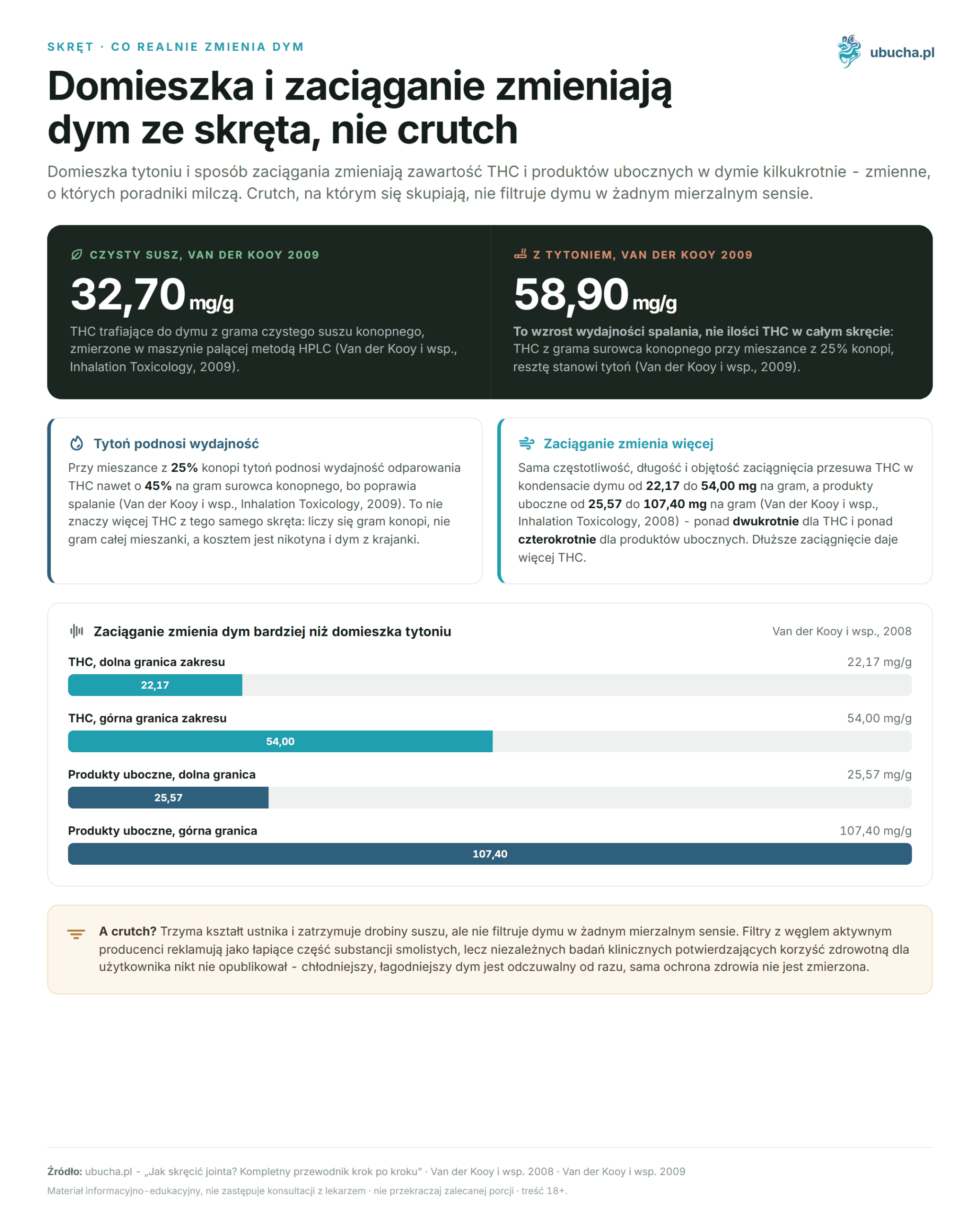
This distinction is often lost in marketing. A plain paper crutch is a structural element, not a filter. Activated charcoal filters are a separate category: manufacturers claim they retain some tar substances, but no independent clinical studies confirm health benefits for the end user. The perceptible effect - cooler, milder smoke - is real and immediate.
- Accordion is a strip about 20 by 60 mm folded two or three times in an M shape, then wrapped with the rest of the cardboard. The zigzag stops the largest bits.
- Roll is made by rolling the strip into a full spiral a few millimeters in diameter. It gives the most open draw and stiffest mouthpiece.
- Activated charcoal filter is a ready-made 6 mm diameter element inserted instead of cardboard. It clearly cools smoke and dulls herb aroma.
Ready Purize 6 mm charcoal filters are available in the filters category. Any stiff uncoated paper works for cardboard, e.g., the booklet cover included by manufacturers for this purpose.
How to spread herb and shape the joint?
This stage decides the outcome more than all others combined. Material should lie along the paper in an even ribbon, lighter near the crutch and denser near the lit end. This creates a delicate internal cone, so the ember goes inward, not sideways.
Shaping starts with rolling. Hold the paper between thumbs and index fingers of both hands and roll back and forth several times. The herb arranges itself into a cylinder, and empty spaces disappear. Only after this does folding the edge make sense, as the material holds its shape.
The most common mistake here is counterintuitive. Learners press hardest near the filter because fingers have the best grip there and leave the lit end loose. The result is a joint that draws heavily and burns unevenly. The correct proportion is the opposite: even along the length, with slight looseness near the crutch.
Adjust the amount of material to the paper size, not appetite. 0.3 g fills a short paper just right; king size slim holds twice as much but makes a thick joint that draws poorly. Excess is always easier to remove before rolling than after.
How to seal the seam and finish the joint?
Glue on the paper is usually gum arabic activated by moisture, and the most common mistake is too much moisture. One quick lick along the strip suffices, without stopping in one place. Excess saliva dissolves the glue, softens the paper, and causes the seam to come undone after drying.
Sealing moves from the crutch side toward the lit end. The edge without glue is folded under the material with thumbs, and the glue strip is pressed from above, sliding fingers along the length. The paper should stick edge to edge, without folds or overlaps wider than the glue strip.
Finishing involves two moves. First, press the contents from the open end by tapping the joint vertically on the table or pushing the material with a thin stick. Then twist the excess paper into a short wick that holds the herb and serves as a lighter.
Lighting method also affects what happens next. Placing the flame at the tip and slowly rotating the joint gives an even, round ember. Lighting from the side or holding the flame too long burns one side at the start, forcing the rest of the session to burn an uneven ember.
Finally, check airflow. Draw air through the mouthpiece before lighting: resistance should be felt, but air must pass freely. If it doesn’t, the joint is pierced, and the only fix is to unroll and redistribute the material. Lighting such a joint ends with it going out after the second puff.
What mistakes ruin first joints?
The first dozen attempts are ruined by four things, each with a different symptom. Too fine grinding chokes airflow. Too much saliva tears the paper. No crutch lets bits into the mouth. Uneven packing causes canoeing, i.e., asymmetric burning. All four can be fixed in one session.
The most confusing part is that symptoms rarely indicate the cause. A joint that goes out is usually not too moist but ground too fine. A joint burning on one side is almost never the paper’s fault but material distribution. Changing paper brand is the most common beginner reaction and the least effective.
| Symptom | Actual cause | Fix |
|---|---|---|
| Goes out after two puffs | Material ground to dust | Fewer grinder turns, coarser fraction |
| Burns on one side | Uneven packing or moist paper | Even rolling before sealing |
| Seam comes undone after a while | Too much saliva on glue | One quick lick with the tongue |
| Bits in mouth | No crutch or too loose roll | Tighter spiral, accordion style |
| Draws very hard | Pierced center, too tight packing | Unroll and redistribute |
There is one more mistake not covered in the table because it concerns conditions, not technique. Rolling on a soft surface, knee, or couch removes finger support and ruins packing even with skill. A hard table fixes this immediately and for free.
Muscle memory builds faster than the frustration of the first evening suggests. After thirty joints, folding no longer requires looking at your fingers.
How does a joint differ from a spliff and a blunt?
The difference concerns content and wrapping. A joint is just herb in paper. A spliff mixes herb with tobacco in the same paper. A blunt is herb wrapped in a tobacco product, i.e., tobacco leaf or a split cigar wrap. Each form has its region and history.
The scale of the habit was measured by Hindocha et al. (Frontiers in Psychiatry, 2016) using Global Drug Survey data. 33,687 people who smoked cannabis at least once in the past year answered, with 65.6% indicating tobacco as the route. Regional distribution was extreme: in Europe, 77.2 to 90.9%; Australasia, 20.7 to 51.6%; Americas, 4.4 to 16.0%. The national sample covered eighteen countries with at least 500 responses each. Poland was not among them, so any number assigned to Polish smokers is an estimate. The main result concerns something other than geography: users without tobacco were more likely to want to reduce tobacco and seek help than those smoking cannabis with tobacco.
Tobacco in a joint does something rarely mentioned. Van der Kooy et al. (Inhalation Toxicology, 2009) burned mixtures with different proportions in a smoking machine and measured THC by HPLC. With 100% cannabis, 32.70 mg THC per gram entered the smoke; with 25% cannabis mix, 58.90 mg per gram. They concluded tobacco increases THC evaporation efficiency by up to 45% by improving combustion. Note this refers to efficiency from a gram of cannabis, not the whole mix, so it doesn’t mean you get more THC from the same joint after adding tobacco. This efficiency comes at the cost of nicotine and shredded tobacco smoke.
A detailed comparison of the three forms, including the origin of the Polish word “blant,” is in a separate post about differences between spliff, joint, and blant. Alternatives to tobacco in joints are described in the text about what to mix herb with instead of tobacco.
What is the smoking etiquette in a group?
The rule is one sentence: two puffs and pass. The English phrase “puff puff pass” came from the Caribbean and the US, and its meaning is purely practical. The joint should last for everyone and circulate at a predictable pace, usually to the left.
The second rule concerns hygiene and is not folklore. The mouthpiece passed from mouth to mouth transfers saliva, along with respiratory viruses and herpes. Separate filters or silicone mouthpiece covers solve the problem without spoiling the atmosphere and are the only sensible option during infection season.
Other customs are local and variable. Sometimes the one who brought the material rolls; elsewhere, the best roller does. In Poland, this part of culture mainly describes foreign customs because the legal status described later leaves no room for social practice with THC-containing material.
Etiquette also has a technical dimension rarely written about. A joint passed around returns usually wetter on the mouthpiece side because saliva soaks into the cardboard. After several rounds, the filter softens, draw increases, and the last person gets something that draws very differently than at the start. A stiffer roll or denser filter withstands this better than a loosely rolled strip.
What does cannabis smoking do to lungs?
Regular smoking damages large airways and causes chronic bronchitis symptoms that subside after quitting. This summarizes available evidence by Tashkin (Annals of the American Thoracic Society, 2013), author of the longest lung studies in this area.
His review is more cautious than popular summaries suggest. No clear link between cannabis smoking and chronic obstructive pulmonary disease was found. Well-designed epidemiological studies also do not indicate increased lung or upper airway cancer risk with light or moderate use, though evidence remains inconclusive for heavy, long-term use. Regular smoking leads to loss of bronchial epithelial cilia and impairs alveolar macrophage ability to kill microbes. The author’s own summary is worth quoting as it is often misunderstood: collected evidence indicates lung risks are much lower even with regular heavy cannabis use than with tobacco smoking. This is not a statement of no risk, but of scale relative to another reference point.
The amount of by-products also depends on how you smoke. Van der Kooy et al. (Inhalation Toxicology, 2008) measured that changing puff frequency, length, and volume shifts THC content in smoke condensate from 22.17 to 54.00 mg per gram, and by-products from 25.57 to 107.40 mg per gram. Smoking style thus more than doubles THC and quadruples by-products, with a direct relationship: longer puffs yield more THC.
Psychology is a separate topic. A meta-analysis by Marconi et al. (Schizophrenia Bulletin, 2016) included 66,816 people from ten studies and showed a dose-dependent relationship: the heaviest users had an odds ratio of 3.90 (CI 2.84-5.34) for schizophrenia and other psychotic disorders compared to non-users. The relationship was consistent across studies. Authors caution causality cannot be definitively established.
Is a vaporizer less harmful than a joint?
Available measurements indicate yes. A vaporizer heats material instead of burning it, releasing cannabinoids with fewer accompanying substances. The difference is not that vapor is clean, but that the ratio of useful to by-products is better.
Direct measurement was done by Pomahacova et al. (Inhalation Toxicology, 2009), comparing the Volcano vaporizer with hemp cigarette smoke analyzed by HPLC. The cannabinoid to by-product ratio in vapor at 200 and 230 degrees Celsius was significantly better than in smoke. The worst result was vaporizing at 170 degrees, below effective evaporation threshold.
How much material actually reaches vapor was checked by Lanz et al. (PLoS ONE, 2016) on five devices. Total THC recovery was 58.4% for Volcano Medic, 66.8% for Plenty, 82.7% for Arizer Solo, and 54.6% for DaVinci; total CBD recovery was 51.4%, 56.1%, 70.0%, and 56.7% respectively. Decarboxylation was efficient in all electric devices: at least 97.3% for THC and 94.6% for CBD. The only gas model performed worse in all respects and burned some material, noted explicitly by authors.
User effects were described by Earleywine and Barnwell (Harm Reduction Journal, 2007) in 6,883 people: vaporizer use was associated with fewer respiratory symptoms even after adjusting for age, sex, and tobacco amount, with advantage increasing with cannabis use. However, this is a different kind of evidence than machine measurement. The survey was voluntary, recruited by drug law reform organizations, and symptoms were self-reported, weakening the conclusion. Devices are in the vaporizers category, and temperatures are discussed in a separate vaporization guide.
How to store herb and papers?
Keep herb in an airtight, opaque container at room temperature with a humidity regulator maintaining the ASTM D8197 water activity range of 0.55 to 0.65. Outside this range, material either crumbles to dust or favors mold.
The biggest enemy of aroma is not air but light and temperature. Terpenes, volatile compounds responsible for smell, evaporate faster the warmer and brighter the container. The same herb on a windowsill loses sharpness in weeks, while in a dark cabinet it keeps it for months. A zip bag is the worst choice because static attracts trichomes to the walls.
Papers have simpler requirements and one sensitive spot. Paper tolerates much, but the gum arabic strip reacts to moisture: in a bathroom or pocket, the booklet sticks into a block, and when dry, glue loses adhesion. Original packaging in a dry drawer suffices, and a broken cardboard cover is useful for filters.
A fridge seems reasonable but is not. Each opening in cold causes humidity spikes, and condensing vapor settles on material. A freezer adds another problem: frozen trichomes break off with every movement, so herb loses its most aromatic fraction before grinding. A dark cabinet at room temperature is better than both.
Containers with hygrometers and regulating sachets are in the hemp storage category.
What does Polish law say about rolling joints?
The law does not care about the joint’s form but its content. Possession of cannabis other than fiber hemp remains a crime in Poland under the Act of July 29, 2005, on counteracting drug addiction, consolidated text Dz.U. 2023 pos. 1939. Paper, filter, or rolling technique do not change this.
Article 62 provides imprisonment up to 3 years, and for significant amounts, 1 to 10 years. Article 62a allows discontinuing proceedings if the amount is small and for personal use, but this is a discretionary authority, not a right of the detained. Discontinuation covers possession under paragraphs 1 and 3, not significant amounts under paragraph 2, and can occur before investigation starts. Treating it as immunity is a mistake repeated online for years.
A separate path is medical cannabis, available in Poland since November 1, 2017, as a pharmaceutical raw material dispensed in pharmacies on prescription. This is a regulated channel with defined composition and origin. Prescriptions without a proper health assessment do not fit this path.
Where is the 0.3% threshold and how is it calculated?
Fiber hemp is a separate category, and precision matters because the threshold is read three ways online. The law counts it for the plant, not the finished product, and not as delta-9-THC alone but as the sum of delta-9-THC and tetrahydrocannabinolic acid in flower or fruiting tops with resin intact, calculated on dry mass and rounded to one decimal place. This sum cannot exceed 0.3%. The basis is Art. 4 point 5 of the Act as amended by the March 24, 2022 law, Dz.U. 2022 pos. 763, effective May 7, 2022. Previously, the threshold was 0.20%.
The distinction between THC alone and the sum with acid is not formal: it changes lab test results and the certificate position. EU law runs separately. Regulation 2021/2115 allows hemp varieties up to 0.3% THC from January 1, 2023, for agricultural subsidies, but the Polish threshold comes from national law, not this regulation. Both values simply coincide.
Cannabidiol itself raises no international agency concerns. The WHO Expert Committee on Drug Dependence critical review from June 2018 states CBD shows no abuse or dependence potential in humans and no public health problems related to pure CBD use as of the report date. Legal herb from this category is in the hemp herb section.
Frequently Asked Questions
Is it possible to roll a joint without a crutch?
It is possible, but the roll will be worse. Without a crutch, bits of material get into the mouth, the mouthpiece crumples when inhaling and blocks airflow, and the last centimeter cannot be smoked without burning your fingers. A cardboard strip solves all three problems at once.
What size rolling paper should I choose at the start?
A shorter 1¼ paper about 78 mm long forgives more mistakes than king size slim. On a shorter length, it is easier to distribute the herb evenly, and a full-fledged joint can be made with just 0.3 g of material, roughly the average measured for a joint.
Why does a joint burn on only one side?
Because the material is packed more loosely there or the paper is more moist. This phenomenon is called canoeing. Temporarily, moistening the faster-burning side with a saliva-wetted finger helps, but the cause lies in the forming: uneven packing is visible only after lighting.
Does an activated charcoal filter purify the smoke?
Manufacturers claim it retains some tar substances, but there are no independent clinical studies for joint filters. The filter clearly cools the smoke and dulls its harshness, which is immediately noticeable. This does not change the fact that you inhale combustion products of plant material.
Is it legal in Poland to buy ready-made hemp joints?
Yes, if they come from fiber hemp, i.e., plants where the sum of delta-9-THC and tetrahydrocannabinolic acid does not exceed 0.3% of dry mass. Such material is not subject to the Act of July 29, 2005, on counteracting drug addiction. Ready-made joints with higher content remain illegal regardless of the trade name.
How much herb fits in a joint?
Ridgeway and Kilmer (2016) estimated the average herb mass in a joint at 0.32 g, with a confidence interval of 0.30 to 0.35 g. They calculated this from 10,628 transactions from 2000-2010, so it is a market size, not a weighing of ready-made joints.
How long can a rolled joint be kept?
In an airtight container, several weeks, although no one has measured this under controlled conditions. The limitation is drying out: overdried herb crumbles inside, the paper becomes brittle, and volatile terpenes evaporate faster the warmer and brighter the joint is stored.
Is a vaporizer a healthier alternative to a joint?
Data indicate yes. Pomahacova et al. (2009) obtained in vapor at 200 and 230 degrees Celsius a significantly better ratio of cannabinoids to by-products than in smoke. Earleywine and Barnwell (2007) noted fewer respiratory symptoms in vaporizer users among 6,883 subjects.
Summary
Rolling technique boils down to eight moves, but two decide the outcome: even material distribution and even packing. Everything else, from paper choice to filter shape, shifts the effect by a few percent. That’s why changing paper brand almost never fixes a joint burning on one side, but changing rolling motion fixes it immediately.
Another thing to remember concerns what you inhale. Smoke from plant material burdens airways regardless of content, and tobacco added to a joint adds nicotine. Measurements from smoking machines and questionnaire studies agree: vapor from a vaporizer outperforms smoke in every available comparison.
Then there is the law, easy to forget when discussing technique. In Poland, joint form does not matter, only content in the material, counted as the sum of delta-9-THC and tetrahydrocannabinolic acid. Legal paths remain fiber hemp herb up to 0.3% of this sum, in the hemp herb category, and if you seek a lung-free route entirely, find it in the hemp oils section.
This article is informational and educational and does not constitute legal advice. The legal status described applies on the publication date, and cannabis regulations may change. Consult a lawyer or current legal acts before decisions. Smoking any plant substance harms airways.
Author: Michał Waluk · Published: 2026-05-11 · Updated: 2026-08-24