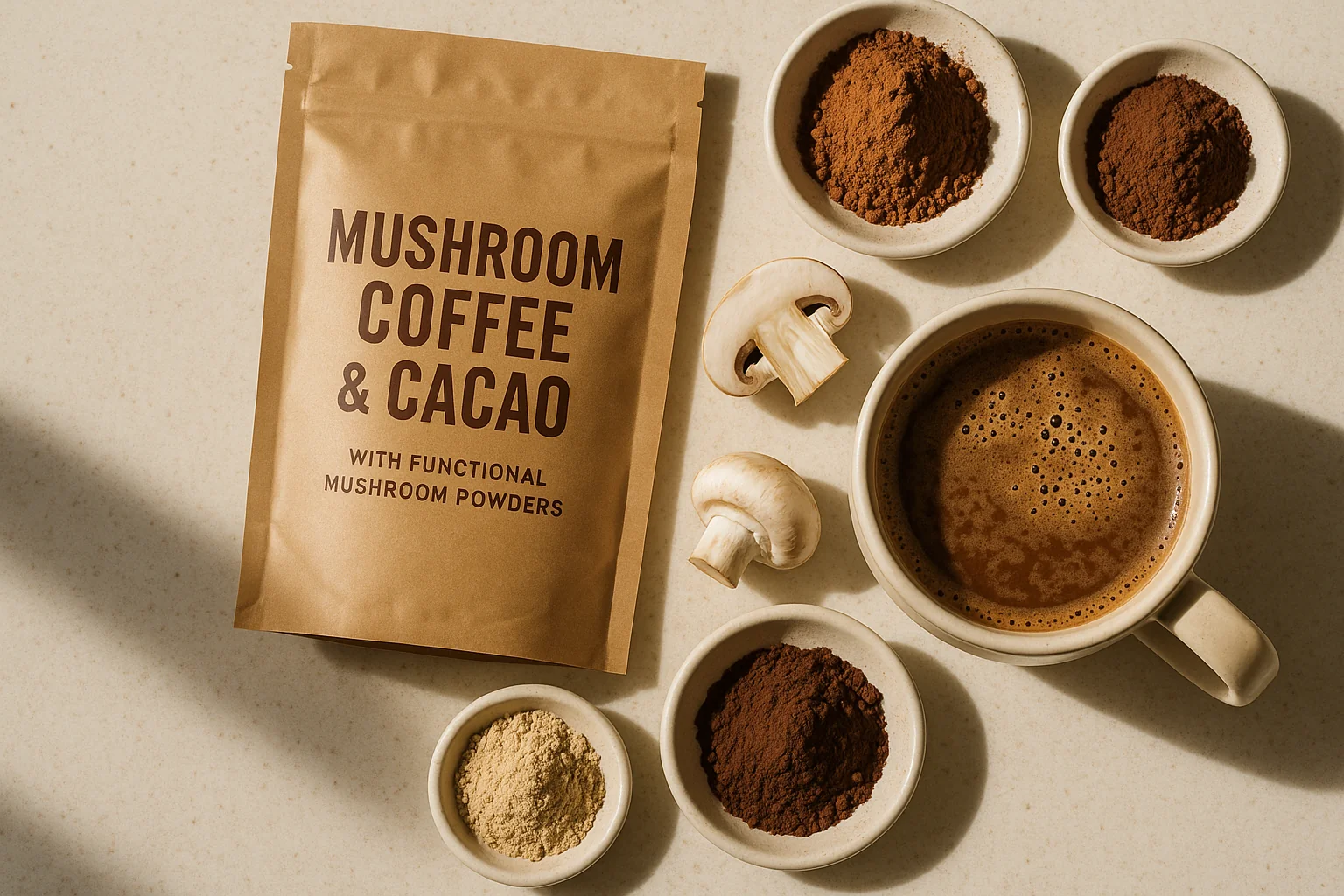

Functional mushrooms in cocoa and coffee: just a trendy fad or does it really work
Functional mushrooms in coffee and cacao – does it work or is it just a trend? Product evaluation, quality requirements, β-glucans, extract 8:1, and a fair analysis 2026.
Sprzedaż produktów „mushroom coffee” i „adaptogenic cacao” wzrosła w pierwszym kwartale 2026 roku o 18% globalnie (Research and Markets, Q1 2026). W każdym Żabce stoją kubki z lion’s mane, każdy influencer wellness pije kakao z reishi. Problem polega na tym, że pod ta samą etykietą „kawa z grzybami” może kryć się produktu z klinicznie aktywną dawką ekstraktu grzyba – albo produkt ze śladową ilością proszku grzybni, który ma więcej wspólnego z marketingiem niż z nauką. Ten artykuł robi to, czego większość recenzji nie robi: uczciwie ocenia rynek, wskazuje pseudonaukowe produkty i podaje konkretne kryteria wyboru tych, które naprawdę działają.
KEY INFORMATION
• Rynek „mushroom coffee” wzrósł o 18% w Q1 2026, ale jakość produktów jest bardzo zróżnicowana – tylko część dostarcza biologicznie aktywnych dawek β-glukanów (Research and Markets, 2026).
• Products with mycelium on grain mainly contain grain starch, not active mushroom polysaccharides – this is the most common market mistake.
• Key quality indicator: declared β-glucan content ≥25% and fruiting body extract (not mycelium).
• A DIY mix with an 8:1 extract powder costs 2–4 times less than ready-made products at the same dose of biologically active ingredients.
Why is the functional mushroom market in beverages full of pseudoscientific products?
Szczerość wymagana przez rzetelny przegląd: znaczna część produktów „mushroom coffee” i „adaptogenic cacao” dostępnych na rynku w 2026 roku to marketing oparty na pseudonauce. Oto dlaczego.
Problem 1 – mycelium on grain instead of fruiting body: Most cheap products grow mushrooms on a grain substrate (rice, oats). Mycelium grows on the grain, and then the whole thing is dried and ground. The final product contains more grain starch than active mushroom polysaccharides. The study by Stamets and Yao (Journal of Dietary Supplements, 2017) showed that products with mycelium on grain contain 2–20 times less β-glucans than fruiting body extracts at the same mass.
Problem 2 – too low a dose per serving: Klinicznie aktywne dawki grzybów funkcjonalnych to 500–2000 mg standaryzowanego ekstraktu dziennie. Wiele gotowych produktów „mushroom coffee” zawiera 100–200 mg proszku grzyba na porcję – to 25–50% minimalnej skutecznej dawki, nawet przy dobrej jakości surowca. Producenci liczą, że konsument nie przeliczy mg na realistyczne oczekiwania.
Problem 3 – lack of standardization: „Zawiera lion’s mane” to nienormatywna informacja. Kluczowe pytanie: „ile mg ekstraktu z owocnika standaryzowanego na ≥25% β-glukanów zawiera jedna porcja?”. Produkty bez tej informacji na etykiecie lub w CoA (Certificate of Analysis) nie pozwalają ocenić skuteczności – i często są po prostu niewystarczające.
Our observations: Testując produkty z rynku polskiego, zauważyliśmy, że nawet produkty z rozbudowanym marketingiem „naukowym” i premium opakowaniem często nie deklarują zawartości β-glukanów na etykiecie. Prosty test: otwórz stronę produktu i szukaj „β-glukanów” lub „polisacharydów”. Jeśli nie znajdziesz ani jednej liczby procentowej – to poważny sygnał ostrzegawczy, niezależnie od ceny i wyglądu opakowania.
How to distinguish good products from bad – selection criteria
The following criteria serve as an elimination filter that sifts out pseudoscientific products without the need for laboratory analysis of each package.
Criterion 1 – fruiting body vs mycelium: Szukaj oznaczenia „fruiting body extract” lub „ekstrakt z owocnika” na etykiecie. Alternatywnie: „Hericium erinaceus fruiting body” lub podobne sformułowania z nazwą łacińską i częścią rośliny. Unikaj „mycelium on grain”, „full spectrum mycelium” lub braku informacji o części rośliny.
Criterion 2 – β-glucan content ≥25%: β-glucans are active polysaccharides responsible for immunomodulation and other biological effects. Every quality fruiting body extract should have ≥25% β-glucans. A CoA (Certificate of Analysis) from an independent laboratory is the gold standard. Products without declared % β-glucans – reject.
Criterion 3 – dose per serving ≥500 mg extract: For a single mushroom: a minimum of 500 mg of standardized extract per serving. For a blend (mix of 3–4 mushrooms): a minimum of 1000 mg blended extract in total. Products with 100–200 mg per serving do not provide effective doses of biologically active ingredients.
Criterion 4 – species name in Latin: „Lion’s mane” to nazwa zwyczajowa. „Hericium erinaceus” to nazwa gatunkowa. Renomowani producenci zawsze podają nazwę łacińską. „Mushroom blend” bez nazw gatunkowych to sygnał ostrzegawczy.
Adaptogenic cacao – what's inside and is it worth it?
Adaptogenic cacao (adaptogenic cacao, ceremonial cacao with mushrooms) is an emerging subcategory of wellness beverages. It combines raw cacao (Theobroma cacao) with functional mushroom powders, and often also with ashwagandha, maca, or other adaptogens.
Cacao itself has value: raw cacao is rich in flavonoids, magnesium, theobromine, and anandamide. Cacao flavonoids exhibit cardioprotective effects and improve blood flow to the brain. Theobromine is less stimulating than caffeine but provides a calm, long-lasting boost. Therefore, the combination of cacao with functional mushrooms makes biological sense – provided the mushrooms are of good quality and in the right dosage.
Adaptogenic cacao with reishi: A classic combination for an evening drink. Reishi promotes sleep at night (GABA-mimetic action), while cacao provides magnesium (which itself supports sleep) and antioxidants. The combination is safe, tasty, and biologically complementary. Look for products with ≥500 mg of reishi extract (10% withanolides) per serving.
Kakao z lion’s mane: Połączenie dla skupienia i nastroju. Lion’s mane stymuluje NGF, kakao poprawia przepływ krwi do mózgu. To kombinacja, która ma sens na rano lub przed pracą wymagającą koncentracji. Odpowiednia dawka lion’s mane: ≥500 mg standaryzowanego ekstraktu z owocnika.
Cacao with cordyceps: An energy-boosting combination. Cordyceps stimulates ATP, and theobromine from cacao provides a calm stimulation. A good choice before workouts or physical activity. Dosage of cordyceps: ≥1000 mg of 4:1 extract or higher.
Will the mushroom trend in beverages last? Market analysis
Research and Markets (2026) estimates the market for functional mushrooms as beverages and supplements to be worth $8.4 billion in 2025, with a projected growth to $16.1 billion by 2030 at a CAGR of 14%. This is not a speculative bubble – it is a lasting megatrend across several sectors.
Czynniki napędzające wzrost: Rosnąca świadomość zdrowotna i aktywne poszukiwanie naturalnych alternatyw dla stymulantów farmaceutycznych i kofeinowych. Estetyka wellness i „clean living” – napoje z grzybami pasują do trendu minimalizmu ingredientowego. Rosnąca liczba badań klinicznych potwierdzających efekty (lion’s mane, reishi, cordyceps) daje kategorii wiarygodność naukową. Social media i influencer marketing – grzyby funkcjonalne są fotogeniczne i dobrze opowiadalne.
Threats to the category: Pseudoscientific products may alienate consumers when they do not experience the promised effects. Lack of regulation – any amount of mushroom allows for its name to be placed on the label. Market inflation – saturation with cheap products may undermine trust in the entire category.
Conclusion: The trend will last for at least another decade, but the category is clearly polarizing – into good products with real, repeatable effects and cheap products that are purely marketing. Consumers with supplement experience are learning to distinguish between these two groups. Your tools: quality criteria from the previous section and always carefully reading the composition along with quality certificates before purchase. An informed consumer makes wise choices.
Sprawdź też artykuł o kawie z lion’s mane
Mushrooms in beverages and temperature – do active ingredients survive brewing?
One of the most common questions regarding functional mushrooms in beverages: does hot water destroy active ingredients? This is a technically important question, as the answer determines whether coffee or cacao with mushrooms is effective supplementation or just pure aesthetics.
β-glucans (polysaccharides): Thermostable up to temperatures above 150°C. The standard temperature of coffee (85–95°C) or tea (70–90°C) does not degrade β-glucans. This is good news – the main class of active mushroom ingredients survives brewing without significant loss.
Triterpenes (reishi, cordyceps): Lipidophilic and generally thermally stable. Brewing temperature does not cause significant degradation of triterpenes. Classic reishi tea (boiling for 20–30 minutes) is a traditional method of extracting triterpenes – high temperature is desirable here, not harmful.
Hericenony i erinacyny (lion’s mane): Less thermally stable than β-glucans and triterpenes. With prolonged boiling above 100°C for an extended period, some hericenones may degrade. With standard addition to coffee or tea (contact with hot liquid for a few minutes), losses are minimal and do not eliminate the biological effect.
Practical conclusion: adding mushroom powder to hot coffee or cacao is biologically safe – active ingredients survive brewing at beverage temperatures. Do not boil mushroom powder for 20+ minutes at high temperatures – this is unnecessary and may degrade some components. A brief mix in hot liquid is optimal.
Comparison of ready-made products vs DIY – economics and quality
Transparentna analiza ekonomiczna pomaga zrozumieć, za co faktycznie płacisz kupując gotowe „mushroom coffee” vs robiąc własny mix.
Typowy gotowy produkt premium (np. Four Sigmatic Lion’s Mane Coffee): Cena około 160–200 zł za 30 porcji = 5,5–6,5 zł/porcję. Zawartość lion’s mane: 250–500 mg ekstraktu 10:1 na porcję. Zawartość β-glukanów: zazwyczaj deklarowane. Jakość: wysoka, certyfikowana. Wadą: wysoka cena dla polskiego konsumenta przy imporcie.
Typowy tani „mushroom coffee” z supermarketu/drogeriii: Price 20–50 PLN for 20 servings = 1–2.5 PLN/serving. Mushroom content: 100–200 mg of powder without standardization for β-glucans. Quality: often mycelium on grain. Biological effects: marginal or zero. Low price justified by low value.
DIY with 8:1 extract powder (recommended): Proszek lion’s mane 8:1 (≥25% β-glukanów): ok. 120 zł za 100 g = 1,2 zł za 1 g. 1 g/dzień = 1,2 zł/dzień. Dodana do własnej kawy: łączny koszt 3–4 zł/porcję (kawa + lion’s mane). Jakość: kontrolowana przez wybór produktu z CoA. Efektywna dawka: gwarantowana. To najlepsza opcja dla osoby świadomej jakości z ograniczonym budżetem.
Economic conclusion: you pay for convenience, not for more active ingredients. Ready premium products are convenient and of good quality, but DIY provides identical or better effects at 50–70% lower price per serving with the right choice of powder. Recommendation: invest once in 100 g of fruiting body extract powder with CoA certification (check the β-glucan content and absence of contaminants), instead of buying cheap ready-made mixtures without declared standardization. One purchase of powder will last for 3–4 months of daily supplementation.
DIY adaptogenic cacao – recipe for an evening drink with reishi
Make your own adaptogenic cacao at home instead of overpaying for ready-made products. Full control over the quality and dosage of active ingredients, at a cost of 3–5 PLN per serving (vs 10–20 PLN for ready premium products).
Evening cacao with reishi (1 serving): Heat 200 ml of plant-based milk (oat or almond) to 70–75°C. Add: 2 teaspoons of raw non-alkalized cacao (10 g), 1/2 teaspoon of reishi extract powder 10:1 (500 mg), a pinch of cinnamon, optionally 1/4 teaspoon of KSM-66 ashwagandha for sleep effects. Mix vigorously or froth with a frother. Sweeten with honey or xylitol to taste. Drink 60–90 minutes before bedtime.
Why it works: reishi (triterpenes – GABAergic and sleep effects) + cacao (magnesium and anandamide – relaxing) + cinnamon (glycemic regulation – stabilizes nighttime blood sugar) = evening drink supporting falling asleep and sleep quality without sleeping pills or medications.
Wariant poranny z lion’s mane i cordycepsa: 200 ml mleka owsianego lub wody, 2 łyżeczki kakao, 1/2 łyżeczki proszku lion’s mane ekstrakt 8:1 (1 g), 1/2 łyżeczki proszku cordyceps militaris ekstrakt 4:1 (1 g), 1/4 łyżeczki cynamonu, opcjonalnie łyżeczka miodu. Podgrzej mleko, wymieszaj wszystkie składniki w blenderze lub spieniaczem przez 30 sekund. Pij 30 minut przed pracą lub treningiem. Lion’s mane poprawia skupienie przez stymulację NGF, cordyceps dostarcza energii przez ATP, kakao wspiera przepływ krwi do mózgu przez flawanoidy. Trzypunktowa synergia kognitywna i energetyczna w jednym napoju.
Frequently Asked Questions
Do functional mushrooms in coffee and cacao really work?
It depends on the quality of the product. Products with certified fruiting body extract (≥25% β-glucans, extract 8:1) can provide biologically active doses in each serving. Products with mycelium powder on grain or without declared β-glucan content are marketing without clinical effects.
How to check if a functional mushroom product is of good quality?
Trzy kryteria: deklarowana zawartość β-glukanów ≥25% na etykiecie lub w CoA, oznaczenie „owocnik” zamiast „mycelium on grain”, oraz łacińska nazwa gatunkowa grzyba. Brak tych informacji to sygnał ostrzegawczy, niezależnie od ceny i wyglądu opakowania.
How many functional mushrooms should one drink contain?
The minimum effective dose is ≥500 mg of standardized mushroom extract (≥25% β-glucans) per serving. Cheaper products often contain 100–200 mg of unstandardized powder – impressive marketing without clinical effects.
What is adaptogenic cacao and how does it differ from regular cacao?
Kakao adaptogeniczne to mieszanka kakao z proszkami grzybów funkcjonalnych (reishi, lion’s mane, cordyceps) i często innymi adaptogenami. Wartość zdrowotna zależy całkowicie od jakości i dawki grzybów – kakao samo w sobie dostarcza magnezu, flawonoidów i teobromy, ale nie NGF ani triterpenów.
What is the best way to consume functional mushrooms daily?
Standaryzowany ekstrakt grzyba w kapsułkach lub proszku 8:1 plus ulubiony napój (kawa, herbata, kakao) jako nośnik. DIY mix z proszkiem 8:1 jest 2–4x tańszy niż gotowe produkty „mushroom coffee” przy tej samej dawce biologicznie aktywnych składników.
This article is for informational and educational purposes and does not replace consultation with a doctor. If you are pregnant, breastfeeding, taking medications, or have chronic conditions, consult the use of supplements or herbs with a specialist.
Author: Michał Waluk · Published: 2026-05-04 · Updated: 2026-05-04