
710 (dabbing day) - what is it and how does it differ from 420 (definition)
710 - what it is, how it works, and what for. A guide from u Bucha.
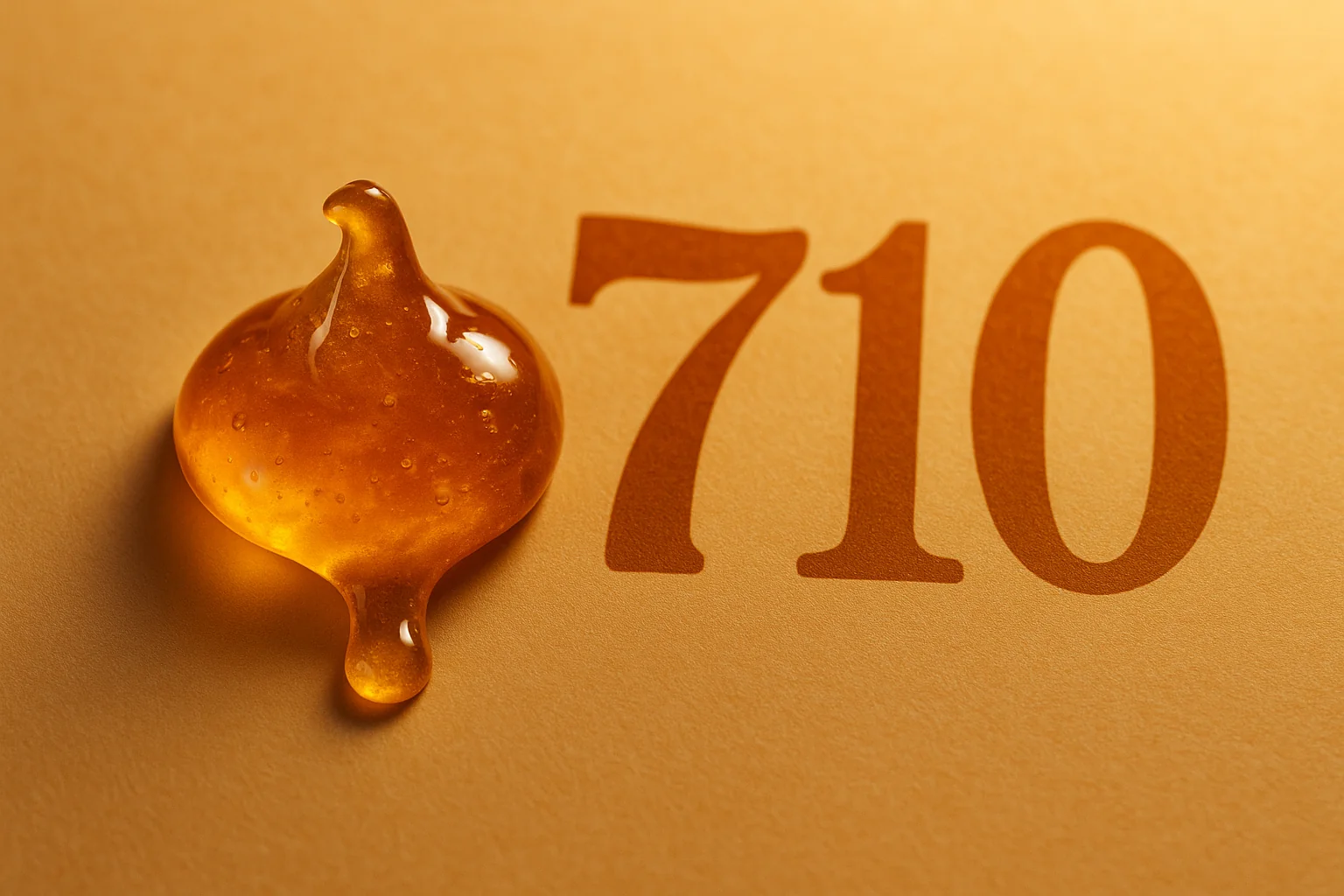
You type "710" into the search engine and get a mix of results: a date in July, some cannabis oil, a discussion forum. There’s no obvious clue here - unless you turn the number upside down. 710 read backwards looks like "OIL". This simple idea gave rise to an unofficial holiday in dabbing culture, celebrated on July 10 by cannabis concentrate enthusiasts around the world. This article explains what 710 is, how it relates to the more well-known 420, and why the concentrate culture has created its own holiday and vocabulary.
KEY INFORMATION
• The number 710 read upside down looks like the word "OIL" - hence July 10 (7/10 in US notation) is the unofficial day of dabbing and concentrates culture.
• The term emerged in social media around 2012, making it much younger than "420" (from the 1970s).
• Cannabis concentrates typically contain 60-90% cannabinoids, compared to 10-25% in flower (UNODC Cannabis Monograph, 2022).
• 420 is a mass celebration of the entire cannabis culture, while 710 is a niche term for concentrate specialists.
What is 710? Where does this number come from?
The history of the number 710 in cannabis culture is much simpler than that of 420. It’s a visual trick: the digits 7, 1, and 0 arranged together and turned 180 degrees resemble the English word "OIL". Hence, it is associated with cannabis oils, resins, and concentrates.
The date July 10 (in American notation: 7/10) became an unofficial holiday for dabbing culture around 2011-2012. Unlike "420", which has a specific origin linked to a group of students from San Rafael, California in 1971, the beginnings of "710" are harder to attribute to a single person or group. The term spread mainly through platforms like Reddit, Instagram, and YouTube, where concentrate enthusiasts began tagging posts with #710 and #OILday.
In 2013, the first major event called the "710 Cup" was organized in Denver, Colorado - a competition for concentrate producers, analogous to the popular Cannabis Cups for flowers. Today, the "710 Cup" and similar events take place in various cities across the USA where marijuana is legal, attracting both producers and collectors of dabbing equipment.
420 vs. 710 - a table of differences
Two numbers, one culture - but different traditions, various subcultures, and different levels of recognition. The table below organizes how 420 and 710 differ from each other.
| Feature | 420 | 710 |
|---|---|---|
| Date | April 20 (4/20) | July 10 (7/10) |
| Symbolic time | 4:20 (AM or PM) | 7:10 (AM or PM) |
| Association with product | Hemp flower, general culture | Concentrates, oils, dab |
| Year of popularization | 1980s (by fans of Grateful Dead) | Around 2012 (social media) |
| Global recognition | Mass (mainstream) | Niche (enthusiasts) |
| Connection to activism | Strong (legalization marches) | Weak (more consumer-oriented) |
| Etymology | Historical (school in San Rafael, 1971) | Visual (710 = OIL reversed) |
The table shows that 420 is a cultural foundation, while 710 is a specialized overlay - a term that does not replace 420 but expands the vocabulary of cannabis culture to include the concentrate dimension. Someone who knows 420 may not necessarily know 710 - but someone deeply immersed in dabbing culture knows both.
What is dabbing and what concentrates does the 710 culture use?
Dabbing is a method of consuming cannabis concentrates by vaporizing them on a very heated surface and inhaling the resulting vapor. A dabbing device typically consists of glass or quartz tubes with a heater (called a "nail" or "banger"), heated with a torch or electrically. A portion of concentrate (known as a "dab" - hence the name) is placed on the hot surface and instantly vaporizes.
The world of cannabis concentrates is surprisingly diverse. Each form has a different texture, production method, and flavor profile:
Shatter - glassy-transparent form, hard at room temperature, shatters like glass. Produced by butane extraction (BHO) and long purging. Typically high purity, 70-90% cannabinoids.
Wax / budder / crumble - waxy forms with a creamy or crumbly texture. Produced similarly to shatter, but with a different finishing process (whipping, heat). Often has a more intense aroma than shatter.
Rosin - the only form of concentrate without solvents. Produced by pressing flower or kief under high pressure and heat (around 80-120°C). Retains the full spectrum of terpenes. Can be made at home with a simple press.
Live resin - produced from freshly frozen (not dried) plant material. Freezing immediately after harvest preserves the terpene profile of the "live" plant. The most intense flavor of all concentrates, but more expensive to produce.
Rosin is currently the most popular form of concentrate in legal markets, precisely because it does not require dangerous solvents. In the United States, where marijuana is legal, the sale of solventless concentrates is growing faster than the entire concentrate segment - conscious consumers choose rosins not only for flavor but also as a "cleaner" option. This is a trend that will likely reach Europe as regulations catch up with the market.
710 and safety: what you should know about dabbing
Dabbing eliminates the combustion of plant material, which reduces exposure to tar and carbon monoxide compared to traditional smoking. However, the method has its own risks, which the 710 community is increasingly discussing openly.
The main issue is temperatures. Traditional dabbing uses temperatures above 370°C (700°F) - at such values, the concentrate burns rather than vaporizes. A study published in ACS Omega found that dabbing at high temperatures produces methane, benzene, and toluene in detectable amounts (Meehan-Atrash et al., ACS Omega, 2017). Low temperatures (180-230°C, used in "low-temp dabs") minimize this effect.
The second aspect is the high concentration of cannabinoids. A dab contains 60-90% THC (in the case of marijuana) - many times more than a typical joint. For those without tolerance, this can lead to unpleasant experiences, anxiety, or strong sedation. The 710 culture has developed its own guidelines for a "low-temp low-dose approach" for new consumers.
The 710 culture dictionary - terms worth knowing
The concentrate culture has developed its own dictionary, which sounds like a foreign language to newcomers. Familiarity with these terms helps understand reviews, product labels, and discussions in enthusiast forums.
Dab - a portion of concentrate the size of a grain of rice or smaller, placed on a heated surface. One of the typical doses when dabbing.
Nail / banger - a bowl or platform made of quartz, titanium, or ceramic, on which the dab is placed. Heated with a torch or electrically (e-nail). Quartz is the most common due to its neutral taste and good thermal conductivity.
Carb cap - a cap for the banger that restricts airflow and allows the concentrate to vaporize at lower temperatures. A key element for 'low-temp dabs' - dabbing at low temperatures for better flavor.
Terp pearls - small quartz balls placed in the banger before heating. They rotate during inhalation and evenly distribute the concentrate across the surface, improving vaporization efficiency.
E-nail - an electronic temperature controller that replaces the torch. It maintains a constant temperature in the banger, eliminating guesswork and the risk of overheating. An investment of around 100-300 USD, but recommended for anyone who dabs regularly.
Cold start dab (reverse dab) - reverse technique: the dab is placed on a cold banger and then slowly heated. Effect: lower temperature, less combustion, more intense terpene flavor. Popular among those who value flavor profile over intensity.
Reclaim - a yellowish-brown residue that accumulates in the glass components of the dab rig after multiple uses. It contains residual cannabinoids. It can be collected and reused - less tasty than fresh concentrate, but fully active.
Frequently Asked Questions
Why has the date 7/10 become a symbol of dabbing culture?
The number 710 read upside down looks like the word 'OIL'. That’s why July 10th (7/10 in the American month/day format) has become an unofficial holiday of dabbing and cannabis concentrates culture. This term emerged on social media around 2012 and quickly spread within concentrate enthusiast communities.
What is dabbing and what concentrates are used for it?
Dabbing is a method of consuming cannabis concentrates (oils, resins, waxes) by vaporizing them on a heated surface and inhaling the vapor. Various forms of concentrates are used for dabbing: shatter, wax, rosin, live resin, and BHO. Concentrates typically contain 60-90% cannabinoids vs. 10-25% in dry herb (UNODC Cannabis Monograph, 2022).
What are the differences between 420 and 710 in cannabis culture?
420 is a cultural holiday for cannabis celebrated on April 20th, rooted in the history of the 70s and associated with the entire cannabis culture. 710 is a more niche holiday, focused solely on concentrates and dabbing culture - newer (since around 2012), more technical, and more related to advanced consumption methods. 420 has mass appeal, while 710 remains a specialized term among enthusiasts.
Is dabbing safer than smoking?
Dabbing eliminates the combustion of plant material, which reduces the inhalation of tar and carbon monoxide. However, very high temperatures in traditional dabbing (above 370°C) create toxic products of thermal decomposition (Meehan-Atrash et al., ACS Omega, 2017). New e-nail technologies allow for temperature control and reduce this risk when using low temperatures (180-230°C).
How to read the composition of hemp concentrate?
A good laboratory certificate for a concentrate should include: total cannabinoid content (THC total, CBD total), terpene profile, testing for residual solvents (when extracted with butane BHO), testing for pesticides and heavy metals. For legal products in Poland - always check the certificate from an accredited laboratory.
This article is for informational and educational purposes and does not replace consultation with a doctor. If you are pregnant, breastfeeding, taking medications, or have chronic conditions, consult the use of supplements or herbs with a specialist.
Author: Michał Waluk · Published: 2026-05-04 · Updated: 2026-05-04