
Adaptogenic mushrooms (lion’s mane, reishi, chaga, cordyceps): which to choose and when
Lion's mane, reishi, chaga, and cordyceps: what studies involving humans have shown and how much a daily portion costs. Prices from the u Bucha store, as of 2026-08-08.
Four mushrooms, four different goals, and four very different levels of evidence. Lion's mane, reishi, chaga, and cordyceps end up on the same shelf, in the same cocoa, and in the same gummies, but each has been studied differently, and one of them has hardly been studied in humans at all. Producers rarely separate this, so on one shelf, you find cocoa with five species alongside gummies with one, and both descriptions sound the same. This text separates them: it shows what specifically was measured in studies involving humans, where clinical data ends and animal models begin, and how much a daily portion of products available in the u Bucha store actually costs. At the end, you will find a plan for the first twelve weeks and a checklist of things to check on the label before you pay.
KEY INFORMATION
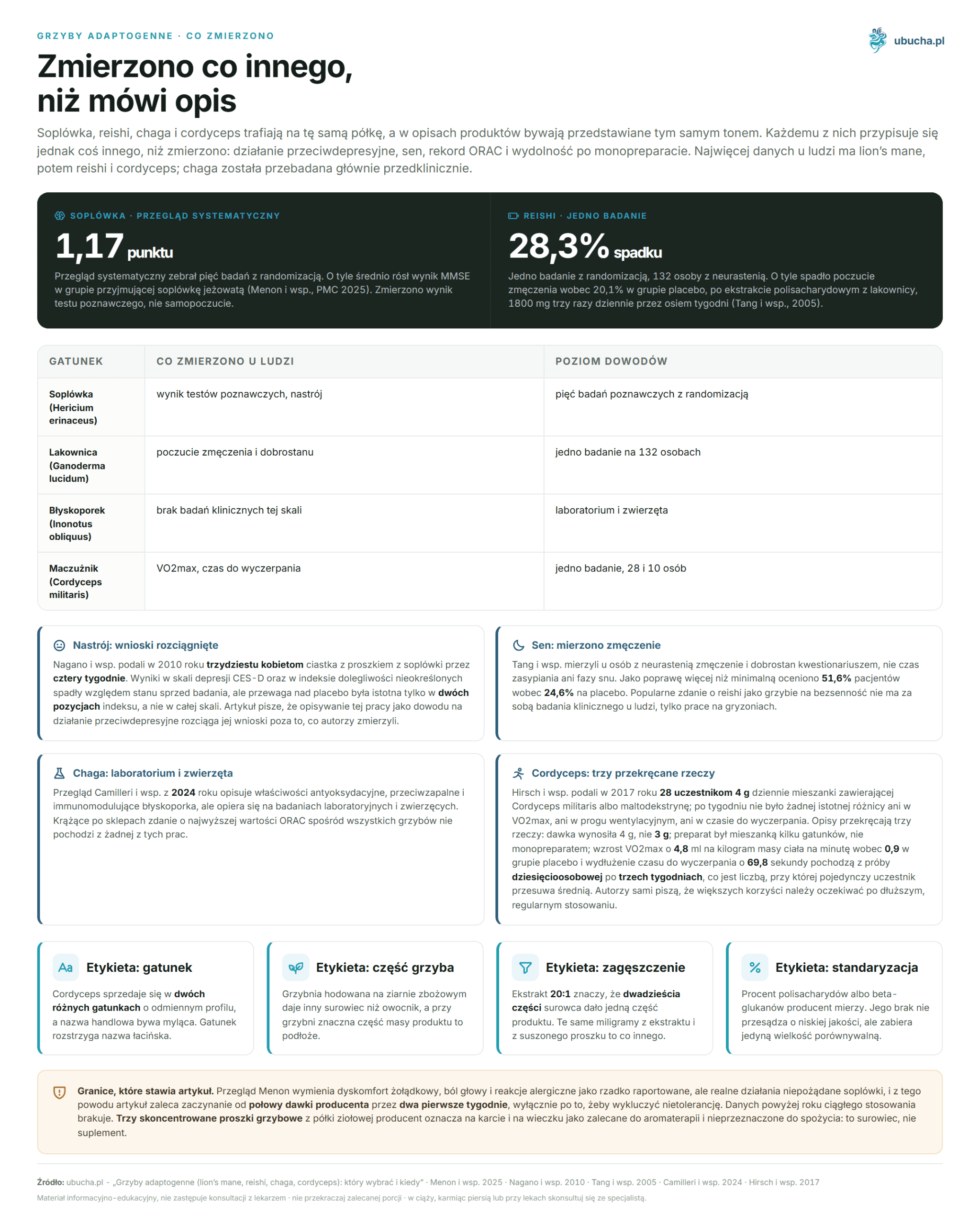
• A review of five randomized studies on lion's mane reports an average increase of 1.17 points in the MMSE score (Menon et al., PMC 2025).
• The most data in humans is available for lion's mane, followed by reishi and cordyceps; chaga has mainly been studied preclinically.
• The cost of a daily portion in the u Bucha store ranges from 2.63 PLN to 7.90 PLN, as of 2026-08-08.
Which adaptogenic mushroom affects the brain and memory?
Hericium erinaceus, commercially described as lion's mane. It is the only one of the four species that has undergone repeated cognitive studies in humans. Systematic review by Menon et al. from 2025 gathered five randomized studies and reported an average increase of 1.17 points in the MMSE score in the group taking the mushroom.
The reference point for all subsequent works is the Japanese study by Mori et al. from 2009. Thirty people aged 50 to 80 with mild cognitive impairment took tablets with dried lion's mane for 16 weeks, four pieces of 250 mg three times a day. The score on the HDS-R scale increased at weeks 8, 12, and 16, and four weeks after discontinuation, it clearly dropped. This last sentence is more important here than the increase itself: the effect lasted as long as the intake did.
The second thread is mood. Nagano i wsp. w 2010 roku they gave thirty women cookies with lion's mane powder for four weeks. The results on the CES-D depression scale and the index of unspecified ailments decreased compared to the state before the study. The advantage over placebo was significant only in two positions of the index, not across the entire scale, so describing this work as evidence of antidepressant action stretches its conclusions beyond what the authors measured.
When to choose reishi and when to choose chaga?
You choose reishi for persistent fatigue, and chaga for oxidative stress and inflammatory conditions. The difference between them is not just in their effects, but in the quality of evidence: reishi has a randomized study on humans, while chaga has no comparable studies.
Tang i wsp. w 2005 roku They administered a polysaccharide extract from the mushroom to 132 individuals diagnosed with neurasthenia at a dose of 1800 mg three times a day for eight weeks. The sense of fatigue decreased by 28.3% compared to 20.1% in the placebo group, and 51.6% of patients rated their improvement as more than minimal compared to 24.6% in the placebo group. It's worth reading what was measured in this study because it wasn't about sleep. Fatigue and well-being were measured using a questionnaire, not sleep onset time or sleep phases. The popular statement about reishi as a mushroom for insomnia lacks clinical studies on humans, only research on rodents. You can find more about the species itself in naszym przewodniku po reishi.
Chaga, known in Polish as the birch polypore, grows on birches in the cool forests of the Northern Hemisphere and forms black, cracked growths. The review by Camilleri et al. from 2024 describes its antioxidant, anti-inflammatory, and immunomodulatory properties, but it is based on laboratory and animal studies. The circulating claim about the highest ORAC value among all mushrooms does not come from any of these studies.
What did the study on cordyceps show?
An increase in oxygen uptake after three weeks, but in a group of ten people and after a mixed mushroom blend, not pure cordyceps. Hirsch i wsp. w 2017 roku They administered 4 g daily to 28 participants of a mixture containing Cordyceps militaris or maltodextrin.
After a week, there was no significant difference between the groups: neither in VO2max, nor in the ventilatory threshold, nor in time to exhaustion. Only ten individuals who extended supplementation for another two weeks achieved a significant increase in VO2max of 4.8 ml per kilogram of body weight per minute compared to 0.9 in the placebo group, as well as an extension of time to exhaustion by 69.8 seconds. The authors themselves state that greater benefits should be expected from longer, regular use.
Three things from this study are regularly misrepresented in product descriptions. The dose was 4 g daily, not 3 g. The preparation was a mixture of several species with cordyceps, not a mono-preparation. The result after three weeks comes from a ten-person trial, which is a number where a single participant can skew the average. We described the detailed dosing of the species itself in osobnym przewodniku o cordycepsie.
How do these four species differ?
In short: they differ in the active fraction and how far the research has progressed. The common denominator is polysaccharides, including beta-glucans, but apart from them, each species brings something different, and the level of confirmation in humans varies significantly among them.
| Species | Nazwa polska | Frakcja aktywna | What has been measured in humans | Level of evidence |
|---|---|---|---|---|
| Hericium erinaceus | Lion's Mane Mushroom | hericenony, erinacyny, beta-glukany | cognitive test results, mood | five randomized studies |
| Ganoderma lucidum | yellow reishi | triterpenoidy, polisacharydy | sense of fatigue and well-being | jedno badanie na 132 osobach |
| Inonotus obliquus | birch polypore | melanins, phenolic compounds, triterpenoids | lack of clinical studies of this scale | laboratory and animals |
| Cordyceps militaris | caterpillar fungus | kordycepina, adenozyna, polisacharydy | VO2max, czas do wyczerpania | one study, 28 and 10 people |
This last column determines what you can expect from the preparation. With lion's mane, we talk about repeated results in several randomized trials, while with chaga, we refer to mechanisms described in vitro and in rodents. This is a difference of magnitude, not nuance, although in product descriptions, both things are often presented with the same tone and vocabulary. It's also worth remembering that shiitake and turkey tail, which appear in blends available in stores, are two separate species with their own research profiles, not discussed in this context.
How much does a daily portion of mushrooms cost at u Bucha?
From 2.63 PLN to 7.90 PLN, depending on the form. The price of the packaging alone says nothing, as packages contain from ten to thirty-three servings. Below, we calculated the catalog price to the cost of one daily serving based on the number of servings declared by the manufacturer. Prices are from the store, as of August 8, 2026.
| Product | What distinguishes | Price | Porcji | Koszt porcji |
|---|---|---|---|---|
| Lion's Mane Vegan Gummies 60 pcs. | 4000 mg of lion's mane per serving, 20:1 extract from fruiting bodies | 78.97 PLN | 30 | 2.63 PLN |
| Lion's Mane Berry Gummies 60 pcs. | ta sama dawka, baza bez cukru | 83.89 zł | 30 | 2.80 zł |
| Boska Lion’s Mane krople 50 ml | ekstrakt 10:1, 1500 mg w porcji 1,5 ml | 95.00 zł | ok. 33 | 2.88 zł |
| 4 Mushroom Complex Gummies 60 pcs. | lion's mane, chaga, reishi, shiitake at 1000 mg | 89.96 zł | 30 | 3.00 zł |
| MIND IN SHAPE Gummies 30 pcs. | 150 mg cordycepsu, zawiera 20 mg kofeiny z guarany | 55.00 PLN | 15 | 3.67 zł |
| Shroomix kakao 240 g | five species at once, with cordyceps and turkey tail | 149.00 zł | ok. 30 | 4.97 zł |
| Adaptogenic Chocolate Plum 100 g | 1000 mg lion's mane per serving, drink form | 69.00 zł | 10 | 6.90 zł |
| Adaptogenialna Kawa 100 g, trzy warianty | lion's mane 1000 mg and cordyceps, reishi, and chaga each 300 mg | 79.00 zł | ok. 10 | 7.90 zł |
| Aura Care Lion's Mane 50 ml | macerat olejowy bezalkoholowy, 1500 mg w porcji | 129.00 zł | porcja podana w kroplach | brak podstawy do przeliczenia |
We intentionally left the last line without a number. The manufacturer defines a serving as 32 drops per day, but does not specify how many servings are in the bottle, and calculating drops to milliliters on your own would yield a number that looks precise but is not based on anything.
Why does the cost per serving differ by more than three times?
Because you are paying for the form, not for the mushroom. The cheapest and most expensive items in the table differ by a factor of three, while the difference in mushroom content per serving goes exactly in the opposite direction: gummies at 2.63 zł carry 4000 mg of lion's mane, while coffee at 7.90 zł has one thousand milligrams.
While browsing the catalog, we noticed something that can mislead more than the price per package. Three concentrated mushroom powders on the herbal shelf appear to be the cheapest source of raw material: reishi 20:1 in a 5 g jar for 59.90 zł and chaga 25:1 in the same weight for 69.90 zł. However, the manufacturer clearly marks them, on the product card and on the lid, as recommended for aromatherapy and not intended for consumption. This is raw material, not a supplement, and should not be compared in cost per serving with gummies or drops. You can find the full range of edible mushroom products in the category adaptogens.
How to plan the first twelve weeks?
With one species, for at least eight weeks, keeping a record of what you observe. The Mori study lasted 16 weeks, and differences appeared from the eighth week. Evaluating a product after two weeks is assessing it before anything has been measured.
Start with half the manufacturer's dose for the first two weeks. The goal is solely to rule out intolerance: the Menon review lists stomach discomfort, headaches, and allergic reactions as rarely reported but real side effects of lion's mane. From the third week, switch to the full dose and maintain it unchanged until the end of the eighth.
Keep a short journal. Each morning, one line: energy, focus, sleep quality on a scale from one to ten. Look at the trend over the week, not a single day, because daily fluctuations are greater than the effect you are looking for. After eight weeks, you have a basis for a decision: you stay, change the species, or discontinue.
Add the second species only after you have evaluated the first. Adding it earlier guarantees that you won’t find out which one made any difference. After twelve weeks, a break for four weeks makes practical sense, not pharmacological: it shows a contrast that you wouldn’t notice with continuous use.
What to look for on the label before purchasing?
For four things, in this order. The first is the species given by its Latin name. Hericium erinaceus, Ganoderma lucidum, Inonotus obliquus, and Cordyceps militaris are specific organisms, and the trade name can be misleading, as cordyceps is sold in two different species with different profiles.
The second part is the mushroom. The fruiting body and mycelium grown on grain provide distinctly different raw materials, and with mycelium, a significant portion of the product's mass is the substrate. Both jelly preparations and the four-mushroom complex in the u Bucha store declare an extract from the fruiting bodies, and this is the information you are looking for in the ingredient list.
The third is the degree of concentration along with the mass per serving. An extract of 20:1 means that twenty parts of the raw material yielded one part of the product, so 4000 mg of lion's mane calculated from a 20:1 extract is different from 4000 mg of dried powder. Manufacturers provide this number in both ways, and you need to check which one was used.
The fourth is standardization to the active fraction, most often to polysaccharides or beta-glucans. The percentage declaration on the label means that the manufacturer measures this fraction. Its absence does not determine low quality, but it takes away the only metric that can be compared between two packages. You will find jelly preparations in the category jelly candy, a proszkowe ekstrakty w kategorii herbs.
Frequently Asked Questions
How do adaptogenic mushrooms differ from regular edible mushrooms?
Functional mushrooms are species whose polysaccharides, triterpenoids, and phenolic compounds have been studied for their effects on immunity, inflammation, and oxidative stress (Sadowska i wsp., PMC 2026). You buy edible mushrooms for their nutritional value and taste, while functional mushrooms for the active fraction that the manufacturer standardizes and lists on the label.
Which mushroom has the most data on memory and concentration?
Lion's mane, or Hericium erinaceus. A systematic review from 2025 included five randomized studies and reported an average increase of 1.17 points in the MMSE score in the group taking the mushroom (Menon i wsp., PMC 2025). It is the only one of the four species with repeated cognitive studies in humans.
Does reishi help with sleep?
A randomized study on 132 people with neurasthenia measured feelings of fatigue and well-being, not sleep architecture. After eight weeks, fatigue decreased by 28.3% compared to 20.1% in the placebo group (Tang i wsp., 2005). There is simply no evidence for reducing sleep onset time in humans.
How much does a daily portion of adaptogenic mushrooms cost?
In the u Bucha store, the price per daily serving ranges from 2.63 PLN for lion's mane gummies to 7.90 PLN for adaptogenic coffee or chocolate, as of August 8, 2026. The range comes from the form of the product, not the amount of mushroom in the serving, as the cheapest item contains the most.
Can powdered mushroom extract from the herbal shelf be consumed?
No, if the producer has labeled it otherwise. Three concentrated mushroom extracts in the u Bucha store have a note on the card and lid stating that they are recommended for aromatherapy and are not intended for consumption. This is a raw material category, not a supplement, despite the very low price per gram.
Can adaptogenic mushrooms be taken daily and what side effects do they cause?
Mushroom preparations are designed for continuous use, and studies lasted from four to sixteen weeks. The systematic review of lion's mane mentions gastrointestinal discomfort, headaches, and allergic reactions as rarely reported side effects (Menon i wsp., PMC 2025). There is a lack of data beyond one year of continuous use.
If you are looking for ready-made preparations with these species, you will find a full selection of mushroom blends, coffees, and chocolates in the category adaptogens, and single-ingredient preparations in the category supplements.
The article is informational and educational in nature and does not replace consultation with a doctor. If you are pregnant, breastfeeding, taking medications, or have chronic conditions, consult the use of supplements or herbs with a specialist.
Author: Michał Waluk · Opublikowano: 2026-06-02 · Aktualizacja: 2026-08-08