
Polish medicinal mushrooms (oyster, butter) - do they match reishi (FAQ)
Polish medicinal mushrooms: answers to the most common questions and what studies say. u Bucha.
Reishi, chaga, lion’s mane - exotic medicinal mushrooms from Asia and Siberia have dominated the supplement market and health article headlines. Meanwhile, in Polish forests grows the turkey tail, one of the best-studied immunological mushrooms in the world. The oyster mushroom available in every supermarket contains a natural statin, ergothioneine, and beta-glucans. This article answers a question that is rarely asked directly: do Polish, European mushrooms have real medicinal value and in what ways do they potentially fall short of more expensive Asian species?
KEY INFORMATION
• Oyster mushroom contains lovastatin - a natural statin that lowers LDL cholesterol by 10-15% in clinical studies (Alam et al., Evidence-Based Complementary Medicine, 2011).
• Turkey tail grows wild in Poland and is one of the most well-researched immunological mushrooms in the world.
• Polish edible mushrooms contain 14 to 35% beta-glucans in dry mass - comparable to exotic species.
• Reishi is distinguished by its unique content of triterpenoids (ganoderic acids), which are absent in oyster mushrooms and slippery jacks.
• Cooking does not destroy beta-glucans - they are thermally stable.
• Never consume mushrooms without certain identification - confusing species poses a risk of poisoning.
Oyster mushroom - a European mushroom with a medicinal composition
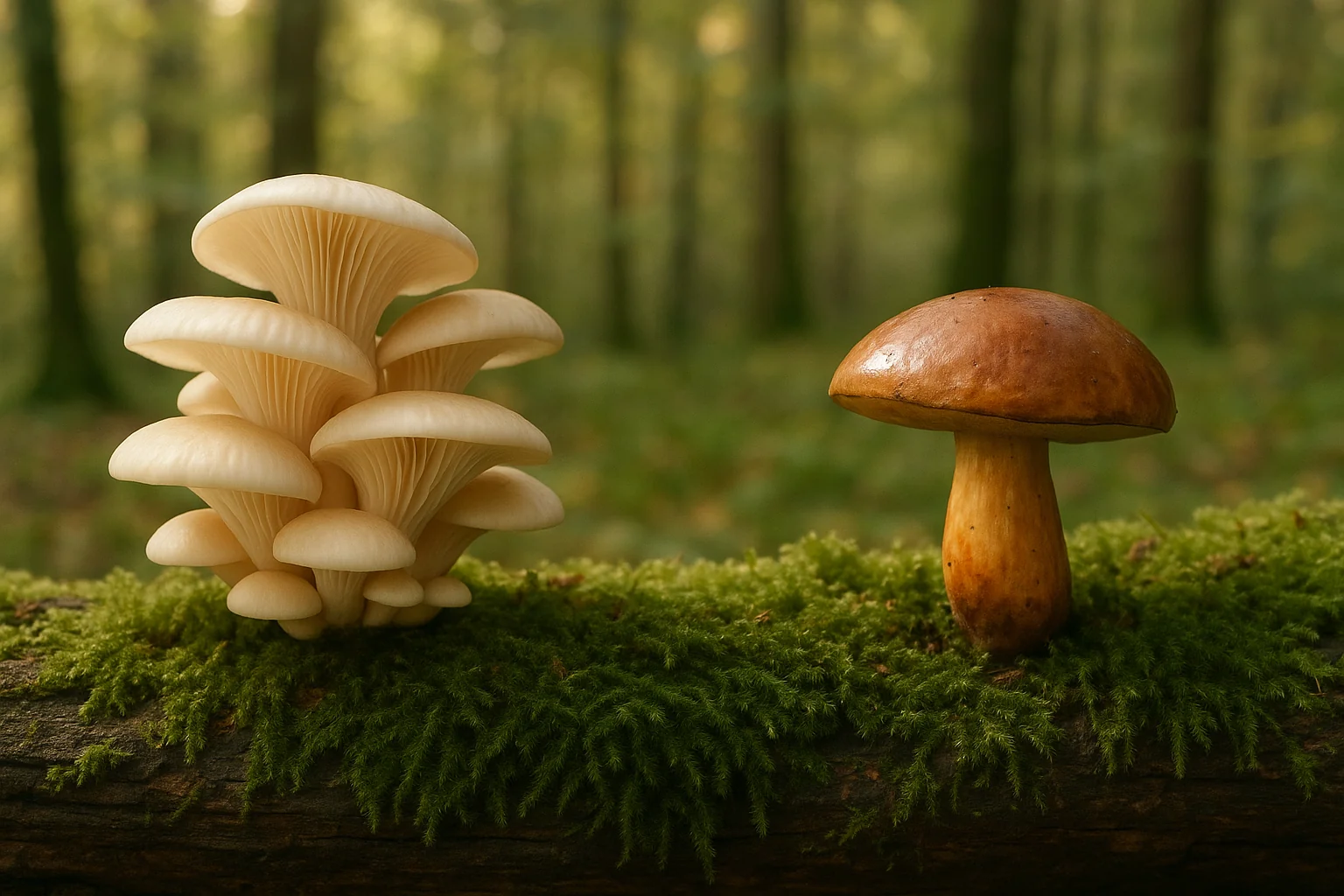
Oyster mushroom (Pleurotus ostreatus) grows wild on dead hardwood in Poland from spring to late autumn and is commonly cultivated commercially. The price in supermarkets is a fraction of the cost of exotic mushroom supplements. And the chemical composition is surprisingly rich.
Laboratory and clinical studies have confirmed several areas of biological activity of oyster mushrooms. First, lovastatin - a naturally occurring statin that inhibits HMG-CoA reductase, a key enzyme in cholesterol synthesis. A pilot study published in Evidence-Based Complementary and Alternative Medicine showed that regular consumption of oyster mushrooms lowered LDL cholesterol and triglycerides while increasing HDL (Alam et al., 2011). The effect was significant, although the study was small and requires confirmation in larger trials.
Secondly, ergothioneine - an antioxidant amino acid synthesized exclusively by fungi and certain bacteria, selectively accumulating in organs with high energy demands (brain, heart, liver). The oyster mushroom is one of the richest available sources of ergothioneine - richer than the common mushroom or chanterelle. Thirdly, beta-glucans - immunomodulating polysaccharides with a structure similar to those found in Asian medicinal mushrooms.
Common mushrooms and other Polish fungi - what you should know
Slippery jack (Suillus luteus) is one of the most common forest mushrooms in Poland, growing under pine trees. It is tasty but rarely discussed in the context of health properties. Studies have shown that it contains polysaccharides with a structure similar to beta-glucans and has antioxidant effects. Luteolin - characteristic of the genus Suillus component - shows anti-inflammatory activity in in vitro studies.
Chanterelle (Cantharellus cibarius) stands out for its exceptional content of carotenoids (especially cantaxanthin and beta-carotene), vitamin D, and B vitamins. It is one of the few mushrooms with a naturally high concentration of vitamin D - 100 g of chanterelles can provide several dozen IU. This is useful in the context of vitamin D deficiencies common in Poland.
| Species | Distinctive ingredients | Documented effect | Availability in Poland |
|---|---|---|---|
| Oyster mushroom | Lovastatin, ergothioneine, beta-glucans | Lowering LDL, immunomodulation, antioxidation | Supermarket, home cultivation |
| Trametes versicolor (turkey tail) | PSK, PSP, beta-glucans | Immunomodulation, support for microbiota | Wild in forests, dried in stores |
| Chanterelle (Cantharellus cibarius) | Carotenoids, vitamin D, B vitamins | Antioxidation, support for vitamin D | Forests, markets |
| Common mushroom | Beta-glucans, ergothioneine, selenium | Immunomodulation, antioxidation | Supermarket |
| Reishi (Asian) | Triterpenoids, polysaccharides, peptidoglycans | Immunomodulation, adaptogenic effects | Supplement stores |
Where Polish mushrooms fall short compared to reishi - a fair comparison
Reishi (Ganoderma lucidum) contains a group of compounds not found in common Polish mushrooms: triterpenoids, primarily ganoderic acids (A, B, C, D, and others). These bitter substances - responsible for the characteristic taste of reishi - show a unique action profile in studies: modulation of the immune system through pathways other than beta-glucans, potential hepatoprotective and adaptogenic effects. Reishi also has significantly more clinical studies, particularly in the context of oncology and fatigue.
Chaga (Inonotus obliquus) growing on birch - including in Poland, in primeval forests - is distinguished by its exceptional content of betulinic acid and melanins, with adaptogenic and antioxidant properties. It is available in Poland but requires specialized knowledge for identification and preparation.
The answer to the titular question is therefore complex: Polish medicinal mushrooms have real bioactive value, in some areas (lovastatin in oyster mushrooms, PSK in turkey tail) surpassing or matching exotic species. In others (triterpenoids in reishi, D-fraction in maitake) they are simply different - with a different profile of active substances, not worse, but distinct.
Ergothioneine - why Polish mushrooms may be an underrated source
Ergothioneine is a sulfur-containing amino acid, synthesized exclusively by fungi and certain bacteria - humans cannot produce it themselves and must obtain it from their diet. Epidemiological studies from the last decade have begun to link higher intake of ergothioneine with a lower risk of neurodegenerative diseases, cardiovascular diseases, and overall longevity. An article published in FEBS Letters 2012 by Cummins and colleagues described ergothioneine as a potential "longevity vitamin" - although this is a media term, not an official scientific term.
What does the oyster mushroom have to do with this? It is one of the richest culinary sources of ergothioneine available. 100 g of fresh oyster mushrooms provides several to dozens of mg of ergothioneine - significantly more than the common mushroom, chanterelle, or most vegetables (which contain trace amounts or none at all). In other words: by regularly eating oyster mushrooms, we provide our bodies with a substance that it cannot produce on its own, and whose potential health benefits are the subject of intensive research.
Ergothioneine is also unique in terms of pharmacokinetics: it has its own transporter - hERGT1 (human ergothioneine transporter) - which actively absorbs it from the intestines and selectively accumulates it in tissues exposed to oxidative stress: mitochondria, erythrocytes, the lens nucleus of the eye, and brain cells. This targeted transport indicates that the body evolutionarily "wanted" access to ergothioneine - suggesting that a diet rich in mushrooms may have been an important element of the evolutionary diet of humans.
How to incorporate Polish medicinal mushrooms into your diet - practically
The easiest strategy is to regularly include oyster mushrooms in your diet - two to three times a week, sautéed, stewed, or baked. Brief sautéing in a pan with olive oil and garlic preserves beta-glucans and most of the ergothioneine. Oyster mushrooms are available year-round in every supermarket and are significantly cheaper than mushroom supplements.
The common mushroom - the most common and cheapest - should be eaten at least once a week. Studies indicate that even minimal regular consumption of mushrooms (100 g per week) is associated with significant metabolic benefits in long-term cohort observations. For those who do not like the taste of mushrooms, dried mushroom powders are available to add to soups and sauces - preserving the properties of beta-glucans.
Turkey tail is available as dried slices for brewing tea or as an extract in capsules. It is a wood-decaying mushroom, so it does not taste like an edible culinary mushroom - it is used exclusively in the form of an infusion or supplement. Long brewing (20-30 minutes in hot water) is crucial for good extraction of PSK and PSP from the tough fruiting body.
Frequently Asked Questions
Do Polish forest mushrooms have medicinal properties?
Yes - many common Polish mushrooms contain bioactive substances with documented properties. Oyster mushrooms contain beta-glucans, lovastatin, and ergothioneine. Turkey tail, growing wild in Poland, is one of the best-studied immunological mushrooms in the world. However, these mushrooms fall short compared to reishi in terms of triterpenoid concentration and the number of clinical studies.
What distinguishes oyster mushrooms in terms of composition?
Oyster mushroom (Pleurotus ostreatus) contains lovastatin (a natural statin that lowers LDL cholesterol), ergothioneine (a strong antioxidant amino acid), and beta-glucans (immunomodulation). Clinical studies have shown that regular consumption of oyster mushrooms can lower LDL cholesterol levels by 10-15%.
Can oyster mushrooms or butter mushrooms be considered a substitute for reishi?
Not directly. Reishi contains unique triterpenoids (ganoderic acids) that are not found in oyster mushrooms or chanterelles. Oyster mushrooms surpass reishi in terms of lovastatin and ergothioneine content. They are different mushrooms with different profiles of active substances - each has its unique areas of application.
Which Polish mushrooms are best for immunity?
In terms of immunomodulation, the best-studied Polish species is turkey tail, growing wild in our forests - it contains PSK and PSP with documented clinical effects. Oyster mushrooms are a well-studied species available in every store, with confirmed beta-glucan content.
Does cooking destroy the medicinal properties of Polish mushrooms?
Beta-glucans are resistant to cooking temperatures - they do not degrade during standard thermal processing. Ergothioneine and ergosterol are relatively thermally stable. Some sensitive vitamins may be destroyed, but the main immunomodulating substances remain active after cooking.
Are wild Polish mushrooms safe for daily consumption?
Yes - edible mushrooms harvested from a reliable source are safe for regular consumption. Important note: never consume mushrooms without certain species identification - poisonous mushrooms can be confused with edible ones. When choosing supplements based on Polish mushrooms, opt for products with certification and specified species names.
How much beta-glucans do Polish mushrooms contain compared to reishi and turkey tail?
Approximately: oyster mushroom - 25-35% dry mass; common mushroom - 14-20%; reishi (extract) - 25-40%; turkey tail (extract) - 30-45%; maitake - 15-30%. Polish edible mushrooms can have comparable beta-glucan content to exotic species, but the latter are usually available as standardized extracts, which facilitates precise dosing.
This article is for informational and educational purposes and does not replace consultation with a doctor. If you are pregnant, breastfeeding, taking medications, or have chronic conditions, consult the use of supplements or herbs with a specialist.
Author: Michał Waluk · Published: 2026-05-04 · Updated: 2026-05-04