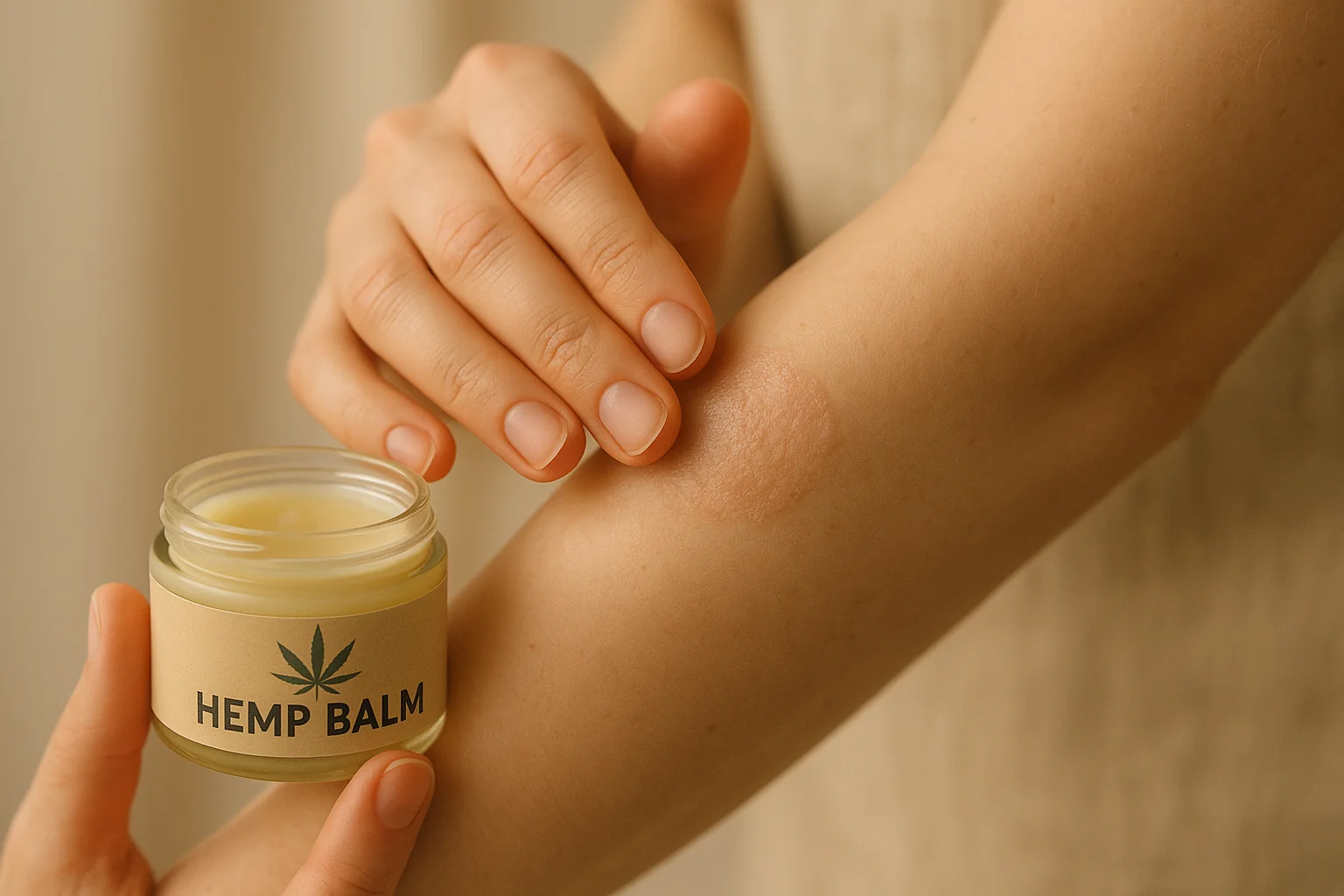

Hemp ointment for eczema and itchy skin: how to use CBD externally
Does hemp CBD ointment help with eczema and itchy skin? CB2 receptors, Maghfour study 2020, patch test, dosing. A practical guide to using CBD externally.
Atopic skin itches - and in a way that can literally keep you awake at night. Atopic dermatitis (AD) affects about 20% of children and 3-5% of adults in Poland, and itching is its most bothersome symptom. Topical CBD is attracting the attention of dermatologists and patients as a potential supplement to standard treatment - with the first promising clinical data. The pilot study by Maghfour et al. (2021) showed a 60% reduction in itching with the use of CBD cream over two weeks. But how does it work and how to safely use CBD on atopic skin? This article answers both questions.
KEY INFORMATION
• Maghfour et al. (Dermatology Online Journal, 2021) - CBD cream (1% CBD) for 2 weeks: 60.3% reduction in itching, 33.5% reduction in severity of lesions (SCORAD) in 20 patients with AD.
• CB2 receptors on keratinocytes regulate inflammation and sebum production - this is the mechanism of action of CBD in eczema.
• A patch test before first use is mandatory for atopic skin - skin hyperreactivity increases the risk of contact reactions.
• CBD does not replace corticosteroids during active eczema flare-ups - it can be a supplement during remission.
Why does atopic skin itch and how can CBD change that?
Atopic dermatitis (AD) is a disease with complex pathophysiology: dysfunction of the skin barrier (filaggrin deficiency, ceramide disorders) + hyperactive Th2 immune response + colonization by Staphylococcus aureus. Itching results from the activation of itch neurons by Th2 cytokines - mainly IL-31, IL-4, and TSLP - as well as by histamine and PAR-2 from mast cells.
CBD acts on several of these pathways simultaneously. First: CB2 receptors on keratinocytes and mast cells modulate the release of inflammatory cytokines - including IL-1β and TNF-α - reducing the local inflammatory signal. Tóth et al. (Trends in Pharmacological Sciences, 2014) they described how the skin's endocannabinoid system regulates keratinocyte homeostasis and inflammation - activation of CB2 inhibits proliferation and normalizes the "exit" from the inflammatory state.
Secondly: CBD blocks the TRPV1 receptor (vanilloid receptor) in skin neurons, raising the threshold for the activation of itch and pain. This is a mechanism that directly suppresses the sensation of itching - independent of the anti-inflammatory effect. Costa et al. (Pain, 2004) they demonstrated that transdermal CBD applied to sensory nerve areas reduces their sensitivity through TRPV1 - which may translate into a decrease in the intensity of itching.
Third: CBD modulates sebum production by sebocytes. Excessive sebogenesis exacerbates AD, while a deficiency of skin lipids weakens the barrier. Tóth et al. (2014) they showed that CBD normalizes sebum secretion by acting on CB2 receptors on sebocytes - which may potentially support the reconstruction of the skin barrier.
What does the Maghfour 2020/2021 study say - key clinical data
Pilot study Maghfour et al. (Dermatology Online Journal, 2021) this is one of the first prospective clinical studies evaluating topical CBD for atopic dermatitis. The study involved 20 patients with confirmed AD who applied a cream with 1% CBD (300 mg CBD per 30 g of cream) to affected areas of skin twice daily for 14 days.
Wyniki po 14 dniach:
- Itching (NRS scale 0-10): reduction from 7.1 to 2.8 - a decrease of 60.3%
- SCORAD (severity index of AD): reduction of 33.5%
- Quality of life (DLQI): improvement of 62%
- Adverse effects: no serious ones; 2 patients reported transient burning after application
Limitations: small n (20 people), no placebo control group, short observation time (2 weeks), lack of randomization. This is a pilot study - the results are hypothesis-generating, not confirmatory. However, the direction of effects and their magnitude are clinically interesting and justify larger, controlled RCTs.
Our observations: Patients with AD often seek alternatives to corticosteroids due to long-term side effects (skin thinning, dependency). CBD does not have these limitations with topical use. However, realistic expectations are key: CBD likely works best as maintenance care during remission and support between flare-ups - not as a first-line treatment for severe flare-ups.
How to use CBD externally for eczema - step-by-step protocol
Atopic skin is hyperreactive and sensitive. Using any new product - even natural - requires caution and preparation.
Step 1 - Patch test (mandatory): Apply a pea-sized amount of the product to the inner side of the wrist or the elbow crease. Cover with a plaster or bandage. After 24 hours, check: no redness, itching, or swelling = no contact allergy. Atopic skin reacts more strongly to contact allergens than healthy skin - never skip this step, even if the product is described as "hypoallergenic."
Step 2 - Skin cleansing: Before application, wash the skin with a mild, fragrance-free soap (pH 5.5-6) or a cleansing emollient. Gently pat dry, do not rub. Apply the product while the skin is still slightly damp - especially for patients with AD, this is important for moisture retention ("soak and seal").
Krok 3 - Aplikacja: Apply a thin layer of CBD ointment or cream to the areas of skin lesions. Do not rub vigorously - gently pat or lightly massage in circular motions. For sensitive areas (skin folds, face), use a minimal amount.
Step 4 - Frequency: 2-3 times a day. The Maghfour study used it twice a day for 14 days with good results. During flare-ups, you can increase to 3 times, but only with good tolerance.
Krok 5 - Czas oceny: Evaluate effectiveness after at least 4 weeks of regular use. Atopic dermatitis (AD) is a chronic condition - the effects of CBD accumulate gradually. Don't give up after the first week if you don't see dramatic improvement.
When not to use CBD topically: For open, oozing, exudative skin lesions. For areas with active Staph. aureus infection (pus-filled lesions) - requires antibiotics, not CBD. On skin with freshly applied topical steroid therapy - wait 30 minutes between applications.
CBD externally and the skin barrier - how can CBD support the regeneration of the epidermis?
Dysfunction of the skin barrier is at the core of the pathophysiology of AD. A deficiency of filaggrin - a structural protein of the epidermis - leads to increased transepidermal water loss (TEWL), penetration of allergens and microorganisms, triggering an inflammatory cascade. Regenerating the barrier is a key goal of atopic care, alongside managing inflammation.
CBD can support the skin barrier through several mechanisms. First: regulation of keratinocyte proliferation and differentiation via CB1 and CB2 receptors - ensuring a proper cycle of epidermal renewal. Excessive or too slow proliferation disrupts the barrier; CBD helps normalize it. Tóth et al. (2014) They described how the endocannabinoid system of the skin regulates keratinocyte homeostasis - CBD as an external modulator of this system can support its restoration.
Secondly: CBD, and especially the accompanying omega-3 and omega-6 fatty acids in full-spectrum preparations (if the ointment contains hemp oil as a carrier), can directly replenish the lipids of the skin barrier. Hemp seed oil contains linoleic and alpha-linolenic acid in a ratio close to ideal for the skin - which has shown significance in rebuilding epidermal ceramides. This is not CBD, but the fatty base of the hemp ointment has its own importance.
Third: inhibiting excessive sebogenesis through CB2 on sebocytes can help stabilize the skin microbiome. Atopic skin has a disrupted microbiome (dominance of Staph. aureus), which is a secondary effect of inflammation. Reducing inflammation and normalizing sebum can create an environment less conducive to pathogenic strains.
How to choose the right CBD hemp ointment for atopic skin?
Atopic skin is particularly sensitive to the ingredients of topical preparations. It is not ordinary skin - it reacts to allergens that healthy skin tolerates without issue. Choosing a CBD hemp ointment for an atopic individual requires additional criteria beyond just the CBD content.
What to look for: A product with a COA (certificate of analysis) confirming CBD content and the absence of pesticides. A formula free of: perfume and synthetic fragrances (the biggest contact allergens in AD), without ethanol (which dehydrates the skin), without preservatives from the paraben group (potential allergens). Emollients as a base: beeswax, shea butter, hemp oil, jojoba oil. All have occlusive properties and are generally non-allergenic.
What to avoid: Products with essential oils (lavender, eucalyptus, mint) as main ingredients - can sensitize atopic skin. Products with "fragrance complexes" or "natural aromas" - these are synthetic or semi-synthetic mixtures with potential allergenic properties. Products without COA - risk of contamination with heavy metals or pesticides, which exacerbate inflammation.
In the absence of a hemp ointment with the appropriate concentration of CBD - an alternative is to apply a few drops of 10% CBD oil on an emollient (emollient cream) as a carrier and massage it in. The concentration of CBD will be known, and the emollient base will be safe. This is a good option for testing before purchasing a dedicated CBD ointment for AD.
CBD and ordinary skin itching - when to use it externally?
Besides AD, CBD externally has applications in many other conditions related to itching and skin irritation. The mechanism of blocking TRPV1 and histamine receptors works regardless of whether the itching comes from eczema, insect bites, allergic contact reactions, or shaving.
Itching from bites and stings: CBD topically can reduce local inflammation and itching through CB2 and TRPV1. It works slower than topical hydrocortisone, but without the risk of side effects. Apply right after a bite and repeat after 2-4 hours.
Irritation after shaving and depilation: Freshly shaved or depilated skin is prone to follicular inflammation and itching. Topical CBD can shorten the duration of irritation through CB2-dependent action on keratinocytes.
Dry, itchy skin in winter: Low humidity and central heating damage the skin's lipid barrier, leading to itching. A CBD ointment or cream with emollients (e.g., shea butter, ceramides) can simultaneously moisturize and relieve itching.
In psoriasis - a chronic inflammatory disease with a tendency for plaques - data on CBD is preliminary. Several observational studies suggest improvement, but there are no controlled RCTs. Psoriasis requires dermatological treatment; CBD as a supplement can be discussed with a dermatologist. You can read more about CBD ointments and mechanisms of action in the article. CBD hemp ointment: what it helps with and how to use it..
Frequently Asked Questions
Does CBD hemp ointment help with eczema (AD)?
Preliminary clinical studies are promising. Maghfour et al. (2021) They demonstrated a reduction in itching by 60.3% and severity of lesions (SCORAD) by 33.5% in 20 patients with AD using CBD cream for 14 days. Mechanism: CB2 receptors on keratinocytes regulate inflammation. The studies are preliminary - CBD may be a valuable supplement to treatment, not a replacement.
How to use CBD hemp ointment for eczema?
Perform a patch test 24 hours before the first application. Apply a thin layer to the skin lesions 2-3 times a day after washing and gently drying. Do not rub - gently pat. Use for at least 4 weeks to assess effectiveness. During an active flare-up, do not discontinue prescribed medications without consulting a dermatologist.
How does eczema differ from ordinary skin itching?
Eczema (AD) is a chronic inflammatory disease with skin barrier dysfunction requiring regular management. Ordinary itching (after a bite, with dryness) is a local and short-term reaction. CBD in AD works through CB2 and normalizes sebogenesis. In ordinary itching, it works through TRPV1 - a faster and one-time effect.
Can CBD ointment replace corticosteroids for eczema?
No - especially not during an active flare-up. Corticosteroids work faster and stronger. CBD can be a valuable supplement during remission as supportive care. Never discontinue corticosteroids prescribed by a dermatologist on your own.
How much CBD should an eczema ointment contain?
The Maghfour study used a cream with 1% CBD (300 mg CBD per 30 g of product - 10 mg/g). Products from the market with a content below 50 mg CBD per 30 g (1.7 mg/g) are unlikely to achieve clinical effects. Always check the total mg of CBD, not just the percentages.
How to perform a patch test before using hemp ointment?
Apply an amount of the product the size of a grain of rice to the inner side of the wrist. Cover with a bandage. After 24 hours, check for any redness, swelling, or itching. Atopic skin is hyperreactive - a patch test is mandatory before any new product, even natural ones. Also check the general usage guidelines: How to use CBD hemp ointment.
Summary - CBD hemp ointment for eczema and itching
Topical CBD for eczema and skin itching has solid mechanistic foundations (CB2, TRPV1, sebum modulation) and initial encouraging clinical data from the Maghfour et al. (2021) study. Realistic application: supplementing emollient care in AD, support during remission, and reducing itching in daily skincare routines. It is not a medication replacing corticosteroids during severe flare-ups - these require dermatological supervision and proven topical therapy.
When choosing a product, key factors are: COA certificate from a laboratory, CBD concentration of at least 8-10 mg/g, formula without fragrance substances and contact allergens. It is worth remembering that hemp seed oil as a carrier base for the ointment has its own emollient properties - linoleic acid rebuilds the lipids of the skin barrier, which is an additional advantage for atopic skin. By choosing a CBD hemp ointment, you gain a double benefit: CBD acting through CB2 and TRPV1 and emollient fatty acids strengthening the barrier. Always perform a 24-hour patch test before the first use on atopic skin. Use regularly 2-3 times a day for at least 4 weeks for a reliable assessment of effectiveness. For additional products supporting the skin, visit the u Bucha store.
This article is for informational and educational purposes and does not replace consultation with a doctor. If you are pregnant, breastfeeding, taking medications, or have chronic conditions, consult the use of supplements or herbs with a specialist.
Author: Michał Waluk · Published: 2026-05-04 · Updated: 2026-05-04