
CBD for menstrual pain: what studies say and what women think
There is no clinical study on CBD in painful menstruation. We check what surveys among women show, where the doses from forums come from, and when to see a doctor.
Painful menstruation is reported by 16% to 91% of women of reproductive age, depending on the studied population and the definition used, while pain severe enough to disrupt daily plans affects 2% to 29% (Ju i in., Epidemiologic Reviews, 2014). With such a scale, every new proposal spreads quickly, and CBD has spread particularly fast. Before you buy an oil, it's worth knowing something that you won't find in product descriptions: there is no published clinical study examining CBD for painful menstruation. This text shows what has really been studied, where the numbers circulating on forums come from, how to read surveys among women using cannabis, and how to recognize pain that requires a gynecologist rather than a supplement.
KEY INFORMATION
• As of August 2026, no clinical study on CBD for painful menstruation has been published. A systematic review from 2026 found only surveys in this area (McLaren et al., ANZJOG, 2026).
• In a survey of 484 Australian women with endometriosis, 13% used cannabis, and the self-reported pain relief was 7.6 out of 10 (Sinclair et al., JOGC, 2020). This is a declaration, not a measurement.
• NSAIDs have 80 randomized studies with 5,820 participants (Marjoribanks et al., Cochrane, 2015). CBD has not a single one.
• There is no established dose of CBD for menstrual pain because there is no study that could determine it.
• Pain that increases from cycle to cycle, pain outside of menstruation, and pain resistant to NSAIDs are indications for diagnostics, not supplementation.
Does CBD relieve menstrual pain?
It is unknown because no one has checked. As of August 2026, not a single study has been published comparing CBD to placebo in women with painful menstruation. A systematic review published in 2026 found thirteen works in the entire area of cannabis and pelvic pain, of which nine were completed, and all were cross-sectional., czyli ankietowe (McLaren i in., ANZJOG, 2026).
One interventional study in this indication has been registered. In the ClinicalTrials.gov registry, there is a phase two trial NCT04091789, planned for 30 participants, with a sublingual tablet containing 30 mg of CBD, 1 mg of THC, palmitoylethanolamide, and a mixture of terpenes. The last update of the entry is from September 2019, results have never been published, and the status is listed as unknown. Even if this trial were completed, it would not answer the question about CBD itself, as the tablet combines five substances at once.
This is not the same as saying "CBD does not work." It means that the question remains open, and anyone who answers it affirmatively does so without data. The authors of the latest review directly mention the lack of prospective randomized studies and the need to conduct them. This is exactly the state of knowledge today.
Where does menstrual pain come from?
From prostaglandins. The endometrium produces prostaglandins PGF2alpha and PGE2 before and during menstruation, which cause strong contractions of the myometrium. The contractions constrict blood vessels, leading to temporary ischemia of the uterine wall, and the ischemic tissue sends a pain signal. This is primary dysmenorrhea, meaning it is not caused by any reproductive organ disease.
Prostaglandins are produced with the help of cyclooxygenase, an enzyme that exists in two forms, COX-1 and COX-2. This is the basis of the entire pharmacology of menstrual pain: ibuprofen and naproxen block cyclooxygenase, thus reducing the production of prostaglandins and weakening contractions. The mechanism has been known since the 1970s, which explains why NSAIDs taken early work better than those taken at the peak of pain.
The frequency of the problem is often reported very differently because different studies define "pain" differently. A review of fifteen population studies reports a range from 16% to 91%, with pain that limits daily functioning reported by 2% to 29% of respondents (Ju i in., Epidemiologic Reviews, 2014). The same study shows that complaints decrease with age and after childbirth, while they increase with high stress levels and a positive family history. If women in your family had severe menstruation, the risk increases several times.
What do surveys among women using cannabis show?
They show high self-reported relief and nothing more. The most frequently cited work is an Australian online survey from late 2017 and early 2018, in which 484 women with surgically confirmed endometriosis described their coping methods for symptoms. Thirteen percent of them used cannabis, the average pain relief rating was 7.6 out of 10, and 56% declared that they reduced their medication doses by at least half (Sinclair i in., JOGC, 2020).
We noticed when checking the sources something that is easy to overlook: the second frequently cited work, Armour i in. (BMC Complementary and Alternative Medicine, 2019), is not an independent confirmation. It is the same survey, the same 484 responses, just described from a broader perspective. When both texts appear side by side as "studies," it creates the illusion of two consistent results where there is one dataset.
This second analysis provides ratings for all home methods: heat 6.52, dietary changes 6.39, hemp oil or CBD 6.33, cannabis 7.6 points out of ten. The 2026 review gathered nine such works, totaling 1,787 people. Adverse effects were reported by 10.2% to 52% of participants, most often intoxication and dry mouth.
Why is the self-assessment of users not evidence of effectiveness?
Because the survey has no results to compare. Only those who already use something respond, so individuals for whom the method did not help and who abandoned it are completely excluded from the sample. Recruitment through support groups on social media further narrows the circle to those engaged in the topic. Without a placebo group, it is impossible to separate the effects of the substance from expectations.
Menstrual pain is particularly susceptible to the illusion of effectiveness. It has a natural peak and a natural decline over one or two days, so anything taken at the peak will appear effective when evaluated afterward. The intensity also varies between cycles, which can easily be mistaken for the effect of the product after two or three trials.
That this is not a theoretical accusation is demonstrated by an Australian attempt to conduct a proper study. The team planned for 63 participants in three groups, including a group with only CBD oil and a placebo group. 12 people were randomized, seven withdrew during the study, and four completed it (Chesterman i in., Complementary Therapies in Clinical Practice, 2025). The main reason was the prohibition on driving during participation. Meanwhile, the market does not wait: an analysis of two American cannabis sales platforms found 408 offers with promises regarding women's health, of which 57% concerned the menstrual cycle, and warnings were present in 6.6% (Nali i in., American Journal of Preventive Medicine, 2026).
How much CBD to take for painful menstruation?
There is no such dose. Dosing is established in studies that compare several dose sizes with placebo and check at which point the effect outweighs the side effects. No such study has been conducted for painful menstruation, so there is no number that can be honestly provided here.
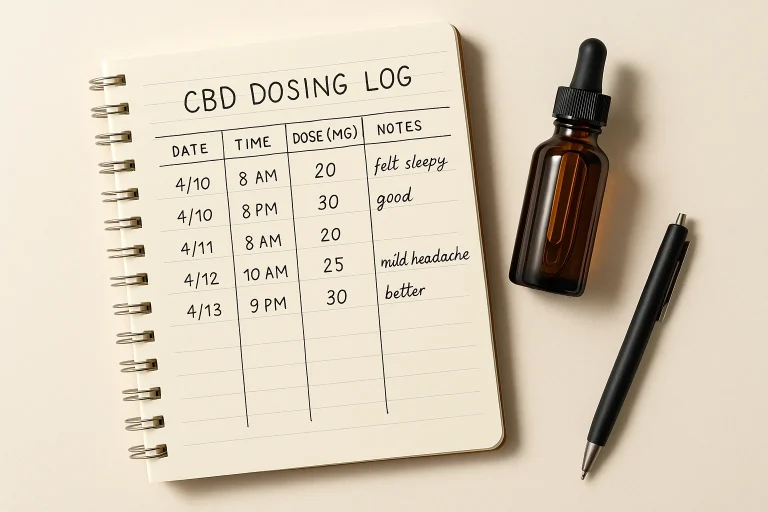
The numbers circulating on forums and in store descriptions, most often 25-50 mg per day or "five drops of 10% oil", come from studies on completely different issues: anxiety, sleep, drug-resistant epilepsy. Transferring doses between indications is not neutral, as different effects of CBD appear at different concentrations. There is also no standard unit: the same "drop" means a different substance content in each preparation.
It is worth remembering that a higher dose is not a safer version just because it is a supplement. A review of product characteristics registered showed side effects in nearly half of users, dependent on the dose, most often drowsiness, sleep disturbances, and increased liver enzyme activity (Brown i Winterstein, Journal of Clinical Medicine, 2019). If you want to try it despite the lack of data, treat it as an experiment on yourself, not as therapy, and inform your attending physician about it. Especially if you are taking anything regularly.
When does menstrual pain require diagnostics rather than a supplement?
When its character changes. Primary dysmenorrhea usually begins within two years of the first menstruation, lasts one to three days, and tends to weaken with age. If your pain behaves differently, it may be a symptom of a disease, and then no over-the-counter product will solve the problem, only mask it.
Signals that warrant a visit to the gynecologist:
- pain increasing from cycle to cycle or appearing after years of regular menstruation
- pelvic pain occurring also outside of menstruation
- pain during intercourse, urination, or defecation during bleeding
- very heavy bleeding, clots, intermenstrual bleeding
- lack of response to NSAIDs taken correctly and in a timely manner
- difficulty getting pregnant associated with painful menstruation
Such a picture usually indicates secondary dysmenorrhea: endometriosis, adenomyosis, uterine fibroids, or a history of pelvic inflammatory disease. Endometriosis affects 6-10% of women of reproductive age, and it takes an average of 6.7 years from the first symptoms to diagnosis, mainly due to delays in primary healthcare (Nnoaham i in., Fertility and Sterility, 2011). Each month of pain suppression with a supplement adds a month to this average.
What really has evidence for painful menstruation?
First of all, NSAIDs. A Cochrane review included 80 randomized studies and 5,820 women with primary dysmenorrhea. If after placebo, moderate or very good relief is felt by 18% of women, after NSAIDs, it is felt by 45% to 53% (Marjoribanks i in., Cochrane Database of Systematic Reviews, 2015). The price is more frequent gastrointestinal complaints, in this analysis 11% to 14% compared to 10% after placebo.
The second proven option is hormonal contraception, which reduces the thickness of the endometrium and thus the production of prostaglandins. Among non-pharmacological methods, the best support in the data comes from local heat and regular aerobic exercise; the others, from acupuncture to dietary supplements, are based on weaker studies and should complement treatment, not replace it (Kirsch i in., Journal of Pain Research, 2024).
Interestingly, women seek cannabis for various reasons. In a qualitative study involving 26 Australian women with primary dysmenorrhea, the most common reason was dissatisfaction with over-the-counter medications, rather than a belief in the superiority of cannabis (Sinclair i in., IJERPH, 2022). The authors conclude that clinical trials in this group are urgently needed. Four years later, they are still lacking. You can find more about the products themselves in the post CBD Dosage.
Does CBD interact with painkillers and contraception?
It may interact, and this has not been studied in this context. CBD inhibits cytochrome P450 enzymes, including CYP3A4 and CYP2C19, through which a large portion of medications is metabolized, including ethinyl estradiol from contraceptive pills. It is known that the phenomenon exists. It is not known at what dose of the supplement it becomes clinically significant, as no one has conducted such a study in women using contraception.
This uncertainty works both ways, so we will not say either "it is safe" or "it poses a risk of pregnancy." The decision should be discussed with someone who knows your list of medications. A pharmacist can check interactions in a few minutes, and it costs nothing.
Separately, it is worth noting where the belief in the effect of cannabis on the disease comes from. In a mouse model of endometriosis, repeated doses of THC reduced pain sensitivity and limited the development of endometrial cysts (Escudero-Lara i in., eLife, 2020). This was THC, not CBD, in mice, not in humans, and the authors directly called for clinical trials. The only attempt at such a study, mentioned above, failed at the recruitment stage. Transferring results from mice to women and from THC to CBD is two leaps at once, and neither is supported by data.
Frequently Asked Questions
Does CBD help with menstrual pain?
It is unknown. As of August 2026, no study has been published comparing CBD to placebo in women with painful menstruation. A systematic review from 2026 (McLaren et al., ANZJOG) found only cross-sectional studies in this area. Surveys show what people declare, not whether the substance works.
How much CBD to take for menstrual pain?
There is no dosage because there is no study that could determine it. Numbers from forums, most often 25-50 mg daily, were transferred from studies on anxiety, sleep, and epilepsy. They have not been verified in painful menstruation. Discuss the use of the supplement with your doctor or pharmacist, especially if you are taking medications regularly.
Is CBD safe during menstruation?
This has not been studied separately. However, it is known that CBD inhibits cytochrome P450 enzymes and can alter the concentration of other medications. Adverse effects, mainly drowsiness, sleep disturbances, and increased liver enzyme activity, have been reported in nearly half of the people using registered preparations (Brown and Winterstein, Journal of Clinical Medicine, 2019).
Czy CBD pomaga przy endometriozie?
There is no evidence from clinical trials. A review from 2026 found nine completed studies on cannabis in endometriosis, and all were cross-sectional. An Australian randomized trial from 2025 recruited 12 out of the planned 63 participants, so it did not provide answers regarding efficacy or safety.
Can CBD oil replace ibuprofen?
There is no basis for such a substitution. NSAIDs have behind them 80 randomized studies involving 5,820 women with primary dysmenorrhea (Marjoribanks et al., Cochrane, 2015). There is not a single published clinical study on CBD for this indication, so comparing the efficacy of both options is simply impossible.
When should menstrual pain be a cause for concern?
When it intensifies from cycle to cycle, appears outside of menstruation, is accompanied by pain during intercourse or bowel movements, or when NSAIDs stop working. These are typical signals of secondary dysmenorrhea. Endometriosis affects 6-10% of women of reproductive age, and diagnosis takes an average of 6.7 years from the first symptoms.
The starting point for painful menstruation remains NSAIDs, hormonal contraception, heat, and movement, while for pain that changes character, gynecological diagnostics. There is no clinical data for CBD in this indication, and it should be treated as an untested substance that some women use at their own risk. If you still want to see how it works for you, browse the category hemp oils and talk to your doctor beforehand.
This article is for informational and educational purposes and does not constitute medical advice. Before starting to use cannabis or CBD for therapeutic purposes, consult a doctor, especially if you are taking other medications, are pregnant, or breastfeeding.
Author: Michał Waluk · Opublikowano: 2026-06-22 · Aktualizacja: 2026-08-08