
Cannabinoid journal - how to keep a log of doses, symptoms, and effects (template)
Dziennik kannabinoidowy: odpowiedzi oparte na badaniach i praktyce. u Bucha.
Finding the optimal CBD dose is a process that takes weeks, not days. Most people who claim that CBD doesn't work for them have never kept systematic records - they changed the product, dose, and time of day simultaneously, which made it unclear what actually worked and what didn't. A cannabinoid journal is a simple tool based on the methodology used by cannabinoid clinics, such as the Realm of Caring Foundation, to track effects in thousands of patients. In this article, you will find a practical template and answers to the most common questions about keeping such a log.
KEY INFORMATION
• The Realm of Caring study (2020) involving over 3000 participants showed that systematic tracking of dosing increases the effectiveness of individual CBD optimization (Naftali et al., Cannabis and Cannabinoid Research, 2020).
• The optimal titration cycle is to change the dose every 3-7 days while recording the effect at each dose - this allows you to find the 'sweet spot' without skipping over it.
• The journal should record at least 6 parameters: time, product, dose, route of administration, symptom rating, and time to effect.
• 4-8 weeks of systematic records provide a sufficient database to make a decision about the target dose.
Why does keeping a journal change CBD dosing outcomes?
CBD exhibits a so-called biphasic effect - in small doses, it acts as a stimulant and anxiolytic, while in large doses it may cause sedation or paradoxical intensification of anxiety in some individuals. This same mechanism was described by Dr. Dustin Sulak, referring to it as the 'therapeutic window': the optimal dose lies within a narrow range that varies between individuals by several to several mg (Zuardi et al., Frontiers in Pharmacology, 2017). Without systematic records, it is easy to overlook this window.
Memory is fallible, especially when assessing subtle effects such as anxiety reduction or sleep improvement. The Realm of Caring study, one of the largest research organizations in the field of medical cannabinoids, found that patients using structured dosing tracking tools achieved better clinical outcomes than those relying solely on retrospective assessment. A journal objectifies subjective feelings and creates a body of evidence for later discussions with a doctor.
An additional benefit is the early detection of tolerance. When the same dose begins to yield weaker effects for several consecutive days, the journal reveals this clearly - instead of permanently increasing the dose, you can plan a short tolerance break and return to a lower effective dose.
Journal template - what to record in each entry?
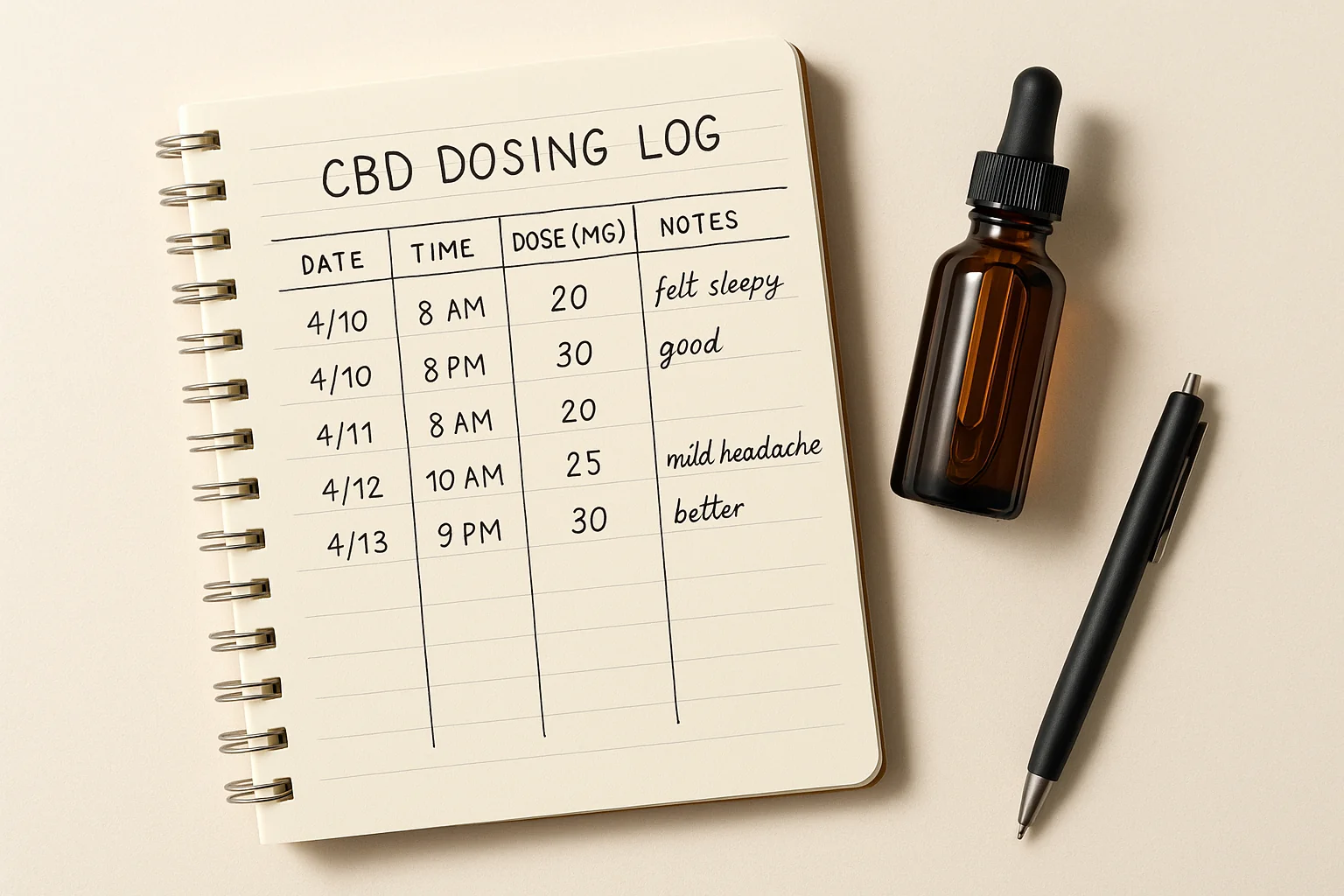
An effective daily entry should not take more than 3 minutes. It is crucial to keep it immediately after taking CBD and after the full duration of action - not from memory the next day. Below is a minimalist template tested in practice:
| Parameter | What to enter | Example |
|---|---|---|
| Date and time | DD.MM.YYYY, HH:MM | 26.05.2026, 21:30 |
| Product and concentration | Name + % CBD | Cannova 15% CBG |
| Dose (mg) | Number of mg of active ingredient | 15 mg CBD |
| Route of administration | Sublingual / capsule / inhalation | Sublingual 90 sec. |
| Objaw przed (0-10) | Your main symptom on the NAS scale | Anxiety: 7/10 |
| Time to effect (onset) | Minutes from intake to feeling | 25 min |
| Objaw po (0-10) | Rating after full effect | Anxiety: 3/10 |
| Duration of effect | Hours of action | 4-5 godz. |
| Notes | Fatigue, gastrointestinal disturbances, overall mood | Mild dry mouth |
How to convert drops to milligrams of CBD?
The most common mistake in journals is writing '3 drops' instead of the actual dose in mg. The conversion is simple: a standard dropper contains about 0.05 ml per drop. For a 10% oil (100 mg CBD per 1 ml), one drop is 5 mg of CBD. For a 5% oil, it is 2.5 mg per drop. Always check the manufacturer's information - at u Bucha, you will find it on each product page.
We have noticed that one of the most common reasons for dissatisfaction with CBD is confusing 'drops' with 'mg' - someone takes '3 drops' for a week, thinking of 15 mg, while actually using 7.5 mg with a 5% oil. Keeping a journal with the dose in mg from the start eliminates this confusion and allows for comparing effects between different products with varying concentrations.
How to detect tolerance using a journal?
Tolerance to CBD is a phenomenon less pronounced than with THC, but real with daily use over a longer period. Its signal is a gradual decrease in effect at the same dose without changing other conditions. A journal allows for this to be detected before tolerance becomes full. When, for 3-5 consecutive days, the improvement in symptoms drops by 30-50% compared to the first week at the same dose - it is a signal to consider a 48-72 hour break or change the product.
Research on the mechanics of CBD tolerance primarily focuses on the CB1 receptor - the receptor through which THC acts. CBD is not a CB1 agonist, which explains the lower risk of rapid tolerance. However, with regular use, adaptations of other molecular pathways occur, including the 5-HT1A receptor and inhibition of FAAH (Ibeas Bih et al., Neurotherapeutics, 2015). A journal is an important monitoring tool here.
Frequently Asked Questions
What should a cannabinoid journal include?
An effective cannabinoid journal should record: the date and time of administration, product and concentration, dose in mg CBD, route of administration (sublingual, oral), symptom scale result (0-10) before and after, time to onset of effect, duration of effect, and any side effects. Systematic records increase the effectiveness of individual dosing (Naftali et al., Cannabis and Cannabinoid Research, 2020).
How long should you keep a journal to draw conclusions?
A minimum of 2-4 weeks of systematic records allows for the identification of effect patterns and the search for the optimal dose. With titration dosing (increasing every 3-7 days), a journal kept for 4-8 weeks provides a sufficient picture to make a decision about the target dose - in accordance with the protocol used in cannabinoid clinics (Zuardi et al., Frontiers in Pharmacology, 2017).
Does keeping a journal help avoid tolerance to CBD?
Yes - a systematic log allows for early detection of decreasing effectiveness at the same dose. When the effect drops by 30-50% at an unchanged dose for 3-5 consecutive days, it is a signal to consider a tolerance break or changing the product before a complete loss of effect occurs. Adaptation of the 5-HT1A and FAAH pathways is measurable over time (Ibeas Bih et al., Neurotherapeutics, 2015).
What symptom scale should be used in the journal?
The numerical analog scale (NAS) 0-10 is most commonly used, where 0 means no symptom and 10 means maximum severity. Use it for pain, anxiety, sleep quality, or mood. The Realm of Caring Foundation uses the same scale in its observational studies on over 3000 participants (Naftali et al., Cannabis and Cannabinoid Research, 2020).
Do mobile apps replace a paper journal?
Applications like Strainprint or Releaf automatically visualize data and generate trend charts - this is a significant advantage. The downside is the risk of data loss after uninstalling or changing devices. A paper journal or offline file (spreadsheet) is a safer long-term archive for personal health data.
What does "window effect" mean and how can it be detected using a journal?
"Window effect" is a phenomenon where CBD works optimally within a narrow dosage range - both too low and too high a dose yield weaker effects. A journal with data from several weeks at different doses allows for drawing a response curve and identifying your individual "sweet spot" as described by Dr. Sulak (Zuardi et al., Frontiers in Pharmacology, 2017).
How to record the duration of action and when to count the effect?
The duration of action is counted from the moment of administration to the onset of the first noticeable effects (onset) and from the beginning to the end of action (duration). For sublingual oil, the onset is usually 15-45 minutes, for capsules - 60-120 minutes (Huestis, Chemistry and Biodiversity, 2007). Recording both values helps assess the appropriate form of the product.
What mistakes should be avoided when keeping a CBD journal?
The most common mistakes: not recording the time of administration (which makes tracking onsets impossible), changing multiple variables at once (product and dose and time of day), assessing the effect right after intake instead of after the full duration, skipping days without effect (important information about tolerance), and not comparing with a baseline day without CBD.
Is the journal useful when talking to a doctor?
A journal with 4-8 weeks of records is the most concrete documentation for a doctor or pharmacist. It shows real patterns, not memory impressions. Patients with dosing documentation communicate effects better and are less likely to discontinue CBD on their own without consultation (Naftali et al., Cannabis and Cannabinoid Research, 2020).
This article is informational and educational in nature. It contains internal links to products available in the u Bucha store. Prices and specifications may change - please check the current data on the product page before purchasing.
Author: Michał Waluk · Published: 2026-05-04 · Updated: 2026-05-04