
BCAA vs EAA: what to realistically choose and are they necessary (table)
BCAA are three amino acids, EAA are all nine. We check the data to see when an amino acid supplement makes sense and when dietary protein is sufficient.
BCAA is one of the best-selling sports supplements in the world, and at the same time, one of those whose promises hold up the least against the data. Robert Wolfe's review in Journal of the International Society of Sports Nutrition ends with a statement that cannot be softened: the claim that BCAA intake stimulates muscle protein synthesis in humans is unfounded (Wolfe, JISSN, 2017). The author did not find a single study measuring the response of protein synthesis to oral BCAA taken alone. This article compares BCAA to EAA point by point, shows three situations where amino acid supplementation really makes a difference, and clearly states when it's better to spend that money on food.
KEY INFORMATION
• The theoretical ceiling for the response to BCAA alone is about a 30% increase in protein synthesis, and that estimate is inflated (Wolfe, JISSN 2017).
• Above 1.62 g of protein per kilogram of body weight per day, additional intake does not lead to an increase in lean mass (Morton, BJSM 2018).
• EAA includes all nine essential amino acids, while BCAA includes only three.
• The u Bucha store does not carry BCAA, EAA, or protein supplements.
What are the differences between BCAA and EAA in composition?
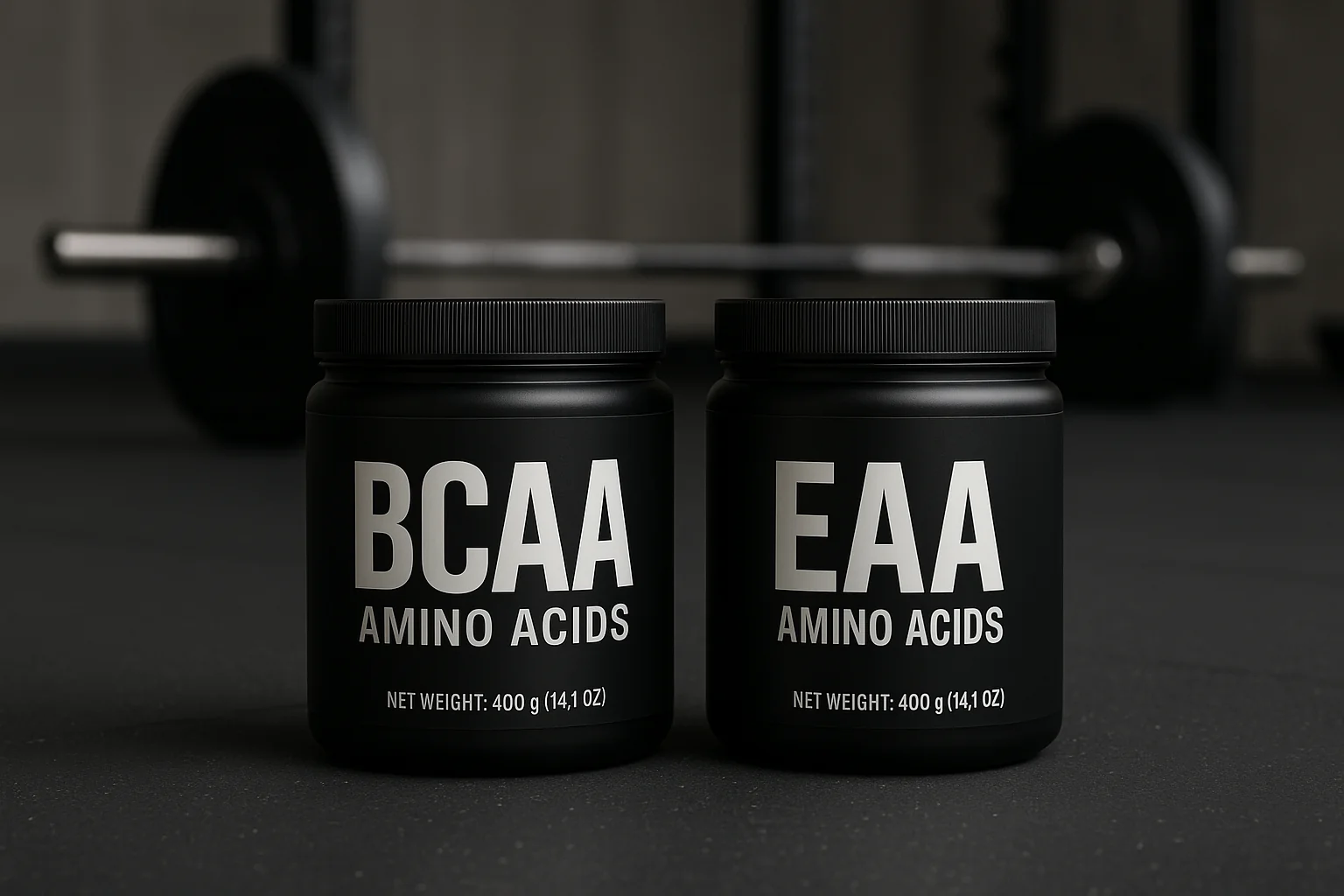
The difference is quantitative and determines everything that follows. EAA is a complete set of nine essential amino acids, which the body cannot produce and must obtain from food. BCAA is a subset of three of them with branched side chains: leucine, isoleucine, and valine. Every BCAA is an EAA, but not vice versa.
To build new muscle protein, all nine are needed at once. The absence of even one halts the process because there is nothing to complete the chain. Taking only BCAA does not eliminate this limitation: the remaining six amino acids must then be sourced from the breakdown of the body's own muscle proteins.
Wolfe calculated where the ceiling of such a solution lies. The maximum possible increase in muscle protein synthesis from BCAA alone corresponds to the difference between protein breakdown and synthesis, which is roughly 30 percent above the synthesis level. The author immediately notes that in practice, this estimate is inflated, as the mandatory oxidation of essential amino acids cannot be completely turned off. In the same review, he did not find any studies on humans measuring the synthesis response to oral BCAA taken without anything else. Two studies with intravenous infusion showed something contrary to what the label promises: BCAA reduced both protein synthesis and breakdown, and the catabolic state persisted throughout the infusion.
BCAA vs EAA: comparison table
The following summary organizes both groups according to features that realistically influence the purchasing decision. In the dosage column, we provide only the amounts measured in studies, not ranges from labels. We do not provide prices for a simple reason: the u Bucha store does not carry any of these products, and copying rates from other stores would be guesswork.
| Feature | BCAA | EAA |
|---|---|---|
| Composition | 3 essential amino acids with branched chains | 9 essential amino acids, including all BCAA |
| Impact on protein synthesis | Theoretical ceiling of about 30% and that estimate is inflated (Wolfe 2017) | Complete building material, without a bottleneck |
| Dawka zmierzona w badaniu | 5,6 g po treningu oporowym (Jackman 2017) | No established serving size; reference point is 20 g of complete protein (Moore 2009) |
| Caloric content of the serving | About 4 kcal per gram, or approximately 20-25 kcal | About 4 kcal per gram, or approximately 40-60 kcal |
| Taste in solution | Usually good, wide range of flavors | Worse, as methionine and tryptophan are noticeably bitter |
| When it makes sense | Practically never, if EAA or protein are available | Fasted training, long window without meals, difficult to close plant-based diet |
| With a diet that meets the requirements | No additional benefit (Morton 2018) | No additional benefit beyond convenience |
If you still decide to take an amino acid supplement, the choice between these columns is easy. EAA contains everything that BCAA has, plus six amino acids that are missing in BCAA. Buying BCAA alongside EAA makes no sense, and instead of EAA, it is worth first calculating how much protein you are actually consuming.
Are BCAA and EAA even necessary?
With a diet that meets protein needs, they are not. A meta-analysis of 49 studies involving 1863 people showed that above a total intake of 1.62 g of protein per kilogram of body weight per day, further protein addition does not increase lean mass gain during resistance training (Morton, British Journal of Sports Medicine, 2018).
This boundary has a straightforward translation to the plate. A person weighing 75 kg closes it at around 120 g of protein per day, which can be consumed without any powder. Above this threshold, an amino acid supplement is just an addition to an addition, and a partial one at that, consisting of three or nine ingredients instead of whole protein.
This does not mean that BCAAs do nothing. In a study involving ten trained men, a dose of 5.6 g of BCAAs taken immediately after training increased the synthesis of myofibrillar proteins by 22 percent compared to placebo (Jackman, Frontiers in Physiology, 2017). However, the reference point there was placebo, which is nothing. The question worth asking before making a purchase is not 'do BCAAs work better than water', but 'do they work better than scrambled eggs'.
The broader picture also does not favor labels. A review summarizing over fifty years of research on BCAAs states outright that there is still no consensus on their therapeutic effectiveness, and the impact of supplementation during physical exertion is listed among the areas requiring further research (Holeček, Nutrition and Metabolism, 2018).
Kiedy suplementacja aminokwasami ma sens?
In three situations, all three of which have a common denominator: it is not about having an advantage over protein from food, but rather that at that moment a full protein meal cannot be consumed. The amino acid supplement replaces the missing meal, and that is where its role ends.
The first situation is training on an empty stomach. In the morning before breakfast, the concentration of amino acids in the blood is low, and the muscle protein balance is negative. A serving of EAA taken before or during the session provides building material without burdening the stomach, which some people simply cannot tolerate before exertion.
The second situation is a long window without food. This applies to both intermittent fasting protocols combined with strength training and long-duration events where a full meal is impractical. EAA then provides a complete set of amino acids with a small portion of liquid.
The third situation is a plant-based diet where it is not possible to meet protein intake. The reason can be digestive or taste-related, but the outcome is the same: intake falls below the threshold from Morton's meta-analysis. Concentrated amino acid powder fills the gap, although a larger portion of plant protein usually remains the cheaper solution.
Co daje leucyna i ile jej potrzeba?
Leucine acts as a signal, not as a brick. After exertion, the rebuilding of protein synthesis requires protein from the diet or BCAAs to raise leucine levels in the tissue and remove the blockade from the translation initiation factor complex 4, which occurs through the activation of mTOR kinase (Norton and Layman, The Journal of Nutrition, 2006).
There is a number circulating that we could not confirm: the threshold of 2-3 g of leucine per serving. We had it in the previous version of this text, pinned to the work of Norton and Layman, and removed it after checking because it is not present in that work. If you encounter this threshold in a product description, ask for the study, not just the name.
The number that is covered refers to whole protein, not just leucine. Six young men consumed post-resistance training drinks containing 0, 5, 10, 20, or 40 g of egg protein. Muscle protein synthesis increased with the dose and peaked at 20 g. At 20 and 40 g, leucine oxidation also increased, meaning the excess was burned rather than incorporated into tissue (Moore, The American Journal of Clinical Nutrition, 2009).
The practical conclusion is less flashy than the labels. Instead of counting milligrams of leucine in a scoop of powder, it is enough to plan a meal with a protein portion of around twenty grams. That amount fits into a regular dish without reaching for anything in powder form.
Are EAAs necessary on a plant-based diet?
They do not have to be if the portion is sufficiently large. Twenty-four trained men consumed 48 g of rice protein isolate or 48 g of whey isolate post-training for eight weeks, in portions matched for calories and nitrogen. Lean body mass, bicep thickness, and bench press results improved in both groups, with no differences between them (Joy, Nutrition Journal, 2013).
The condition is precisely that dose. The authors deliberately selected large, isocaloric portions to check whether at such an amount the difference between plant and animal protein would even hold. It did not hold. With small portions, the picture can be different, and that is a real limitation of a plant-based diet, not just the fact that the protein comes from a plant.
The amino acid profile of plants can indeed be uneven. Grains are low in lysine, legumes are low in methionine, so a diet based on one group easily narrows down. The solution is to combine sources throughout the day, not within a single meal. EAA powder does the same thing faster and at a higher cost.
What you won't buy at u Bucha and what to do about it?
Neither BCAAs nor EAAs. We checked the entire store catalog on August 8, 2026, through the Store API: 386 products for sale, with zero BCAAs or EAAs in the name and zero with any of these abbreviations in the description. There are also no protein supplements, whey, or creatine.
Categories named protein and creatine appear in the store structure and show a non-zero counter, but their listings return zero products. The counter for the category comes from a different count than the list of goods for sale, so its mere presence proves nothing. This is actually good news for this article because there is nothing to pretend about.
We state this directly on the store's blog because the alternative would be worse: a compilation of products that do not exist or a ranking copied from someone else's offer. If BCAAs were to go on sale tomorrow, this text would still advise against them for someone who consumes enough protein, as that is the answer to the question in the title.
If you are looking for supplements that the store actually carries, go to the category supplements. As of August 8, 2026, the listing returns 174 items for sale: collagen, probiotics, and vitamin preparations. You will not find branched-chain amino acids among them, and after reading the above paragraphs, you should not be worried about that.
Frequently Asked Questions
What is the difference between BCAA and EAA?
EAA is a complete set of nine essential amino acids, meaning those that the body does not produce and must obtain from food. BCAA is a subset of three of them with branched side chains: leucine, isoleucine, and valine. Each BCAA is therefore an EAA, but the other six essential amino acids are absent from the BCAA supplement.
Are BCAA necessary when the diet meets protein requirements?
No. A meta-analysis of 49 studies involving 1863 people showed that above a total intake of 1.62 g of protein per kilogram of body weight per day, adding protein does not increase lean body mass gain during resistance training (Morton, BJSM, 2018). An amino acid supplement is then just an addition to an addition.
When do EAA make sense?
When a complete protein meal cannot be consumed: during fasted training in the morning, during long hours without food in an intermittent fasting protocol, and on a plant-based diet where it is difficult to meet protein intake. In all three cases, EAA replaces the missing meal, but it does not perform better than it.
How much protein needs to be consumed for an amino acid supplement to become irrelevant?
About 1.62 g per kilogram of body weight per day, counting the entire diet, not just supplementation. In a single post-workout meal, muscle protein synthesis peaked at 20 g of egg protein, and larger portions primarily went into oxidation (Moore, AJCN, 2009).
Do BCAA help with fatigue during long workouts?
The evidence is not conclusive. The mechanism is based on the competition of BCAAs with tryptophan for transport to the brain, but a review summarizing over fifty years of research states that there is no consensus on the effectiveness of BCAAs and points to physical exertion as an area requiring further research (Holeček, Nutrition and Metabolism, 2018).
Czy sklep u Bucha sprzedaje BCAA lub EAA?
No. A review of the entire catalog through the Store API on August 8, 2026, yielded 386 products for sale and zero items with BCAAs or EAAs in the name or description. There are also no protein supplements or creatine. Categories with those names appear in the menu, but their listings return zero products.
You will find the full, actually available offer in the category supplements in the u Bucha store.
This article is for informational and educational purposes and does not constitute medical advice. Before starting supplementation, consult your doctor, especially if you are taking medications regularly, are pregnant or breastfeeding, or have a chronic illness.
Author: Michał Waluk · Opublikowano: 2026-06-29 · Aktualizacja: 2026-08-08