
Acetyl-L-Carnitine ALCAR - what it offers, dosage, and risks 2026
ALCAR for memory, energy, and recovery. We check what studies confirm regarding depression, neuropathy, and dementia, and what the supplement does not.
Acetyl-L-carnitine, abbreviated as ALCAR, is sold in Poland as a supplement for memory, mental energy, and nervous system recovery. Each of these three promises has a different state of evidence, and two of them look completely different when you look into the studies cited in product descriptions. This text was created after checking all six scientific identifiers that were in the previous version of the article. Three led to works from completely different fields, and one to a publication unknown to the Europe PMC database. Below you will find what remained after this check: four studies and two meta-analyses, described with the numbers that actually stand in them, and one study that ends with a warning.
KEY INFORMATION
- A meta-analysis of 12 studies with 791 participants showed a significant reduction in depression symptoms compared to placebo, and compared to antidepressants, the results were comparable with fewer side effects (Veronese, Psychosomatic Medicine, 2018).
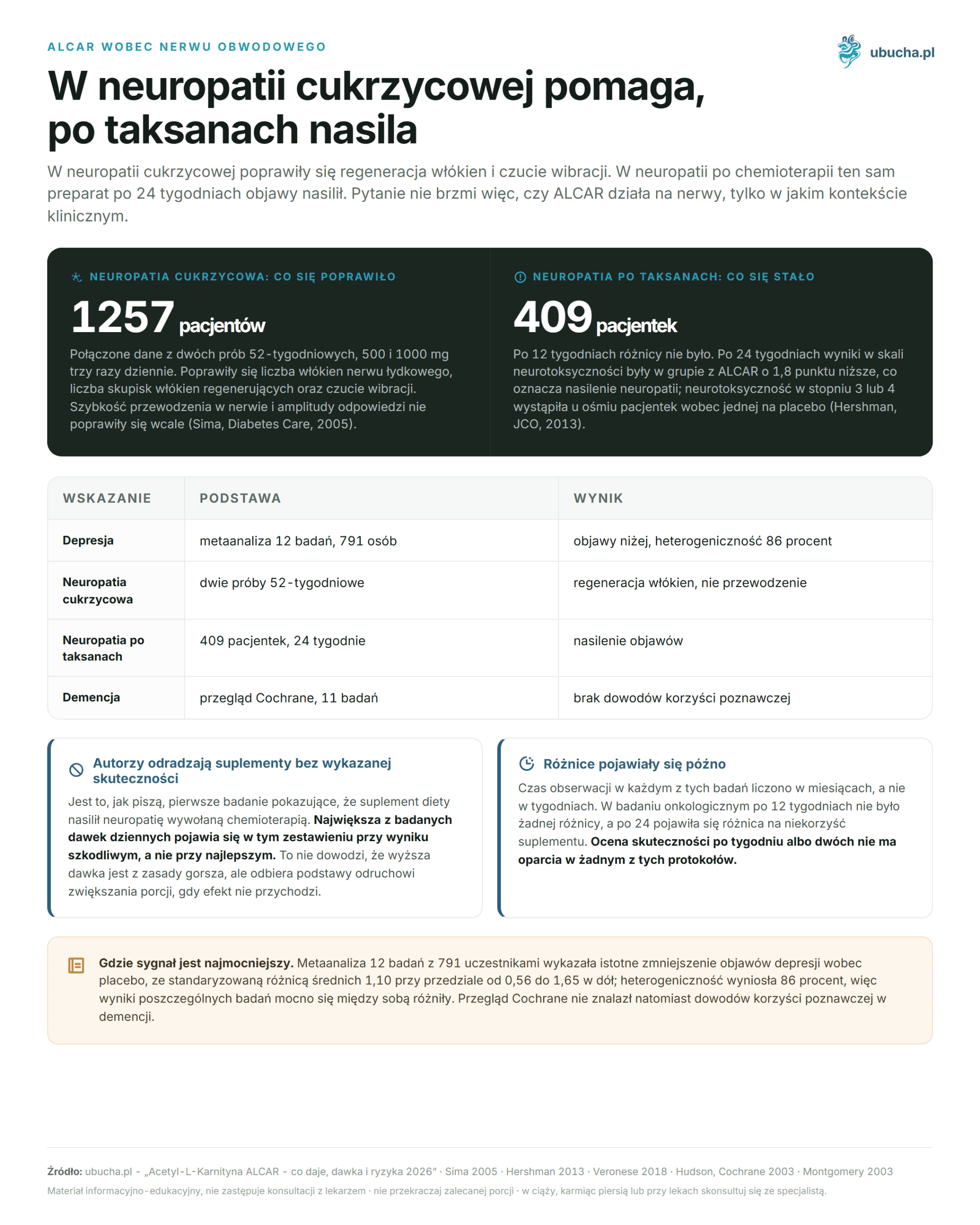
- In a study on diabetic neuropathy involving 1257 individuals, there was an improvement in nerve fiber regeneration and vibration sensation, but nerve conduction velocity did not improve at all (Sima, Diabetes Care, 2005).
- The Cochrane review found no evidence for improvement in cognitive function in dementia (Hudson, Cochrane, 2003).
- In a study involving 409 women treated with taxanes, ALCAR worsened neuropathy after 24 weeks, and the authors advise against using supplements without proven efficacy (Hershman, JCO, 2013).
- Carnitine inhibits the entry of thyroid hormones into the cell nucleus, which is significant when treating with levothyroxine (Benvenga, Thyroid, 2000).
What is ALCAR and how does it differ from L-carnitine?
ALCAR is L-carnitine with an attached acetyl group. Carnitine itself is a natural compound present in all mammalian tissues, in millimolar concentrations, and the body obtains it through two pathways: from its own synthesis and from food, primarily from meat and dairy (Longo, Biochim Biophys Acta, 2016).
The practical difference between the two forms concerns where they go and for what purpose. Free carnitine or that bound to tartaric acid is mainly used in the context of muscles and physical effort. ALCAR is chosen by researchers studying the nervous system because the molecule is widely distributed in mammalian tissues, including the brain, the blood-brain barrier, neurons, and astrocytes (Sergi, Aging Clin Exp Res, 2018).
The acetyl group is not just an ornament. Once detached, it enters cellular metabolism as an acetate moiety, thus serving as a material for energy transformations and for the synthesis of neurotransmitters. This is why all the studies discussed below on mood, memory, and peripheral nerves use this form, rather than the regular carnitine tartrate known from sports stores.
One terminological note that saves money when purchasing. The names L-carnitine, L-carnitine tartrate, propionyl-L-carnitine, and acetyl-L-carnitine refer to different molecules with different applications. If the reason for purchase is anything discussed in this article, the label must state acetyl-L-carnitine. None of the studies described tested the other forms for these indications.
How does the carnitine pendulum work?
Carnitine is responsible for one specific task: transporting long-chain fatty acids across the inner mitochondrial membrane so they can be burned in the process of beta-oxidation (Longo, Biochim Biophys Acta, 2016). Without this transport, fat will not enter the place where energy is produced, regardless of how much is in the blood.
Carnitine enters the cell via the OCTN2 transporter, a high-affinity protein specialized for this one task. The kidneys recover it from urine using the same mechanism, allowing the body to conserve a resource whose synthesis is costly. At pharmacological doses, carnitine enters cells through an additional pathway, via an amino acid transporter designated as B0 plus, and this observation has clinical significance, which will be discussed shortly.
This description implies an important limitation that rarely appears on packaging. Transport is a necessary condition for fat oxidation, but it is not a regulator in a healthy individual. If there is no deficiency of carnitine in the cell, adding another dose will not speed anything up, because the bottleneck is not transport but the demand for energy.
Therefore, the statement about increased mitochondrial energy after supplementation is a shorthand that can be misleading. It only makes sense where carnitine is genuinely lacking. When that is the case, the next section describes.
When is carnitine deficiency real?
Primary carnitine deficiency is a genetic disorder, not a dietary state. It is caused by mutations in the OCTN2 transporter encoded by the SLC22A5 gene, inherited in an autosomal recessive manner. The result is reduced accumulation of carnitine in cells, increased loss in urine, and low serum concentration (Longo, Biochim Biophys Acta, 2016).
The clinical picture depends on age. In young children, the disease manifests as hypoglycemia without ketone bodies and hepatic encephalopathy. Later, skeletal muscle and cardiac myopathy may occur, or sudden death due to arrhythmia, usually triggered by starvation or a catabolic state. Diagnosis is made based on low free carnitine levels in newborn screening, confirmed by measuring uptake in fibroblasts or gene sequencing.
The disease responds to oral carnitine, and this is a situation where supplementation is documented to make sense. However, it is managed by a metabolic physician based on tests, not a decision made in an online store. Diagnoses can occur in adults, made only after their healthy child's screening showed very low levels of carnitine.
For the average reader, the conclusion is simple and worth remembering. Fatigue, cognitive fog, and reduced exercise tolerance almost never result from a carnitine deficiency. Much more often, they are caused by anemia, a deficiency of vitamin B12 or iron, hypothyroidism, sleep apnea, and depression. All these causes can be verified through tests, and each has a treatment that is more effective than any supplement.
What does ALCAR do in the nervous system?
Several mechanisms have been described, and it is worth noting right away that they come from preclinical studies, not from measurements in patients. ALCAR exhibits cytoprotective, antioxidant, and anti-apoptotic effects in the nervous system. It also has analgesic properties by reducing glutamate concentration in synapses (Sergi, Aging Clin Exp Res, 2018).
The second group of effects concerns nerve regeneration. ALCAR facilitates recovery and repair after primary injury, influences the synthesis of neuronal membranes and their fluidity and efficiency, increases protein synthesis, and improves axonal transport of neurofilament proteins and tubulin. It also enhances the response to nerve growth factor, which is believed to promote the growth of neurites.
The third group pertains to cognitive functions and is the least well-established. A review dedicated to dementia mentions the restoration of cell membranes and synaptic functions, enhancement of cholinergic activity, support for mitochondrial energy metabolism, protection against toxins, and neurotrophic effects. However, the authors summarize that the role of ALCAR in dementia remains a subject of debate (Pennisi, Nutrients, 2020).
This distinction between mechanism and effect is more important here than usual. The list of mechanisms looks impressive and is exactly how it appears in product descriptions. However, it does not say anything about whether the patient will notice a difference. Clinical studies answer that question, and they are much more modest.
Does ALCAR improve memory in dementia?
The best answer comes from a systematic review by Cochrane, which included 11 double-blind studies, all conducted on individuals with Alzheimer's disease (Hudson, Cochrane, 2003). The result is much more cautious than the descriptions of supplements suggest.
Statistically significant differences in favor of ALCAR appeared in the number of individuals rated as improved in the global clinical assessment, after 12 and 24 weeks. After 52 weeks, the difference disappeared. In other areas, such as cognitive functions, severity of dementia, functional ability, and global clinical assessment treated as a continuous variable, no evidence of benefit was found.
The authors add a caveat that is worth quoting in full, as it rarely gets further. Given the large number of comparisons, a statistically significant result may be a matter of chance. Their final conclusion is that there is no evidence to justify the routine use of ALCAR in clinical practice and that the available data do not suggest it will prove to be an important drug.
Various adverse effects were reported, but in the pooled analysis, there were no significant differences between the treatment group and placebo. This is the only good news from this review, and it concerns safety, not efficacy. The previous version of this article attributed moderate benefits to the same review in the ADAS-Cog and MMSE scales. Such a conclusion is not present in it.
Why did two analyses from 2003 yield different conclusions?
Because they measured different things and counted differently. In the same year that the Cochrane review was published, a meta-analysis of double-blind studies in individuals with mild cognitive impairment and early Alzheimer's disease was published. The studies lasted 3, 6, or 12 months, and the doses ranged from 1.5 to 3 g per day (Montgomery, Int Clin Psychopharmacol, 2003).
This analysis showed an advantage of ALCAR over placebo: the integrated effect size was 0.201 with a confidence interval from 0.107 to 0.295, and for the global assessment of clinical change, it was 0.32 with a range from 0.18 to 0.47. The benefit was visible already at the first assessment after three months and increased over time. The preparation was well tolerated in all studies.
Where does the discrepancy come from? The Cochrane review included only patients with Alzheimer's disease and treated individual scales separately, and for some of them, analyzed data only from individuals who completed the study. The Montgomery meta-analysis also included mild cognitive impairment, which is an earlier state, and combined different scales into one composite measure. An effect size of around 0.2 is considered a small effect, less than what is usually deemed noticeable for the patient.
The practical conclusion is therefore not that one analysis is correct and the other is wrong. It is this: there is a signal, but it is weak, clearer in earlier stages and with composite clinical measures than in cognitive tests. A critical review from 2020 ends in the same place, indicating the need for studies with homogeneous samples before ALCAR is used systematically (Pennisi, Nutrients, 2020).
Does ALCAR help with depression?
This is the strongest signal of efficacy in the entire body of work on this molecule. The systematic review with meta-analysis included 12 randomized controlled trials with a total of 791 participants with an average age of 54 years, among whom 65% were women (Veronese, Psychosomatic Medicine, 2018). In eleven of these studies, ALCAR was administered as monotherapy.
Data from nine studies, involving 231 individuals taking ALCAR versus 216 taking placebo and 20 without intervention, showed a significant reduction in depressive symptoms. The standardized mean difference was minus 1.10 with a confidence interval from minus 1.65 to minus 0.56. Heterogeneity was very high at 86%, indicating that the results of individual studies varied significantly.
Three studies compared ALCAR directly with antidepressants, with 162 individuals in each group. The efficacy proved comparable, and the incidence of adverse effects was significantly lower in the ALCAR group. Subgroup analysis indicated that the preparation worked most effectively in older individuals. The authors conclude that large studies are needed to confirm or refute these findings.
The previous version of this article attributed this meta-analysis to an author named Wang and the British Journal of Psychiatry, stating an effect size of minus 0.67 and a faster action than reference drugs, visible after a week or two. The number of participants and the number of studies matched, but the rest did not. The work was published in Psychosomatic Medicine, the effect size is clearly larger, and the meta-analysis says nothing about the speed of action.
Is ALCAR deficiency a marker of depression?
This is a hypothesis that would explain why supplementation works for some individuals and not for others. Researchers measured acetyl-L-carnitine levels in patients with major depression and in age- and gender-matched healthy individuals, in two independent centers (Nasca, PNAS, 2018).
Acetyl-L-carnitine levels were lower in patients, while free carnitine levels remained unchanged. This is an important distinction, as it shows that it concerns a specific form, not the overall carnitine pool in the body. Additional analyses showed that the depth of deficiency reflected both the severity of depression and the age of onset.
The greatest reduction was found in individuals with treatment-resistant depression. In this group, low levels were predicted by childhood trauma, especially experiences of emotional neglect, and female gender. The authors propose a candidate biomarker that distinguishes a subtype of depression with an earlier onset and greater severity.
However, it must be stated clearly what this study does not show. It did not demonstrate that supplementing the deficiency with a supplement improves the patient's condition, nor that measuring the levels is available in routine diagnostics. This is a study about mechanisms and directions for further research, not a basis for self-treatment. Depression remains a condition treated by a psychiatrist, and medications should not be discontinued in favor of a supplement.
What did the largest study on diabetic neuropathy show?
Peripheral neuropathy is a common complication of diabetes, with a prevalence of up to 50% among older patients with this disease (Sergi, Aging Clin Exp Res, 2018). The largest study on ALCAR in this indication combined data from two 52-week placebo trials, testing two doses, 500 and 1000 mg administered three times a day. The analysis included 1257 patients, which is 93% of those enrolled (Sima, Diabetes Care, 2005).
Two things measured directly in the nerve improved: the number of fibers in the sural nerve and the number of clusters of regenerating fibers. Vibration sensation also improved in both studies. Pain, as the most bothersome symptom, significantly decreased in one of the studies and in the combined group receiving the higher dose.
One thing did not improve, and that is a statement that gets lost in product descriptions. The conduction velocity in the nerve and the amplitudes of the responses did not improve. The previous version of this article claimed exactly the opposite, stating a pain reduction of 39% compared to 8% in the placebo group, and greater benefits for individuals with a shorter history of diabetes. None of these numbers are present in the study.
The conclusion for the patient is moderately positive but requires honest presentation. The study suggests an impact on fiber regeneration and sensory symptoms, not on conduction efficiency. The primary treatment remains diabetes management conducted by an endocrinologist. If you are looking for a comparison with other methods of alleviating nerve pain, we described them in the text about treating neuropathic pain with cannabis.
Why is ALCAR discouraged during chemotherapy?
Because the only large study in this indication ended with results contrary to the intended outcome. A 24-week double-blind trial included women receiving adjunctive chemotherapy based on taxanes. A total of 409 patients were evaluated, of which 208 received ALCAR at a dose of 3000 mg daily, and 201 received placebo (Hershman, JCO, 2013).
After 12 weeks, there was no difference. After 24 weeks, the neurotoxicity scores were 1.8 points lower in the ALCAR group, indicating an exacerbation of neuropathy, with statistical significance. Patients taking ALCAR more frequently experienced a drop in scores of more than 5 points, and neurotoxicity of grade 3 or 4 occurred in eight of them compared to one in the placebo group.
The authors summarize this unequivocally. There was no evidence of ALCAR's effect on neuropathy after 12 weeks, while after 24 weeks, ALCAR significantly exacerbated it. This is, as they write, the first study showing that a dietary supplement exacerbated chemotherapy-induced neuropathy, and they conclude with a recommendation to discourage patients from using supplements without proven efficacy.
This result is worth keeping alongside the result from diabetic neuropathy because together they convey something that neither of them says separately. The same molecule, in the same tissue and regarding a similarly sounding symptom, produced a beneficial effect in one context and a harmful effect in another. A person undergoing oncological treatment should not take ALCAR without the consent of their oncologist.
Jakie dawki stosowano w badaniach?
In this article, we provide doses solely as a description of specific studies, not as a recommendation for the reader. The reason is practical: each of the described indications is a disease, and the choice of dose should be made by the physician who knows the study results and other medications being taken.
In the meta-analysis of studies on depression, no single dose was provided because the individual trials differed in protocols. In the meta-analysis concerning cognitive disorders, doses ranged from 1.5 to 3 g per day, and the studies lasted 3, 6, or 12 months (Montgomery, Int Clin Psychopharmacol, 2003). In the study on diabetic neuropathy, 500 and 1000 mg were compared, administered three times daily for 52 weeks. In the oncological study, where the outcome was unfavorable, 3000 mg was used daily for 24 weeks.
One pattern worth noting emerges from this. The observation period in each of these studies was counted in months, not weeks, and differences appeared late. In the oncological study, after 12 weeks, there was no difference, and after 24 weeks, a difference appeared to the detriment of the supplement. Therefore, assessing efficacy after one or two weeks has no basis in any of these protocols.
The second pattern concerns the direction of thinking about the dose. The largest of the studied daily doses appears in this comparison with an unfavorable outcome, not with the best. This does not prove that a higher dose is inherently worse, but it undermines the basis for the popular reflex of increasing the dose when the effect does not come.
Does ALCAR help with weight loss?
Not to a degree that would justify purchasing it for this purpose, and the available data concerns carnitine in general, not ALCAR itself. The meta-analysis of randomized studies included 9 trials of appropriate methodological quality with a total of 911 participants (Pooyandjoo, Obesity Reviews, 2016).
Individuals receiving carnitine lost significantly more body weight than the control group: the mean difference was 1.33 kg with a confidence interval from 0.57 to 2.09 kg. The body mass index decreased by 0.47 units. However, the meta-regression analysis showed something more important than the average itself: the magnitude of weight loss significantly decreased with the duration of supplementation.
The translation to purchasing decisions is straightforward. A difference of about one kilogram, diminishing over time, is practically indistinguishable from daily fluctuations in body weight. None of these studies tested ALCAR as a form dedicated to weight loss, and the claim of a fat burner has no basis here.
If you are looking for supplements described in the context of concentration and motivation, rather than body weight, we have compiled data regarding another amino acid in the text about the properties of tyrosine regarding concentration and motivation. The principle remains the same: the size of the effect matters, not the mechanism described on the packaging.
When does ALCAR require a conversation with a doctor?
The first area is the thyroid. Carnitine inhibits the entry of thyroid hormones into the cell nucleus, with the inhibition of transport to the nucleus being clearly stronger than the inhibition of entry into the cell itself. In studies on cell lines, at carnitine concentrations significantly higher than physiological, the uptake of triiodothyronine into the nucleus decreased by 25% in neuronal cells and 35% in hepatic cells, and at higher concentrations, approximately 60% and 70%, respectively (Benvenga, Thyroid, 2000).
This effect was subsequently confirmed in humans, although in a situation contrary to the typical one. In a randomized placebo-controlled study involving 50 women receiving levothyroxine at a dose that inhibits TSH secretion, carnitine prevented and reversed symptoms of hyperthyroidism, and additionally positively affected bone mineralization (Benvenga, J Clin Endocrinol Metab, 2001). For a person being treated for hypothyroidism, however, the same property acts in an undesirable direction, as it weakens the effect of the medication taken.
The second area is situations where carnitine deficiency is secondary to disease. It has been described in liver and kidney diseases, diabetes, sepsis, cardiomyopathy, malnutrition, and endocrine disorders, and supplementation can be part of the treatment conducted by a physician (Flanagan, Nutrition and Metabolism, 2010). This reverses the usual logic of purchase: carnitine makes sense in these situations because the doctor has identified a deficiency, not because the patient felt fatigued.
The third area is medications, and here an explanation is due to the reader. In the previous version of this article, there were two warnings: about the increase in INR in individuals taking coumarin derivatives and about the exacerbation of seizures after carnitine in individuals with epilepsy. No sources could be found for them, and the authors of the randomized study in women treated with levothyroxine state directly that carnitine has no known interactions with medications (Benvenga, J Clin Endocrinol Metab, 2001). Therefore, we leave only the recommendation for caution, without attributing a mechanism to it.
The fourth area is pregnancy, breastfeeding, developmental age, and advanced kidney disease, where supplementation can be part of nephrological treatment. In all these situations, the decision is made by the attending physician. The mere availability without a prescription says nothing about safety in a specific clinical situation, and if you are taking medications chronically, a conversation with a doctor or pharmacist should precede the purchase.
What have we removed from this entry and why?
Three groups of content. The first consists of identifiers leading elsewhere. The number labeled as a meta-analysis of depression led to a paper on coronary artery fistulas, the number labeled as a meta-analysis of weight loss to an article on halophilic fungi, and the number labeled as an oncological study to a paper on inflammasomes. The fourth number, labeled as a study by Pettegrew from 2002 in the Journal of the Neurological Sciences, is not known to the Europe PMC database.
This last entry carried three separate paragraphs in the previous version: about 12 weeks of supplementation, about the increase in the integrity marker of neurons in the hippocampus and prefrontal cortex, and about the stabilization of results in 41% of patients compared to 17% on placebo. The actual works of this author look different. The 1995 study included 7 patients with Alzheimer's disease taking ALCAR, 5 taking placebo, and 21 healthy individuals, lasted a year, and measured phosphorus compounds, not the marker mentioned. The 2002 paper is an observation of two individuals in late-life depression.
The second group consists of statistics without the possibility of verification. The percentage of individuals making typical mistakes when purchasing, the shares of individual packages in sales, the median price per hundred grams, the percentage of adverse effects given to the nearest percentage point, and the percentage of users experiencing stimulation. None of these numbers can be attributed to a source, so none were left.
The third group is prices. The article does not provide amounts for a specific product because the store catalog changes faster than the text, and the price mentioned in the content can become misleading within weeks of publication.
Summary: what remains of ALCAR's promises
Of the three slogans under which ALCAR is sold, mood is the most defensible. A meta-analysis of 12 studies involving 791 participants shows a significant reduction in depression symptoms compared to placebo and effectiveness comparable to antidepressants with fewer side effects, particularly in older individuals. High heterogeneity calls for caution, and the authors themselves request large confirmatory studies.
The second place goes to peripheral nerves, but with a caveat. In diabetic neuropathy, there was improvement in fiber regeneration and vibration sensation, but nerve conduction did not improve. In chemotherapy-induced neuropathy, the same preparation exacerbated symptoms, so the question is not whether ALCAR works on nerves, but in what clinical context.
Memory ranks the lowest, which is the promise under which ALCAR most often ends up in the cart. The Cochrane review found no evidence of benefits in cognitive function, functional ability, or dementia severity, and a meta-analysis from the same year showed a small effect primarily visible in aggregate clinical assessments. Weight loss closes the list with a difference of about one kilogram, decreasing over time.
If you still want to try, the order matters. First, rule out common causes of fatigue and memory deterioration with your doctor, then check your thyroid and medications, and only at the end choose a product with a certificate of analysis and plan a trial lasting months. A supplement purchased before these steps usually does not harm but delays the identification of what truly causes the symptoms.
Frequently Asked Questions
How does ALCAR differ from regular L-carnitine?
ALCAR is L-carnitine with an acetyl group. Both forms participate in the transport of fatty acids to mitochondria, but ALCAR is widely distributed in nervous tissue, including the brain, the blood-brain barrier, neurons, and astrocytes (Sergi, Aging Clin Exp Res, 2018). Therefore, studies on mood and nerves use this form.
Does ALCAR help with depression?
The data is promising but requires confirmation. A meta-analysis of 12 studies involving 791 participants showed a significant reduction in symptoms compared to placebo, and compared to antidepressants, the results were comparable with fewer side effects (Veronese, Psychosomatic Medicine, 2018). Do not discontinue psychiatric medications in favor of a supplement.
Does ALCAR improve memory?
The Cochrane review covering 11 studies in individuals with Alzheimer's disease found no evidence of benefits in cognitive function, dementia severity, or functional ability, and the authors do not recommend routine use (Hudson, Cochrane, 2003). A meta-analysis from the same year showed a small effect.
Does ALCAR work for diabetic neuropathy?
Partially. In a combined analysis of two annual studies involving 1257 patients, the number of fibers in the sural nerve, clusters of regenerating fibers, and vibration sensation improved, while pain decreased in some analyses. The conduction velocity in the nerve did not improve at all (Sima, Diabetes Care, 2005).
Can I take ALCAR during chemotherapy?
Not without the oncologist's consent. In a study involving 409 women treated with taxanes, ALCAR significantly exacerbated neuropathy after 24 weeks, and neurotoxicity of grade 3 or 4 occurred in eight patients compared to one on placebo (Hershman, JCO, 2013). The authors advise against supplements without proven efficacy.
Is ALCAR safe with thyroid diseases?
It requires a conversation with an endocrinologist. Carnitine inhibits the entry of thyroid hormones into the cell nucleus, and the inhibition of transport to the nucleus is stronger than the entry into the cell itself (Benvenga, Thyroid, 2000). In a person treated with levothyroxine for hypothyroidism, this may weaken the effect of the medication.
Does ALCAR help with weight loss?
Very little, and the data pertains to carnitine in general. In a meta-analysis of 9 studies involving 911 participants, the difference was 1.33 kg in favor of carnitine, and the magnitude of weight loss decreased with the duration of supplementation (Pooyandjoo, Obesity Reviews, 2016). This effect is indistinguishable from daily fluctuations in weight.
How long does the trial last before I assess the effect?
Research protocols are measured in months. Analyses concerning cognitive function included trials lasting 3, 6, or 12 months, the study on diabetic neuropathy lasted 52 weeks, and in the oncology study, the difference appeared only after 24 weeks. An assessment after a week or two has no basis in any of these protocols.
If after talking to your doctor you are looking for a product with a known composition and a certificate of analysis, available options can be found in the category supplements.
This article is for informational and educational purposes and does not constitute medical advice. Before starting supplementation, consult your doctor, especially if you are taking medications regularly, are pregnant or breastfeeding, or have a chronic illness.
Author: Michał Waluk · Opublikowano: 2026-05-11 · Aktualizacja: 2026-08-10