
Vitamin K2 MK-7: why D3 can be harmful without it and how to dose it correctly
Vitamin K2 MK-7 vs MK-4, Rotterdam Study (Geleijnse 2004), calcium in arteries without K2, dosing 100–200 µg with D3 – a complete guide.
Vitamin D3 is a common supplement today – most Poles take it in winter. Fewer people know that D3 supplemented without vitamin K2 can potentially accelerate vascular calcification. The mechanism is well described: D3 significantly increases calcium absorption, and K2 determines whether this calcium goes to the bones or to the arteries. This article explains how K2 MK-7 works, how it differs from MK-4, what studies support this recommendation, and how to correctly dose both supplements together.
KEY INFORMATION
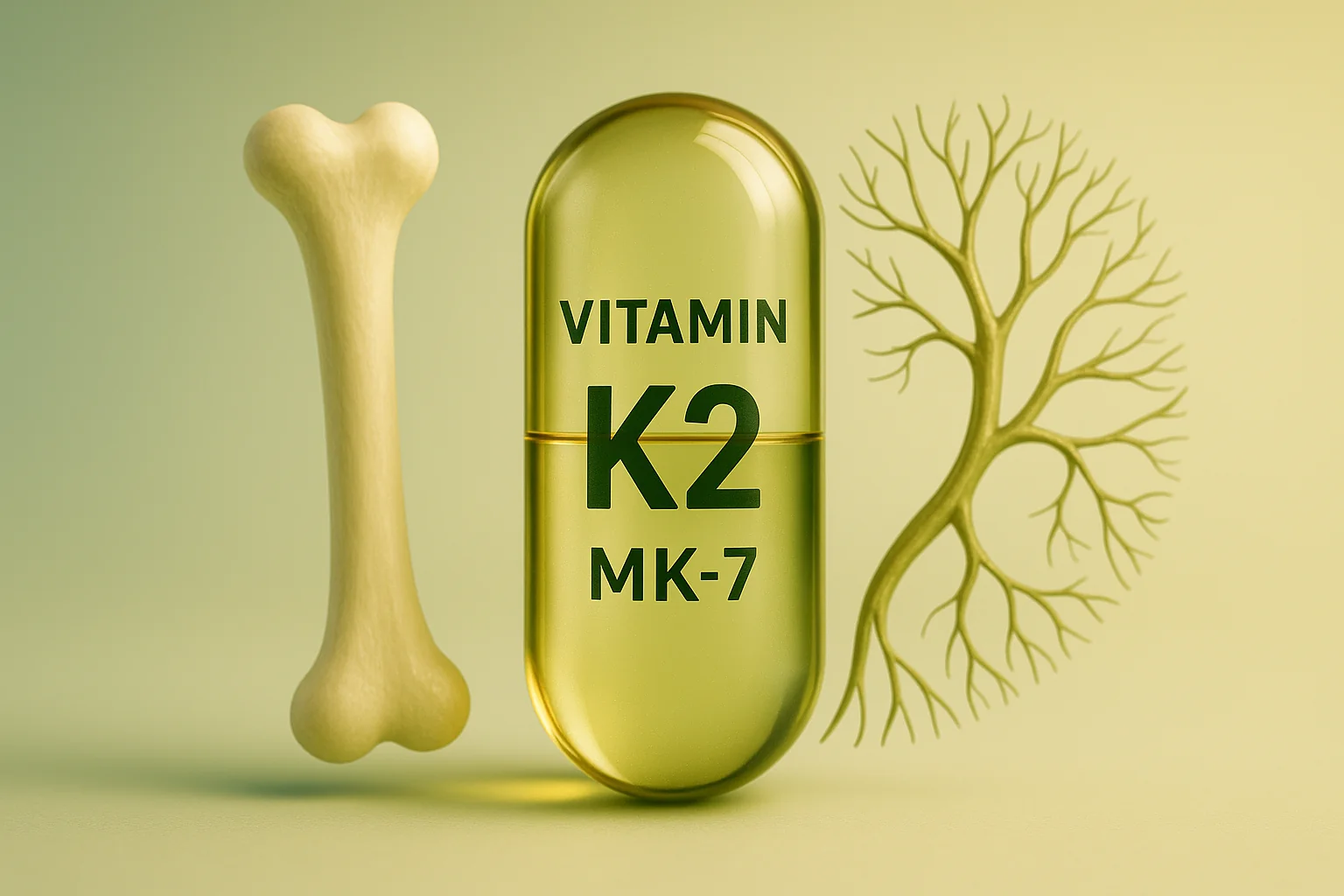
• K2 MK-7 (half-life 72 h) is the preferred supplemental form – it activates MGP in arteries and osteocalcin in bones.
• The Rotterdam Study (Geleijnse et al. 2004, n=4807) showed a 57% reduction in cardiovascular mortality with the highest intake of K2 – not K1.
• Ratio: 100 µg K2 MK-7 for every 2000–2500 IU D3. Take with fat (fat-soluble vitamin).
• Absolute contraindications: warfarin/acenocoumarol (vitamin K antagonists). NOAC (dabigatran, rivaroxaban) – K2 is safe.
How K2 works – vitamin K-dependent proteins (VKD proteins)
Vitamin K is a cofactor for glutamyl carboxylase – an enzyme that activates vitamin K-dependent proteins (VKD) by carboxylating glutamic acid residues to γ-carboxyglutamate (Gla). Without carboxylation, these proteins are biologically inactive – they cannot bind calcium ions and perform their functions. The most important VKD proteins related to calcium metabolism: osteocalcin (OC, also known as BGP – Bone Gla Protein) – produced by osteoblasts; active (carboxylated) osteocalcin incorporates calcium into the bone matrix and inhibits mineralization outside the bones; MGP (Matrix Gla Protein) – the strongest known inhibitor of vascular calcification; produced in the walls of blood vessels and cartilage; deactivated MGP (uncarboxylated, ucMGP) is a marker of K2 deficiency and a predictor of vascular calcification; protein S and protein C (coagulation system) – striking fact: the same K2 pathways that protect vessels are involved in regulating coagulation – hence the conflict with warfarin.
Key tissue distinction: the liver prefers K1 (phylloquinone) for activating coagulation factors; extrahepatic tissues (bones, arteries, kidneys, brain) prefer K2 – especially long-chain forms of menaquinone. This explains why K1 supplementation (spinach, kale) cannot replace K2 for vascular protection.
The Rotterdam Study and evidence for K2 MK-7 – what the research says
The Rotterdam Study (Geleijnse et al., Journal of Nutrition, 2004, n=4807, follow-up 10 years): a prospective Dutch analysis; women and men aged 55+; the highest tertiles of K2 intake (mainly MK-7 and MK-8 from fermented cheeses) were associated with a 26% reduction in all-cause mortality and a 57% reduction in cardiovascular mortality compared to the lowest tertile. An important detail: the effect was related to K2, not K1 – high K1 intake was not associated with reduced mortality. This suggests a unique role for K2 in vascular protection, independent of overall leafy vegetable intake rich in K1.
The study by Knapen et al. (Osteoporosis International, 2013, RCT, n=244, postmenopausal women): 180 µg K2 MK-7/day for 3 years – results: slowed loss of bone mineral density in the femoral neck (-1.2% vs -2.7% placebo), improved arterial stiffness (measured as PWV – pulse wave velocity) – arteries became less stiff in the K2 group, with no changes in the placebo group. Khoury et al. (Nutrients, 2019): K2 MK-7 100 µg/day for 12 weeks reduced levels of uncarboxylated MGP (ucMGP) by 50% – a direct biomarker of vascular protection activation.
Mechanism: why D3 without K2 can harm arteries
Witamina D3 (cholekalcyferol) zwiększa ekspresję białka wiążącego wapń (calbindin D9K) w enterocytach jelita cienkiego, co prowadzi do wzrostu wchłaniania wapnia o 30–80% w zależności od dawki. D3 w dawkach 2000–10000 IU może podnieść wchłanianie wapnia znacząco powyżej potrzeb kostnych, jeśli dieta jest bogata w wapń (nabiał). Maresz (Integrative Medicine: A Clinician’s Journal, 2015) szczegółowo opisuje paradoks: suplementacja D3 aktywuje osteocalcynę (wymaga K2 do karboksylacji) – bez K2 osteocalcyna pozostaje nieskarboksylowana (ucOC) i nieaktywna; wapń zaabsorbowany dzięki D3 trafia do krwi, ale nie jest sprawnie „przekierowany” do kości przez ucOC; jednocześnie nieskarboksylowany MGP (ucMGP) nie hamuje zwapnień naczyniowych. Wynik: potencjalne zwapnienia tętnic mimo suplementacji D3.
Badanie Dalmeijer et al. (Atherosclerosis, 2012): wyższe stężenia ucMGP (marker niedoboru K2) były niezależnym predyktorem zwapnień aorty w badaniu prospektywnym. Budoff et al. (JACC, meta-analizy): zwapnienia tętnic wieńcowych (CAC score) są silnym predyktorem zawałów – redukcja ucMGP przez K2 może być mechanizmem kardioprotekcji. Ta obserwacja nie oznacza, że D3 bez K2 jest „niebezpieczna” u wszystkich – ale przy dawkach D3 powyżej 2000 IU stosowanych długoterminowo, suplementacja K2 MK-7 jest uzasadnioną ostrożnością opartą na dobrym mechanizmie biologicznym.
Dosing K2 MK-7 – practical protocol for D3 supplementation
Doses of K2 MK-7 based on studies and consensus recommendations: minimum dose for vascular protection: 75 µg/day (Rotterdam Study – observational dose); clinically studied dose: 100–180 µg/day (Knapen 2013, Khoury 2019); dose with high D3 doses: 200–300 µg/day (mechanistic extrapolation, no RCT with these doses). D3:K2 ratio as a practical guideline: 1000 IU D3 → 45–50 µg K2 MK-7; 2000 IU D3 → 100 µg K2 MK-7; 5000 IU D3 → 200 µg K2 MK-7. This is not a rigid standard based on interventional studies – it is a pragmatic principle derived from the mechanism of action.
When and how to take K2 MK-7: in the morning or at noon (not in the evening – although there are no studies confirming a specific time of day); always with a meal containing fat (min. 10 g of fat significantly enhances the absorption of fat-soluble vitamins); K2 and D3 can be taken together – both in one capsule (many K2+D3 supplements) and in separate preparations; consistency is more important than the time of day – a daily dose of 100 µg MK-7 works for about 72 hours, so missing one day is not critical.
Our observations: Rynek zalewa preparaty „D3+K2” w proporcjach 1000 IU D3 + 100 µg K2 MK-7 lub 2000 IU D3 + 200 µg K2. Obie proporcje są racjonalne. Problem tkwi w tym, że wiele preparatów stosuje K2 MK-4 zamiast MK-7 – nie oznaczając tego wyraźnie lub oznaczając jako „vitaminum K2 (menachinon-4)”. Czas półtrwania MK-4 wynosi 1 godzinę vs 72 godziny dla MK-7 – preparat z MK-4 w kapsułce raz dziennie nie daje stabilnej ekspozycji biologicznej. Czytaj skład: szukaj „MK-7” lub „menachinon-7” lub „natto-derived”.
K2 and osteoporosis – what the data says
Poza ochroną naczyniową K2 ma udokumentowaną rolę w metabolizmie kostnym. W Japonii forma MK-4 (45 mg/dzień – dawka farmakologiczna, 250× wyższa niż typowa suplementacja!) jest zarejestrowanym lekiem (menatetrenon) do leczenia osteoporozy. Ale czy niższe dawki MK-7 mają znaczenie kliniczne dla kości? Knapen et al. (2013): 180 µg MK-7/dzień przez 3 lata – mniejsza utrata gęstości kości szyjki kości udowej (−1.2% vs −2.7% placebo, p<0.05) u kobiet pomenopauzalnych. Cochrane Review 2006 (Cockayne et al.): metaanaliza K2 i osteoporoza – wyniki obiecujące, ale ograniczona do japońskich danych z dużymi dawkami MK-4. Efekt K2 MK-7 na kości jest synergistyczny z D3: D3 zwiększa produkcję osteocalcyny przez osteoblasty, K2 aktywuje tę osteocalcynę (karboksylacja) umożliwiając jej wiązanie wapnia w macierzy kostnej. supplements for children
Contraindications and interactions of K2 MK-7 – especially warfarin
Warfarin (Coumadin) and acenocoumarol (Sintrom) act as vitamin K antagonists – they block the vitamin K epoxide reductase (VKOR), preventing the recycling of the active form of K. K2 supplementation provides vitamin K directly, bypassing VKOR – thus competing with the mechanism of action of warfarin. The result: K2 may reduce INR in patients taking warfarin, increasing the risk of thrombosis. This is an absolute contraindication: no patient on warfarin or acenocoumarol should use K2 supplements without strict monitoring of INR and the consent of a hematologist or cardiologist. New oral anticoagulants (NOACs): dabigatran (Pradaxa), rivaroxaban (Xarelto), apixaban (Eliquis), edoxaban – do not act through the vitamin K pathway. Patients on NOACs can use K2 MK-7 without concern for drug interaction. Other interactions: long-term antibiotics may reduce K2 synthesis by gut flora (gram-negative bacteria produce menaquinones) – K2 supplementation may be indicated during antibiotic therapy. Fat absorption-reducing medications (orlistat, cholestyramine) may decrease the absorption of K2 as a fat-soluble vitamin.
K2 and other health areas – kidneys, brain, insulin resistance
Beyond vascular and bone protection, K2 MK-7 appears in studies concerning several other health areas. Kidneys: kidney calcifications (nephrocalcinosis) and calcium kidney stones are associated with low K2 status. Scheiber et al. (2015): higher ucMGP correlated with a higher frequency of kidney calcifications. Kidney transplant patients have particularly high risk of vascular calcifications – several RCTs are testing K2 in these patients. Insulin resistance and type 2 diabetes: osteocalcin (activated by K2) participates not only in bone metabolism but also in regulating insulin sensitivity. Ferron et al. (Cell, 2007): osteocalcin stimulated insulin secretion by the pancreas and improved muscle insulin sensitivity in rodent studies. Clinical studies in humans (Ushiroyama et al. 2012): active osteocalcin was inversely correlated with fasting glucose and insulin resistance. This is an attractive mechanism, but interventional RCTs of K2 on insulin resistance are still few. Studies of the nervous system: MGP and osteocalcin are also produced in the brain; K2 may have neuroprotective effects through the activation of Gla proteins in nervous tissue – preliminary studies, lack of strong clinical data.
Sources of K2 in the diet – can supplements be replaced?
Natto (fermented soy by Bacillus subtilis, Japan): 800–1100 µg K2 MK-7/100 g – one serving of natto (50 g) provides 400–550 µg K2 MK-7, covering several days' requirement. Natto is an extraordinary food – the best source of K2 MK-7 in the world. The problem: the taste of natto is intense and specific; it is hard to find in Poland. European aged cheeses (Gouda, Edam, Brie): 10–80 µg K2 MK-7/100 g – depending on the aging time and fermentation process. This is the main source of K2 in the Dutch diet (Rotterdam Study). Other sources of MK-4 (not MK-7): ghee, clarified butter – 15 µg/100 g; egg yolk – 10–25 µg/100 g; chicken liver. Why do Europeans have K2 deficiencies: the average European diet provides 20–50 µg K2/day, mainly MK-4. Studies suggest that for optimal activation of MGP (vascular marker), 75–200 µg K2/day is needed. With high D3 supplementation, diet alone without natto is likely insufficient. immune supplements for children
Frequently Asked Questions
Below are answers to the most common questions about vitamin K2 MK-7, its relationship with D3, and safety of use.
What is the difference between K2 MK-7 and K2 MK-4?
MK-7 has a half-life of about 72 hours and one dose per day (100–200 µg) is sufficient; it is the form from natto and fermentation. MK-4 has a half-life of about 1 hour, requires multiple dosing, and is an enzymatically synthesized form. Clinical studies regarding vascular protection (Rotterdam Study, Knapen 2013) concern MK-7. MK-4 in pharmacological doses (45 mg) has been studied as a drug for osteoporosis in Japan.
Why can D3 without K2 be dangerous?
D3 zwiększa wchłanianie wapnia o 30–80%. Bez K2 wapń nie jest sprawnie „przekierowany” do kości przez osteocalcynę ani nie jest hamowane odkładanie wapnia w tętnicach przez MGP – oba te białka wymagają K2 do aktywacji. Maresz (2015) szczegółowo opisuje ten mechanizm. Przy dawkach D3 ≥2000 IU suplementacja K2 MK-7 100–200 µg jest uzasadniona.
How much K2 to take with D3 and in what proportion?
Practical rule: 100 µg K2 MK-7 for every 2000–2500 IU D3. With D3 5000 IU – 200 µg K2 MK-7. Take with a fatty meal – K2 is a fat-soluble vitamin, without fat absorption is several times lower.
Is K2 safe during anticoagulation?
With warfarin/acenocoumarol – absolute contraindication (pharmacological antagonism). With NOACs (dabigatran, rivaroxaban, apixaban) – K2 is safe, these drugs do not act through the vitamin K pathway.
From which foods can K2 be obtained?
Natto (800–1100 µg/100 g) is definitely the best source of K2 MK-7. Aged cheeses (Gouda, Edam) – 10–80 µg/100 g. The European diet provides ~20–50 µg/day – usually insufficient with high D3 supplementation.
When is K2 supplementation particularly important?
Women after menopause (osteoporosis + vessels), individuals taking D3 ≥2000 IU, individuals with a family history of vascular diseases with a calcification component, kidney transplant patients (high risk of vascular calcifications), individuals with insulin resistance (ucMGP higher with insulin resistance).
This article is for informational and educational purposes only and does not constitute medical advice. Before starting to use cannabis or CBD for therapeutic purposes, consult with a doctor, especially if you are taking other medications, are pregnant, or breastfeeding.
Author: Michał Waluk · Published: 2026-05-04 · Updated: 2026-05-04