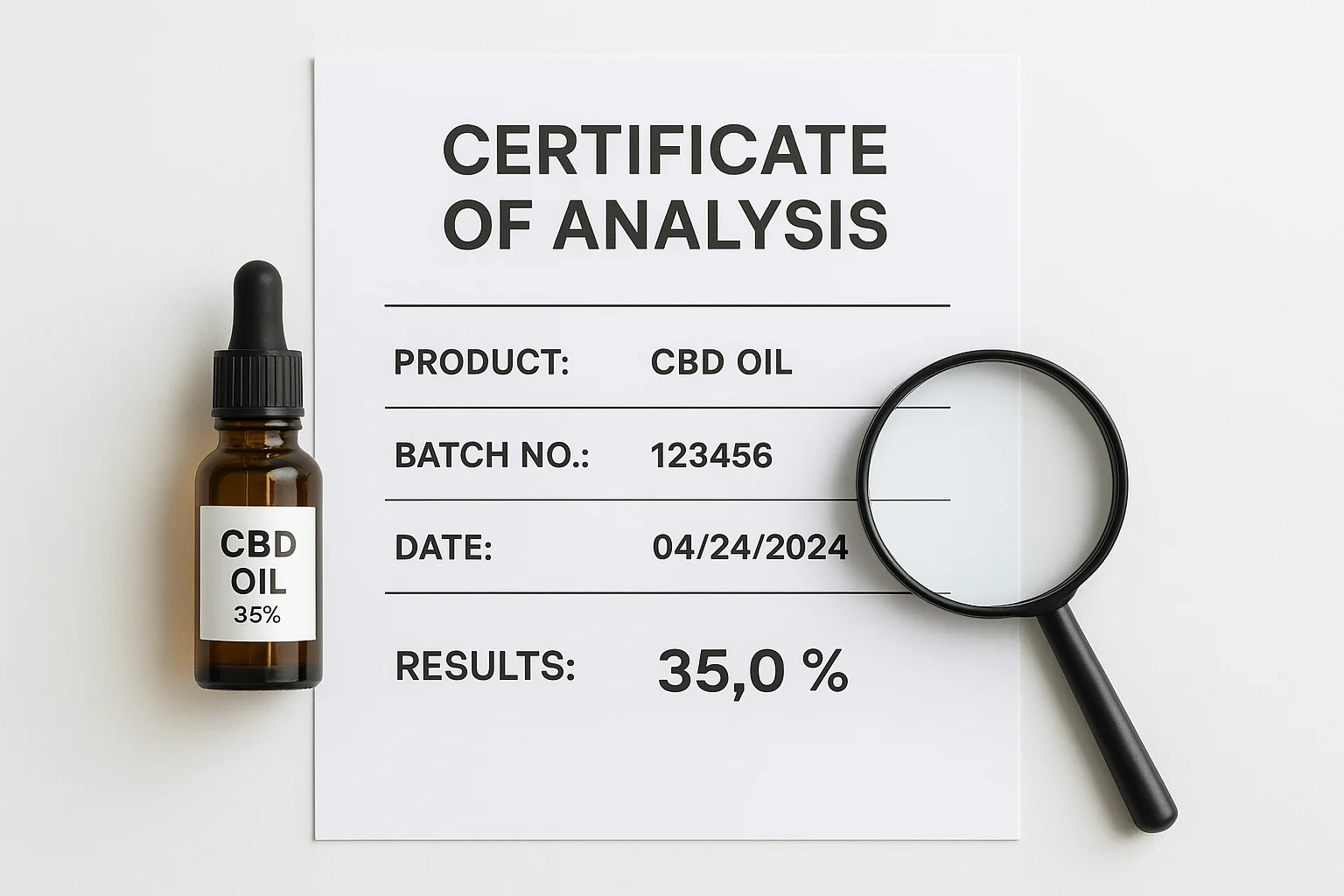

How to read a CBD certificate (COA): what to check before buying hemp oil
How to read a CBD certificate (COA)? Check the cannabinoid panel, THC, pesticides, heavy metals, and ISO 17025 accreditation of the laboratory. A complete guide to the COA.
Certyfikat analizy (COA — Certificate of Analysis) to jedyny dokumentarny dowód na to, co naprawdę jest w butelce olejku CBD. Problem w tym, że większość kupujących albo nie wie o jego istnieniu, albo nie potrafi go czytać — i ufa samej etykiecie. A etykieta to deklaracja producenta. COA to wynik badania niezależnego laboratorium. To różnica między „słowo handlowca” a „twarde dane analityczne”. W tym artykule przejdziemy przez każdy element COA krok po kroku: panel kannabinoidów, pestycydy, metale ciężkie, mikrobiologię, akredytację laboratorium i matching numeru partii.
KEY INFORMATION
• A COA issued by an accredited ISO 17025 laboratory is the basic safety standard when purchasing CBD.
• Sprawdź „Total THC” (nie tylko delta-9-THC): Total THC = THC + 0,877 × THCA — powinna wynosić poniżej 0,3%.
• The batch number (Batch ID) on the bottle must match the number on the COA — otherwise, the certificate does not pertain to your product.
• Desired results: ND (not detected) for pesticides, heavy metals, and solvent residues.
Why is it important to check the COA before purchasing?
The CBD market in Poland and Europe is poorly regulated compared to the pharmaceutical market. Manufacturers must declare the composition, but independent verification is not mandatory for every batch of product. The results of studies from independent organizations (e.g. Project CBD, CannaSafe) are alarming: up to 40% of tested CBD products in the USA and Europe had CBD concentrations deviating from the declared amount by more than 20%, and some contained detectable levels of pesticides or heavy metals not listed on the label.
A COA is not a guarantee of perfection — it is a guarantee of transparency. A manufacturer who provides a COA gives you the opportunity to verify their claims. A manufacturer without a COA asks for your blind faith. In an environment where product quality directly affects your health, this is a fundamental difference.
Cannabinoid panel – the core of every COA
The cannabinoid panel is the most important section of the certificate. It contains a list of all measured cannabinoids with their concentrations — usually expressed in mg/ml or percentages. Here’s what to check and why.
Total CBD (total CBD content): Sprawdź wartość „Total CBD” — powinna być zbliżona do deklarowanej na etykiecie, z tolerancją ±10%. Dla olejku 10% (1000 mg CBD/10 ml) COA powinien wykazywać 900–1100 mg Total CBD. Jeśli COA podaje tylko „CBD” bez „CBDA” — może nie uwzględniać formy kwaśnej. Total CBD = CBD + 0,877 × CBDA. Dobry COA podaje obie wartości i przelicza je łącznie.
Total THC: To najważniejsza wartość z perspektywy prawnej i zdrowotnej. Total THC = delta-9-THC + 0,877 × THCA. Nie patrz tylko na „delta-9-THC” — forma THCA (kwas THC-A) nie wywołuje efektu psychoaktywnego, ale przy ogrzewaniu (dekarboxylacja) przekształca się w THC. W produktach legalnych Total THC powinien być poniżej 0,2–0,3%. Dla maksymalnego bezpieczeństwa przy testach narkotykowych szukaj produktów z „ND” (not detected) dla obu form.
Other cannabinoids: A good COA also lists the concentrations of CBG (cannabigerol), CBN (cannabinol), CBC (cannabichromene), CBDV, and others. Full-spectrum products naturally contain these cannabinoids in small amounts — this is desirable due to the entourage effect. A CBD isolate should have CBD in the range of 95–99%, with other cannabinoids at ND or trace levels.
Pesticide panel – what the laboratory should test
Hemp is a bioaccumulative plant — it absorbs chemicals from the soil and air, including pesticides, with remarkable efficiency. If the plant grew in soil contaminated with insecticides or fungicides, the finished CBD extract may contain them at concentrations capable of causing health effects.
A good pesticide panel in the COA should cover at least 60–100 substances, tested using LC-MS/MS (liquid chromatography with tandem mass spectrometry) or GC-MS/MS for volatile pesticides. All results should be at ND (Not Detected) or below the EU MRL (Maximum Residue Level) limit for individual substances.
Czerwone flagi w panelu pestycydów: wyniki „Pass/Fail” bez podania wartości liczbowych (nie możesz ocenić marginesu), panel zawierający tylko 10–15 substancji (niewystarczający zakres), brak metody analitycznej (co sugeruje, że lab nie podlega standardowej akredytacji). Jeśli producent twierdzi, że „ekologiczne uprawy” eliminują konieczność badania — to błędne rozumowanie. Certyfikacja ekologiczna zmniejsza ryzyko, ale nie eliminuje go całkowicie, a COA jest obiektywną weryfikacją, nie deklaracją.
Heavy metals – why is this important for CBD?
Historically, hemp has been used for phytoremediation — removing heavy metals from contaminated soil. This is a good property for environmental cleanup but a bad one for supplement safety. Plants grown in soils with historical industrial contamination (especially in Poland, where heavy industry has affected the soils of central and southern regions) may contain lead, arsenic, cadmium, and mercury.
Prawidłowy panel metali ciężkich w COA powinien obejmować cztery „wielką czwórkę”: ołów (Pb), arsen (As), kadm (Cd) i rtęć (Hg). Wszystkie powinny być ND lub poniżej limitów USP (np. Pb <0,5 ppm w suplementach diety). Metoda analityczna to ICP-MS (spektrometria mas z plazmą indukcyjnie sprzężoną) — jedyna wystarczająco czuła dla wartości ppb. Granica wykrywalności (LOD) powinna być poniżej 10 ppb (parts per billion) dla każdego z metali.
Lead is particularly concerning with prolonged use of supplements — it accumulates in tissues and bones, and its safe concentration in a single dose can become toxic with months of exposure. When purchasing CBD for children or individuals regularly taking the product, verifying heavy metals is an absolute priority.
Solvent residues – extraction matters
CBD is extracted from hemp using various methods: supercritical CO2, ethanol, hexane, or other organic solvents. The extraction method affects the cannabinoid profile and the chemical residues in the final product.
Ekstrakcja CO2 jest uważana za „złoty standard” pod względem czystości — CO2 jest obojętny chemicznie i nie pozostawia toksycznych śladów. Ekstrakcja etanolowa daje typowo szeroki profil kannabinoidowy (dobry dla full-spectrum), ale wymaga dokładnego odparowania etanolu — pozostałości etanolu powyżej 5000 ppm są potencjalnie szkodliwe. Ekstrakcja heksanem lub innymi rozpuszczalnikami ropopochodnymi zostawia znacznie groźniejsze potencjalne pozostałości i jest coraz rzadsza u renomowanych producentów.
The COA should include a solvent residue panel using the GC-Headspace method. All results: ND or below the USP Class 1/2/3 limit. The absence of a solvent panel in the COA is a significant deficiency — especially if the extraction method is not provided or the manufacturer is new/unknown.
ISO 17025 accreditation – how to verify a laboratory
ISO 17025 is an international standard for testing and calibration laboratories. It includes requirements for personnel competence, calibration of measuring equipment, validation of analytical methods, quality control of results, and management of the quality system. A laboratory with ISO 17025 must regularly participate in external proficiency testing schemes and be subject to audits by the accrediting body.
How to verify? Every COA should provide the laboratory's accreditation number. In Poland, accreditations are granted by the Polish Centre for Accreditation (PCA) — verification is possible on the website pca.gov.pl. For foreign laboratories: A2LA (USA), UKAS (UK), DAkkS (Germany), COFRAC (France) — all have public search databases. Enter the accreditation number from the COA and check if the laboratory is active and accredited for the appropriate range of tests.
Our observations: Sprawdzamy COA dla produktów, które recenzujemy — jednym z najczęstszych problemów jest brak daty ważności certyfikatu lub brak jasnego powiązania z aktualną partią produktu. Certyfikat sprzed 18 miesięcy dla produktu aktualnie w sprzedaży nie daje żadnej gwarancji jakości bieżącej partii. Producenci poważnie traktujący jakość wystawiają nowe COA dla każdej partii (lot) produkcji — nie raz na rok „dla produktu” ogólnie.
Matching the batch number – how to do it in practice
The batch number (Batch ID, Lot Number, LOT) is a unique identifier for a specific production series. Each bottle produced in the same series has the same LOT number — different batches may vary, as each new production starts with new raw materials and may have a slightly different chemical profile.
Praktycznie: znajdź numer LOT na butelce (zwykle na etykiecie lub spodzie opakowania). Następnie otwórz COA udostępniony przez producenta — i porównaj numer LOT/Batch ID w nagłówku certyfikatu z numerem na butelce. Jeśli nie ma wyraźnego Batch ID w COA — certyfikat jest „ogólny” i może dotyczyć innej partii. Niektórzy producenci tworzą strony QR-kodów, gdzie po zeskanowaniu kodu na butelce pojawia się dokładny COA dla tej partii — to najwygodniejszy i najbardziej wiarygodny system.
Co zrobić jeśli Batch ID się nie zgadza? Skontaktuj się z producentem i poproś o COA dla dokładnego numeru LOT na butelce. Rzetelny producent powinien dostarczyć ten dokument bez problemu. Jeśli odmawia lub twierdzi, że „nie ma takiego numeru” — to sygnał do szukania innego dostawcy. Przy wyborze olejku CBD warto też sprawdzić przewodnik wyboru produktu: Jak wybrać olejek CBD.
Microbiology – often overlooked section of the COA
The microbiological panel is a section of the COA that many users ignore — yet it is important, especially for products consumed orally. It checks for the presence of microbiological pathogens: Salmonella, E.coli, Staphylococcus aureus, fungi and molds, and the total aerobic count.
Why are hemp plants susceptible to microbiological contamination? Plants grown outdoors come into contact with soil, rain, and insects — which increases the risk of colonization by pathogens. Ethanol extraction may not eliminate all microbiological contaminants. CBD products without a microbiological panel — especially those produced by small, unverified manufacturers — pose potential risks, particularly for individuals with compromised immunity.
Standardowe limity: Salmonella — nieobecna w 1 g, E.coli — <10 CFU/g, łączna liczba drobnoustrojów — <1000 CFU/g (zależnie od regulacji). Certyfikat powinien podawać wyniki ilościowe lub „nieobecne”, nie tylko „Pass”. Informacje o bezpieczeństwie CBD dla osób ze schorzeniami i wzmacnianiu odporności znajdziesz w artykule CBD and immunity.
Frequently Asked Questions
What is a COA certificate for CBD oil?
A COA (Certificate of Analysis) is a laboratory document confirming the chemical composition of a CBD product. A reliable COA includes a panel of cannabinoids, pesticides, heavy metals, solvent residues, and microbiology — issued by an accredited external laboratory with ISO 17025 and a Batch ID number matching the product.
How to check if THC in CBD oil is within the norm?
Sprawdź „Total THC” w panelu kannabinoidów: Total THC = delta-9-THC + 0,877 × THCA. Dla produktów legalnych w UE wartość powinna być poniżej 0,2–0,3%. Dla maksymalnego bezpieczeństwa przy testach narkotykowych — szukaj „ND” dla obu form THC. Więcej o CBD i testach narkotykowych w artykule CBD and drug tests.
What is ISO 17025 accreditation for a CBD laboratory?
ISO 17025 is a standard for the competence of testing laboratories, covering quality management, equipment calibration, and method validation. You can verify the accreditation number in the PCA database (Poland) or A2LA, UKAS, DAkkS (abroad). A laboratory without accreditation does not guarantee the reliability of results.
Co oznacza „ND” na certyfikacie CBD?
ND (Not Detected) — concentration below the limit of detection (LOD) of the method used. For pesticides and heavy metals, ND is a desired result. LOD should be stated in the COA — a good method has an LOD below 10 ppb for metals and 0.01% for THC.
How to match the COA to a specific bottle of CBD oil?
Find the batch number (Batch ID, Lot Number) on the bottle label and compare it with the number in the header of the COA certificate. If the numbers do not match, the certificate does not pertain to your product. Ask the manufacturer for the COA for the exact LOT number.
How much CBD should the oil contain according to the label?
A good product has a CBD content in the COA within ±10% of the declared value. A 1000 mg CBD oil should have 900–1100 mg in the COA. Deviations above 20% suggest production issues or manufacturer dishonesty. Total CBD = CBD + 0.877 × CBDA.
This article is for informational and educational purposes. It contains internal links to products available in the u Bucha store. Prices and specifications may change — check the current data on the product page before purchasing.
Author: Michał Waluk · Published: 2026-05-04 · Updated: 2026-05-04