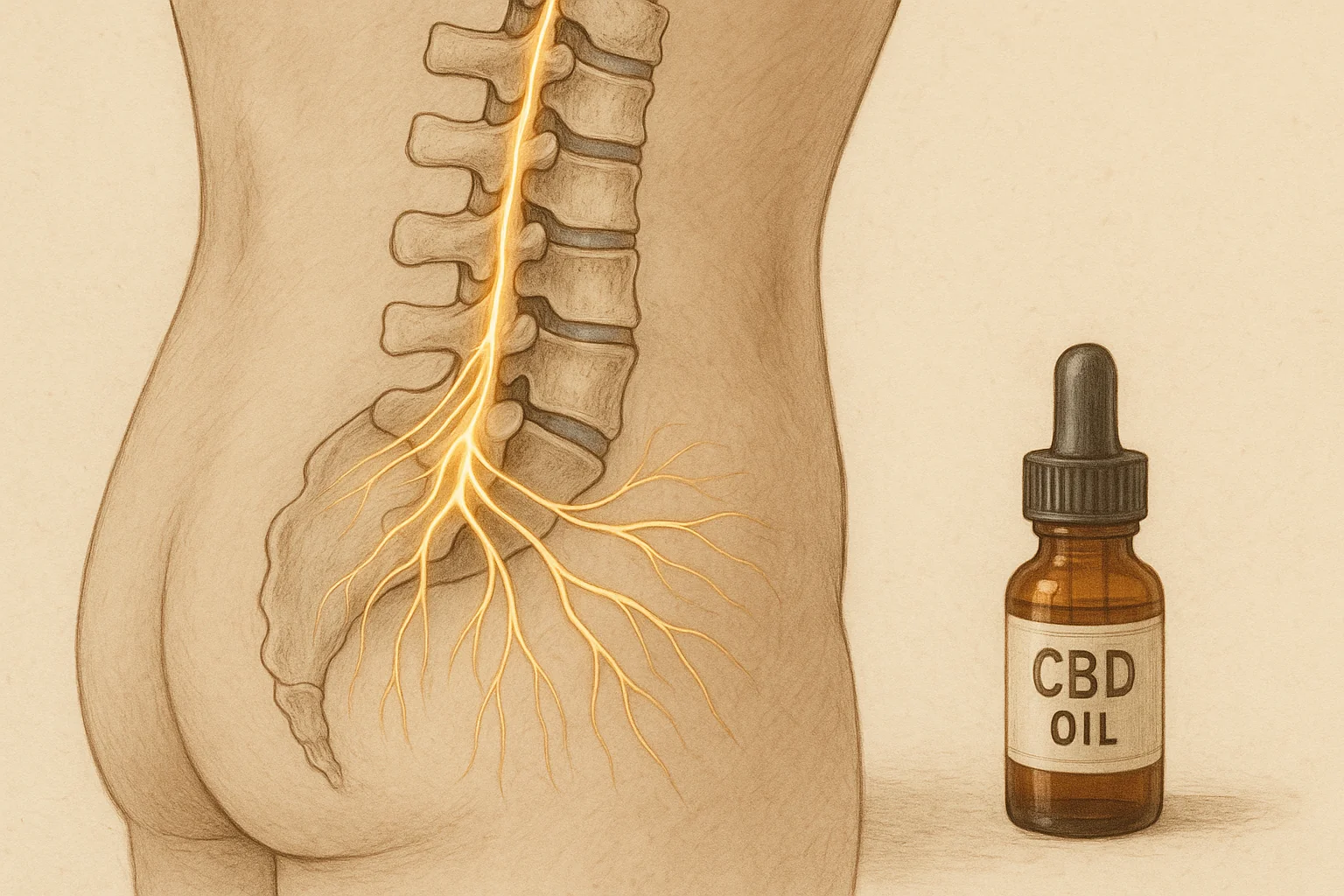

CBD Oil for Sciatica and Nerve Pain: Effectiveness and Dosage
Does CBD oil help with sciatica and nerve pain? Cochrane review results, real dosing, drug interactions, and CBD's place in the treatment plan.
Sciatica can turn an ordinary day into a series of sacrifices. It's hard to sit, hard to stand up, and going down stairs starts to require a plan. Pain radiates from the lumbar region through the buttock to the calf, often accompanied by tingling and numbness. CBD is increasingly mentioned in discussions about such pain because the endocannabinoid system does indeed participate in its modulation. The problem is that the mechanism is one thing, and the result of a randomized trial is another. The latest update of the Cochrane review did not show a clear effect of CBD-dominant preparations on neuropathic pain. Below you will find what is known, what is not known, practical dosing, and where CBD may make sense.
KEY INFORMATION
• The 2018 Cochrane review: at least 30% pain relief was reported by 39% of those on cannabinoid preparations compared to 33% on placebo (Mücke et al., Cochrane, 2018).
• The 2026 update, covering five trials with CBD-dominant preparations, did not show a clear effect on neuropathic pain relief.
• No randomized study has tested pure CBD directly for sciatica.
• CBD inhibits CYP3A4 and CYP2C19, so it may alter the concentration of opioids and other medications in the blood.
• Therapy due to adverse effects was interrupted by 10% of participants compared to 5% on placebo.
What is sciatica and why is nerve pain difficult to treat?
Sciatica is pain caused by irritation or compression of the sciatic nerve, most often due to a herniated disc at the L4-S1 level. The pain is neuropathic in nature: it originates from the damaged nerve, not from the surrounding tissue. Therefore, paracetamol and ibuprofen are less effective here than for regular muscle pain.
The sciatic nerve is the longest nerve in the human body. It runs from the lumbosacral region through the buttock and down the entire leg, so irritation of the root in the spine can cause symptoms all the way down to the calf and foot. Besides disc herniation, causes can include spinal canal stenosis or piriformis syndrome.
Neuropathic pain follows a different logic than nociceptive pain. A damaged nerve sends signals without an actual stimulus, and the threshold for stimulation decreases, so even a light touch can start to hurt. This phenomenon is called allodynia. The prevalence of chronic pain with a neuropathic component is estimated in the population at 6-10% (Ateş i in., Cochrane Database of Systematic Reviews, 2026).
Treatment remains challenging despite available medications. Gabapentin, pregabalin, and amitriptyline form the first line, but they help only a minority of patients and carry drowsiness and dizziness. This gap drives interest in cannabinoids, as patients seek something to complement their therapy without adding another list of side effects.
How would CBD work on nerve pain?
CBD interacts with several molecular targets involved in pain transmission: the TRPV1 channel, the CB2 receptor on immune cells, and PPAR-gamma receptors. However, a systematic review of CBD pharmacology notes that a significant portion of these effects has been described in vitro at concentrations higher than those achievable in the body (Ibeas Bih i in., Neurotherapeutics, 2015).
This distinction determines how to interpret promises from labels. A molecular target described in a test tube does not automatically translate to relief for a person with sciatica, as what matters in the body is the concentration of CBD in nerve tissue.
| Molecular target | Co robi CBD | Strength of evidence |
|---|---|---|
| TRPV1 | Modulates the channel that receives pain and temperature stimuli | Described in vitro, without confirmation in humans with sciatica |
| CB2 | Suppresses the inflammatory response of microglia around the irritated nerve | Animal models of neuropathy, consistent results |
| PPAR-gamma | Reduces the secretion of pro-inflammatory cytokines TNF-alpha and IL-6 | Mainly cell studies |
| Degradation of anandamide | Slows the degradation of endogenous cannabinoids | Mechanizm sporny, dane niejednoznaczne |
Animal models perform significantly better than studies involving humans. Activation of CB2 receptors reduced allodynia and pain hypersensitivity after nerve injury in rodents, as summarized by Rahn i Hohmann (Neurotherapeutics, 2009). A review of CBD pharmacology in pain confirms the analgesic and anti-inflammatory effect in neuropathy models, with a strong dependence on dosage and route of administration (Mlost i in., International Journal of Molecular Sciences, 2020).
We have noticed a recurring misunderstanding in conversations with readers. The statement "CBD inhibits neuroinflammation" is true in cell cultures and rats, yet it says nothing certain about the compressed L5 root in a specific individual. Remember this distinction before spending several hundred zlotys on a three-month treatment.
What do clinical studies say about cannabinoids in neuropathic pain?
The strongest summary comes from the Cochrane review. In the 2018 version, at least 30% pain relief was reported by 39% of participants taking cannabinoid preparations compared to 33% on placebo, and at the 50% threshold, it was 21% versus 17% (Mücke i in., Cochrane, 2018). The difference is real, but very small.
The authors converted this into the number of people that need to be treated for one additional person to feel an improvement: 11 at the 30% threshold and 20 at the 50% threshold. At the same time, 10% of participants discontinued treatment due to adverse effects compared to 5% on placebo. The benefits and harms have a comparable scale here.
An update of the review from 2026 shifts the picture even further towards skepticism. It included 21 studies and 2187 participants, including five trials with a CBD advantage. For this group, no clear effect was demonstrated at either the 30% or 50% threshold (Ateş i in., Cochrane, 2026). The certainty of the evidence was rated as low and very low.
An older review, frequently cited in marketing materials, states the same more cautiously. A meta-analysis of 24 randomized trials showed a moderate reduction in chronic pain compared to placebo, but the authors emphasized that most individual studies did not show an effect, and the clinical significance of the result remains uncertain (Aviram i Samuelly-Leichtag, Pain Physician, 2017). Separately, it is worth knowing about a trial with pure CBD for acute lower back pain: one hundred people in the emergency department received 400 mg of CBD or placebo, and after two hours, the difference in pain intensity was 0.3 points on a ten-point scale (Bebee i in., Medical Journal of Australia, 2021).
Does CBD ointment work better for sciatica than oil?
Topical preparations mainly reach the epidermis, muscles, and fascia. The sciatic nerve runs deep under the gluteus maximus muscle, so an ointment applied to the buttock has minimal direct contact with it. In typical sciatica, the systemic route, i.e., sublingual oil, has better pharmacological justification.
However, topical CBD has its own data in peripheral neuropathy. In a four-week randomized trial, 29 people with symptomatic lower limb neuropathy used CBD oil on the skin or placebo. The CBD group reported significantly less acute and stabbing pain and fewer sensations of cold and itching (Xu i in., Current Pharmaceutical Biotechnology, 2020).
The limitations of this trial should be noted immediately. Twenty-nine people is a very small group, the observation lasted four weeks, and it concerned neuropathy of the feet and lower legs, not compression of the nerve root in the spine. Transferring this result to sciatica is a hypothesis, not a conclusion.
In practice, a topical preparation can be a sensible addition when sciatica is accompanied by tension in the piriformis muscle. Relaxing this muscle reduces pressure on the nerve, so a massage with hemp gel may help indirectly. You can find more about external application forms in the post about hemp ointment for joints and muscles.
How is CBD dosed for nerve pain?
There is no CBD dosage with proven efficacy for sciatica. The review of evidence for CBD in chronic pain concludes that no recommendations can be formulated because almost all data come from preparations combined with THC (Boyaji i in., Current Pain and Headache Reports, 2020). The following numbers describe practice, not a treatment standard.
A reasonable approach is to slowly titrate from a small dose and assess after a set time. With 10% oil, one drop contains about 5 mg of CBD.
- Week 1-2: 10 mg in the morning and 10 mg in the evening, which is two drops of 10% oil.
- Week 3-4: 15 mg in the morning and 15 mg in the evening, which is three drops.
- Week 5-8: if there is no effect, 25 mg twice a day or switch to 15% oil to avoid increasing the volume of oil.
- After 8 weeks: no change in the pain diary means that CBD is not the right tool here.
The upper limit without medical supervision is a sensible 50 mg per day. A safety review shows a clear relationship between adverse effects and dosage, with elevated liver tests and drowsiness at the forefront (Brown i Winterstein, Journal of Clinical Medicine, 2019). Since a single dose of 400 mg did not improve lower back pain compared to placebo, endlessly increasing the dose has no basis.
The method of administration makes less difference than product descriptions suggest. A systematic review of CBD pharmacokinetics in humans states that absolute bioavailability was properly measured only after smoking (31%), and there is a lack of such data for oral and sublingual routes. However, an increase in maximum concentration after a meal and in fat formulations has been confirmed (Millar i in., Frontiers in Pharmacology, 2018). Practical conclusion: take the oil with a fatty meal.
How does CBD interact with sciatica medications?
CBD inhibits the enzymes CYP3A4 and CYP2C19 and affects the P-glycoprotein responsible for drug removal from cells. The safety review describes it as a substance that can be both a perpetrator and a victim of interactions, and advises caution for individuals taking multiple preparations at once (Brown i Winterstein, Journal of Clinical Medicine, 2019).
| Lek | What happens when CBD is added | What to do |
|---|---|---|
| Tramadol, oksykodon | Slower hepatic metabolism, possible increase in blood concentration | Do not combine without the consent of the attending physician |
| Gabapentyna, pregabalina | No enzymatic interaction, calming effect accumulates | Watch out for drowsiness, do not drive right away |
| Amitryptylina | Common CYP2C19 pathway, risk of increased adverse effects | Inform your doctor about the intention to use CBD |
| Ibuprofen, diklofenak | Other enzymes (CYP2C9), minor overlap | Low risk, inform during long-term use |
Opioids require the most attention. Adding CBD to tramadol or oxycodone without the doctor's knowledge poses a risk of sedation and respiratory depression without certain pain relief benefits. This is a poor trade-off, especially for an older person.
Gabapentin and pregabalin behave differently than is often written about them. Both medications are excreted by the kidneys with virtually no liver metabolism, so the classic enzymatic interaction with CBD does not apply to them. The real risk is pharmacodynamic: the summation of the sedative effect and worsening coordination. Before adding CBD to your ongoing treatment, show your pharmacist a list of the medications you are taking. We discussed the CYP450 mechanism and typical drug pairs in more detail in the post about CBD oil for seniors.
How to incorporate CBD into the treatment plan for sciatica?
CBD is not a treatment for sciatica and there is no data that would allow it to be considered a standalone treatment. Its sensible role is as an adjunct to physiotherapy for someone who has already undergone standard treatment and is looking for something with a mild safety profile. The foundation remains movement.
Stretching exercises for the piriformis muscle and strengthening exercises for the spinal stabilizers have the best long-term documentation. Pain blocks this mechanism: lack of movement weakens the stabilizing muscles, weaker stabilization increases pressure on the nerve root, and greater pressure means more pain. If CBD helps you get into an exercise cycle, it has fulfilled its function.
The second point worth fighting for is sleep. The relationship between its deficiency and pain works both ways and involves the opioid, immune, and endocannabinoid systems (Haack i in., Neuropsychopharmacology, 2020). A large series of cases from a psychiatric clinic noted an improvement in sleep in the first month for 66.7% of patients at a dose of about 25 mg per day, although the subjects presented with anxiety and insomnia, not with root pain (Shannon i in., Permanente Journal, 2019).
Ergonomics change more than a supplement. Taking a break to stand up every 45-60 minutes, sitting without slumping in the lumbar region, and sleeping on your side with a pillow between your knees reduce pressure on the nerve every day, regardless of whether you are taking oil.
The last element is measurement. Keep a pain diary on a scale from 0 to 10, note the dose and time of administration, and after eight weeks, look at the trend instead of the impression. Lack of improvement is a signal to return to the doctor and consider imaging diagnostics. We apply similar principles in back and spine pain.
Frequently Asked Questions
Does CBD really help with sciatica?
There is no good evidence for this. The 2026 update of the Cochrane review included five studies with preparations dominated by CBD and did not show a clear effect on relief from neuropathic pain. The mechanism is described, but it has not yet translated into clinical outcomes in humans.
How much CBD should I take for sciatica?
There is no proven effective dose for sciatica. In practice, titration is used: 10 mg in the morning and 10 mg in the evening for two weeks, then 15 mg twice a day. The upper limit without medical supervision is about 50 mg per day.
How long does it take to see effects of CBD for nerve pain?
Eight weeks is sufficient for a fair assessment. If after this time the pain diary does not show a downward trend at a dose of 50 mg per day, further increases are not warranted. A study with a single dose of 400 mg of CBD also did not show improvement compared to placebo.
Does CBD interact with pain medications?
Yes. CBD inhibits CYP3A4 and CYP2C19 and affects P-glycoprotein, so it may increase the concentration of tramadol and oxycodone. Gabapentin and pregabalin are excreted by the kidneys, and here the risk is the summation of drowsiness. Consult this with your pharmacist.
Does CBD ointment work for sciatica pain?
The topical preparation reaches the epidermis, muscles, and fascia, while the sciatic nerve runs deep under the gluteus muscle. A small trial with CBD oil on the skin reduced pain in people with foot neuropathy, but this is a different issue than root compression in the spine.
Can CBD replace physiotherapy for sciatica?
No. Stretching and strengthening exercises for the spinal stabilizers have the best long-term documentation. CBD does not act on the cause of nerve compression. Its role is as an adjunct that helps some people start exercising.
What concentration of CBD oil should I choose for severe nerve pain?
At doses of around 25-50 mg per day, a 15% or 20% oil is more convenient, as it requires 3-7 drops instead of a dozen. Start with a 10% concentration to gauge tolerance, and increase after establishing a dose that makes a difference.
If after this reading you want to check concentrations and compositions, the full offer awaits you in the section hemp oils in the u Bucha store.
This article is for informational and educational purposes and does not constitute medical advice. Before starting to use cannabis or CBD for therapeutic purposes, consult a doctor, especially if you are taking other medications, are pregnant, or breastfeeding.
Author: Michał Waluk · Opublikowano: 2026-06-22 · Aktualizacja: 2026-08-07