
Sulforaphane (broccoli extract): detox and antioxidant (table)
Sulforaphane and the NRF2 pathway: what three clinical studies have shown, why myrosinase determines bioavailability, and how broccoli sprouts differ from capsules.
Three-day-old broccoli sprouts contain ten to a hundred times more glucoraphanin than the mature plant of the same cultivar. This finding from 1997, published in the Proceedings of the National Academy of Sciences by the team of Fahey, Zhang, and Talalay from Johns Hopkins, opened an entire field of research on functional foods (Fahey i wsp., PNAS, 1997). Since then, sulforaphane has been the subject of over three thousand publications describing its effects in rodent models and over fifty studies involving humans (Yagishita i wsp., Molecules, 2019). This article shows what these studies really imply, where the evidence ends and marketing begins, and why the form of the preparation affects the outcome more than its declared content.
KEY INFORMATION
• Sulforaphane acts through the KEAP1-NRF2 pathway, and this is the only molecular target recognized today as confirmed (Dinkova-Kostova et al., 2017).
• In a 12-week study involving 291 participants, a drink made from broccoli sprouts increased the excretion of benzene metabolites by 61% (Egner et al., 2014).
• In a phase II study involving 20 men with recurrent prostate cancer, the primary endpoint was not achieved.
• Preparations with preserved active myrosinase provide 3-4 times higher bioavailability of sulforaphane than glucoraphanin alone.
• The u Bucha store does not offer sulforaphane or broccoli extract.
How does sulforaphane work at the cellular level?
The plant does not contain sulforaphane. It has glucoraphanin, an inactive precursor from the group of glucosinolates, and the enzyme myrosinase kept in separate compartments of the cell. Only tissue damage, such as chewing, cutting, or sprouting, brings them into contact, and myrosinase converts glucoraphanin into sulforaphane. This is a plant defense mechanism that has proven interesting for humans.
In the cell, sulforaphane reacts with cysteine residues of the KEAP1 protein, which under normal conditions directs the transcription factor NRF2 to degradation. The released NRF2 moves to the nucleus and activates protective response genes. The authors of the review of this mechanism make an important caveat: sulforaphane is attributed many molecular targets, but only the KEAP1-NRF2 pathway can be considered confirmed today (Dinkova-Kostova i wsp., Trends in Food Science and Technology, 2017).
The practical effect is the induction of phase two xenobiotic metabolism enzymes, including glutathione transferases and quinone reductase. These enzymes attach water-soluble groups to foreign substances, allowing the body to excrete them. The same system metabolizes some medications, so a person on permanent medication should start the conversation about supplementation with their doctor, not the label. A related mechanism is described in glutationie, which is a donor of the thiol group in this reaction.
Does sulforaphane really support detoxification?
Yes, and here the word "detox" is backed by measurement, which is rare with supplements. It is determined by a randomized study conducted in Qidong on the Yangtze River, in an area with high air pollution, involving 291 participants over 12 weeks (Egner i wsp., Cancer Prevention Research, 2014).
Participants received a daily drink made from broccoli sprouts providing 600 micromoles of glucoraphanin and 40 micromoles of sulforaphane or a placebo. The concentration of mercapturic acids in urine, which are products of conjugation of pollutants with glutathione, was measured. In the group receiving the drink, the excretion of conjugated benzene was 61% higher, and acrolein by 23%, both statistically significant results. No difference was found for crotonaldehyde, and the bioavailability of sulforaphane did not decrease throughout the administration period.
It is worth reading this result carefully, as it can be stretched. Increased excretion of metabolites of two specific air pollutants was measured, not "cleansing the body." Sulforaphane does not act as a heavy metal chelator and does not replace treatment for liver diseases. It also does nothing on its own: it strengthens the system that the body already has. If this system lacks raw material, strengthening has nothing to work with.
What is known about sulforaphane and cancers?
Much in animal models, little in humans, and the only published clinical study on this indication did not achieve its goal. A study from 1997 already showed that extracts from three-day-old sprouts reduced the frequency and rate of breast tumor development in rats treated with dimethylbenzanthracene. However, translating this to humans proved more difficult than expected.
In a phase II study, 20 men with recurrent prostate cancer received an extract providing 200 micromoles of sulforaphane daily for a maximum of 20 weeks. The primary endpoint was the percentage of patients with a decrease in PSA concentration of at least half. It was achieved by one participant out of twenty, so the study did not meet its intended goal. The side effect was more favorable: the PSA doubling time extended from 6.1 to 9.6 months, and the treatment proved safe, with no grade three adverse events. The authors cautiously state that further studies may be warranted (Alumkal i wsp., Investigational New Drugs, 2015).
We noted that in popular discussions, the same result is often presented as a success, as only the extension of the PSA doubling time is cited. The statement about the unmet endpoint disappears, even though it is the conclusion of the study. Thus, sulforaphane remains an interesting dietary component with documented detoxifying effects; it is not a cancer therapy.
What did the sulforaphane study in autism show?
The most frequently cited clinical trial concerns the autism spectrum and is a double-blind study with a placebo. It involved 44 young men aged 13 to 27 with moderate to severe symptoms: 29 received sulforaphane, 15 placebo, for 18 weeks, and then for four weeks no one received anything (Singh i wsp., PNAS, 2014).
After 18 weeks, the results on the Aberrant Behavior Checklist improved by 34% in the treatment group, and by 17% on the Social Responsiveness Scale, while in the placebo group the change did not exceed 3.3%. The authors also noted an advantage in clinical assessment regarding social interactions and verbal communication. After discontinuation of the preparation, scores returned towards baseline values, which argues that the observed effect was related to the substance, and also means that it did not become permanent. Similarly, we describe the early state of evidence in kannabidiwarynie badanej w padaczce i autyzmie.
| Study | Who was affected | How long did it last | Outcome |
|---|---|---|---|
| Egner 2014, Qidong | 291 people from a high air pollution area | 12 weeks | Excretion of conjugated benzene higher by 61%, acrolein by 23%; no difference for crotonaldehyde |
| Alumkal 2015, faza II | 20 men with recurrent prostate cancer | do 20 tygodni | Endpoint not achieved (1 out of 20); PSA doubling time 6.1 to 9.6 months |
| Singh 2014, PNAS | 44 men aged 13-27 with autism spectrum | 18 tygodni i 4 tygodnie bez preparatu | Improvement of ABC scores by 34% and SRS by 17%; return towards baseline values after discontinuation |
Why does the form of the preparation determine its effectiveness?
Because without myrosinase, glucoraphanin remains largely unused. A comparison in volunteers showed that sprouts and seeds given without prior extraction, thus retaining their own enzyme, provide sulforaphane with 3-4 times higher bioavailability than glucoraphanin given without active plant myrosinase. This occurred regardless of the carrier and dosage (Fahey i wsp., PLOS ONE, 2015).
The stomach environment also affects the outcome. In a later study by the same team, participants took an extract from seeds and sprouts before and after starting omeprazole therapy. After the proton pump inhibitor was introduced, they excreted more sulforaphane metabolites, indicating that stomach acidity reduces the conversion of glucoraphanin. The enteric coating improved conversion, likely protecting the enzyme from acid (Fahey i wsp., Nutrients, 2019).
This leads to a simple guideline when reading labels: it is not just the declared content of glucoraphanin that matters, but whether the producer provides active myrosinase along with it or whether the preparation is based on whole sprouts. A preparation with only glucoraphanin is not useless, but its actual effect depends on the enzyme supplied by the diet or gut microbiota, which is an unpredictable quantity. The same predictability issue applies to many plant extracts, as we demonstrate with EGCG z zielonej herbaty.
How to grow broccoli sprouts at home?
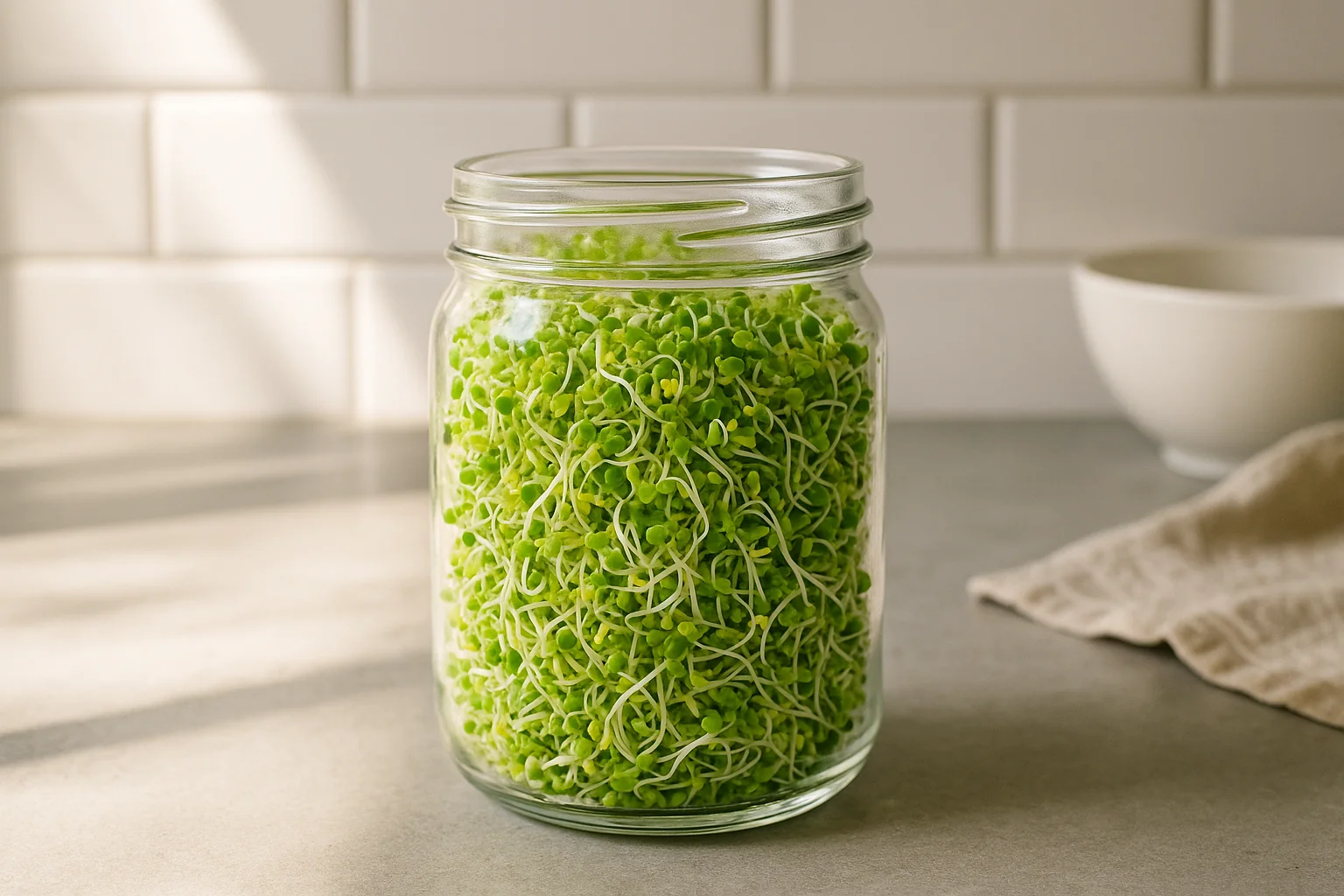
The easiest way is in a jar, in four steps and without any equipment. It was in three-day-old sprouts that, in 1997, ten to a hundred times more glucoraphanin was measured than in the mature plant, and the fresh sprout retains its own myrosinase, the enzyme responsible for bioavailability.
- Soak two tablespoons of broccoli seeds intended for sprouting in water for 8-12 hours, then drain and rinse.
- Place the jar upside down at an angle, so that the water drains freely, at room temperature and away from direct light.
- Rinse with cold water and drain twice a day; this is the most important habit, as moisture without airflow promotes mold.
- After 3-5 days, the sprouts will be a few centimeters long, and their cotyledons will turn green. Store them in the refrigerator and use within a few days.
Only buy seeds labeled as intended for sprouting, as seed material may be treated with plant protection products. Sprouts are eaten raw, so heating them defeats the purpose: high temperatures destroy myrosinase, leaving only the inactive precursor. Add them to soup or a hot dish only on the plate, as in our broccoli cream soup.
Frequently Asked Questions
Does sulforaphane really support detoxification?
In one specific sense, yes. In a study of 291 people over 12 weeks, a drink made from broccoli sprouts increased the excretion of glutathione-conjugated metabolites of benzene by 61% and acrolein by 23%. This measures two air pollutants, not evidence of 'detoxifying the body' in a marketing sense.
How much sulforaphane was administered in clinical studies?
Depending on the study. In a trial with men with prostate cancer, it was 200 micromoles per day for a maximum of 20 weeks, in a study concerning autism from 50 to 150 micromoles per day for 18 weeks, and in a detoxification study, the drink provided 40 micromoles of sulforaphane and 600 micromoles of glucoraphanin. These are descriptions of protocols, not recommendations.
Broccoli sprouts or capsules?
The presence of active myrosinase is decisive, not the form of the preparation. Sprouts and seeds provided without prior extraction yield sulforaphane with a bioavailability 3-4 times higher than glucoraphanin without the active plant enzyme. A capsule with added myrosinase performs comparably; the dried product devoid of the enzyme performs the worst.
Does sulforaphane treat cancers?
No. The only published phase II study on this indication, involving 20 men with recurrent prostate cancer, did not achieve the primary endpoint: a decrease in PSA by at least half was achieved by one participant. An extension of the PSA doubling time was noted, but the authors consider it a premise for further research, not a therapeutic outcome.
Is sulforaphane safe?
In studies lasting up to 20 weeks, no grade three adverse events were recorded, even at 200 micromoles per day. There is no data on use longer than a year. Broccoli sprouts as a meal component are just a regular vegetable. Consult supplementation with a doctor if you are on permanent medication, as sulforaphane stimulates enzymes involved in their metabolism.
We do not offer sulforaphane or broccoli extract; we have gathered other antioxidant preparations in the category supplements.
This article is for informational and educational purposes and does not constitute medical advice. Before starting supplementation, consult your doctor, especially if you are taking medications regularly, are pregnant or breastfeeding, or have a chronic illness.
Author: Michał Waluk · Opublikowano: 2026-07-15 · Aktualizacja: 2026-08-16