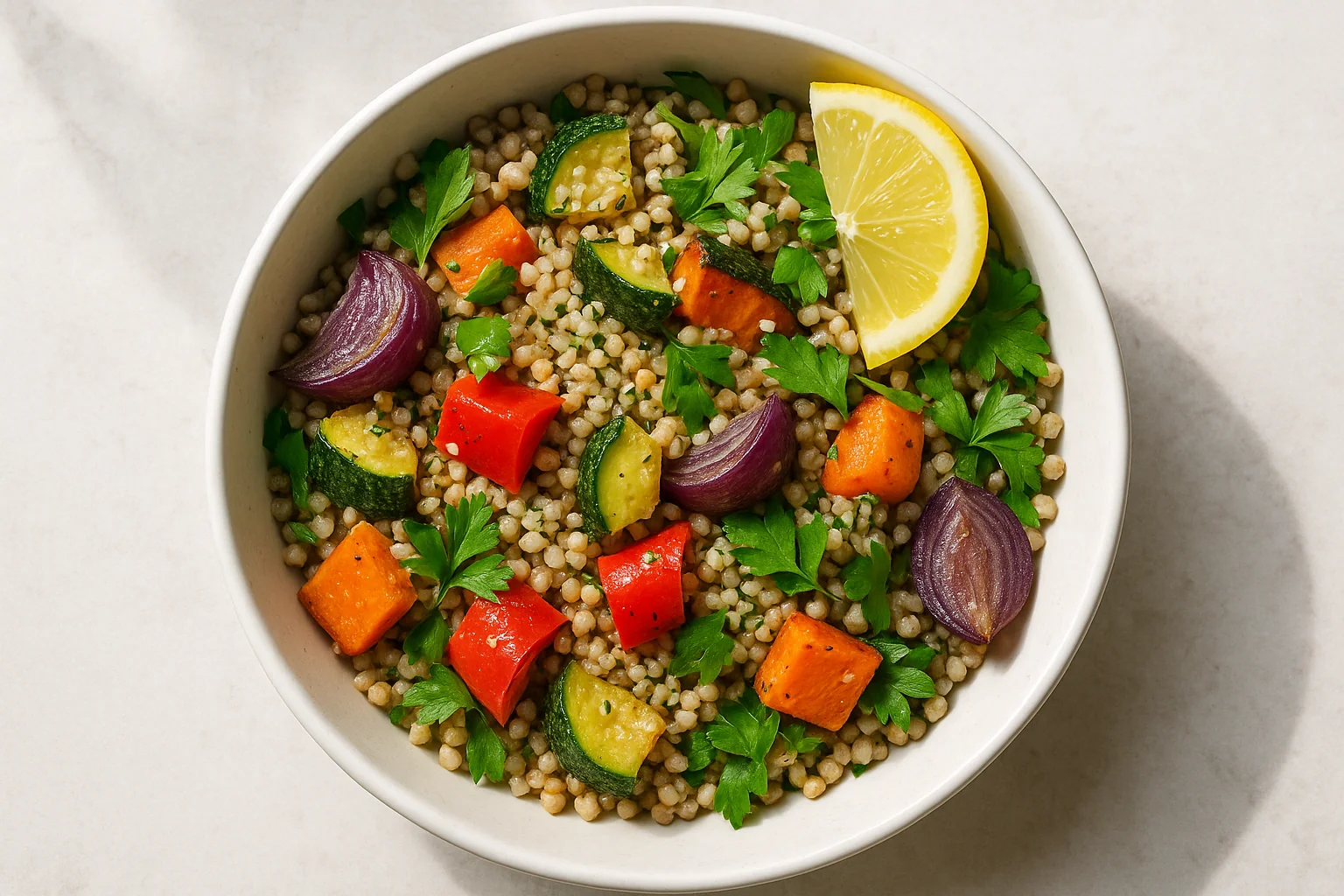

Buckwheat salad with hemp seeds
Buckwheat and Hemp Seed Salad – Step-by-step recipe. Nutritional information, lemon dressing, and tips for a filling gluten-free salad.
Buckwheat provides the salad with something that other bases can't: it fills you up, holds the dressing, and won't get mushy after an hour in the fridge. Shelled hemp seeds added just before serving enhance this recipe with crunch, additional protein, and a complete set of amino acids that buckwheat alone does not provide. The salad is gluten-free, ready in 35 minutes, and lasts in the fridge for three days without losing texture. I will show you how to assemble it so that the buckwheat remains fluffy, the dressing clings to the grains, and the hemp seeds don't disappear, softened at the bottom of the bowl.
KEY INFORMATION
• Hulled hemp seeds contain about 31 g of protein per 100 g - more than chia (17 g) and flaxseed (18 g) (House et al., Food Chemistry, 2010).
• Hemp seeds provide a complete profile of 9 essential amino acids, complementing the limited amino acid profile of buckwheat.
• Stosunek omega-6 do omega-3 w nasionach konopi wynosi ok. 3:1 - optymalny dla diety zachodniej (Callaway, Euphytica, 2004).
• Buckwheat is naturally gluten-free and has a low glycemic index.
What do hemp seeds add to buckwheat salad?
Buckwheat provides about 6 g of protein per 100 g of dry weight and is rich in rutin, magnesium, and iron, but its amino acid profile is not complete. House et al. (Food Chemistry, 2010) demonstrated that shelled hemp seeds contain all 9 essential amino acids, including lysine and methionine, which are lacking in optimal amounts in buckwheat. Two tablespoons of seeds (about 20 g) fill this gap and contribute about 6 g of additional protein per serving.
Hemp seeds also act as a natural textural element - their delicate crunch contrasts with the softness of the buckwheat and roasted vegetables. USDA FoodData Central (2023) indicates that 3 tablespoons of seeds (30 g) provide about 166 kcal, 9 g of protein, and 14 g of fat, predominantly polyunsaturated fatty acids. In the salad with buckwheat, it is a complete protein addition that requires no cooking or marinating.
We noticed in tests that hemp seeds absorb moisture from the dressing faster than other seeds - after 15 minutes in the mixture, they become soft and lose their crunch. Therefore, sprinkle them directly on the plate just before serving, not in a serving bowl.
Nutritional values - what does this serving provide?
One serving (75 g of dry groats, 2 tablespoons of hemp seeds, roasted vegetables, dressing with a tablespoon of hemp oil) provides about 380-420 kcal, 18-22 g of protein, 16 g of fat (mainly PUFA), and about 42 g of carbohydrates. The fiber from the groats, vegetables, and seeds is about 7-8 g per serving. The salad is naturally gluten-free and rich in magnesium and rutin from buckwheat groats.
Ingredients - what do you need?
Proportions for 2 servings. Cooking time for groats: 15 minutes. Roasting time for vegetables: 15-18 minutes. Assembling the salad: 5 minutes.
- 150 g of unroasted buckwheat
- 1 zucchini (about 200 g)
- 1 red bell pepper (about 150 g)
- 4 tablespoons of shelled hemp seeds
- 2 handfuls of arugula or baby spinach (about 60 g)
- a small bunch of parsley
- optional: 60 g of feta cheese or avocado
- 2 tablespoons of cold-pressed hemp oil
- 1 tablespoon of lemon juice
- 1 teaspoon of Dijon mustard
- 1 teaspoon of honey or maple syrup
- 1 tablespoon of olive oil (for roasting vegetables)
- salt, pepper, oregano
How to prepare a salad with buckwheat groats - step by step?
The groats and vegetables cook simultaneously. Start by preheating the oven and boiling water - both processes finish around the same time.
Step 1. Cook the buckwheat. Pour 150 g of groats into a pot, add 300 ml of cold water, and a pinch of salt. Bring to a boil, reduce the heat, and cook covered for 12-15 minutes until the water is absorbed. Remove from heat and let sit covered for 5 minutes. Spread the groats on a large plate to cool - in a bowl, steam retains moisture for too long.
Step 2. Roast the vegetables. Preheat the oven to 200°C. Dice the zucchini and bell pepper into about 2 cm cubes. Transfer to a baking sheet, drizzle with a tablespoon of oil, and sprinkle with salt, pepper, and oregano. Bake for 15-18 minutes until slightly browned. Cool for at least 10 minutes before adding to the groats.
Step 3. Make the dressing. In a jar, pour 2 tablespoons of cold-pressed hemp oil, add lemon juice, mustard, honey, salt, and pepper. Close tightly and shake vigorously for 20 seconds. Use hemp oil only cold - the smoke point is about 165°C.
Step 4. Chop the greens. Rinse and dry the arugula. Chop the parsley. If using avocado, slice it just before serving. Crumble the feta with your hands into irregular pieces.
Step 5. Assemble the salad. In a large bowl, combine the cooled buckwheat, roasted vegetables, arugula, and parsley. Drizzle with the dressing and gently mix. Transfer to plates, adding feta or avocado. This recipe pairs wonderfully with a quinoa bowl with hemp seeds - similar assembly principle, different base.
Step 6. Sprinkle with hemp seeds and serve. Just before serving, sprinkle each portion with 2 tablespoons of hulled hemp seeds. Not earlier - the seeds absorb moisture from the dressing and lose their crunch after about 10-15 minutes. Serve immediately.
Tips and variations
The buckwheat salad is flexible. Here are a few tried-and-true directions:
Version with roasted pumpkin. In autumn, replace zucchini and bell pepper with 200 g of diced hokkaido pumpkin. The pumpkin is sweeter and creates a beautiful contrast with the nutty flavor of the groats and hemp seeds. Roasting time for pumpkin: 20-22 minutes at 200°C.
Protein version. Add grilled salmon (100 g per person), hard-boiled eggs, or roasted chickpeas - the protein content of the serving will then exceed 30 g. Keep the hemp seeds as they complement the amino acids regardless of the chosen protein.
The most common mistake. Mixing warm buckwheat with hemp oil dressing. Hemp oil loses its properties when heated, and warm buckwheat oxidizes its fatty acids. Allow the buckwheat and vegetables at least 15 minutes after removing them from the pot and oven.
Frequently Asked Questions
How much protein does a serving of this salad provide?
One serving with 2 tablespoons of hemp seeds provides about 18-22 g of protein. Buckwheat groats contribute about 6 g of protein per 100 g of dry mass. Hulled hemp seeds contain about 31 g of protein per 100 g - USDA FoodData Central (2023) it is indicated as one of the richest plant sources of protein.
Why do hemp seeds go well with buckwheat salad?
Buckwheat groats have a nutty flavor that naturally resonates with hemp seeds. The seeds also complement the amino acid profile of the groats - hemp contains all 9 essential amino acids (House et al., Food Chemistry, 2010), including lysine and methionine, which are lacking in optimal amounts in buckwheat.
Is buckwheat gluten-free?
Yes - buckwheat groats are gluten-free and are a different species from wheat. People with celiac disease should choose groats with a gluten-free certification due to the risk of cross-contamination. Hemp seeds are naturally gluten-free (USDA FoodData Central, 2023).
How long can you store buckwheat salad?
A salad without dressing and hemp seeds lasts in the refrigerator for up to 3 days. Dressing in a sealed jar - 4-5 days. Always add hemp seeds and dressing just before serving, as the groats absorb the dressing and lose texture after a few hours (USDA FoodData Central).
How to prevent buckwheat from clumping in the salad?
Spread the cooked groats on a flat plate - the steam will evaporate quickly and the grains will loosen. Optionally drizzle a teaspoon of oil over the still warm groats and mix with a fork. The groats must be completely cooled before combining with the dressing made with hemp oil (USDA FoodData Central, 2023).
This article is for informational and educational purposes and does not replace consultation with a doctor. If you are pregnant, breastfeeding, taking medications, or have chronic conditions, consult the use of supplements or herbs with a specialist.
Author: Michał Waluk · Published: 2026-05-04 · Updated: 2026-05-04