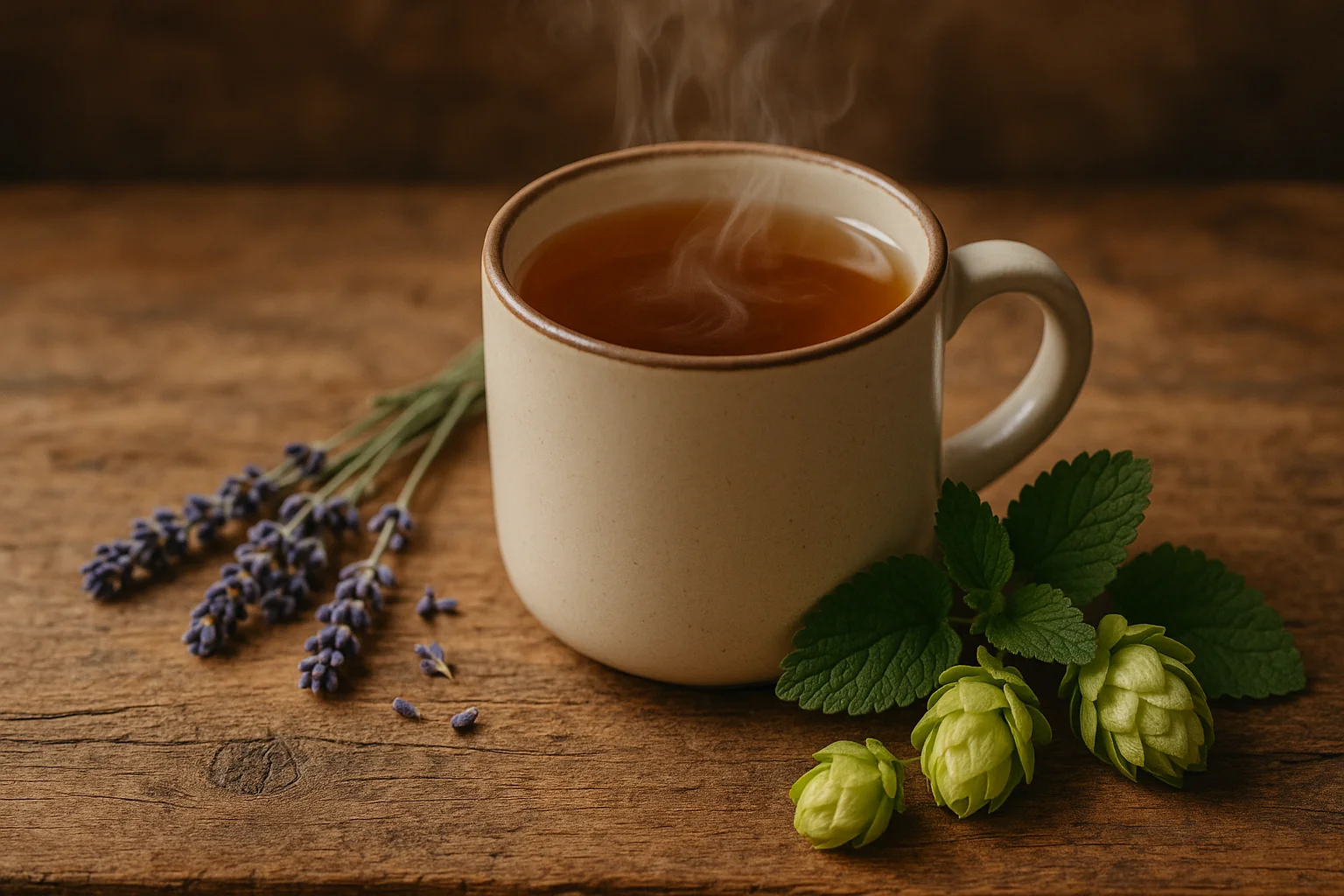

Teas for sleep - lemon balm, lavender, hops, and CBD (comparison)
Teas for sleep: comparison, differences, and what to realistically choose. A table and specific tips from u Bucha.
Sleep problems affect up to 33% of Poles, and according to data from the World Health Organization, insomnia is one of the most commonly reported sleep disorders in Europe (WHO, 2022). Many of us seek natural solutions before turning to medication. Herbal teas are the first step that millions of people take in the evenings. But do lemon balm, lavender, hops, and CBD work the same way? They differ in mechanism, strength of effect, and clinical evidence. This article shows you these differences in specific numbers and a simple table, so you can choose what truly fits your situation.
KEY INFORMATION
• Insomnia or sleep disorders affect about 33% of adults in Poland (WHO, 2022) - herbs are one of the first natural support tools.
• Lemon balm has shown effectiveness in RCT studies at a dose of 600 mg of extract daily (Kennedy et al., 2003).
• Hops, lavender, and CBD have different mechanisms of action and varying levels of clinical evidence.
• Herbal blends synergistically combine mechanisms - often more effective than a single herb.
• No tea can replace a medical consultation for chronic insomnia.
Lemon balm - how does it work and what do studies say?
Lemon balm (Melissa officinalis) is one of the best-studied sedative herbs. An extract of lemon balm at a dose of 600 mg significantly improved mood and reduced feelings of anxiety in healthy volunteers in a double-blind clinical trial from 2003 (Kennedy et al., Neuropsychopharmacology, 2003). This is an important result because it is not a self-assessment survey - it is a controlled RCT.
The mechanism is bidirectional. Rosmarinic acid present in lemon balm inhibits the activity of the MAO-A enzyme, which breaks down serotonin and dopamine. At the same time, flavonoid glycosides modulate GABA-A receptors, similar to benzodiazepine medications, but weaker and without addictive effects. The net effect is a clear calming of the nervous system without sedation.
Lemon balm infusion is brewed from fresh or dried leaves. The water temperature should be 90-95 degrees Celsius, and the brewing time is 7-10 minutes under cover to retain the volatile essential oils. With a standard infusion (2 g of dried leaves per 200 ml), you achieve a dose of about 150-200 mg of rosmarinic acid and related polyphenols. Studies used higher doses of extract, but regular infusion 2-3 times a day provides a real, cumulative effect.
Lemon balm is safe for healthy adults with short-term use. The only significant interaction concerns sedative medications and alcohol, which its effects may enhance. The European Medicines Agency (EMA) has classified lemon balm as a traditional herbal product with documented use in mild states of nervous tension and difficulties falling asleep (EMA HMPC Monograph, Melissa officinalis, 2013).
Citation capsule: An extract of lemon balm at a dose of 600 mg significantly improved mood and reduced feelings of anxiety compared to placebo in healthy volunteers (Kennedy et al., Neuropsychopharmacology, 2003). This result suggests that daily lemon balm infusion, used regularly, can realistically reduce evening tension and shorten the time it takes to fall asleep.
Lawenda - aromat czy realna pomoc na sen?
Lavender (Lavandula angustifolia) is often associated solely with aromatherapy. This is too narrow a view. The EMA HMPC Monograph from 2012 classified an oral lavender preparation (Silexan, 80 mg of oil) as a traditional herbal product supporting the alleviation of anxiety states in adults (EMA HMPC Monograph, 2012). The oral form differs from the infusion, but the mechanism is the same.
The main active ingredients are linalool and linalyl acetate. Linalool binds to NMDA and AMPA receptors, inhibiting excessive neuronal activity. This mechanism is different from lemon balm, which means that combining both herbs may work additively. Lavender aromatherapy through skin inhalation is a separate absorption pathway that also shows effects in studies, but the bioavailability is significantly lower.
We have noticed that customers asking about sleep teas often reach for lavender as an addition to a blend rather than as a standalone infusion. This makes pharmacological sense: linalool and rosmarinic acid from lemon balm act on different receptors, so combining them in one blend provides a broader calming profile than each herb alone.
Lavender infusion requires caution with the amount of dried herb. A too large dose can give an intense, slightly bitter taste and cause headaches in sensitive individuals. Typically, 1-2 teaspoons of dried flowers per 200 ml of water is sufficient. EMA recommends using lavender only for adults and adolescents over 12 years of age. For children under this age, consultation with a pediatrician is necessary.
Hops cones - an underrated sedative herb
Common hop (Humulus lupulus) is an herb known to every beer lover, but few associate it with tea for sleep. Meanwhile, hop cones have a solid research basis. The key mechanism was discovered by Zanoli and colleagues in 2005: during the digestion of 2-methyl-3-buten-2-ol, it is converted into dimethylvinyl-dihydrobenzofuran (DMVHBF), a compound with pronounced sedative effects (Zanoli et al., Phytotherapy Research, 2005). This explains why hops work more slowly than lemon balm - they need time for intestinal metabolism.
The sedative effect of hops is weaker in monotherapy, but significantly increases when combined with valerian. A meta-analysis of clinical studies from 2006 confirmed that the combination of valerian and hops significantly improves sleep quality compared to placebo (Bent et al., American Journal of Medicine, 2006). Hops alone have limited RCT evidence, but perform well in herbal blends.
From our experience, those seeking a stronger sedative effect than lemon balm alone most often inquire about blends with hops. Hop cones have a characteristic, slightly bitter aroma that is mellowed and well-composed in a blend with lemon balm and lavender. We less frequently encounter customers brewing hops on their own.
When brewing hops cones, use 1 teaspoon of dried herb per 200 ml of water at a temperature of 90-95 degrees Celsius. Brewing time is 7-10 minutes. Hops are not recommended for depression (the calming effect may exacerbate apathy), during pregnancy, and for children without consulting a doctor.
Herbata CBD - jak wspiera sen?
CBD (cannabidiol) affects sleep through the endocannabinoid system (ECS), but the mechanism is broader than just binding to CB1 and CB2 receptors. CBD modulates the serotonin receptor 5-HT1A, which reduces activation of the anxiety system. In a clinical study by Shannon and colleagues from 2019, CBD at a dose of 25 mg per day improved sleep in 79.2% of patients with accompanying anxiety within the first month of use (Shannon et al., The Permanente Journal, 2019). This is one of the stronger clinical studies to date regarding CBD and sleep.
CBD tea is a term that encompasses two different formats. The first is dry hemp biomass (CBD herb), from which we brew an infusion. The second is an herbal tea with added CBD extract. Both work, but differ in bioavailability: freeze-dried extract added to the infusion is absorbed better than raw herb, as CBD from dry material requires fats for effective absorption.
We have noticed that customers choosing CBD tea for sleep most often look for a format more convenient than sublingual oil. Tea consumed 45-60 minutes before sleep becomes an evening ritual that has intrinsic relaxing value, regardless of the pharmacology of CBD. This behavioral context is often overlooked in most studies, yet it has real significance in practice.
Teas containing CBD extract from certified EU hemp (with THC levels below 0.3%) are legal in Poland as food products. CBD is not a controlled substance under Polish pharmaceutical law. Always check if the manufacturer provides a certificate of analysis (CoA) confirming the THC content in a specific batch of the product.
Comparison of sleep teas - table
The table below compares four main options and herbal blends according to their mechanism of action, time of effect, dosage, available clinical evidence, and practical assessment. None of these teas is a medicine - they are natural support that works best with regular use and healthy sleep hygiene.
| Herb | Mechanism of action | Duration of action | Dosage (infusion) | Clinical evidence | Assessment |
|---|---|---|---|---|---|
| Lemon Balm | MAO-A inhibition, GABA-A modulation | 30-60 min | 2-3 cups | Solid (RCT, Kennedy 2003) | 5/5 |
| Lavender | Linalool - inhibition of neuronal activity (NMDA, AMPA) | 30-60 min | 1-2 cups | Moderate (EMA 2012, RCT) | 4/5 |
| Hops | Sedative metabolite DMVHBF from the intestinal metabolism of 2-methyl-3-buten-2-ol | 45-90 min | 1-2 cups | Limited - often studied with valerian | 3/5 |
| CBD (hemp tea) | Modulation of ECS receptors, agonism of 5-HT1A serotonin | 30-90 min | Dependent on mg of CBD per serving | Promising (Shannon et al. 2019) | 4/5 |
| Blend (lemon balm + lavender + hops) | Synergistic action on GABA-A, MAO-A, NMDA, and DMVHBF | 30-60 min | 1-2 cups | No RCT for blends, but clinically popular | 5/5 |
How to read this table? A rating of 5/5 for lemon balm and the blend does not mean they are "better than nature". It reflects the relationship of effect to risk and the quality of available evidence. The blend won because it combines mechanisms that do not conflict with each other and is easier to use daily than experimenting with four separate herbs.
How to brew teas for sleep to work best?
The brewing method directly affects the effect of the herbs. Water that is too hot destroys the volatile essential oils responsible for part of the action of lavender and lemon balm. A brewing time that is too short will not extract the full spectrum of polyphenols. Chemical composition studies of herbal infusions indicate that a time of 7-10 minutes at a temperature of 90-95 degrees Celsius provides the highest concentration of active ingredients compared to shorter or longer brewing (Ercisli et al., Foods, 2021).
Water temperature is the first factor. Do not pour boiling water (100 degrees Celsius) over the herb. Boiling water destroys linalool in lavender and rosmarinic acid in lemon balm through thermal oxidation. The optimal 90-95 degrees Celsius can be achieved by waiting 1-2 minutes after boiling. A kitchen thermometer is more precise here than intuition.
Covering the vessel during brewing is the second, often overlooked step. Volatile essential oils evaporate into the air if the cup or pot is left uncovered. Covering with a saucer or lid for 7-10 minutes retains these compounds in the infusion. This simple change significantly enhances the effect of lemon balm and lavender.
Brewing time varies for different herbs. Delicate lemon balm leaves and lavender flowers reach optimum after 7-8 minutes. Hops cones, being a tougher raw material, require a full 10 minutes. Herbal blends usually have manufacturer recommendations on the packaging - it is worth following them, as the composition determines the optimal time.
Is it worth adding honey to evening teas? Yes, but in small amounts. Honey does not affect the mechanism of action of the herbs but can soften the bitterness of hops and facilitate regular brewing by improving the taste. Large amounts of sugar in the evening can disrupt nighttime glycemia and indirectly affect sleep quality - stick to one teaspoon.
Frequently Asked Questions
Below you will find answers to the questions that most often accompany the decision to reach for sleep tea. Each is based on current clinical data or regulatory guidelines.
Which sleep tea works the fastest?
Lemon balm and lavender begin to have a calming effect within 30-60 minutes after consumption. Hops have a slightly slower effect because their sedative properties result from the accumulation of the metabolite DMVHBF during digestion (Zanoli et al., Phytotherapy Research, 2005). CBD tea takes effect after 30-90 minutes, depending on the dose and form of the product.
How many cups of lemon balm tea can you drink in a day?
The standard recommendation is 2-3 cups per day. Clinical studies used doses of lemon balm extract of 600-1200 mg per day, which corresponds to 2-4 cups of infusion (Kennedy et al., Neuropsychopharmacology, 2003). With long-term use, it is advisable to take breaks: 1 week off for every 3-4 weeks of use to avoid tolerance.
Is lavender tea safe for children?
Lavender tea for children under 12 years old is not recommended without consulting a pediatrician. Lavandula angustifolia contains linalool and linalyl acetate, the safety of which in young children has not been fully studied. EMA recommends the use of lavender in adults and adolescents over 12 years of age (EMA HMPC Monograph, 2012).
Is CBD tea for sleep legal in Poland?
Yes. Teas containing CBD extract without THC above 0.3% are legal in Poland as food products. CBD is not a controlled substance, and products made from certified EU hemp are allowed on the market. Always check if the manufacturer provides a CoA certificate confirming THC content below the legal limit.
When to drink sleep tea - how long before going to bed?
Ideally, 45-60 minutes before planned sleep. This interval allows time for the active ingredients to be absorbed and helps avoid the need to get up at night. Drinking tea just before going to bed can disrupt sleep due to a full bladder, especially with 3 or more evening cups. One cup 45 minutes before sleep is a safe and effective rule.
This article is for informational and educational purposes and does not replace consultation with a doctor. If you are pregnant, breastfeeding, taking medications, or have chronic conditions, consult the use of supplements or herbs with a specialist.
Author: Michał Waluk · Published: 2026-05-04 · Updated: 2026-05-04