
Black cohosh for hot flashes - what Cochrane says
Pluskwica groniasta: rzetelna odpowiedz oparta na badaniach. u Bucha.
Hot flashes affect up to 75% of women during menopause and can be so bothersome that they significantly disrupt sleep, work, and daily life. Hormone replacement therapy (HRT) is effective, but not every woman can or wants to use it. In this context, black cohosh (Cimicifuga racemosa, known as black cohosh) has become one of the most studied menopausal herbs. In this article, we examine what clinical studies really show - including a key Cochrane review - about the efficacy and safety of this plant.
KEY INFORMATION
• The Cochrane review (16 studies, 2027 women) showed a reduction in hot flashes by about 26% compared to placebo (Leach & Moore, Cochrane, 2012).
• Effects appear after 4-8 weeks; EMA approves use for up to 6 months without medical supervision.
• The mechanism of action is not estrogenic - black cohosh likely modulates 5-HT1A serotonin receptors.
• Rare cases of hepatotoxicity require caution in individuals with liver diseases.
What is black cohosh and where does it come from?
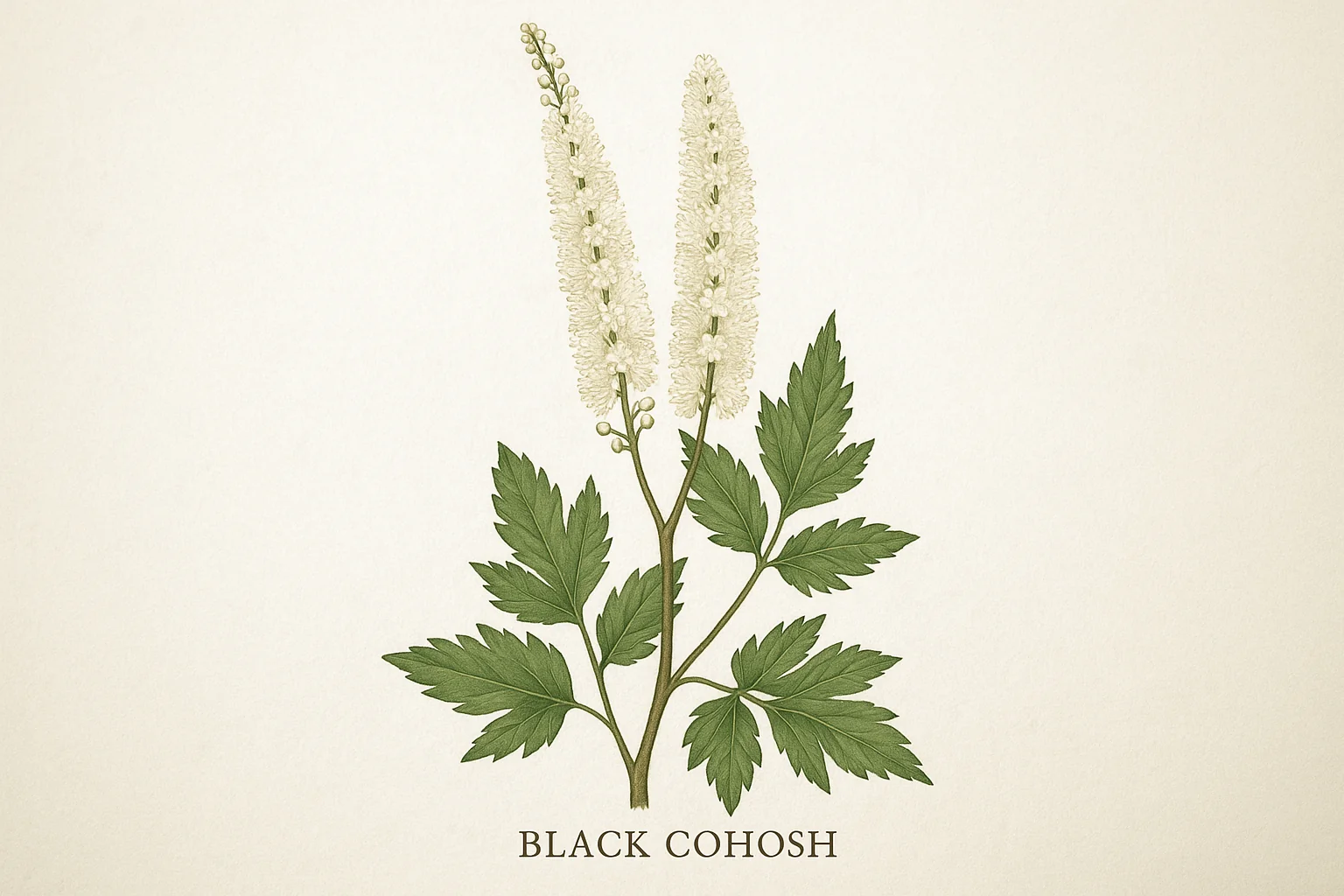
Black cohosh (Cimicifuga racemosa, synonym: Actaea racemosa) is a perennial herb from the buttercup family, growing in the forests of eastern North America. Its root was used by indigenous peoples of America - including the Iroquois - to treat women's ailments long before contact with Europeans (EMA monograph, 2018). It reached Europe in the 19th century and has been one of the most researched menopausal supplements since the 1990s.
The plant contains several groups of active compounds: glycosidic triterpenes (including actein, cimicifugoside), isoflavones, and derivatives of hydroxycinnamic acids. For a long time, it was believed that the latter had estrogen-like effects - hence the popular name "natural estrogens." Newer studies have challenged this belief, which has significant clinical implications for women after breast cancer.
What did the Cochrane review and other meta-analyses show?
The key Cochrane review by Leach and Moore from 2012 included 16 randomized clinical trials involving 2027 women. The results indicated that black cohosh reduces the frequency of hot flashes by about 26% compared to placebo (Leach & Moore, Cochrane, 2012). The effect is statistically significant, but the authors rated the quality of evidence as moderate due to methodological heterogeneity among the studies.
An earlier meta-analysis by Bosse and colleagues from 2009, which included 9 RCTs, showed a reduction in the hot flash index (Kupperman Menopause Index) of 26.4% compared to placebo (Bosse et al., Menopause, 2009). Importantly, studies lasting more than 12 weeks showed a stronger effect than shorter ones - suggesting that black cohosh needs time to fully take effect.
We have noticed that discussions about black cohosh often overlook a key context: a 26% reduction is not the same as the elimination of symptoms. A woman experiencing 10 hot flashes a day can expect a reduction to about 7-8. For some, this is significant relief, while for others, it may be insufficient. Realistic expectations are key to evaluating therapy.
How black cohosh works - mechanism of action
For years, the estrogen hypothesis dominated: it assumed that isoflavones from black cohosh bind to estrogen receptors (ER-alpha and ER-beta) and mimic hormone action. However, studies by Liske and Friede from 2002 showed no effect of black cohosh on FSH, LH levels, or endometrial thickness - which one would expect with estrogenic action (Liske et al., Journal of Women’s Health & Gender-Based Medicine, 2002).
The current consensus points to a serotonergic and dopaminergic mechanism. The extract from black cohosh binds to 5-HT1A (serotonin) receptors in the hypothalamus, which controls thermoregulation. Disruptions in the serotonin system during menopause, resulting from estrogen deficiency, can lead to a "reset" of the hypothalamic thermostat - and black cohosh likely partially corrects this mechanism (Liske et al., 2002; Borrelli & Ernst, Maturitas, 2007).
How long does the effect last and how long can one use black cohosh?
The effects of black cohosh usually appear after 4-8 weeks of regular use. This is a clear difference compared to HRT, which acts faster - usually within 2-4 weeks. The European Medicines Agency in its monograph for Actaea racemosa approves use for up to 6 months without the need for medical consultation (EMA Herbal Monograph, 2018). Longer treatments are possible but should be conducted under medical supervision.
Why is the limit set to 6 months? It does not stem from proven harm, but from a lack of long-term safety data. Most clinical studies lasted 12-24 weeks. Longer observations are rare, and the EMA applies a precautionary principle.
It's also worth noting that discontinuing the use of pluskwica does not cause the "rebound effect" characteristic of HRT. Menopausal symptoms may return to their previous intensity, but do not increase beyond the baseline. This is an important distinction for women planning short-term support during a challenging period.
Safety: does black cohosh harm the liver?
The issue of hepatotoxicity of black cohosh is one of the most discussed aspects of its safety. By 2020, over 50 cases of liver damage potentially related to the use of preparations containing Cimicifuga racemosa (Teschke et al., Menopause, 2010). Most cases were mild and resolved after discontinuation of the supplement.
Our observations indicate that many cases of "hepatotoxicity of pluskwica" described in the literature involved multi-ingredient preparations, where it was not possible to clearly attribute liver damage specifically to pluskwica. Teschke and colleagues, using the rigorous RUCAM methodology to assess causality, found that only a few cases met the criteria for a "probable" causal relationship.
WHO and EMA classify the risk of hepatotoxicity from pluskwica groniasta as "low but possible" when using standard doses. Individuals with liver diseases, those who abuse alcohol, or those taking hepatotoxic medications (e.g., high doses of paracetamol, statins) should exercise caution and consult a doctor before starting supplementation (WHO Monographs on Medicinal Plants, vol. 2). Recommendation: if jaundice, dark urine, or abdominal pain occurs, discontinue the preparation and consult a doctor.
Pluskwica and breast cancer - can it be used?
The question of the safety of pluskwica groniasta in women after breast cancer is one of the most common and requires a precise answer. Earlier concerns stemmed from the estrogen hypothesis - since pluskwica acts like estrogen, it could stimulate the growth of hormone-dependent tumors. Newer studies have largely dispelled these concerns.
A large observational study by Zepelin and colleagues (2007), involving over 18,000 women after breast cancer, found no increased risk of recurrence in women using black cohosh (Zepelin et al., Menopause, 2007). Similar results were obtained by Rebbeck and colleagues in a case-control study. European oncology guidelines from ESMO do not recommend black cohosh as a first-line treatment but do not prohibit its use after oncological consultation.
Key caveat: the studies did not involve women taking tamoxifen or aromatase inhibitors. The interactions of pluskwica with these medications via the CYP2D6 enzyme are unclear and require caution. If you are undergoing oncological treatment, any supplement - including pluskwica - requires the approval of your attending physician.
Frequently Asked Questions
Does black cohosh work for hot flashes?
Yes, with moderate strength of evidence. A 2012 Cochrane review (16 studies, 2027 women) showed a reduction in the frequency of hot flashes by about 26% compared to placebo (Leach & Moore, Cochrane, 2012). The effect is real, but not as strong as HRT - which is worth considering when choosing a treatment method.
How long should you take black cohosh to see effects?
The effects of pluskwica groniasta usually appear after 4-8 weeks of regular use. In clinical studies, the observation period was typically 12 weeks. The European Medicines Agency (EMA, monograph Cimicifugae rhizoma, 2018) approves use for up to 6 months without medical supervision.
Is black cohosh safe for the liver?
When using the recommended doses, the risk is low. The literature describes rare cases of liver damage, but their causal relationship is uncertain (Teschke et al., Menopause, 2010). People with liver diseases should consult the use of black cohosh with a doctor and monitor for warning signs (jaundice, dark urine).
What is the recommended dose of black cohosh?
Standardowa dawka to 40-80 mg dziennie ekstraktu standaryzowanego z korzenia pluskwicy. Monografia EMA dla Actaea racemosa recommends 6.5-13 mg of dry extract standardized to 2.5% triterpenes (EMA Herbal Monograph, 2018). The dosage depends on the concentration of the extract in the preparation - always read the manufacturer's label.
Does black cohosh act like estrogen?
Not in the classical sense. The earlier estrogen hypothesis is rejected by newer studies (Liske et al., 2002). Pluskwica does not change the levels of FSH, LH, or the thickness of the endometrium. The likely mechanism is the modulation of serotonin receptors 5-HT1A in the hypothalamus - which explains its action on thermoregulation without an estrogenic effect.
Can black cohosh be combined with tamoxifen or other medications?
Interactions with tamoxifen are unclear due to possible effects on the CYP2D6 enzyme. Women undergoing oncological therapy (tamoxifen, aromatase inhibitors) should definitely consult the use of black cohosh with an oncologist or the attending physician before adding the supplement.
This article is for informational and educational purposes and does not replace consultation with a doctor. If you are pregnant, breastfeeding, taking medications, or have chronic conditions, consult the use of supplements or herbs with a specialist.
Author: Michał Waluk · Published: 2026-05-04 · Updated: 2026-05-04