
Vitamin B12 and energy: why deficiency does not show obvious symptoms and how to check it
Vitamin B12 and energy – why deficiency can be hard to detect, who is at risk, the best test, and how to supplement methylcobalamin. Based on research.
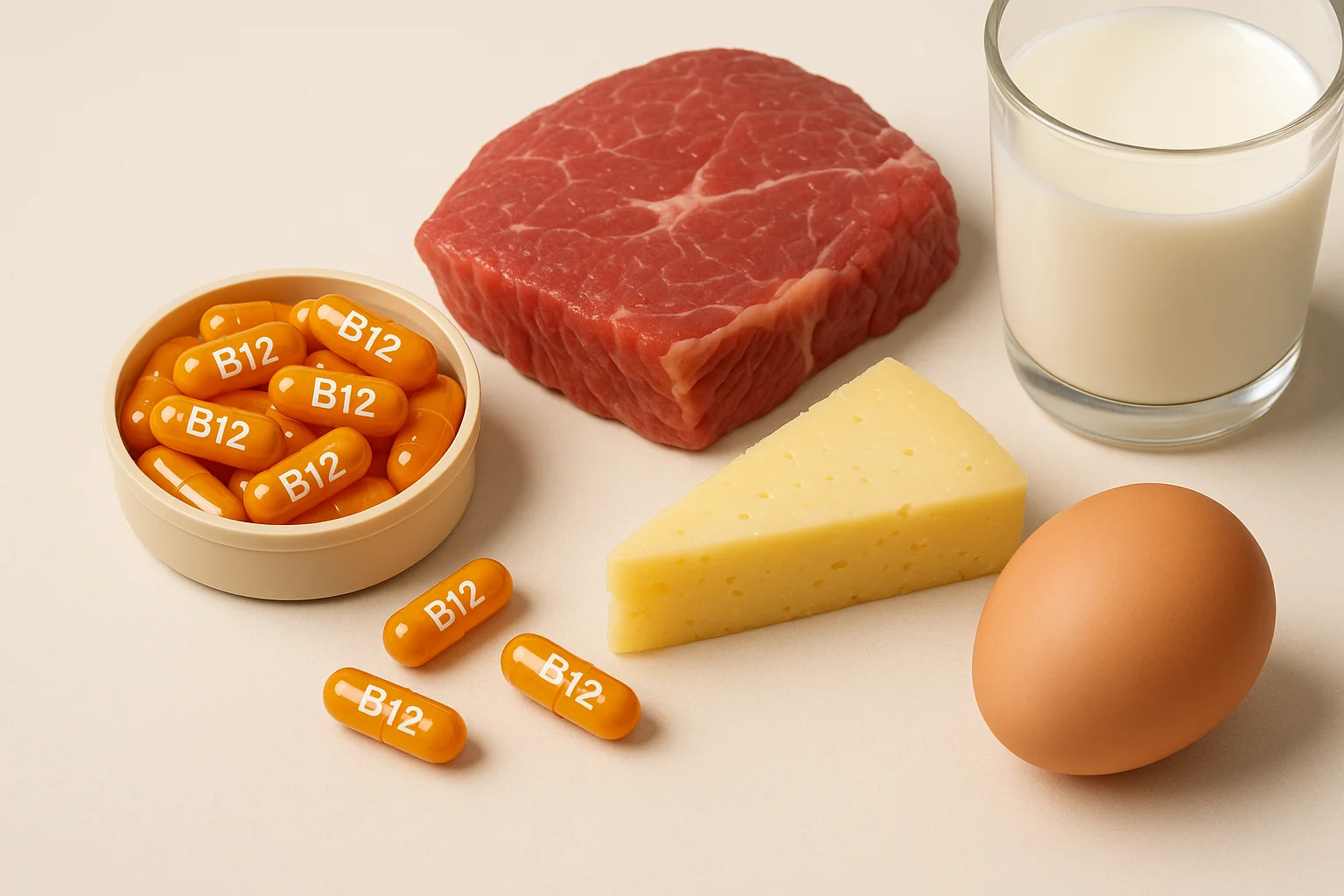
Vitamin B12 (cobalamin) is responsible for the production of red blood cells, DNA synthesis, and the protection of the nervous system. Its deficiency is insidious: it can last for years without clear symptoms, and standard blood tests often do not detect it. How is this possible? Why might a vegan without any symptoms have a serious deficiency? Who else is at risk? You will learn which test actually reveals deficiency, which form of supplement is best, and how to dose B12 for different risk groups.
KEY INFORMATION
• B12 deficiency affects about 6% of people under 60 and even 20% of those over 60 in Western countries (Stabler, New England Journal of Medicine, 2013).
• The standard test "total cobalamin" can be normal in the case of functional deficiency — holotranscobalamin (holoTC) is a more sensitive marker.
• Methylcobalamin and adenosylcobalamin are active forms of B12 — they do not require hepatic conversion.
• Metformin (a diabetes medication) reduces B12 absorption by about 30% — diabetics are at risk.
Why is B12 so difficult to detect?
The body stores B12 in the liver in amounts sufficient for 2-5 years. This means that a person who suddenly switches to a vegan diet will not feel a deficiency for years — and when symptoms finally appear, they may already be advanced. Stabler (New England Journal of Medicine, 2013) In a key clinical review, it was described that B12 deficiency in older adults is a "silent epidemic" — affecting 20% of people over 60 in Western countries, although most are asymptomatic in the early stages.
The second issue is the imprecision of the standard test. The "total cobalamin" test in serum measures both active cobalamin (holoTC, transported by holotranscobalamin to cells) and inactive cobalamin transported by haptocorrin (which does not reach tissues). The inactive fraction constitutes 70-80% of total cobalamin. This means that a "normal" result may mask a real deficiency of active B12. Therefore, testing for holoTC and homocysteine provides a much fuller picture of B12 status in tissues.
Our observations: Spirulina promoted as a "plant source of B12" is a particularly dangerous trap precisely because its coryneforms inflate the total cobalamin test result. A vegan taking spirulina may have a B12 result "within normal limits" (400 pmol/l), but their holoTC is 20 pmol/l — a deep deficiency in a full diagnostic picture. This is one of the reasons why dietary communities are very clear: vegans must supplement active B12, not rely on spirulina.
Malignant anemia - what is it and who does it affect?
Pernicious anemia is an autoimmune disease in which the body produces antibodies against gastric parietal cells and/or intrinsic factor (IF). Without gastric IF, B12 cannot be absorbed in the small intestine (to absorb B12, it needs to bind with IF in the stomach, and the B12-IF complex binds to the cubilin receptor in the final segment of the small intestine). The effect: even very high dietary intake of B12 does not correct the deficiency because absorption is blocked.
Malignant anemia affects about 2-3% of the population over 60 years old. Treatment involves injections of hydroxocobalamin (1000 µg intramuscularly every 3 months) or high oral doses of B12 (1000-2000 µg daily), where about 1% of B12 is absorbed through passive diffusion regardless of IF. An alternative is sublingual preparations - B12 tablets under the tongue, where absorption through the oral mucosa bypasses the intestinal barrier.
Gastric atrophy after age 50 and metformin
In individuals over 50, the production of hydrochloric acid and intrinsic factor by the stomach naturally declines (atrophy of the gastric mucosa). Without proper gastric acidity, B12 from food (bound to proteins) is not released and does not bind with IF. As a result, even a person eating meat and dairy may have a B12 deficiency due to absorption disorders, not intake. This is one of the reasons why regular testing of B12 status is recommended after age 50, regardless of diet.
Metformin (first-line medication for type 2 diabetes) reduces B12 absorption by about 30% by inhibiting calcium-dependent receptors in the final segment of the small intestine, where the B12-IF complex is normally absorbed, and with long-term use, the effect accumulates. Reinstatler et al. (Diabetes Care, 2012) In the NHANES analysis, it was shown that among individuals taking metformin for more than 3 years, the risk of low B12 levels increased 2.4 times compared to those not on metformin. The Polish Diabetes Society recommends annual monitoring of B12 in patients on metformin. Supplementation of B12 500-1000 µg daily of methylcobalamin is effective in correcting this effect while continuing metformin treatment — monitoring holoTC annually is recommended by most national diabetes associations.
B12 and brain health and dementia - what do we know in 2026
Vitamin B12, through its effect on homocysteine, is linked to the risk of neurodegenerative diseases. Elevated homocysteine (above 15 µmol/l - hyperhomocysteinemia) is an independent risk factor for stroke, cardiovascular diseases, and dementia. Supplementation of B12, B6, and folic acid lowers homocysteine, but research results on dementia prevention are mixed.
The VITACOG study (Oxford, 2010, Smith et al.) showed that supplementation of B12, B6, and folates over 2 years slowed brain atrophy by 53% on MRI in individuals with mild cognitive impairment and initially elevated homocysteine above 13 µmol/l. However, other large studies (SEARCH, HOPE-2) did not show a reduction in dementia in the general population. Conclusion: B12 and lowering homocysteine may protect the brain in individuals with initially elevated homocysteine — but not as a general preventive measure with normal markers. Test homocysteine (available in private labs for 30-40 PLN) and act only when it is elevated.
How to properly test B12 - tests and interpretation
Routine testing of "B12 in serum" (total cobalamin) is not an ideal test for the reasons described earlier. The diagnostic panel that has real clinical value is: holotranscobalamin (holoTC, "active B12") - measures the fraction of B12 actually transported to cells. Normal: above 35-40 pmol/l. Below 25 pmol/l is a clear deficiency. Homocysteine - increases with B12 (and folate) deficiency. Normal: below 10 µmol/l. Methylmalonic acid (MMA) - increases specifically with B12 deficiency (without correlation with folates). Normal: below 0.4 µmol/l.
A comprehensive test of holoTC + homocysteine + MMA is the gold standard for diagnosing B12 deficiency. Available in private laboratories without a referral (e.g., Diagnostyka, Synevo) for a total cost of about 150-200 PLN. It is advisable to perform this test annually for vegans, those using metformin, or after the age of 50. Always interpret results in a clinical context with a doctor — borderline values require a holistic assessment, not an isolated comparison with laboratory references. vegan supplements
After identifying a deficiency and starting supplementation, a follow-up holoTC test after 3 months allows for the assessment of the effectiveness of the form and dosage used. If there is no normalization (holoTC still below 35 pmol/l), it is worth considering changing the form of the supplement (from cyanocobalamin to sublingual methylcobalamin) or diagnosing absorption disorders (Schilling test, stomach endoscopy with assessment of the mucosa).
Forms of B12 in supplements - which one to choose?
There are four forms of cobalamin available on the market. Cyanocobalamin is the cheapest and most stable form, used in most cheap multivitamin supplements and reimbursed medications. It requires hepatic conversion to methylcobalamin and adenosylcobalamin. It contains a minimal cyanide load (negligible at normal doses, but caution is advised in cases of nicotine use, smoking, or occupational exposure to cyanide). Effective, though not optimal — the liver must undergo an additional conversion step, which may be limited in liver diseases.
Methylcobalamin is the active coenzyme form, crucial for folate metabolism and methylation. It does not require hepatic conversion. Studies have shown better tissue retention than cyanocobalamin. It is the preferred form in supplementation, especially in neurological issues (peripheral neuropathy) and impaired liver function. Dosage in deficiency: 1000-2000 µg daily sublingually for 1-3 months, then 500-1000 µg/day for maintenance. Adenosylcobalamin is the second active coenzyme form, responsible for mitochondrial metabolism (propionyl-CoA → succinyl-CoA pathway). Together with methylcobalamin, it covers the full spectrum of B12 functions. Hydroxocobalamin is used in injections for malignant anemia and cyanide poisoning.
B12 and the nervous system - neurological symptoms of deficiency
B12 is essential for the synthesis of myelin — the sheath that protects the axons of neurons. A deficiency of B12 leads to myelin degeneration of the spinal cord and peripheral nerves (subacute combined degeneration). Neurological symptoms: tingling and numbness in the hands and feet (paresthesia), balance and gait disturbances, weakness of muscle strength, mood and personality changes, and in advanced deficiency — dementia.
Neurological symptoms can precede anemia by many months or years and are more difficult to reverse than megaloblastic anemia. This is why early diagnosis is so important — especially since neurological deficiency can occur with normal morphology results. Lindenbaum et al. (New England Journal of Medicine, 1988) They described a series of cases of severe neurological symptoms of B12 without anemia — which debunked the prevailing belief at the time that anemia precedes neurology.
B12 and folates - a tandem that is essential to differentiate
B12 and folic acid (B9) work in close cooperation in the one-carbon methylation pathway. Both deficiencies produce similar symptoms of megaloblastic anemia, as both are essential for the maturation of erythrocytes. The key difference: supplementation of folates in the case of B12 deficiency may improve blood morphology (reducing megaloblastic anemia), but does not stop the progression of neuropathy from B12 deficiency. This is a clinical trap — the patient feels better, the morphology looks better, but neurological damage continues to progress.
Therefore, when suspecting a deficiency of B12 or folates, never supplement solely with folic acid without diagnosing B12. The gold standard is to test both: holoTC (B12) and folates in erythrocytes (a better marker than serum folates, which may be temporarily elevated). Typically, B12 deficiency in vegans is more likely than folate deficiency — a diet rich in leafy greens usually meets the folate requirement but not B12.
B12 and energy - what to realistically expect from supplementation
B12 is essential for the production of erythrocytes (the maturation of megaloblasts into erythrocytes requires active cobalamin) and for energy metabolism in mitochondria. With a B12 deficiency, the results are megaloblastic anemia, neuropathy, and fatigue. Supplementation in a person with a deficiency provides a noticeable improvement in energy, concentration, and well-being within 4-8 weeks of regular use.
However, B12 is not an "energy booster" for a person with normal levels. If your holoTC and homocysteine levels are normal, additional B12 supplementation will not improve your energy, reflexes, or concentration in any way - the body will excrete the excess through urine. Fatigue with normal B12 levels requires diagnostics in another direction: iron, ferritin, D3, thyroid, cortisol. supplements for energy and concentration
A practical guide to B12 supplementation for different groups
For vegans and vegetarians who do not eat fish: methylcobalamin 1000 µg daily for the first 3 months, then 500 µg/day or 2000 µg twice a week (absorption decreases with dosage - it is more effective at lower doses). Check holoTC every 12 months. For individuals over 50 suspected of gastric atrophy: sublingual tablets or sublingual spray with methylcobalamin - bypassing the acidic barrier of the stomach. Dosage as for vegans. For diabetics on metformin: monitor B12 annually, supplement 500-1000 µg of methylcobalamin daily as a precaution, especially with metformin doses above 1500 mg/day.
The best preparation is sublingual methylcobalamin 1000 µg or sublingual spray - absorption bypassing the intrinsic factor guarantees effectiveness regardless of stomach condition. Check certificates - the better biological form (methylcobalamin) costs a bit more than cyanocobalamin, but the difference in quality is justified. Take B12 in the morning on an empty stomach or at least 30 minutes before eating for better absorption through the mucous membrane. vegan supplements
Frequently Asked Questions
Below are answers to the most common questions about vitamin B12 and energy.
What are the first symptoms of B12 deficiency?
The most common initial symptoms are fatigue and weakness (megaloblastic anemia), tingling and numbness in the limbs (early neuropathy), and pallor. Memory and concentration disturbances may occur. Symptoms can last for years without anemia - Lindenbaum et al. (NEJM, 1988) described advanced neuropathy with normal morphology.
Which B12 test is the best?
Holotranscobalamin (holoTC) and homocysteine are the most sensitive markers. Normal holoTC: above 35-40 pmol/l, homocysteine below 10 µmol/l, MMA below 0.4 µmol/l. Total cobalamin in serum can be normal with a real deficiency of active B12 - Stabler (NEJM, 2013) recommends a holoTC + MMA panel when deficiency is suspected.
Which form of B12 is the best in supplements?
Methylcobalamin and adenosylcobalamin are biologically active without liver conversion. Cyanocobalamin is cheaper and stable but requires conversion. For vegan or neurological supplementation, methylcobalamin 1000-2000 µg daily sublingually is recommended, as absorption through the oral mucosa bypasses intestinal barriers.
Who is at risk of vitamin B12 deficiency?
Vegans and vegetarians, individuals over 50 years old with gastric atrophy, patients on long-term metformin (risk of deficiency 2.4 times higher, Reinstatler et al., Diabetes Care, 2012), and those with pernicious anemia. Altogether, these risk groups encompass several percent of the adult population.
How to dose B12 in case of deficiency?
With confirmed deficiency: 1000-2000 µg of methylcobalamin daily for 1-3 months, then 500-1000 µg/day for maintenance. In pernicious anemia: injections of hydroxocobalamin 1000 µg i.m. every 3 months or high oral doses sublingually. Monitor holoTC after 3 months of supplementation.
Does B12 provide energy?
B12 corrects fatigue due to megaloblastic anemia and neurological deficiency - the effect is visible after 4-8 weeks in individuals with confirmed deficiency. However, with normal B12 levels, supplementation does not improve energy or concentration - the body excretes the excess through urine. Persistent fatigue requires broader diagnostics.
This article is for informational and educational purposes and does not constitute medical advice. Before starting to use cannabis or CBD for therapeutic purposes, consult a doctor, especially if you are taking other medications, are pregnant, or breastfeeding.
Author: Michał Waluk · Published: 2026-05-04 · Updated: 2026-05-04