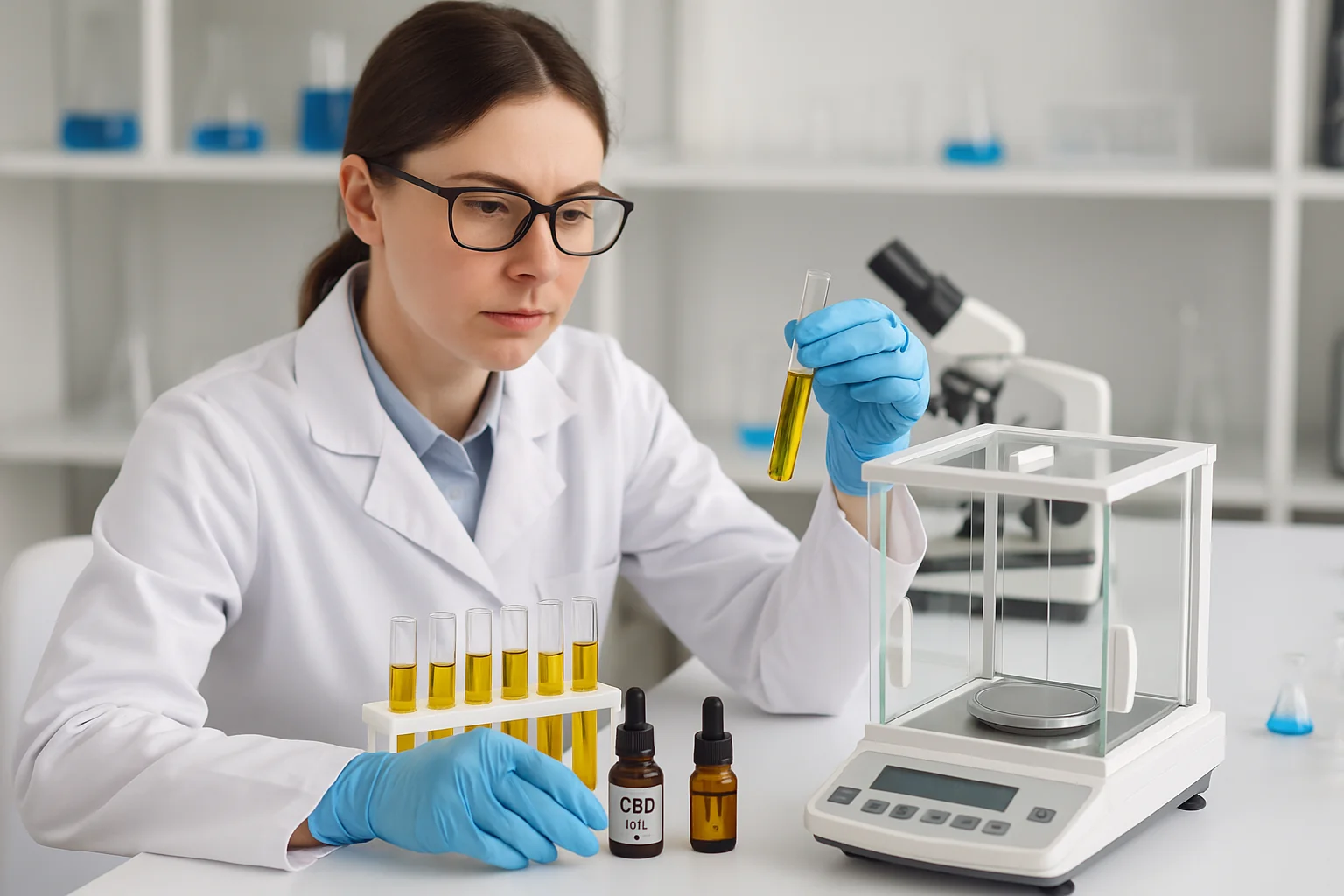

Pesticides and microbiology in CBD - what does an independent laboratory test (FAQ)
Pestycydy i mikrobiologia w CBD: odpowiedzi na najczestsze pytania i co mowia badania. u Bucha.
A CoA (Certificate of Analysis) is now the standard that distinguishes a reliable manufacturer from an accidental importer. Meanwhile, a study conducted by the European Monitoring Centre for Drugs and Drug Addiction (EMCDDA) found that over 30% of CBD products on the European market did not meet the declared composition or contained chemical contaminants (EMCDDA, 2022). This article specifically explains what independent laboratories test, why cannabis is particularly susceptible to pesticide accumulation, and how to read a certificate before paying for CBD oil.
KEY INFORMATION
• Independent laboratories test CBD oil for: cannabinoids, pesticides, heavy metals, mycotoxins, solvent residues, and microbiology.
• Hemp accumulates compounds from the soil - cultivation on contaminated fields transfers pesticides directly to the extract.
• A CoA (Certificate of Analysis) from an accredited laboratory (ISO/IEC 17025) is the only reliable proof of product safety.
• Over 30% of CBD products on the European market did not meet the declared composition or contained contaminants (EMCDDA, 2022).
• The absence of a batch number on the CoA or a certificate from the manufacturer's internal department are warning signs.
Why are laboratory tests for CBD so important?
Industrial hemp (Cannabis sativa L.) is a plant with an exceptional ability to absorb compounds from the soil - this mechanism is called phytoremediation. This is why it was used to clean up contaminated areas after the Chernobyl disaster (Vyslouzilova et al., Industrial Crops and Products, 2003). The plant absorbs cadmium, lead, arsenic, mercury from the soil - but also residues of pesticides, herbicides, and fungicides. If the cultivated field has been treated with plant protection products in the past, there is a real risk that these compounds will end up in the final extract.
This is not just a theoretical problem. The CBD supplement market has rapidly expanded since 2018, when hemp with low THC content was removed from the list of controlled substances in many EU countries. New producers entered the market with products of varying quality, often without reliable laboratory tests. Therefore, the CoA has become the de facto industry standard for manufacturers who care about their reputation.
What exactly does an independent laboratory check?
A full analysis of CBD oil includes several independent categories of tests. Each of them answers a different question regarding the safety and quality of the product. It is worth knowing the scope of these tests to assess whether the certificate presented by the manufacturer is complete.
Cannabinoid Profile
The first and most obvious part of the CoA is the cannabinoid profile: what phytochemicals the product contains and in what concentrations. The standard tested panel includes CBD, THC, CBG, CBN, CBC, THCA, and CBDA. A key parameter from a legal perspective is the THC content - in the EU, a product sold as a supplement cannot exceed 0.2-0.3% THC (depending on the country). The manufacturer declares the CBD concentration in mg; the laboratory verifies whether the declaration corresponds to reality. Discrepancies above ±20% between the label and the CoA result are a serious quality issue.
Pesticides and Herbicides
This is one of the most comprehensive testing panels. Accredited laboratories typically test from 200 to over 400 active substances used in plant protection. In the context of hemp, the biggest issues are: glyphosate (a herbicide commonly used before sowing), imidacloprid (a neonicotinoid insecticide), carbendazim (a fungicide), and bifenthrin (an acaricide). European Regulation (EC) No. 396/2005 establishes MRL (Maximum Residue Levels) - in the absence of a specific limit for a given pesticide, the default level is 0.01 mg/kg.
It is worth knowing that the CoA for pesticides can be issued by two methods: screening method, which detects presence above the detection threshold, or quantitative method, which provides the exact concentration. A certificate with a quantitative method is more valuable - we know not only "if it is there", but "how much there is". Ask the manufacturer what method their laboratory uses.
Heavy Metals
Hemp accumulates heavy metals from the soil more effectively than most agricultural crops. Standard testing includes four key metals: lead (Pb), mercury (Hg), cadmium (Cd), and arsenic (As). Limits for dietary supplements in the EU are defined by Regulation (EC) No. 1881/2006 and EFSA guidelines. Lead is particularly problematic in industrial soils - CBD oils produced from hemp grown in former industrial areas may contain it above safe limits.
Mycotoxins
Aflatoxins (B1, B2, G1, G2) and ochratoxin A are toxic fungi that can appear in hemp biomass stored in humid conditions. They are particularly dangerous for individuals with immune disorders, can act hepatotoxic and potentially carcinogenic (IARC classifies aflatoxin B1 as a Group 1 carcinogen). The limits for aflatoxins in dietary supplements in the EU are 4 μg/kg for the sum of B1+B2+G1+G2.
Solvent Residues from Extraction
CBD is extracted from hemp using various methods: supercritical CO2, ethanol, propane, or butane. The CO2 method and ethanol extraction are considered safe when conducted properly. However, with careless production, trace amounts of organic solvents may remain in the final product. The CoA testing includes the ICH Q3C panel - classification of class 1 (avoid), class 2 (limited), and class 3 (acceptable). Hexane, pentane, and benzene are examples of class 1 solvents, whose presence disqualifies the product.
Microbiological testing - why is it performed?
Microbiological testing of CBD oil is a control of the number of viable microorganisms in the product. It is particularly important for immunocompromised individuals - after chemotherapy, with HIV, after organ transplants, with chronic autoimmune diseases. For these groups, even a low level of bacterial contamination can have serious health consequences.
The standard microbiological panel includes: total aerobic microbial count (TAMC), total yeast and mold count (TYMC), and tests for the presence of pathogens: Salmonella spp., Escherichia coli, and Staphylococcus aureus. Standards for dietary supplements are included in the European Pharmacopoeia (Ph. Eur.) - for TAMC, the limit is usually 10³ CFU/g, for TYMC 10² CFU/g, and for Salmonella and S. aureus, total absence is required.
Where do microbiological contaminants in CBD oils come from? The biomass of hemp after harvest may contain soil microorganisms. If the drying and storage of the raw material do not occur under controlled temperature and humidity conditions, moulds and yeasts can proliferate. CO2 extraction eliminates most microorganisms (high temperature and pressure have a bactericidal effect), but ethanol extraction at low temperatures may not be sufficient. A good manufacturer tests not only the finished product but also the raw material before extraction.
How to read a CoA certificate step by step?
At first glance, a CoA certificate may seem like a complicated laboratory document. In practice, it is enough to check a few key points. Below is a simplified table that helps assess the completeness of the certificate.
| Element of the CoA certificate | What to check | Warning signal |
|---|---|---|
| Laboratory name | External, independent from the manufacturer | No name or "internal QC" |
| ISO/IEC 17025 accreditation | PCA accreditation number or other national authority | No accreditation number |
| Batch number (Lot/Batch) | Matches the number on the packaging | No number or discrepancy |
| Date of testing | Not older than 12 months from the date of purchase | Certificate without a date or older than 2 years |
| Cannabinoid Profile | CBD, THC, CBG, CBN - with numerical values | Tylko „ND” (non-detected) lub brak THC |
| Pesticide panel | Min. 100 substances, with limits and results | No panel or fewer than 50 substances |
| Heavy Metals | Pb, Hg, Cd, As - with numerical values | No metal testing |
| Microbiological testing | TAMC, TYMC, Salmonella, E. coli | Lack of microbiological testing |
In practice, we see that many manufacturers provide only a cannabinoid profile certificate - without testing for pesticides and heavy metals. Such a CoA is incomplete information. The buyer sees that "CBD is confirmed", but knows nothing about chemical contaminants. A full certificate should include all four categories: cannabinoids, pesticides, metals, and microbiology.
Certified cultivation vs conventional - how does it affect safety?
An organic farming certificate (in the EU: the "euro-leaf" logo in accordance with Regulation (EU) 2018/848) prohibits the use of synthetic pesticides and herbicides. This significantly reduces the risk of contamination of the final product. However, an organic farming certificate does not exempt the manufacturer from the obligation to conduct laboratory tests of the finished extract - the soil may contain historical contaminants from before the period of organic farming.
Cannabis certified in the EU must come from varieties registered in the Union catalog. The European cannabis variety catalog, maintained by the European Food Safety Authority (EFSA), includes only varieties with genetically low THC content (below 0.2%). Cultivation of unregistered varieties is illegal, and their extract cannot be sold as a dietary supplement on the EU market. Checking whether the producer uses registered varieties is an additional level of quality verification.
Frequently Asked Questions
What does an independent laboratory check in CBD oil?
An independent laboratory tests CBD oil for: cannabinoid profile (CBD, THC, CBG, CBN concentrations), presence of pesticides and herbicides (panel of 200-400 substances), heavy metals (lead, mercury, cadmium, arsenic), mycotoxins (aflatoxins, ochratoxin A), extraction solvent residues, and the number of microorganisms. The full result of these tests goes into the CoA certificate, which a reliable manufacturer should publicly provide for each batch of the product.
What pesticides are most commonly detected in CBD products?
EIHA (European Industrial Hemp Association) studies indicate glyphosate, imidacloprid, and carbendazim as the most frequently detected in low-quality hemp products. Hemp is a so-called phytoremediator - it absorbs compounds from the soil. Certified organic cultivation significantly reduces this risk, but does not eliminate it entirely, which is why CoA testing of the finished extract is always necessary.
Why do hemp plants accumulate pesticides more than other plants?
Hemp has a documented ability to uptake and accumulate compounds from the soil - a phytoremediation mechanism that was used to clean up contaminated areas after the Chernobyl disaster (Vyslouzilova et al., Industrial Crops and Products, 2003). Plants from fields with historical pesticide residues transfer these compounds to the extract. This is one of the reasons why the quality of the raw material and CoA certificates are so important when choosing CBD oil.
What is a CoA and how to read it?
A CoA (Certificate of Analysis) is a report from tests issued by an independent, accredited laboratory. It includes: the name of the laboratory with the ISO/IEC 17025 accreditation number, the date of testing, the product batch number, results for each cannabinoid, and results of tests for pesticides, heavy metals, and microbiology. The certificate should be accessible via a QR code on the packaging or on the manufacturer's website - the batch number must match the one on your packaging.
What standards apply to pesticides in CBD supplements in Poland?
In Poland and the EU, hemp extract sold as a dietary supplement is subject to Regulation (EC) No. 396/2005 on the maximum allowable levels of pesticide residues in food. The default limit for pesticides without a specific MRL is 0.01 mg/kg. Products from accredited laboratories compliant with ISO/IEC 17025 standards (ISO/IEC 17025:2017) provide the greatest assurance of compliance with these standards.
Can CBD oils from online stores be dangerous due to contamination?
There is a risk, especially for products without a complete CoA. A study published in the Journal of Analytical Toxicology found that about 25% of tested CBD supplement samples from European online sales contained chemical contaminants or non-compliant THC concentrations. Choosing a producer with a complete CoA from an external laboratory, a batch number matching the packaging, and a current testing date significantly minimizes this risk.
How to check if a CBD producer really conducts laboratory tests?
Look for a CoA with the name of a specific external laboratory - not the internal QC department. Check ISO/IEC 17025 accreditation in the register of the Polish Accreditation Center (PCA). Compare the batch number (Lot/Batch) on the packaging with the number in the CoA - they must be identical. A certificate without a testing date, without a batch number, or issued by a laboratory without accreditation are signals that should stop you from making a purchase.
What is microbiological testing of CBD and why is it performed?
Microbiological testing checks the number of aerobic bacteria (TAMC), yeasts and molds (TYMC), and the presence of pathogens: Salmonella spp., E. coli, and Staphylococcus aureus. Hemp harvested from fields can accumulate microorganisms from the soil. Standards for dietary supplements outlined in the European Pharmacopoeia require TAMC ≤ 10³ CFU/g, TYMC ≤ 10² CFU/g, and absence of Salmonella and S. aureus. This testing is particularly important for individuals with compromised immunity.
This article is informational and educational in nature. It contains internal links to products available in the u Bucha store. Prices and specifications may change - please check the current data on the product page before purchasing.
Author: Michał Waluk · Published: 2026-05-04 · Updated: 2026-05-04