
CBD oil before or after a meal? When to take it for the best effect
When to take CBD oil — before or after meals? How do fats increase CBD bioavailability by up to 4x? Practical tips on the optimal timing and method of taking CBD.
To jedno z najczęściej zadawanych pytań przez osoby zaczynające przygodę z CBD — i dobrze, że je zadają. Pora i sposób przyjęcia CBD ma realny wpływ na to, ile substancji faktycznie trafia do krwioobiegu. Badanie opublikowane w Epilepsia (2019) pokazało coś zaskakującego: ten sam olejek CBD wzięty z posiłkiem bogatym w tłuszcze dał 4-krotnie wyższe stężenie CBD we krwi niż na czczo. Cztery razy. To nie marginalny efekt — to różnica między „CBD prawie nie działa” a „CBD naprawdę czuję”. W tym artykule wyjaśniamy dlaczego tłuszcze mają takie znaczenie, o jakiej porze dnia brać CBD i jak dostosować schemat do celu stosowania.
KEY INFORMATION
• A high-fat meal increases Cmax of CBD by up to 4 times, and AUC (area under the curve, a measure of total exposure) by about 3 times (Birnbaum et al., Epilepsia, 2019).
• CBD is a lipophilic substance — without fats in the intestines, it is poorly absorbed (bioavailability 6–15% orally on an empty stomach).
• Sublingual CBD oil (held under the tongue for 60–90 seconds) is absorbed through the mucous membrane — partially bypassing first-pass metabolism and is less dependent on food than capsules.
• The timing of CBD intake should be adjusted to the purpose: in the morning for anxiety/stress, in the evening for insomnia, divided for chronic pain.
• Consistency in the timing of intake is more important than perfect synchronization with meals.
Why do fats drastically increase CBD absorption?
CBD to substancja lipofilowa — „lubi tłuszcze” i rozpuszcza się w nich, a nie w wodzie. To ma bezpośredni wpływ na wchłanianie w układzie pokarmowym. Gdy przyjmujesz olejek CBD i połykasz go, CBD trafia do jelit, gdzie musi zostać „upakowane” przez żółć w micele (mikroskopijne kuleczki tłuszczowo-żółciowe), żeby mogło przeniknąć przez śluzówkę jelita do krwioobiegu. Bez tłuszczów w posiłku — żółci jest mało, miceli jest mało, wchłanianie jest marne.
Study Birnbaum et al. (Epilepsia, 2019) conducted a crossover study in 8 patients with drug-resistant epilepsy taking Epidiolex (pharmaceutical CBD preparation). The same patients took CBD on an empty stomach or after a high-fat meal (800–1000 kcal, about 54 g of fat). Result: Cmax (peak concentration of CBD in the blood) increased 4.85 times after a fatty meal compared to administration on an empty stomach. AUC (total exposure) increased 3 times. Tmax (time to peak concentration) was similar. In other words: CBD taken after a fatty meal works stronger, longer, and more completely — at the same dose.
This mechanism mainly concerns swallowed CBD (intestinal absorption). With sublingual administration — holding the oil under the tongue for 60–90 seconds — CBD is absorbed directly through the oral mucosa into the venous blood of the neck, bypassing the liver. This pathway is less dependent on food, although fats in saliva may slightly improve absorption through the mucous membranes.
Does sublingual CBD oil also require a meal?
It depends on the administration technique. If you hold the oil under your tongue for 60–90 seconds and do not swallow immediately, a significant portion of CBD is absorbed directly through the mucous membrane — and in this case, food is less significant. This is the so-called sublingual route, which bypasses first-pass metabolism in the liver.
However, in practice, most people swallow part of the oil after a few dozen seconds — and this swallowed fraction passes through the digestive system like any oral dose. For this fraction, fats in the meal matter. Pharmacokinetic review Millar et al. (Molecules, 2019) estimated that even with ideal sublingual administration, about 30–40% of CBD is still swallowed. Therefore, taking CBD oil with or after meals containing fats is always wiser than on an empty stomach — even when using the sublingual technique.
Our observations: Użytkownicy, którzy przeszli ze schemastu „CBD na czczo rano” na „CBD do śniadania z awokado lub orzechami”, regularnie opisują wyraźniejszy efekt przy tej samej dawce. Dla wielu osób ta prosta zmiana pozwoliła „poczuć” CBD po raz pierwszy, choć stosowali je od tygodni. Biodostępność naprawdę robi różnicę — szczególnie przy niskich dawkach startowych.
What time of day to take CBD — in the morning or in the evening?
Nie ma jednej „optymalnej” pory — zależy od celu stosowania. Oto podział:
For anxiety, stress, mental tension: Rano, do śniadania. CBD działa na receptory 5-HT1A i GABA, zmniejszając reaktywność stresową przez cały dzień. Rano ustawiasz „nastrój bazowy” układu nerwowego na spokojniejszy tryb. Dla niektórych osób CBD rano może dawać lekkie uczucie relaksu — co w kontekście pracy umysłowej jest zazwyczaj korzystne, nie upośledzające. Olejek podjęzykowo działa po 15–30 min, więc weź go chwilę przed lub w trakcie śniadania.
For insomnia and sleep issues: 1–2 hours before bedtime, after dinner. CBD is not a strong sedative, but it reduces pre-sleep anxiety and helps with falling asleep. An evening dose after a fatty meal (e.g., after dinner with olive oil or nuts) provides a higher concentration of CBD exactly when you need calm to fall asleep. Related article — CBD for sleep — is the oil enough — discusses CBD and sleep in detail.
For chronic pain: Split the dose — half in the morning (before breakfast), half in the evening (before dinner). This way, you maintain a stable level of CBD throughout the day. For acute pain — sublingual oil regardless of meals, effect after 15–45 minutes.
For concentration and mental work: In the morning or at noon, avoid large doses (>25 mg) that may cause drowsiness. Small to medium doses (10–20 mg) are more stimulating than calming for most people.
What fats to choose to maximize CBD absorption?
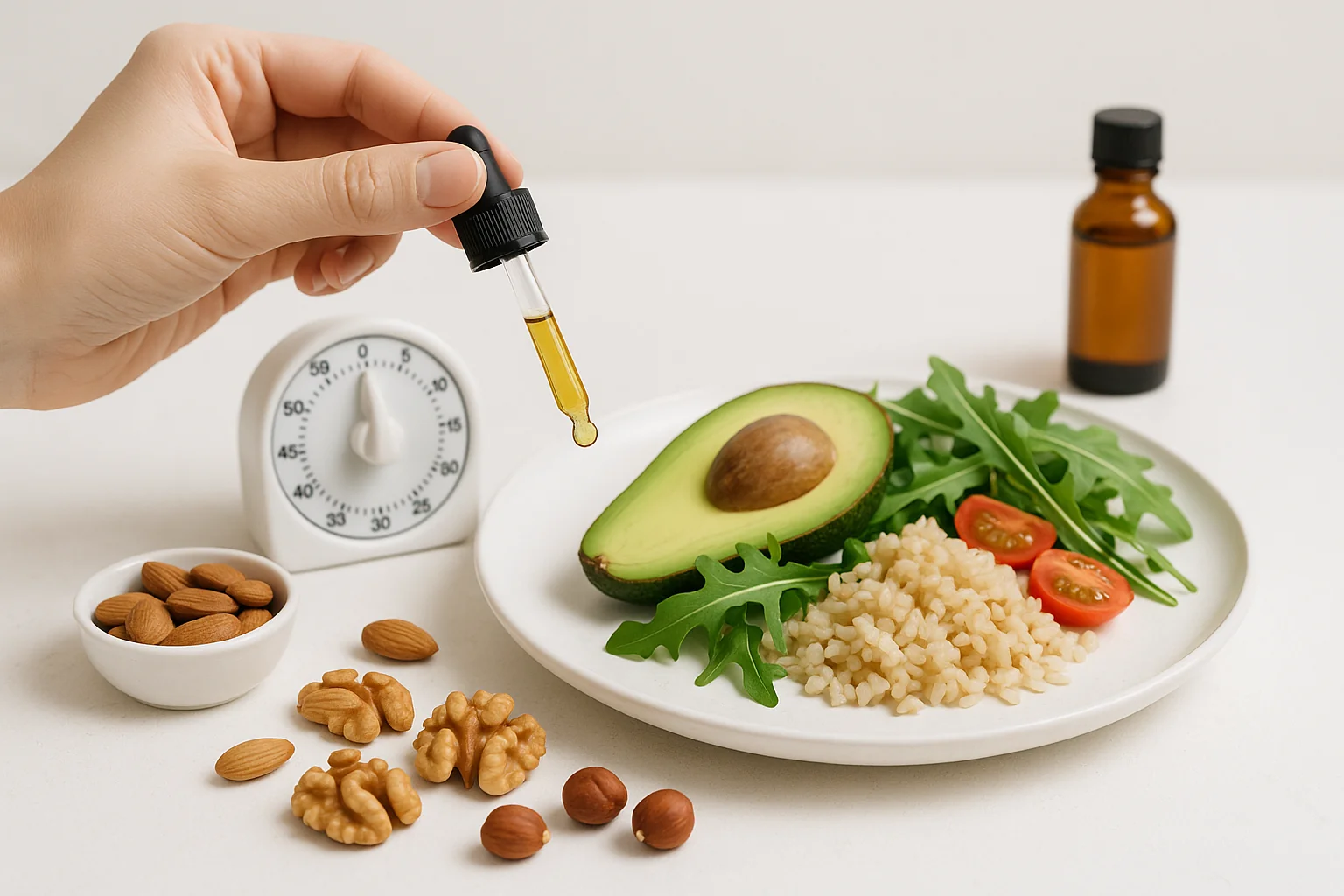
Good news: you don't need to follow a special diet. Just ensure that the meal before or with CBD contains a decent portion of fat — about 15–20 g. Examples of products that will suffice:
Avocado (1/2 piece = ~15 g of fat), a handful of mixed nuts (~15–20 g of fat), a tablespoon of olive oil on a salad (~14 g of fat), 2 tablespoons of peanut butter (~16 g of fat), a piece of salmon (~15–20 g of fat). You don't need to consume an 800 kcal fatty breakfast like in the Birnbaum study — that was an extreme condition showing the maximum effect. In practice, even a moderate portion of fat significantly improves CBD absorption.
If your CBD oil is based on MCT oil (fractionated coconut oil) — you already have a built-in carrier oil that slightly improves absorption on its own. But this does not replace the fats from the meal — MCT in oil is a few milliliters, while a fatty meal contains several grams of lipids that stimulate bile production.
CBD and coffee, tea, and other beverages — can they block absorption?
Many CBD users ask whether they can combine CBD oil with coffee or tea. The answer is: yes, but it's worth knowing a few things.
Coffee (caffeine) and CBD act on different receptors — caffeine blocks adenosine A1/A2a, CBD works through the endocannabinoid system and 5-HT1A. There is no documented pharmacokinetic interaction between caffeine and CBD. However, it is easy to focus solely on drinking coffee and miss out on fats in the morning meal — which lowers CBD bioavailability. Espresso without food ≠ optimal conditions for CBD.
Herbal tea, especially peppermint or chamomile, does not affect CBD absorption. Green tea contains catechins that may slightly influence CYP enzymes — but at supplemental doses of CBD, this interaction is clinically insignificant.
Milk and dairy drinks contain fats (whole milk: ~3.5% fat) — a glass of whole milk with CBD provides a slight boost to bioavailability. Plant-based drinks made from oats or rice do not contain fat — almond milk has marginal amounts. If you drink CBD with a dairy beverage, choose full-fat or add a tablespoon of almond butter to plant milk.
How often and for how long should you take CBD?
CBD is not an immediate remedy for most indications — it works through accumulation in the endocannabinoid system. With regular use, the level of CBD in the blood gradually stabilizes, and the effects become more predictable and lasting. Here are some approximate time frames:
Immediate effects (sublingual oil): After 15–45 minutes of intake. Peak effect after 1–2 hours. Duration of effect 4–6 hours. This is the effect of a single dose.
Cumulative effects: Po 2–4 tygodniach regularnego codziennego stosowania. Układ endokannabinoidowy „kalibruje się” — receptory CB1 i CB2 zmieniają gęstość ekspresji, poziomy endokannabinoidów się ustabilizowują. Wiele osób opisuje, że po pierwszych 2–3 tygodniach efekty stają się silniejsze i dłużej trwające.
When to assess effectiveness: Minimum po 4–6 tygodniach regularnego stosowania w docelowej dawce. Zbyt wczesna rezygnacja („nie działa po tygodniu”) jest częstym błędem — CBD wymaga czasu na efekty długoterminowe. Wyjątkiem jest efekt doraźny przy lęku ostrym lub bólu — który powinien być widoczny po każdej dawce. Więcej o tym, po jakim czasie działa CBD, przeczytasz w artykule How long does it take for CBD to work.
Frequently Asked Questions
Should CBD be taken before or after meals?
After meals — especially after a meal rich in fats. Birnbaum et al. (Epilepsia, 2019) showed a 4-fold increase in Cmax of CBD when taken after a high-fat meal. You don't need to eat a lot — just 15–20 g of healthy fats (avocado, nuts, olive oil) is sufficient.
How do fats increase the absorption of CBD?
CBD jest lipofilowe — rozpuszcza się w tłuszczach. Tłuszcze w jelitach stymulują wydzielanie żółci, która „pakuje” CBD w micele umożliwiające wchłanianie przez śluzówkę jelita. Bez tłuszczów większość CBD przechodzi przez jelita niewchłonięte.
What time of day should you take CBD?
It depends on the purpose: in the morning for stress/anxiety, in the evening for insomnia, split morning-evening for chronic pain. The most important thing is to be consistent with the timing — this maintains a stable level of CBD in the blood.
Can CBD be taken on an empty stomach?
Yes — especially sublingual oil, which is absorbed through the mucous membrane. However, the bioavailability of swallowed CBD on an empty stomach is significantly lower (6–15% vs 20–25% with a meal). For maximum effect — always with a fatty meal.
Which fats best increase CBD absorption?
Any fats work — there is no need for specific types. Just 15–20 g of fat is enough: avocado, nuts, olive oil, fatty fish, peanut butter. The Birnbaum study used a standard high-fat breakfast — in practice, moderate fats from any healthy meal will suffice.
This article is for informational and educational purposes only and does not constitute medical advice. Before starting to use cannabis or CBD for therapeutic purposes, consult with a doctor, especially if you are taking other medications, are pregnant, or breastfeeding.
Author: Michał Waluk · Published: 2026-05-04 · Updated: 2026-05-04