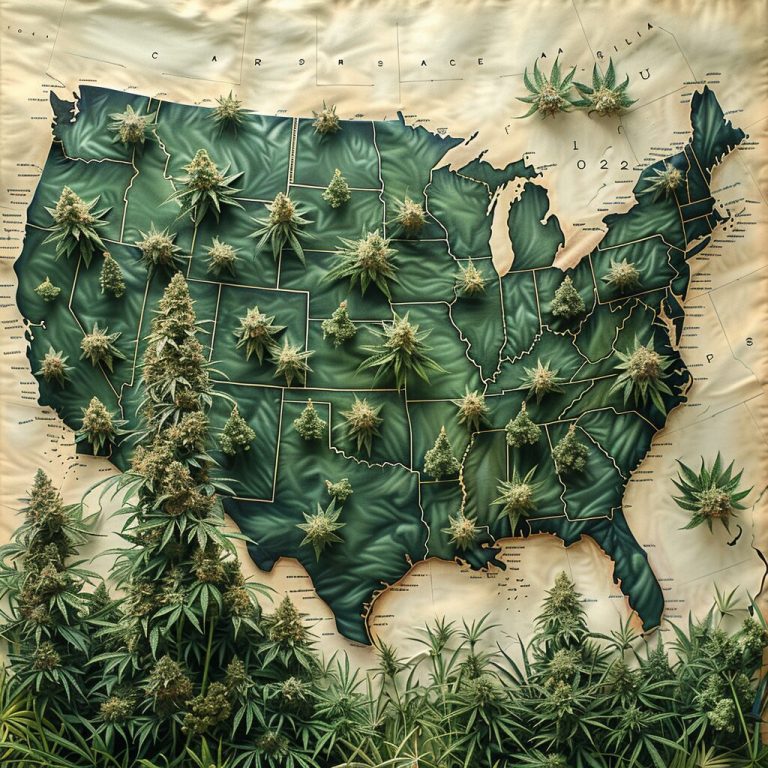

Cannabis legalization in Germany 2026: current legal situation (CanG, Cannabis Clubs, limits)
German legalization of marijuana from 1.04.2024: limits of 25g/50g, Cannabis Social Clubs, limit of 3.5 ng/ml THC for drivers. What does it mean for Poles? Complete guide 2026.
Key information at a glance
- April 1, 2024: entry into force of the law Konsumcannabisgesetz (CanG). Adults may possess 25 g in public spaces, 50 g at home and cultivate 3 plants for personal use (Federal Ministry of Health, 2024).
- July 1, 2024: start Cannabis Social Clubs, up to 500 members, limit of 50 g/month per person, exclusively residents of Germany over 18 years of age.
- THC limit for drivers: 3.5 ng/ml in serum applies from August 22, 2024.
- For Polish citizens: the law from July 29, 2005 still applies in Poland on counteracting drug addiction. Transporting marijuana across the Polish-German border is a crime. The German cannabis market is estimated at
- 4.7 billion EUR annually in 2024 (Federal Institute for Drugs and Medical Devices; EMCDDA, 2024 EMCDDA, 2024).
, partially legalizing marijuana for adults, came into force. KonsumcannabisgesetzEMCDDA from 2024 According to the data , in Germany alone, about 4.5 million adults use cannabis annually, and the illegal market was valued at over 4 billion euros before the reform. This change is more than just a local political decision. It is a signal for the entire European Union, including Poland, where the restrictive law from July 29, 2005 still applies. In this article, I will show what German law really looks like in 2026, what it means for tourists from Poland, and what the Polish regulator can learn from its western neighbor. cannabis law in Poland, pillar legality of CBD and THCShort answer: what is allowed today in Germany, and what is not?
From April 1, 2024, adults in Germany can possess up to
marijuana in public spaces, up to 25 g at their place of residence and cultivate 50 g for personal use. Cannabis Social Clubs will operate from July 1, 2024, with a limit of 50 g/month per member ( 3 plants BMG, 2024). Medical marijuana has been legal since 2017.Retail trade in recreational cannabis remains prohibited. Commercial stores do not exist, and selling to someone outside the club is punishable by fines and imprisonment. This model is completely different from the Canadian or state model in the USA. Germany has consciously chosen a middle path, between decriminalization and full commercial legalization.
For tourists from Poland, this means one thing. Consumption in Germany, in a private apartment, within 25 g, is legal.
Transporting across the border remains a crime under the Polish law from July 29, 2005 ( ). This dualism is key to understanding why Polish citizens still end up at the police station in Słubice or Zgorzelec.ISAP, Journal of Laws 2005 No. 179 item 1485The German Konsumcannabisgesetz, effective from April 1, 2024, allows possession of 25 g of marijuana in public spaces and 50 g at home for individuals over 18 years of age. Cannabis Social Clubs (from July 1, 2024) can have up to 500 members with a monthly limit of 50 g per person (Federal Ministry of Health, 2024).
What was the history of German drug policy before CanG?
For over five decades, Germany relied on
Betäubungsmittelgesetz (BtMG) from 1972. This law treated marijuana the same as heroin and cocaine. According to data from the Federal Criminal Police Office from 2022, the German police conducted over 220,000 proceedings annually related to cannabis, of which 75% concerned solely possession for personal use. From BtMG to medical marijuana in 2017
BtMG classified psychoactive substances into three categories. Cannabis was placed in
Anlage I , meaning prohibited for trade and prescription. Any form of possession was a crime, although sentences for small amounts were often limited to dismissal under § 31a BtMG.A breakthrough occurred in March 2017. The Bundestag adopted an amendment that allowed the prescription of medical marijuana to patients with chronic ailments.
The Federal Institute for Drugs and Medical Devices (BfArM) launched Cannabisagentur , an agency overseeing cultivation under prescription. In 2023, according to BfArM reports, German doctors issued about 350,000 BtM prescriptions for cannabis flos.The signaling coalition 2021-2024 and the path to legalization
The federal elections of 2021 changed the political landscape. The coalition of SPD, Greens, and FDP, called
Ampel , included cannabis legalization in the coalition agreement. Following the proceedings of the Bundestag in 2023, I noticed that the CanG project underwent several corrections. It originally proposed commercial sales, ultimately limited to cannabis clubs due to the European Commission's concerns regarding the 1961 UN Convention., included the legalization of cannabis in the coalition agreement. While following the proceedings of the Bundestag in 2023, I noticed that the CanG project underwent several revisions. Initially, it proposed commercial sales, ultimately limited to cannabis clubs due to concerns from the European Commission regarding the 1961 UN Convention.
407 to 226 (Deutscher Bundestag, plenary protocol). The Bundesrat did not exercise its veto right, and from April 1, 2024, Germany became the first major EU country with such liberal cannabis regulations. the history of marijuana legalization in Europe, a pillar article on EU regulations
What exactly did the Konsumcannabisgesetz (CanG) change from April 1, 2024?
The CanG law of March 27, 2024 introduced
four pillars of reform. These concern possession limits, consumption locations, protection of minors, and the absence of commercial sales. According to the Federal Ministry of Health (2024) , adults can legally possess 25 g in public places, 50 g at home, and cultivate 3 female plants. This is the first such profound reform of German drug law in half a century.Pillar 1: Possession and home cultivation limits
The 25 g limit in public spaces includes all forms: dried flower, hash, oil extracts (calculated based on the weight of the flower). The 50 g at home counts from the place of permanent residence. Three plants can grow both on the balcony and inside the apartment, provided they are secured against access by children and neighbors.
Exceeding the limit by a small amount is treated as an offense (
Ordnungswidrigkeit). Exceeding 30 g in public and 60 g at home is already a crime. It is worth remembering aboutweight tolerance . German courts in 2024 issued several rulings stating that a measurement error within 5% should not result in a penalty.Pillar 2: Consumption in public spaces
Smoking marijuana on the street is legal in Germany, but with significant exceptions. Consumption is prohibited:
within
- 100 meters of schools, kindergartens, playgrounds, and sports facilities, in pedestrian zones between 7:00 AM and 8:00 PM,
- in public transport vehicles and on platforms,
- in the presence of persons under 18 years of age.
- Local authorities (municipalities and states) can impose additional restrictions. Bavaria has gone the furthest, prohibiting consumption at most
Volksfeste , including Oktoberfest 2024.Pillar 3: Protection of minors
Persons under 18 years of age cannot possess, purchase, or consume cannabis. Selling or giving marijuana to a minor is punishable by up to 5 years in prison. For individuals aged 18-21, cannabis clubs are subject to
a reduced monthly limit of 30 g and a requirement that THC in the dispensed flower does not exceed 10%. Pillar 4: No commercial retail trade
Germany has consciously opted out of the store model that operates in Canada or Colorado. The reason is twofold: compliance with the 1961 UN convention and the European Commission's concern about violating the EU Treaty. Instead of stores, Cannabis Social Clubs were introduced. A commercial pilot in selected cities (Frankfurt, Hanover) was to start in 2025-2026, but after the February 2025 elections and the return of CDU/CSU to power, the project was suspended.
CanG is based on four pillars: limits of 25 g in public and 50 g at home, regulation of consumption at a distance of 100 m from schools, protection of individuals under 18 years of age, and a total ban on retail trade. The law was adopted by a vote of 407 to 226 in the Bundestag (Deutscher Bundestag, 2024).
How do Cannabis Social Clubs operate from July 1, 2024?
Cannabis Social Clubs (CSC), formally
Anbauvereinigungen , are cooperative cultivation associations that can have up to 500 members from July 1, 2024.. Each club must obtain a license from the relevant state, maintain a member register, and report the amount of harvested crops once a year. According to data from Deutscher Hanfverbandfrom March 2025, there are about 270 registered CSCs , the most in North Rhine-Westphalia and Hamburg. Who can become a club member?The requirements are clear. A member must be at least 18 years old, have German residency status (Anmeldung), and not belong to another CSC. Simultaneous membership is punishable by exclusion and a fine. The monthly fee covers cultivation costs, not profit: clubs operate on a non-profit basis.
What are the distribution limits?
Each member can receive
a maximum of 25 g per day and 50 g per month
. For young adults (18-21 years), the monthly limit is 30 g, and THC cannot exceed 10%. The club cannot sell cannabis to non-members. Violating this rule means losing the license and a prison sentence of up to 3 years. Geographical restrictions for clubsCSCs cannot be located closer than 200 meters from schools, kindergartens, and sports facilities. In practice, this limits locations to the outskirts of cities and industrial zones. According to my analysis of real estate offers for CSCs in Berlin and Frankfurt, in the first half of 2024, rental prices in areas permitted for cannabis clubs increased on average by 12-18%, indicating strong demand and limited supply of compliant premises.
how cannabis clubs operate in Europe, an article on Spanish CSC models
CSC cannot be located closer than 200 meters from schools, kindergartens, and sports facilities. In practice, this limits locations to the outskirts of cities and industrial zones. According to my analysis of real estate offers for CSC in Berlin and Frankfurt, in the first half of 2024, rental prices in areas permitted for cannabis clubs increased on average by 12-18%, indicating strong demand and limited supply of compliant premises.
No. Commercial retail sales of recreational marijuana in Germany
still do not exist
. The original CanG project anticipated a second pillar: a commercial pilot in selected cities for 5 years. According to BMG (2024), it was to start in 2025 in Frankfurt, Hanover, and Berlin, but after the federal elections on February 23, 2025, the plans were frozen. Why was the commercial model postponed? The reason is the return of CDU/CSU to the ruling coalition. The Christian Democrats have been opposed to the reform from the beginning and announced a revision of CanG already during the election campaign. Friedrich Merz, Chancellor of Germany since March 2025, stated in one of his first interviews for
Frankfurter Allgemeine Zeitung
that "the commercial pilot will not start in the current term". What about the existing legalization of private consumption? announced that "the commercial pilot will not start in the current term."
reversing
the reform has proven difficult. According to a survey ARD-DeutschlandTrend from January 2026, 57% of Germans support maintaining the legalization of private consumption, and 42% also support the existence of Cannabis Social Clubs. The CDU/CSU-SPD coalition in the coalition agreement from March 2025 announced an "evaluation of the effects of CanG" instead of direct derogation. This practically means maintaining the current regulations at least until mid-2026. The commercial pilot of retail cannabis sales in Germany, originally planned for 2025-2026 in Frankfurt and Hanover, was suspended after the February 2025 elections and the return of CDU/CSU to power. The ARD survey from January 2026 shows that 57% of Germans support maintaining the current legalization of private consumption (ARD-DeutschlandTrend, 2026). supports maintaining the legalization of private consumption, and 42% also support the existence of Cannabis Social Clubs. The CDU/CSU-SPD coalition in the coalition agreement from March 2025 announced an "evaluation of the effects of CanG" instead of direct derogation. This practically means maintaining current regulations until at least mid-2026.
Medical marijuana has been legal in Germany since March 2017, and CanG essentially
simplified the prescription procedure
. After April 1, 2024, doctors can issue a regular prescriptioninstead of a special BtM prescription (Betäubungsmittel-Rezept). According to data BfArM (2024) , the number of patients treated with medical marijuana increased from 350,000 in 2023 to over 1 millionin the first quarter of 2025. Medical indications and reimbursement Medical marijuana in Germany is available by prescription for a wide range of conditions. It is most commonly prescribed for:
chronic pain (mainly neuropathic),
spasticity in multiple sclerosis,
- nausea after chemotherapy,
- sleep disorders and anxiety,
- ADHD in adults (off-label),
- Tourette syndrome.
- Reimbursement by health insurance funds (
- Tourette's syndrome.
) requires individual approval. According toStatista 2024, about 65% of reimbursement applications are positively considered, and the monthly cost of therapy ranges from 200 to 800 EUR. The change from BtM prescription to regularis the biggest procedural change from the patient's perspective. The BtM prescription required a special form, strict record-keeping in pharmacies, and was valid for 7 days. After CanG, cannabis flos and THC extracts operate under the rules of a regular prescription for up to 28 days, significantly facilitating the continuity of therapy.
medical marijuana in Poland procedure, article on Importgenehmigung and Polish prescriptions
How did doctors, police officers, drivers, and lawyers react to CanG?
The CanG reform triggered
four distinct fronts of reaction
among German professionals. Doctors criticize the lack of patient education, police struggle with drug testing, drivers learn the new THC limit, and lawyers handle a growing wave of restitution cases. According to a survey Bundesärztekammer from June 2024, as many as 62% of German doctors believe that the reform was implemented too quickly. Doctors: lack of educational campaign German medical chambers have critically responded to CanG. The main complaints are the lack of a federal educational campaign aimed at patients and youth.
Deutsche Gesellschaft für Suchtmedizin
indicates that in the first half of 2024, the number of emergency room admissions due to acute THC poisoning increased by about 18% in the age group of 16-25 years. Police officers: problem with testing during stops The German police faced a practical problem. The standard saliva test detects THC even 24 hours after consumption, while the effect wears off after 4-6 hours. A legal gap has emerged. A driver who consumed cannabis the day before could be considered "under the influence" despite no actual impairment.
Drivers: new limit of 3.5 ng/ml THC from August 22, 2024
The German police faced a practical problem. The standard saliva test detects THC even 24 hours after consumption, while the effects wear off after 4-6 hours. A legal loophole has emerged. A driver who consumed cannabis the day before could be considered "under the influence" despite not being actually impaired.
Straßenverkehrsgesetz
(StVG). From August 22, 2024 , a limit of 3.5 ng/ml THC in serum . This is comparable to 0.2 per mille of alcohol. Exceeding this limit results in: a fine from 500 to 1500 EUR,penalty points (1-2 points in Flensburg),
- and a driving ban from 1 to 3 months.
- Combining cannabis with alcohol above 0.2 per mille or driving by young drivers (under 21 years) results in harsher penalties.
- Lawyers: wave of restitution cases
CanG introduced
mandatory amnesty
for individuals convicted solely for acts that are no longer punishable after April 1, 2024. German courts processed over 180,000 applications for annulment of the sentence or its part ({ Deutscher Richterbund , annual report 2024). This is the largest drug amnesty in post-war German history.The CanG reform has triggered mixed reactions: 62% of German doctors believe it was implemented too quickly (Bundesärztekammer 2024), the police received a new limit of 3.5 ng/ml THC for drivers from August 22, 2024, and courts processed over 180,000 applications for restitution of sentences by the end of 2024 (Deutscher Richterbund, 2024).What does German legalization mean for Polish citizens in Germany?
Poles living or working in Germany are subject to German law and can legally use 25 g in public and 50 g at home.
Transporting marijuana across the Polish-German border remains a crime
under Polish law. According to statistics from the Border Guard in 2024, in that year alone, over 4,200 people Act of July 29, 2005, on counteracting drug addictionwere detained trying to smuggle cannabis from Germany. Can I smoke in Germany as a tourist from Poland? Yes, but with reservations. A Polish tourist in Germany can legally possess up to 25 g and consume it in permitted places. They do not need to have German residency. However, they cannot join a Cannabis Social Club, as this requires residency status (
Anmeldung
What are the consequences of transporting marijuana across the border?Polish law does not differentiate the source of origin. Possessing marijuana in Poland, even if legally acquired in Germany, is a crime. According to Article 62 of the 2005 law:).
possession of a few grams: up to 3 years of imprisonment (possible dismissal under Article 62a in the case of a "less serious offense"),
substantial amount: from 1 year to 10 years,
- possession of up to several grams: up to 3 years of imprisonment (possible dismissal under Article 62a in case of "less serious offense"),
- What about consumption in a car registered in Poland?
- German THC limits for drivers (3.5 ng/ml in serum) apply regardless of the vehicle's country of registration. Upon crossing the border with Poland, Polish Penal Code and Road Traffic Law are applied. There is no analogous limit in Poland. Any presence of THC in a driver's body may result in charges under Article 178a of the Penal Code or an offense under Article 87 of the Offenses Code.
Consultations conducted in 2024 indicate that the Border Guard has particularly strengthened controls at the Świecko, Olszyna, and Jędrzychowice crossings. Vehicles with Polish plates returning on Sunday evenings are most often checked.
legality of cannabis in Poland 2026, article on the law from July 29, 2005
How does German legalization affect other EU countries and Poland?
The German reform is
the largest regulatory movement in the EU in decades.
Together with Malta (2021) and Luxembourg (2023), Germany forms a bloc of countries with a liberal approach to cannabis. According to EMCDDA (2024), eight other EU members (including the Czech Republic, the Netherlands, and Spain) are currently conducting legislative debates. Poland remains among the countries without reform plans. The reaction of other EU countriesThe Czech Republic, Germany's southern neighbor, announced a plan for commercial legalization modeled on CanG in 2024. However, the project got stuck in parliament after coalition changes. The Netherlands launched a pilot in 2024
gesloten coffeeshopketen
(closed supply chain) in 10 municipalities. Spain maintains asociaciones cannábicas , a cooperative model similar to German CSCs. What does this mean for Poland?Poland borders three countries with more liberal cannabis laws: Germany, the Czech Republic, and (since 2023) Luxembourg (through transit). Social pressure is increasing. According to a CBOS survey from 2024,
49% of Poles support decriminalization
of possession of small amounts of marijuana for personal use, and 35% advocate for full medical legalization with NHF reimbursement. At the EU level, the German reform has also forced a discussion about the CJEU ruling Kanavape.
The ruling C-663/18 from November 19, 2020established that CBD derived from the whole hemp plant is not a narcotic under the 1961 UN Convention. This groundbreaking ruling opened the way for the free movement of CBD products in the EU and indirectly strengthened the argument for reforming recreational cannabis. the legal status of CBD in the EU after the Kanavape ruling, an article on CJEU jurisprudence What are the economic implications of German legalization?
The German cannabis market in 2024 is valued at
, of which the illegal market constituted about 60% before the reform. According to
and the report in 2024 (Federal Institute for Drugs and Medical Devices;Institut für Wirtschaftsforschung (IFW Kiel) BfArM from 2024, legalization will bring an additional 1.3 billion EUR annually in the form of taxes and licensing fees for CSCs. Impact on the state budget Although retail sales have not started, the state benefits from licensing fees from cannabis clubs, VAT on cultivation materials and seeds, and savings in the justice system. According to IFW Kiel, the justice system alone will save up to 800 million EUR annually due to the reduction in drug cases.
New jobs
The sector of legal cultivation and medical marijuana in Germany employs (as of the end of 2024) about
15,000 people
, and by the end of 2026, this number could exceed 30,000, especially after the potential launch of a commercial pilot. Impact on the illegal market. According to 270 registered CSCsAccording to the Federal Criminal Police Office, in 2024, the value of the illegal market fell by about
23%
compared to 2023. This shows that the reform has indeed displaced part of the underground trade, although the illegal market still serves individuals without residency status and those avoiding formal registration in clubs. 23% How does the German model compare to the USA, Canada, and the Netherlands?
Germany occupies
an intermediate position
between decriminalization and commercial legalization. Canada has allowed full retail sales since 2018, the USA remains federally illegal despite legalization in 24 states (as of 2024), and the Netherlands operates in a gray area of tolerance ( gedoogbeleid ). Germany is the first EU country with a formally written law legalizing home consumption without retail trade.Canada: full commercializationCanada passed the
Cannabis Act
in October 2018, allowing sales in licensed stores. The possession limit is 30 g in public. According to Statistics Canada, in 2023, legal sales reached 4.5 billion CAD. However, this model requires federal exemption from the UN convention, which the EU does not want to do collectively. USA: state mosaicIn the USA, federal illegality coexists with legalization in 24 states (as of the end of 2024). Colorado (Amendment 64 from 2012) and Washington were pioneers. Colorado's tax revenues have exceeded 2.5 billion USD since 2014. However, the federal ban causes banking and transportation issues.
Netherlands: tolerance without legalization
Dutch policy
has been in place since the 1970s. Coffeeshops can sell up to 5 g per person, but cultivation remains formally illegal. This is the famous "backdoor" problem that Germany consciously avoided through the club model.
Comparative table Canada: full commercialization has been in effect since the 1970s. Coffeeshops can sell up to 5 g per person, but cultivation remains formally illegal. This is the famous "backdoor" problem that Germany has consciously circumvented through the club model.
What can Poland learn from Germany in the area of medical marijuana?
Poland has had medical marijuana available by prescription since 2017, but the system operates in a limited manner. According to data from the National Health Fund, in 2023, about
130,000 prescriptions
for cannabis flos were issued in Poland, seven times less than in Germany during the same period. Germany offers several practical lessons that Poland could adapt without changing the 2005 law. Lesson 1: Simplifying the prescription issuance procedure In Poland, every prescription for medical marijuana requires obtaining an import permit (
Importgenehmigung
) from the Chief Pharmaceutical Inspectorate. Germany has abolished the special BtM prescription for cannabis since 2024. The Polish regulator could introduce a similar simplification while maintaining a medical record in the e-health system.Lesson 2: Education for primary care physiciansIn Germany, medical marijuana is prescribed not only by specialists but also by family doctors. In Poland, over 80% of prescriptions are issued by doctors in three specialties: neurology, oncology, and psychiatry. Expanding the competencies of primary care physicians would require a federal educational program similar to the German
Suchtmedizinische Grundversorgung
Lesson 3: Reimbursement with a spectrum of indications Germany reimburses cannabis for a wide range of indications upon individual approval. In Poland, reimbursement practically does not exist, and the monthly cost of therapy reaches 1500-2500 PLN. Expanding the NHF list of indications would increase therapy availability for patients who today forgo it for economic reasons..
The Polish CBD and medical marijuana market is developing dynamically. Specialized cannabis shops offer a full portfolio of oils, hemp flowers with THC below 0.3%, and CBG preparations.
What is the current Polish legal context and the prospects for reform? Statista 2024 The Polish legal system in 2026 is based on
the law from July 29, 2005 on counteracting drug addiction
). Marijuana with THC above 0.3% remains illegal, and its possession is punishable by up to 3 years in prison (Article 62). CBD from hemp with THC below 0.3% remains legal according to the CJEU ruling Kanavape (C-663/18).
No plans for recreational legalization None of the ruling parties in 2026 has submitted a formal project for recreational legalization. The Left periodically proposes decriminalization, but they do not gain a majority in the Sejm. The Confederation proposed a liberalization project in the medical area in 2024, but the project got stuck in the health committee. (Journal of Laws 2005 No. 179 item 1485The status of CBD and hemp
After the CJEU Kanavape ruling from 2020, CBD as a substance is not a narcotic under European law.
WHO ECDD in its critical assessment from 2018
confirmed that CBD does not exhibit addictive or toxic potential. This forms the basis for the legality of the Polish CBD market and hemp flowers
with THC below 0.3%. Directions for potential reform If Poland were to reform, it would likely follow the German path. The model of cannabis clubs complies with the 1961 UN convention, does not require changes in EU law, and allows monitoring of consumption. According to a CBOS survey from 2024, 49% of Poles support decriminalization, an increase of 12 percentage points compared to 2019. Recommended products from the legal CBD offer For individuals in Poland looking for legal alternatives, the offer of legal hemp flowers
and CBD oils is wide:
Verified CBD and CBG products available legally in Poland:
SOOL CBD 5%, full-spectrum oil
: 76 PLN, mild concentration for the start of therapy. Recommended products from the legal CBD offer SOOL CBD 10%, full-spectrum oil
: 99 PLN, for experienced users.
- Cannova CBG 15%, oil with cannabigerol: 240 PLN, an alternative to CBD.
- Mars CBD 9%, hemp flowers: 59 PLN, flower with THC below 0.3% compliant with Polish law.
- FAQ: frequently asked questions about marijuana legalization in Germany1. Can I legally smoke marijuana in Berlin as a Pole?
- Yes, as a tourist from Poland, you can legally possess up to 25 g of marijuana in public spaces in Berlin and consume it in permitted places. You do not need to be a resident. However, remember the prohibitions: 100 m from schools and playgrounds, in pedestrian zones from 7 AM to 8 PM, in public transport (Federal Ministry of Health, 2024).2. How much marijuana can be possessed in Germany from April 1, 2024?
The public limit is 25 g, at home 50 g, plus the possibility of cultivating 3 female plants for personal use. Exceeding up to 30 g (publicly) or 60 g (at home) is treated as an offense, above that as a crime punishable by up to 3 years in prison (CanG art. 3, BMG, 2024).
3. Can I buy marijuana in a German store?
No. Commercial retail sales of recreational marijuana do not exist in Germany. The pilot originally planned for 2025-2026 in Frankfurt and Hanover was suspended after the February 2025 elections. Legal sources are Cannabis Social Clubs (only for residents) or home cultivation of up to 3 plants (Federal Ministry of Health, 2024).
4. What are the consequences of transporting marijuana from Germany to Poland?
Transporting marijuana across the Polish-German border constitutes a crime under Article 55 of the Polish law from July 29, 2005, punishable by 3 months to 5 years in prison. According to Border Guard statistics, in 2024, over 4,200 people were detained trying to smuggle cannabis (ISAP, Dz.U. 2005 nr 179 poz. 1485).
5. What is the THC limit for drivers in Germany?
From August 22, 2024, the limit in Germany is 3.5 ng/ml THC in blood serum. Exceeding this results in a fine from 500 to 1500 EUR and a driving ban for 1-3 months. Combining cannabis with alcohol above 0.2 per mille or driving by individuals under 21 results in harsher penalties (Straßenverkehrsgesetz, 2024).
6. Can a Pole join a Cannabis Social Club in Germany?
Only if they have German residency status (
) and are at least 18 years old. Tourists, students on short trips, and individuals working temporarily without registration cannot become members of CSC. The distribution limit is 25 g per day and 50 g per month (Federal Ministry of Health, 2024).
7. Is CBD legal in Poland after German legalization?
Yes, CBD remains legal in Poland; its status has not changed after the German reform. Oils, flowers, and extracts from hemp with THC below 0.3% are allowed for trade according to the CJEU ruling Kanavape (C-663/18) and the critical assessment of WHO ECDD from 2018 (CJEU, November 19, 2020).
8. Can German doctors issue a prescription for a Pole?Polish law does not differentiate the source of origin. Possessing marijuana in Poland, even if legally acquired in Germany, is a crime. According to Article 62 of the 2005 law:Yes, a German doctor can issue a prescription for medical marijuana for a person with Polish health insurance. To fill it in a Polish pharmacy, a translation and import permit from the Chief Pharmaceutical Inspectorate are required. This is a time-consuming and costly procedure, and NHF reimbursement is practically excluded (BfArM, 2024).
9. How many people in Germany are treated with medical marijuana?
According to the Federal Institute for Drugs and Medical Devices,
in the first quarter of 2025, over 1 million patients were treated with medical marijuana in Germany. This is a jump from 350,000 in 2023. The change from BtM prescription to regular significantly facilitated the continuity of therapy (BfArM, 2025).
10. Does Poland plan to legalize marijuana in 2026?
No. None of the ruling parties in 2026 has submitted a formal project for recreational legalization. The Left proposes decriminalization, and the Confederation proposed a medical liberalization project in 2024. According to the CBOS survey from 2024, 49% of Poles support decriminalization, but the topic is not a priority for the parliamentary majority (CBOS, 2024).
According to the data The German Konsumcannabisgesetz isthe largest drug reform in the EU in half a century.
The limit of 25 g in public, 50 g at home, and 3 plants at home has been in effect since April 1, 2024. Cannabis Social Clubs will operate from July 1, 2024. Commercial sales have still not started and are unlikely to start in the current term of the CDU/CSU-SPD government.
For Poland, two conclusions are most important. First, the German club model complies with the UN convention and could serve as a model for Poland's potential reform. Second, there is currently no political majority for such a reform. Polish citizens should remember one thing: German law ends at the border, and the Polish law from July 29, 2005 still treats transporting marijuana as a crime. The safest form of legal consumption in Poland remains CBD and CBG products from hemp with THC below 0.3%.
Summary and conclusions
how to choose CBD oil, a buying guide This article is for informational and educational purposes only.It does not constitute legal
or medical advice. The regulatory status of marijuana in Germany, Poland, and the EU is changing dynamically. Before taking specific actions, consult a lawyer specializing in criminal and pharmaceutical law.
In Poland, marijuana with THC above 0.3% remains illegal
Legal disclaimer
Attention: under the law from July 29, 2005 on counteracting drug addiction. CBD from hemp with THC below 0.3% is legal according to the CJEU ruling Kanavape (C-663/18). Transporting marijuana across the Polish-German border constitutes a crime under Article 55 of the aforementioned law.
W The authors are not responsible for decisions made based on the content of this article. Information is current as of April 25, 2026 German legalization of marijuana from April 1, 2024: limits of 25g/50g, Cannabis Social Clubs, limit of 3.5 ng/ml THC for drivers. What does it mean for Poles? Complete guide 2026. Marijuana legalization in Germany 2026: current legal situation (CanG, Cannabis Clubs, limits) - Legality and regulations
The authors are not responsible for decisions made based on the content of this article. Information is current as of April 25, 2026.