
Runner's high and the endocannabinoid system (FAQ)
Euforia biegacza: odpowiedzi na najczestsze pytania i co mowia badania. u Bucha.
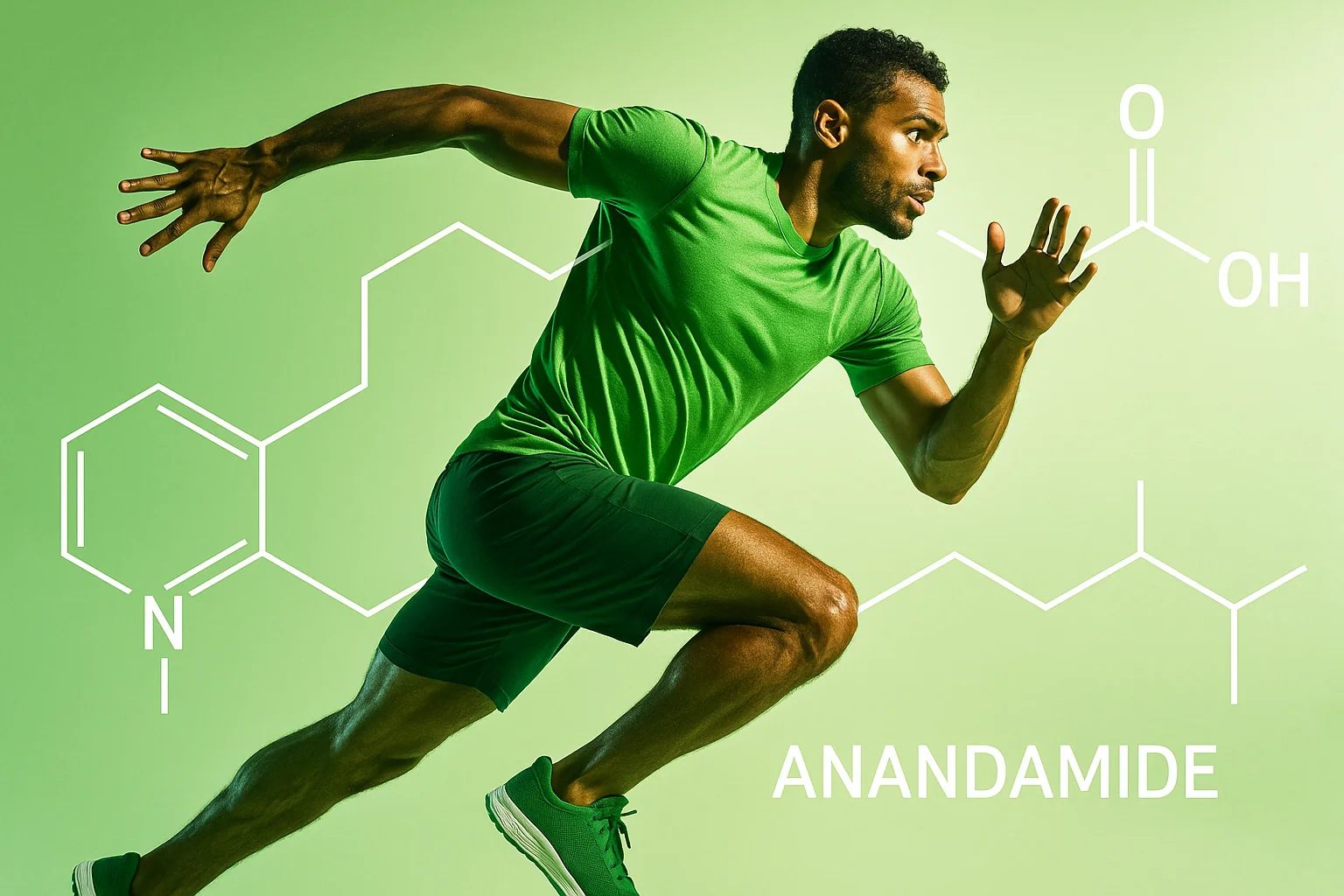
For half a century, science mistakenly attributed runner's euphoria to endorphins. The problem was simple: endorphins are large peptides that do not cross the blood-brain barrier - they physically cannot induce euphoria because they cannot reach brain receptors. In 2021, Raichlen's research solved this puzzle: the key mediator of runner's high is anandamide - an endogenous cannabinoid that increases by several dozen percent during running and easily penetrates the brain (Raichlen et al., Psychoneuroendocrinology, 2021). This article answers the most common questions about this fascinating biological reward for movement.
KEY INFORMATION
• Runner's high is mainly induced by anandamide, not endorphins - endorphins do not cross the blood-brain barrier in significant amounts (Raichlen et al., 2021).
• The optimal stimulus is 30+ minutes of running at 70-80% max heart rate - sprinting or walking do not induce a noticeable increase in AEA.
• CBD inhibits FAAH - the enzyme that breaks down anandamide - which may theoretically prolong the effect, although there is a lack of clinical studies.
• Runner's high is not common - it depends on individual density of CB1 receptors and training status.
How do we know it's anandamide and not endorphins?
The history of this mistake is instructive. In the 1980s, endorphins were discovered and quickly attributed to every good feeling after exercise. The logic was tempting: running → pain → the body produces opioids → euphoria. For decades, this explanation was repeated in textbooks and media. The problem was only recognized when it was checked whether endorphins actually reach the brain.
Endorphins are peptides - large, polar molecules. The blood-brain barrier is highly selective and blocks most peptides from entering the brain. Experiments with opioid receptor antagonists (naloxone) showed that blocking opioid receptors did not eliminate runner's high. If endorphins were the cause, naloxone should have worked. It did not.
The anandamide hypothesis emerged when the endocannabinoid system was discovered. Anandamide is a small lipophilic molecule - ideal for crossing the blood-brain barrier. Raichlen's 2021 study experimentally confirmed it: a 30-minute run at 70-80% max heart rate significantly raised blood levels of AEA and reduced anxiety levels, while the same individuals running slowly (walking) or very fast (sprinting) did not show such an increase in anandamide.
Anandamide during running - how does it work mechanistically?
Aerobic effort triggers several mechanisms leading to an increase in anandamide. Primarily, activation of the sympathetic system (adrenaline, noradrenaline) stimulates AEA synthesis in adipocytes and peripheral tissues. Mechanical muscle effort can also directly induce the synthesis of endocannabinoids via the N-acylethanolamine pathway.
The key point is that the increase in AEA during running is transient. The FAAH enzyme quickly degrades anandamide - the half-life is literally minutes. Therefore, runner's euphoria occurs during running and fades shortly after completion. The brain 'receives' a dose of anandamide only during the effort window: too weak an effort does not produce sufficient AEA, while too intense triggers other stress pathways that mask the effect.
| Intensity of effort | Increase in AEA | Mood after running | Notes |
|---|---|---|---|
| Walking (40% of max heart rate) | No significant increase | Slight improvement | Too little sympathetic stimulation |
| Moderate running (70% of max heart rate) | Significant increase | Noticeable improvement, reduction of anxiety | Optimal window for AEA |
| Sprint (>85% max heart rate) | Weak or absent | Stress dominates | Cortisol and lactate mask the ECS effect |
Ewolucja runner’s high - po co nam ta nagroda?
Raichlen proposed a fascinating evolutionary hypothesis: runner's high is a biological reward for movement that evolved in hominids as an incentive for long-distance running - a key skill in the strategy of persistence hunting (chasing prey to exhaustion). The human species is uniquely adapted for long-distance running: we have a cooling system through sweating, a body structure optimized for running, and our earliest tools indicate hunting through persistence.
Interestingly, Raichlen's study included not only humans but also dogs and ferrets. Dogs - animals capable of long-distance running - showed an increase in AEA after aerobic effort, similar to humans. Ferrets - animals incapable of this type of locomotion - did not show a significant increase in anandamide after the same exercise protocol. This suggests that the AEA pathway as a reward for running is evolutionarily specific to species adapted for long-distance aerobic effort - and is not a general 'exercise reward' mechanism across all mammals.
The endocannabinoid system as a center for sports regulation
Runner's high is just one aspect of the ECS's role in physical activity. The endocannabinoid system also participates in regulating recovery after exertion (through CB2 and anti-inflammatory pathways), controlling energy metabolism during exercise, modulating the perception of muscle pain, and regulating motivation for further exercise. It is a complete system affecting nearly every aspect of the sports experience.
CBD - as a phytocannabinoid modulating this system - is gaining increasing interest among athletes. The World Anti-Doping Agency (WADA) removed CBD from the list of prohibited substances in 2018. Many professional athletes use CBD in the context of recovery, stress management, and sleep quality. At the same time - to be fair - there is a lack of large randomized clinical studies confirming the ergogenic effects of CBD in elite athletes.
Frequently Asked Questions
What is runner's high and when does it occur?
Runner's high is a state of euphoria and reduced pain perception that occurs during prolonged aerobic effort - usually after 30-40 minutes of running at 70-80% max heart rate. The key mediator is the increase in blood levels of anandamide, not endorphins - endorphins do not cross the blood-brain barrier (Raichlen et al., 2021).
Why do endorphins not explain runner's high?
Endorphins are large peptides that do not cross the blood-brain barrier in significant amounts. Experiments with naloxone (an opioid antagonist) did not eliminate runner's high, which rules out endorphins as the main mechanism. Anandamide is a lipophilic, small molecule capable of crossing the barrier - it reaches the CB1 receptors in the brain and induces euphoria.
What intensity of running induces runner's high?
The optimal intensity is 70-80% of maximum heart rate for at least 30 minutes. Raichlen's study tested walking, moderate running, and sprinting - only moderate running significantly raised AEA levels and improved mood. Sprinting was too intense - metabolic stress dominated. Walking was insufficient to activate the endocannabinoid pathway.
Can CBD enhance the effects of runner's high?
CBD inhibits the FAAH enzyme that breaks down anandamide. Theoretically, less FAAH means a longer action time for AEA produced during running. However, there are no clinical studies confirming that CBD before training enhances runner's high in practice. It is a biologically plausible hypothesis without solid data for now.
Do other sports also induce runner's high?
Yes - any moderate-intensity aerobic effort maintained for 30+ minutes can raise anandamide levels: cycling, swimming, rowing, dancing. Strength training with short time under tension triggers different hormonal adaptations and less effectively stimulates the endocannabinoid pathway.
Why do not all experience runner's high?
Runner's high is not common. Factors influencing its occurrence include: individual CB1 receptor density (genetically determined), level of training, running conditions, and emotional state. Individuals with higher baseline CB1 density or lower FAAH activity may experience stronger effects. The absence of runner's high does not mean that running does not provide health benefits.
How quickly does the effect of anandamide disappear after running?
Anandamide has a half-life of minutes - the FAAH enzyme quickly degrades it. The euphoria after running usually lasts from a few minutes to a maximum of one hour after the effort ends. This is why runner's high is temporary - without FAAH inhibition, AEA levels quickly return to baseline.
How does regular running change the endocannabinoid system in the long term?
Research on runner's euphoria often focuses on a one-time increase in anandamide, but regular aerobic training also affects the ECS system in the long term. Studies on animal models have shown that chronic running training increases CB1 receptor expression in the hippocampus and prefrontal cortex - structures crucial for mood and stress resilience (Scherma et al., Frontiers in Psychiatry, 2014). This may explain why regular exercise is one of the most effective methods for improving mood and reducing symptoms of depression and anxiety.
In other words: a single run provides a temporary spike in anandamide. Regular running for weeks and months can 'rebuild' the endocannabinoid system - making the brain more sensitive to AEA and better at regulating the stress response. This is one of the mechanisms through which physical exercise acts as a natural 'therapy' for the nervous system, regardless of supplementation.
For individuals using CBD: combining regular aerobic training with CBD may work synergistically through two independent mechanisms - CBD inhibits FAAH, prolonging AEA action, while training raises baseline AEA levels and increases CB1 receptor density. However, there are no direct clinical studies confirming this synergy in humans - it is a biologically plausible hypothesis requiring verification.
Practical conclusions for runners
What does this mean for someone looking to maximize the psychological effects of running? Here are a few specific tips based on scientific data.
Run for at least 30 minutes at a moderate intensity - roughly at a level where you can speak in short sentences but feel the effort. Below this threshold, the increase in AEA is weak; above 85% of max heart rate, stress dominates and masks the endocannabinoid effect. Consistency is more important than one-time intensity: daily 30-minute runs will build a stronger adaptive effect than one marathon a week.
Hydration and temperature matter: running in overheating or dehydration triggers stress mechanisms that compete with the endocannabinoid signal. Run in comfortable thermal conditions, especially if you care about the psychological effect, not just the physical one.
Music can enhance the effect. Studies show that positive musical stimuli activate the reward system through dopaminergic and serotonergic pathways - which also modulate the endocannabinoid response. This partially explains why running with headphones is subjectively more enjoyable and may facilitate achieving runner's high.
This article is informational and educational in nature. It contains internal links to products available in the u Bucha store. Prices and specifications may change - please check the current data on the product page before purchasing.
Author: Michał Waluk · Published: 2026-05-04 · Updated: 2026-05-04