
Ekstrakcja konopi - CO2 vs etanol vs rosin vs BHO (tabela)
Ekstrakcja konopi: porownanie, roznice i co wybrac. Tabela od u Bucha.
The extraction method is one of the most important factors influencing the quality, purity, and phytochemical profile of CBD oil or hemp concentrate - yet it rarely appears on product labels. Most consumers are unaware that the choice between CO2, ethanol, rosin, and BHO is a choice between entirely different chemical processes, yielding products with different compositions and varying health risks. Studies on terpene profiles show that CO2 extraction at low temperatures preserves monoterpenes significantly better than ethanol extraction at room temperature - which translates to a richer aroma and potentially stronger entourage effect (Rovetto & Aieta, J. Supercrit. Fluids, 2017). This article explains the mechanism of each method, its advantages, and limitations.
KEY INFORMATION
• Supercritical CO2: the cleanest and most selective method - the standard for premium and pharmaceutical CBD products.
• Ethanol: scalable and inexpensive, dominates mass production of CBD oils, requires additional purification.
• Rosin: the only solvent-free method (without solvents) - heat and mechanical pressure, preserves terpenes.
• BHO (butane): an efficient method for concentrates, but extremely risky in production - explosions, toxic residual solvent.
• The extraction method directly affects the terpene profile, purity, and wax content in the final product.
Why does the extraction method matter for CBD quality?
Every hemp extract is the product of a process that separates desired phytochemicals (cannabinoids, terpenes, flavonoids) from unwanted components of the plant material (waxes, chlorophyll, lipids, chlorophyll). Different extraction methods vary in solvent polarity, temperature, and pressure - and each of these parameters affects which compounds "come out" of the plant into the extract.
Polar solvents (ethanol, water) extract both lipophilic cannabinoids and hydrophilic pigments and sugars. Non-polar solvents (butane, propane) extract more selectively - mainly lipophilic compounds. Supercritical CO2 has a unique property: by changing pressure and temperature, its solvent properties can be smoothly adjusted between polar and non-polar ranges, providing exceptional selectivity.
Terpenes are particularly sensitive to extraction conditions. Monoterpenes (e.g., myrcene, limonene) have low boiling points - from 60°C to 180°C - and easily degrade or evaporate at elevated temperatures. Sesquiterpenes (beta-caryophyllene, humulene) are more stable. Extraction methods conducted at low temperatures preserve a fuller terpene profile - and terpenes directly influence the taste, aroma, and biological effect of the final product through the entourage effect mechanism.
How does supercritical CO2 extraction work and why is it the premium standard?
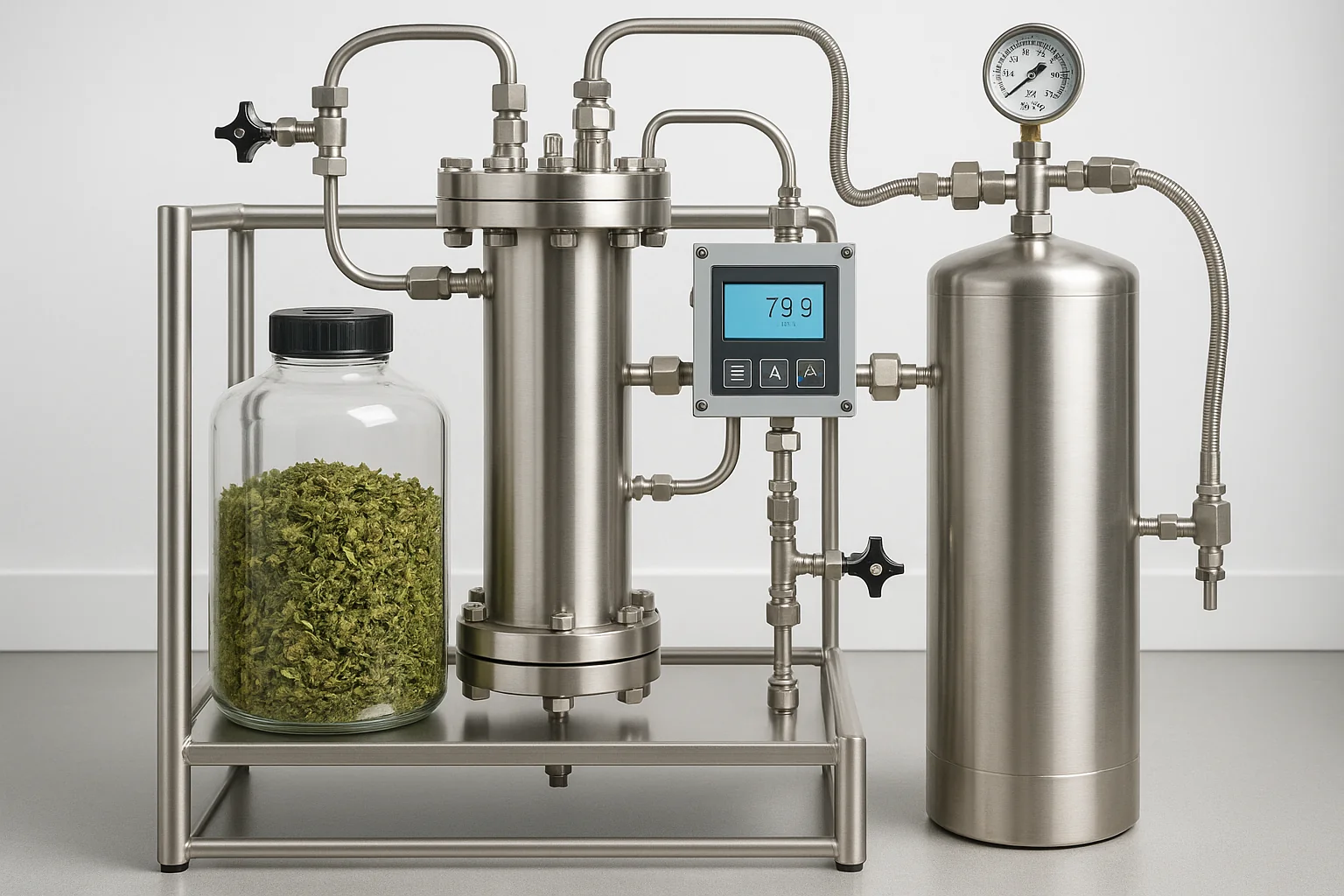
CO2 under standard conditions is a gas. Above the critical temperature (31.1°C) and critical pressure (73.8 bar), it transitions to a supercritical state - retaining properties of both a liquid (density, dissolving ability) and a gas (low surface tension, diffusion into pores). In this state, CO2 acts as an excellent selective solvent for extracting cannabinoids and terpenes from plant material.
The selectivity of CO2 is a key advantage. By changing parameters (so-called pressure and temperature modulation in cascading systems), different fractions can be "selected" sequentially: first terpenes at lower pressure, then cannabinoids at higher, leaving waxes and chlorophyll in the raw material. This precision is unattainable with ethanol or butane. The result is a pure, bright yellow extract without residual solvents (CO2 completely evaporates as gas after expansion), free of waxes and with preserved terpene profile.
Investing in CO2 extraction equipment costs between 50,000-500,000 USD for a production facility. This explains why this method dominates among large, certified producers rather than small operations. The unit cost of CO2 extract is higher than that of ethanol, which directly translates to the premium price of CBD oils based on this technology.
Ekstrakcja etanolem - dlaczego dominuje w masowej produkcji?
Ethanol is the simplest and cheapest among the major extraction methods. The plant material is immersed in ethanol - most often at very low temperatures (-40°C to -60°C, the so-called "cryo-extraction") or at room temperature - for several minutes to several hours. Ethanol effectively extracts both cannabinoids and terpenes, but also unwanted components: chlorophylls (responsible for the green color and bitter taste), waxes, and lipids.
Therefore, after ethanol extraction, a purification step is necessary - winterization: the extract is mixed with cold ethanol and cooled to -20°C to -40°C, causing waxes and lipids to crystallize. After filtration, unwanted components are removed. Then, ethanol evaporates under reduced pressure. Additional steps include decolorization (activated carbon or silica gel), which gives the extract a bright color.
Cryo-extraction (very low temperature during the extraction itself) significantly reduces the amount of extracted waxes and chlorophylls without the need for winterization, simplifying the process. It is also beneficial for terpenes - low temperature limits their degradation during extraction. More and more mass producers are transitioning to ethanol cryo-extraction as a compromise between cost and quality.
Rosin - solvent-free extraction through heat and pressure
Rosin is the only cannabis extraction method that does not use any chemical solvents. The plant material (flower, kif, or hash) is placed between two heated metal plates of a hydraulic or manual press (rosin press) and compressed at a temperature of 60-100°C for several to several dozen seconds. Heat and mechanical pressure squeeze the cannabinoid resin from the trichomes and resin glands of the plant onto silicone-coated parchment.
The result is a golden, translucent resin with a consistency ranging from oil to wax - depending on the moisture content of the material and the press parameters. Rosin contains a full profile of hemp phytochemicals - cannabinoids, terpenes, flavonoids - with minimal thermal degradation, as the process temperature is low. It requires no further purification from solvents, as no solvents were used.
However, the yield from a rosin press is low: from one gram of flower, typically 10-25% of the weight is obtained in rosin, while CO2 and ethanol yield 15-35% from similar raw material (with lower THC/CBD in the raw material, of course, the yield is proportionally lower). For small scale (home or artisanal), rosin is the method of choice - the investment in a press is 200-5000 USD, with no special safety requirements. For industrial scale, the yield is too low.
Comparison table of cannabis extraction methods
| Parameter | Supercritical CO2 | Ethanol (cryo) | Rosin (heat + pressure) | BHO (butane) |
|---|---|---|---|---|
| Solvent | CO2 (safe, no residues) | Ethanol (residual possible) | None (solvent-free) | Butane (toxic, explosive) |
| Selectivity | Very high (regulated) | Low-medium | Medium | High for terpenes/cannabinoids |
| Terpene behavior | Very good (low T) | Good (cryo), average (RT) | Very good | Very good |
| Purity from waxes/chl. | Bardzo wysoka | Requires winterization | Medium (contains waxes) | High |
| Yield from raw material | 15-35% | 20-40% | 10-25% | 15-30% |
| Equipment cost | Bardzo wysoki (50-500 tys. USD) | Average (5-50 thousand USD) | Niski (200-5 tys. USD) | Medium (requires safe installation) |
| Process safety | High (CO2 does not explode) | Medium (ethanol is flammable) | Very high | Low (explosion risk) |
| Applications | Premium CBD oils, pharmacy | Mass production of CBD oils | Craft concentrates | Wax, shatter, premium concentrates |
| Residual solvents in CoA | None (CO2 evaporates) | Wymagany test (<5000 ppm etanol) | None | Wymagany test (<5000 ppb butan) |
Data update: May 04, 2026 | Sources: Rovetto & Aieta, J. Supercrit. Fluids 2017; Romano & Hazekamp, Cannabinoids 2013
BHO - dlaczego jest wydajne i dlaczego jest ryzykowne?
BHO (Butane Hash Oil) uses liquefied butane as a solvent. Butane is very non-polar - it selectively extracts cannabinoids and terpenes with minimal extraction of waxes, chlorophylls, and other unwanted components. The result is an extract with a beautiful aroma and a rich terpene profile - wax, shatter, crumble, budder are different consistencies of BHO resulting from various process conditions and terpene content.
The problem is fundamental: butane has a very low boiling point (-0.6°C) and is extremely flammable in the range of 1.9-8.5% concentration in the air. During open extraction (canning plant material and passing butane through an open tube), butane vapors accumulate near the floor - and a spark from any source (light switch, refrigerator, mobile phone) can trigger an explosion. Hundreds of serious accidents and dozens of fatalities related to home BHO production have been reported annually in the USA.
Professional BHO production takes place in closed-loop systems, in rooms with explosion-proof ventilation, where butane is recovered and returned to the process, rather than released into the atmosphere. Such an installation is safe but requires certification and investments of tens of thousands of dollars. The finished BHO product must undergo rigorous testing for residual butane in CoA - acceptable limits for hydrocarbon solvents are usually below 5000 ppb (parts per billion) in pharmaceutical products.
How to choose a CBD product based on the extraction method?
For most CBD supplement consumers, the decision boils down to CO2 versus ethanol - BHO is the domain of the concentrate market, and rosin of the artisanal market. Here are practical conclusions: if you care about maximum purity and absence of residual solvents - look for products with CO2 extraction and check the CoA section "Residual Solvents: Not Detected". If you care about the terpene profile and aroma - CO2 low-temperature or rosin are better than standard ethanol extraction at room temperature.
If you are buying mass-produced CBD oil at a good price - it is likely based on ethanol extract. This is not a drawback if the producer conducts proper winterization and tests for residual ethanol. Ethanol in a good quality CBD oil should be below 5000 ppm (the acceptable limit for USP class 3 solvents) - which is safe at normal dosing.
Always ask for a CoA that includes the "Residual Solvents" section. For CO2 products, it should show "ND" (not detected) for all solvents. For ethanol - a value below 5000 ppm. For BHO - butane below 5000 ppb. The absence of a residual solvents section in the CoA is a warning sign: either the producer is not testing, or the results are unfavorable.
How does decarboxylation during extraction affect the final product profile?
Each extraction method has a different thermal profile - and this directly affects how many acidic cannabinoids (CBDa, THCa) are decarboxylated into active forms (CBD, THC) during the process. Rosin, conducted at temperatures of 60-100°C, causes partial decarboxylation - resulting in an extract containing a mixture of CBDa and CBD, with the ratio depending on time and temperature. Low temperatures (60-70°C) and short times (5-10 seconds) preserve more CBDa; higher temperatures (90-100°C) and longer times yield a product closer to the active forms.
CO2 extraction under typical production conditions (40-60°C) leads to minimal decarboxylation - CO2 extract from unheated raw material mainly contains CBDa and is "raw" in its profile. Producers who want active CBD in the product intentionally decarboxylate the raw material before extraction (heating the plant material in an oven or decarboxylation chamber) or the extract after extraction. The choice - pre- or post-extraction decarboxylation - affects the preservation of terpenes: pre-decarboxylation at too high a temperature can degrade terpenes along with acidic cannabinoids.
Ethanol in cryo-extraction (-40°C to -60°C) does not cause any decarboxylation - cryo-ethanol extract is essentially raw. Only the evaporation of ethanol conducted at elevated temperatures (under reduced pressure, typically 40-60°C) can cause trace decarboxylation. Intentional decarboxylation requires a separate step. This is important information for producers: if the CoA of the ethanol product shows mainly CBD (not CBDa), it means that a conscious decarboxylation step was taken - which is a correct practice for standard CBD oils.
Are there new cannabis extraction methods beyond CO2, ethanol, rosin, and BHO?
The hemp industry is an active area of technological innovation, and several new or niche extraction methods are gaining popularity. Ultrasonic extraction (sonochemical) uses ultrasonic waves to mechanically break down plant cells and increase extraction efficiency in combination with ethanol or another solvent. The advantage is a short extraction time (minutes instead of hours) and lower temperature - which may better preserve terpenes and acidic cannabinoids. The method is commercially available, although the equipment is expensive.
Microwave-assisted extraction (MAE) heats plant material from the inside by absorbing microwave waves, causing the expansion of intracellular water and the rupture of cell walls, releasing the contents into the solvent. MAE is fast and energy-efficient, but high temperatures can degrade terpenes and lead to decarboxylation - which is a disadvantage in the production of raw extracts.
Ionic liquids and deep eutectic solvents (DES) extraction is the latest wave of academic research. DES made from natural ingredients (e.g., choline + sorbitol) can be biodegradable and "green" - without the toxicity of residual solvents. Research on cannabinoids from DES is promising, but the method has not yet moved beyond the laboratory scale for commercial production. The future may belong to such "green" methods that meet the requirements of sustainable chemistry.
Frequently Asked Questions
What is the best cannabis extraction method?
There is no single "best" method - each has different advantages depending on the goal. CO2 extraction is the cleanest and most selective - the standard for premium CBD and pharmaceuticals. Ethanol extraction is scalable and inexpensive - dominating mass production. Rosin is solvent-free and preserves terpenes - preferred artisanally. BHO is efficient for concentrates but extremely risky in production.
How does CO2 differ from ethanol extraction?
Supercritical CO2 is selective - by changing parameters, it extracts different fractions sequentially. Ethanol is non-selective - it extracts everything at once, including waxes and chlorophylls that require winterization. CO2 yields a cleaner extract without further purification and does not leave residual solvents. Ethanol is cheaper operationally and scales more easily to large production.
What is rosin and how does it differ from other methods?
Rosin is extraction solely through heat (60-100°C) and mechanical pressure from a press - zero chemical solvents. It presses cannabinoid resin directly from trichomes. It preserves terpenes better than high-temperature methods. It is solvent-free, eliminating the risk of residual solvents. The yield is low (10-25%), which limits applications to small scale.
Does the extraction method affect the quality of CBD oil?
Yes, significantly. It affects the terpene profile (CO2 and rosin preserve them better), purity from waxes and chlorophyll (CO2 is the cleanest), residual solvents (BHO and ethanol require CoA testing), and taste and aroma. Study Rovetto & Aieta (J. Supercrit. Fluids, 2017) clearly showed a richer monoterpene profile in CO2 extracts compared to ethanol.
Why is BHO dangerous?
BHO uses butane - an extremely flammable gas (explosiveness range 1.9-8.5% in air). Home production of BHO is the cause of hundreds of serious accidents and dozens of deaths annually in the USA and Europe. Professional production requires closed systems with explosion-proof ventilation. Additionally, residual butane in the finished product is toxic and requires rigorous testing in the CoA.
How to check if CBD oil contains residual solvents?
In the CoA certificate, look for the "Residual Solvents" section. For CO2, it should show "ND" (not detected) for all solvents. For ethanol - a value below 5000 ppm (USP class 3 limit). For BHO - butane below 5000 ppb. The absence of this section in the CoA is a warning sign. The CoA should be issued by an accredited laboratory for a specific batch of the product.
This article is for informational and educational purposes and does not replace consultation with a doctor. If you are pregnant, breastfeeding, taking medications, or have chronic conditions, consult the use of supplements or herbs with a specialist.
Author: Michał Waluk · Published: 2026-05-04 · Updated: 2026-05-04