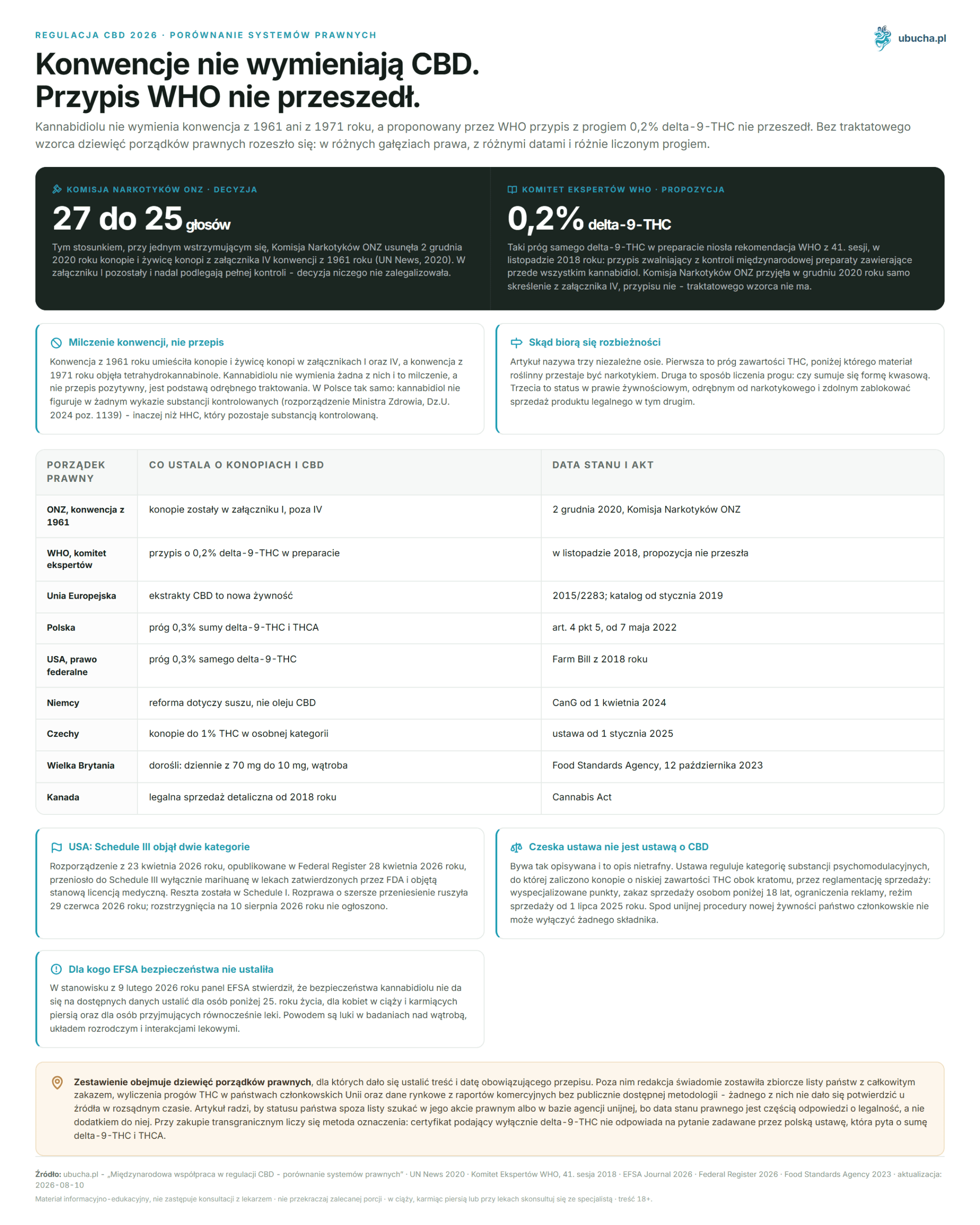

International Cooperation in CBD Regulation - A Comparison of Legal Systems
How the UN, WHO, EU, USA, and Poland regulate CBD and medical marijuana in 2026. The Kanavape ruling, Novel Food, EFSA opinion, and the legal status of each jurisdiction.
There is no single international legal regime for CBD. There are several national regimes built on the common foundation of the UN convention, but diverging in details that determine whether a specific product can be sold. The same oil may be a supplement in one country, a non-consumable product in another, and the subject of proceedings in a third. Below you will find the legal status of nine jurisdictions for which the content of the applicable regulation could be established: the UN convention, WHO recommendations, EU law, Poland, the United States, Germany, the Czech Republic, the United Kingdom, and Canada. Each entry includes the date of the status, as in this field, the date is part of the information, not its decoration. Jurisdictions that could not be confirmed at the source have been deliberately omitted, and we state this explicitly.
KEY INFORMATION
• On December 2, 2020, the UN Commission on Narcotic Drugs, by a vote of 27 to 25 with one abstention, removed cannabis and cannabis resin from Schedule IV of the 1961 convention; they remained in Schedule I (UN News, 2020).
• The CJEU ruling in the Kanavape case (C-663/18) on November 19, 2020: CBD is not a narcotic under the UN convention.
• EFSA on February 9, 2026, set a temporary safe dose of CBD at 0.0275 mg/kg of body weight per day, or about 2 mg per day for a person weighing 70 kg.
• In Poland, the limit is set by the sum of delta-9-THC and THCA at 0.3% of dry weight (Article 4 point 5 of the Act on Counteracting Drug Addiction).
• In the USA, as of April 28, 2026, Schedule III includes only FDA-approved products and marijuana subject to state medical licenses; the rest remains in Schedule I.
Why do CBD regulations differ so much between countries?
Because CBD has never been covered by any narcotic convention, while it comes from a plant that has been covered by all of them. International law regulates cannabis as a plant and THC as a substance, while cannabidiol is not mentioned. Therefore, countries had to build their own responses to the question of what a product containing CBD is, and they built them in different branches of law.
This gives rise to three independent axes of divergence. The first is the THC content threshold below which plant material ceases to be a narcotic. The second is the method of calculating this threshold, as the result depends on whether the acidic form of the cannabinoid is summed. The third, most painful today, is the product’s status under food law, which is completely separate from narcotic law and can block the sale of a product that is fully legal from the perspective of the latter.
This third axis explains the apparent paradox of the Polish market. Dried cannabis below the statutory threshold is not subject to the Act on Counteracting Drug Addiction, yet oil from the same raw material cannot be freely sold as food until it passes the EU novel food procedure. This is not a contradiction or a gap. These are two regulations that answer two different questions and do not have to give the same answer.
The practical conclusion for the buyer and the exporter is the same: the product’s status must be checked separately in each country and separately in each of these branches. Compliance with narcotic law does not determine eligibility for food trade, and compliance in one member state does not automatically transfer to another. A guide on the legality of cannabis and CBD in Poland and the EU breaks this difference down into its components.
How have UN conventions shaped global cannabis law?
The foundation is the Single Convention on Narcotic Drugs of 1961, which placed cannabis and cannabis resin in Schedules I and IV, i.e., in the most restrictive categories. Schedule IV was reserved for substances deemed particularly dangerous and devoid of therapeutic value. Cannabis was listed there for 59 years.
The change came on December 2, 2020. The UN Commission on Narcotic Drugs, adopting the recommendation of the World Health Organization, decided by a vote of 27 to 25 with one abstention to remove cannabis and cannabis resin from Schedule IV of the 1961 convention. The scale of this change is often overestimated, so it is worth describing it precisely: cannabis remained in Schedule I and continues to be subject to full control under the convention. The decision did not legalize anything but formally recognized the medical value of the plant and removed its label as a substance without therapeutic applications.
The Convention on Psychotropic Substances of 1971 covered psychoactive substances, and it was in this convention that tetrahydrocannabinols were included. CBD was not mentioned in either of these two conventions, and this silence, rather than any positive provision, is the proper basis for its separate treatment.
The consequence for today’s trade is that states have considerable freedom. The conventions set a minimum level of control over cannabis and THC, not a maximum, and say nothing about cannabidiol. Each state can therefore regulate CBD more strictly or leniently without violating treaty obligations, and that is exactly what we observe.
What did WHO state about pure CBD and why was it not enough?
The WHO Expert Committee on Drug Dependence at its 41st session in November 2018 recommended that preparations considered pure cannabidiol should not be subject to control under international narcotic conventions. Earlier, at the 40th session in 2018, the same committee reviewed cannabidiol and found no potential for abuse or dependence.
However, the recommendation had a specific technical form that is rarely discussed and which changes its meaning. WHO proposed adding a footnote to the entry “cannabis and cannabis resin” in Schedule I of the 1961 convention stating that preparations containing primarily cannabidiol and no more than 0.2% delta-9-THC are not subject to international control. The recommendation thus carried its own numerical threshold, which is lower than today’s Polish threshold.
The UN Commission on Narcotic Drugs adopted in December 2020 only the recommendation to remove cannabis from Schedule IV. The proposal for a footnote regarding preparations with a predominance of cannabidiol did not pass. The result is that WHO’s position on CBD remains a scientific position without binding force, and states have no treaty benchmark to refer to.
For the market, this means an uncomfortable situation. The highest public health authority stated that pure cannabidiol does not require narcotic control, but the legal system did not record this. The details of this review are discussed in a separate text on the WHO report from 2018.
What did the CJEU rule in the Kanavape case?
The Court of Justice of the European Union ruled on November 19, 2020, in case C-663/18 that cannabidiol is not a narcotic under the UN convention, even when derived from the whole cannabis plant, and not just from seeds or fibers. The case concerned Kanavape brand vaporizer oil, legally produced in the Czech Republic and sold in France, where criminal proceedings were underway against the sellers.
The second part of the ruling concerns the free movement of goods. The Court found that regulations prohibiting the marketing of CBD lawfully produced in another member state violate Article 34 of the Treaty on the Functioning of the European Union. Such a ban is permissible only if it serves to protect public health and does not go beyond what is necessary for that purpose.
This condition is the most important here and is often overlooked in summaries. The ruling did not legalize the trade in CBD throughout the EU and did not take away the right of states to impose restrictions. It shifted the burden of proof: the state imposing the ban must demonstrate a health risk and the proportionality of the measure, rather than the entrepreneur having to demonstrate safety.
In practice, this means that bans based solely on the classification of the plant ceased to be defensible, while bans based on documented health risks remained possible. Therefore, CBD regulation in the EU has shifted from narcotic law to food law, where risk assessment is built into the procedure itself.
How does the EU Novel Food procedure work and what has EFSA’s opinion changed?
Regulation (EU) 2015/2283 on novel food requires that food products not used in the EU to a significant extent before May 15, 1997, obtain authorization before being placed on the market. In January 2019, the European Commission included cannabinoid extracts in the novel food catalog, subjecting CBD oils and supplements to this procedure.
The first stop occurred on June 7, 2022. The EFSA panel published a position stating that the safety of CBD as a novel food cannot be established based on available data and pointed out gaps regarding its impact on the liver, digestive tract, and hormonal, nervous, and reproductive systems. The conclusions led to a suspension.
The status as of 2026 is already different, and this is the latest change in this area. In an update published on February 9, 2026, (EFSA Journal, PMC12884199), the panel confirmed that data gaps persist, but for the first time set a benchmark: a temporary safe dose of 0.0275 mg per kilogram of body weight per day, or about 2 mg per day for a person weighing 70 kg. This value applies only to dietary supplements with a purity of cannabidiol of at least 98%, without nanoparticles. The panel also stated that the safety of CBD cannot be established for individuals under 25 years of age, pregnant and breastfeeding women, and individuals taking medications.
For the producer, this number changes the economic calculation more than any ruling. The temporary dose of 2 mg per day is an order of magnitude lower than the doses declared on most packages currently on the European market.
What THC limits apply to food from hemp seeds?
This regulation is separate from the novel food procedure and expressed in different units, which can be a source of misunderstandings. EU limits for food from hemp seeds are given in milligrams per kilogram of product, not in percentages of dry plant weight. The basis is Commission Regulation (EU) 2023/915 of April 25, 2023, on the maximum allowable levels of certain contaminants in food, applicable since May 25, 2023.
For hemp seeds and products processed from them, including ground seeds, the maximum allowable level is 3.0 mg/kg. For hemp seed oil, it is higher at 7.5 mg/kg. The level refers to the sum of delta-9-THC and delta-9-THCA expressed as delta-9-THC, with a conversion factor of 0.877 for the acidic form.
The same principle recurs here as in national regulations: the legislator counts the sum of both forms of the cannabinoid, not just delta-9-THC. This is the third instance in this text where this mechanism appears, and it is a good test of the credibility of any cannabis study. A study that states a threshold without indicating whether it refers to the sum does not answer the question posed by the regulation.
Regulation 2023/915 replaced the earlier Regulation 1881/2006, to which limits for hemp seeds were introduced by Regulation (EU) 2022/1393, applicable since January 1, 2023. If you see the same values in an older study linked to Regulation 1881/2006, it describes the status before May 2023.
What does cannabis regulation look like in the United States in 2026?
Federal law in the USA separates hemp from marijuana by the THC content threshold. The Agriculture Improvement Act of 2018, known as the Farm Bill, excluded hemp containing no more than 0.3% delta-9-THC in dry weight from narcotic control. However, CBD food products remained outside the FDA-approved trade, which has not recognized cannabidiol as an acceptable food or dietary supplement ingredient.
Marijuana itself remained in Schedule I for years, the most stringent category. In 2026, this status partially changed. The acting Attorney General issued a regulation on April 23, 2026, published in the Federal Register on April 28, 2026, which moved two categories to Schedule III: marijuana contained in FDA-approved medicinal products and marijuana subject to state medical licenses.
All remaining marijuana remained in Schedule I. Thus, a two-tier system was created, rather than a general reclassification as previously discussed. The matter of broader transfer of all forms of marijuana to Schedule III has been referred to expedited administrative proceedings, with hearings starting on June 29, 2026. No decisions in the full legislative process had been announced as of August 10, 2026.
The status of marijuana and CBD sold as food, dietary supplements, or medicinal products without approval remains unresolved. This is the same gap that the European Union is trying to close with the novel food procedure, except that there is not even a procedure on the other side of the Atlantic to close it.
Which European countries have changed their regulations the most?
Three jurisdictions have pushed the boundaries the furthest, each in a different direction: Germany towards the consumer, the Czech Republic towards a separate product category, and the United Kingdom towards strict dosage regulation. The table below compares the status of each along with the date.
| Country | Act and Date of Entry into Force | What the change involves |
|---|---|---|
| Germany | Cannabisgesetz (CanG), April 1, 2024 | possession of up to 25 g in public and up to 50 g at home, cultivation of up to 3 plants per adult; from July 1, 2024, non-commercial cultivation associations of up to 500 members |
| Czech Republic | Act on Psychomodulatory Substances, January 1, 2025; sales regime from July 1, 2025 | a separate category covering cannabis with up to 1% THC and kratom; sales only in specialized points, ban on sales to individuals under 18 years of age, advertising restrictions |
| United Kingdom | Food Standards Agency position of October 12, 2023 | reduction of the recommended daily intake of CBD for adults from 70 mg to 10 mg, based on liver risk with long-term use |
The Czech solution is sometimes described as “a separate CBD law,” which is an inaccurate description. The law regulates a category of psychomodulatory substances, which includes low-THC cannabis alongside kratom, and does so through a sales regulation method, not an exemption from it. A member state cannot exempt any ingredient from the EU novel food procedure, as this arises from a regulation applied directly.
The German reform, on the other hand, concerns consumable cannabis, not CBD products, and these two threads often mix in public discourse. Legalizing possession of 25 g of dried cannabis does not change the status of cannabidiol oil in Germany, which remains subject to the same EU novel food procedure as in Poland.
What does the regulation of medical marijuana and CBD look like in Poland?
Poland follows two separate paths. Patient access is based on Article 33a of the Act of July 29, 2005, on Counteracting Drug Addiction (consolidated text Journal of Laws 2023, item 1939), added by the Act of July 7, 2017 (Journal of Laws 2017, item 1458) and in effect since November 1, 2017. Cannabis other than fiber and extracts and tinctures can be a pharmaceutical raw material for prescription drugs, provided that a permit from the President of the Office for Registration is obtained, issued for 5 years.
The second path is the consumer market, based on the definition in Article 4 point 5 of the Act. Fiber cannabis includes plants of the species Cannabis sativa, in which the sum of delta-9-THC and tetrahydrocannabinolic acid does not exceed 0.3% based on dry weight, rounded to one decimal place. This wording has been in effect since May 7, 2022, and was established by the Act of March 24, 2022 (Journal of Laws 2022, item 763); previously, the national threshold was 0.20%.
The method of calculating the threshold is more important here than the value itself. The threshold concerns the sum of delta-9-THC and THCA, not just delta-9-THC, so a sample described colloquially as “0.1% THC” may exceed the statutory limit when summed with the acidic form. The Polish threshold corresponds to the EU threshold from Regulation (EU) 2021/2115, but these are two separate regulations of the same value, not one resulting from the other.
Pure cannabidiol does not appear in any list of controlled substances maintained by the Minister of Health (consolidated text Journal of Laws 2024, item 1139). In contrast, HHC remains a controlled substance in Poland. The amendment to the Act on Counteracting Drug Addiction coming into force on August 27, 2026, does not change either the THC threshold, the classification of substances, or the rules for retail sales.
How to check the quality of a product when regulations differ?
Since legal regimes diverge, the burden of verification falls on batch documentation. The reason is documented by a study published in 2017 in JAMA (Bonn-Miller et al., PMC5818782), which tested 84 CBD products purchased online. Only 30.95% of them were correctly labeled. 42.85% of products had a lower declared content, and 26.19% had a higher content, meaning less cannabidiol than on the label. THC was detected in 18 out of 84 samples, or 21.43%.
These numbers pertain to the American market from eight years ago and should not be directly transferred to today’s Europe. However, they show why the label is not a source of information about content, while the batch analysis certificate is. Detecting THC in one in five samples has legal, not just quality, consequences: it is this content that determines which side of the statutory threshold the product will fall on during inspection.
A worthwhile analysis certificate includes cannabinoid identification by chromatographic method, results for heavy metals, pesticide residues, and solvents, as well as microbiological testing. The batch number on the certificate must match the number on the packaging, as the certificate is issued for the batch, not for the product in general.
In cross-border purchases, there is one more question: what method was used to calculate THC. A certificate stating only delta-9-THC does not answer the question posed by Polish law, which asks for the sum of delta-9-THC and THCA. A text on the regulation of CBD products and quality requirements expands on this topic, and you can find the products in the hemp oils category.
What does this review not cover and why?
The above summary covers nine legal systems for which the content and date of the applicable regulation could be established: the UN conventions, WHO recommendations, EU law, Poland, the United States, Germany, the Czech Republic, the United Kingdom, and Canada. This is a deliberately short list.
Jurisdictions that have claims that cannot be confirmed at the source in a reasonable time have been omitted: aggregate lists of countries with a total ban, calculations of THC thresholds in individual EU member states, and market data from commercial reports without publicly available methodology. Providing them with a date and source would only be seemingly possible, as the source usually repeats another secondary study.
Canada deserves a separate mention, as its experience is most often referenced in this discussion. The Cannabis Act initiated legal retail sales in October 2018, and studies on the transfer of consumer spending indicate that after a few years, the legal channel took over about three-quarters of national cannabis spending. This is the only number from the Canadian market that we provide, as it is the only one that could be related to a peer-reviewed publication.
If you are looking for the legal status of a country not on this list, check it in that country’s legal act or in the database of the EU agency, not in a summary like this. Summaries age faster than regulations, as they are updated less frequently than the law changes.
Summary: where is the harmonization of CBD regulations heading?
The direction is visible, the pace is not. Narcotic law has ceased to be the main field of dispute over CBD: UN conventions do not cover it, the CJEU has directly refused to recognize it as a narcotic, and Polish law does not mention cannabidiol even once. The conflict has shifted to food law, and it is there that the shape of the market will be determined.
The most important change in the last year is the EFSA opinion of February 9, 2026. For the first time, a number has appeared around which a conversation about an acceptable dose can be conducted, although the value of 2 mg per day for an adult is clearly lower than the doses currently declared. In the United States, a similar ruling has still not been made, and the April transfer to Schedule III included only two narrow categories of products.
For the reader, the practical conclusion remains unchanged and is worth repeating. The date of the legal status is part of the answer to the question of legality, not an addition to it, and the analysis certificate of a specific batch tells more about the product than the manufacturer’s declaration and more than any international summary.
Frequently Asked Questions
Is CBD a narcotic under European Union law?
No. The Court of Justice of the European Union ruled on November 19, 2020, in case C-663/18 (Kanavape) that cannabidiol is not a narcotic under the UN convention, even when derived from the whole cannabis plant. Its status under food law remains a separate issue.
What exactly did the UN decision in December 2020 change?
On December 2, 2020, the UN Commission on Narcotic Drugs, by a vote of 27 to 25, with one abstention, removed cannabis and cannabis resin from Schedule IV of the 1961 convention. However, these substances remained in Schedule I and continue to be subject to full control under the convention. The decision recognized the medical value of the plant but did not legalize anything.
What dose of CBD is currently considered safe by the European Food Safety Authority?
In an update on February 9, 2026, the EFSA panel set a temporary safe dose of 0.0275 mg per kilogram of body weight per day, which is about 2 mg per day for a person weighing 70 kg. This value applies only to supplements with a purity of cannabidiol of at least 98%, without nanoparticles.
For whom does EFSA fail to establish the safety of CBD?
The panel stated in 2026 that based on available data, it is not possible to establish the safety of cannabidiol for individuals under 25 years of age, for pregnant and breastfeeding women, and for individuals taking medications simultaneously. The reason is gaps in research on the liver, reproductive system, and drug interactions.
What is the THC threshold in Poland and how is it calculated?
The threshold is 0.3% based on dry weight and is calculated as the sum of delta-9-THC and tetrahydrocannabinolic acid, rounded to one decimal place (Article 4 point 5 of the Act on Counteracting Drug Addiction). This wording has been in effect since May 7, 2022; previously, the threshold was 0.20%.
Was marijuana reclassified in the United States in 2026?
Only partially. The regulation of April 23, 2026, published on April 28, 2026, moved marijuana contained in FDA-approved products and subject to state medical licenses to Schedule III. All remaining marijuana remained in Schedule I, and proceedings for broader reclassification are ongoing.
What did the Czech law of 2025 actually change?
The Czech law on psychomodulatory substances, effective from January 1, 2025, with a sales regime from July 1, 2025, created a separate category covering cannabis with up to 1% THC and kratom. Sales are allowed only in specialized points, with a ban on sales to individuals under 18 years of age and advertising restrictions.
Is an analysis certificate from another country sufficient in Poland?
Not always, as the method of determination matters. The Polish law asks for the sum of delta-9-THC and tetrahydrocannabinolic acid, so a certificate stating only delta-9-THC does not answer that question. Also, check if the batch number on the certificate matches the number on the product packaging.
This article is for informational and educational purposes only and does not constitute legal advice. The legal status described in the article is valid as of the date of publication: cannabis regulations may change. Consult a lawyer or current legal acts before making decisions.
Author: Michał Waluk · Published: 2026-05-10 · Updated: 2026-08-10