
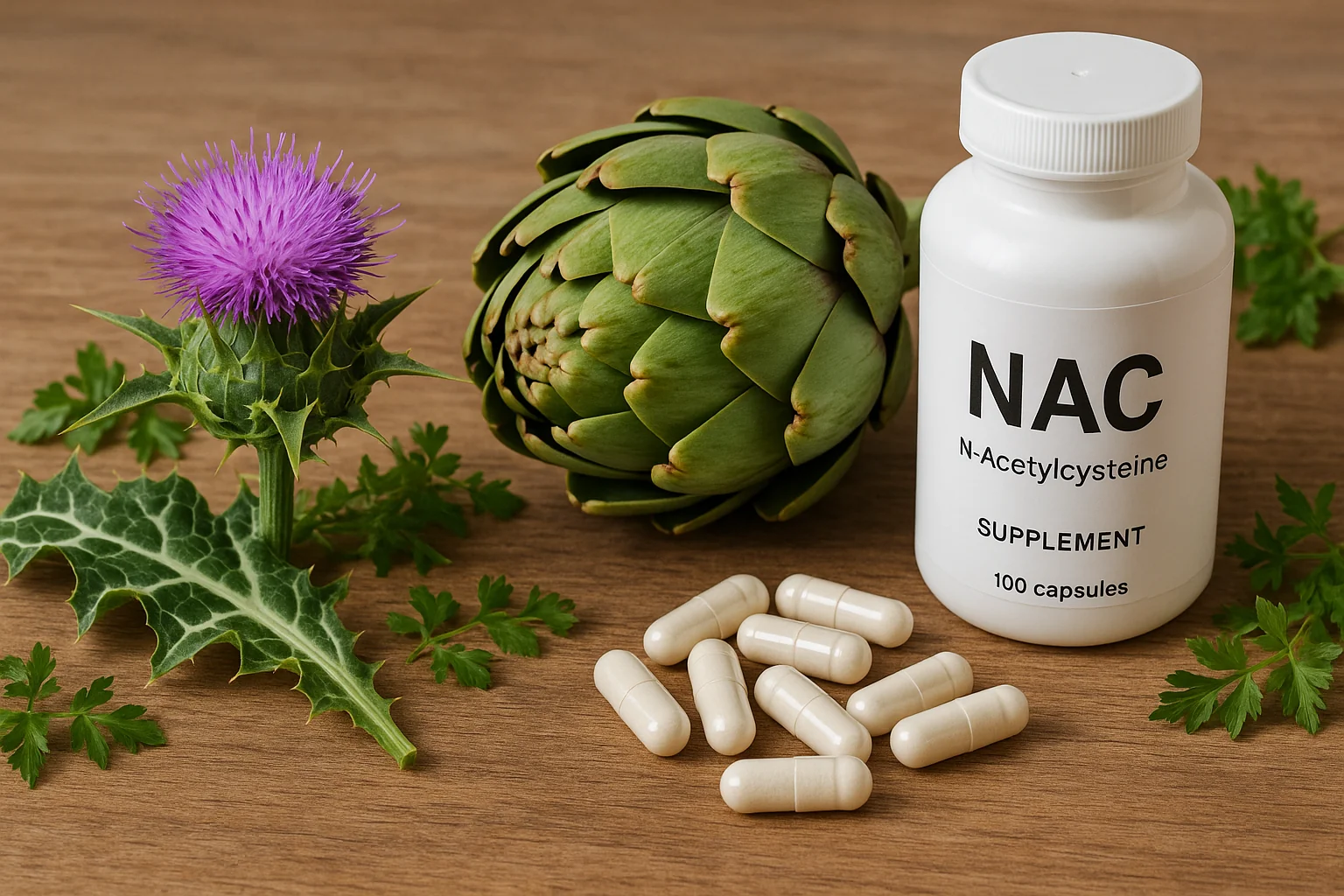

Natural liver support - milk thistle, artichoke, and NAC (set)
Natural liver support: a comparison with methodology — how to choose. u Bucha.
The liver performs over 500 distinct metabolic functions - from protein synthesis and drug detoxification to regulating glucose levels and producing bile. Every day, it processes all the blood in the body. With chronic exposure to alcohol, medications, processed foods, or in conditions of insulin resistance, hepatocytes lose their ability to regenerate efficiently. WHO data indicates that non-alcoholic fatty liver disease (NAFLD) already affects about 25% of the adult population worldwide (WHO, 2023). The three most researched natural hepatoprotective supplements are silymarin from milk thistle, artichoke extract, and NAC (N-acetylcysteine). This article compares them according to a clear methodology and explains how to combine them.
KEY INFORMATION
• Silymarin (milk thistle) is the best-studied hepatoprotective phytotherapeutic - a meta-analysis of 19 RCTs confirmed a reduction in ALT and AST in liver diseases.
• NAC (N-acetylcysteine) has the strongest clinical evidence - it is an antidote in acetaminophen poisoning and shows effectiveness in NAFLD.
• Artichoke extract best supports bile production and fat digestion.
• All three work through different, complementary mechanisms - they can be safely combined.
• NAFLD affects 25% of the adult population worldwide (WHO, 2023) - natural liver support is an increasingly relevant topic.
Methodology of the comparison: how did we evaluate liver supplements?
Evaluating hepatoprotective supplements requires clear criteria - the market is full of products with questionable effectiveness and marketing phrases like "cleanses the liver" or "detox." Each criterion in this compilation has an assigned weight.
| Evaluation Criteria | Weight | What we check |
|---|---|---|
| Strength of clinical evidence (RCT/meta-analyses) | 40% | Number and quality of randomized studies in humans, effect on ALT/AST/fatty liver |
| Documented mechanism of action | 25% | Specific biochemical pathways confirmed in vitro and in vivo |
| Safety profile | 20% | Drug interactions, side effects, safe dosage |
| Bioavailability and standardization | 15% | Form of extract, degree of standardization of active substances, absorption |
Why does the strength of clinical evidence weigh as much as 40%? Because many supplements "for the liver" base their marketing on cell studies or anecdotes. We require data from human studies, preferably randomized with a control group. Supplements without such data do not make it into this compilation.
Nr 1 - NAC (N-acetylocysteina): najsilniejsze dowody kliniczne
NAC is a precursor to glutathione - the most important intracellular antioxidant and the main detoxifying agent of the liver. Glutathione binds reactive drug metabolites and toxins, neutralizing them before they damage hepatocytes. In emergency medicine, NAC is the official antidote for acetaminophen poisoning - administered within 8-24 hours of poisoning, it prevents acute liver failure (Smilkstein et al., NEJM, 1988).
In a supplemental context, a randomized clinical trial showed that 1200 mg of NAC daily for 6 months improved ALT, AST levels, and liver steatosis in NAFLD compared to placebo (Khoshbaten et al., Hepatitis Monthly, 2010). Other studies confirmed the beneficial effect of NAC on hepatic insulin resistance and inflammatory markers in NAFLD. This places NAC at the top of the evidence strength ranking.
Dosage: 600 mg twice daily (1200 mg/day) for a minimum of 3 months. NAC can be taken with or without food, although it is better tolerated with meals. Safe at doses up to 1800 mg daily - occasional side effects include nausea or an unpleasant sulfur smell.
Nr 2 - Sylimaryna (ostropest plamisty): klasyczny hepatoprotektor
Milk thistle (Silybum marianum) has been used in the treatment of liver diseases for over 2000 years - from ancient Egypt to modern phytotherapy. Its active fraction, silymarin, is a complex of flavonolignans (silibin A and B, silidianin, silichristin) with multifaceted hepatoprotective effects.
A meta-analysis of 19 randomized clinical trials showed that silymarin significantly reduced ALT and AST levels in patients with alcoholic liver disease, viral hepatitis, and toxic liver damage compared to placebo (Saller et al., Drugs, 2008). The mechanisms of action of silymarin include: stabilization of hepatocyte membranes (inhibition of lipid peroxidation), scavenging of free radicals, inhibition of TNF-alpha (anti-inflammatory action), and stimulation of ribosomal RNA synthesis (accelerating hepatocyte regeneration). Silymarin also inhibits fibrogenesis - it limits the progression of liver fibrosis, which is clinically significant in chronic diseases.
An important note regarding bioavailability: silymarin is poorly soluble in water - its bioavailability from standard preparations is only 20-50%. Better absorption is provided by phospholipid preparations (silymarin-phosphatidylcholine, known as Siliphos or Milk Thistle Phytosome), which have bioavailability up to 4-10 times higher than standard extract.
Dosage: 140-420 mg of silymarin daily (in 2-3 doses) standardized to 70-80% silymarins, with a meal containing fat. Treatment for a minimum of 8-12 weeks. Safety profile is very good - occasional mild laxative effect at high doses.
No. 3 - Artichoke extract: choleretic support and lipids
Globe artichoke (Cynara scolymus) contains cynarin and chlorogenic acid - phenolic compounds with choleretic (cholagogum) and bile-promoting (cholereticum) effects. They stimulate hepatocytes to increase bile production and secretion, improving digestion and absorption of fats as well as cholesterol elimination through the digestive tract.
A randomized clinical trial showed that standardized artichoke extract (640 mg twice daily for 8 weeks) significantly reduced total cholesterol and LDL levels in patients with mild hypercholesterolemia (Englisch et al., Arzneimittelforschung, 2000). Mechanism: inhibition of the HMG-CoA reductase enzyme (similar to statins, but less pronounced) and increased cholesterol excretion with bile. In a study with NAFLD, artichoke extract reduced triglyceride levels and improved liver enzymes over 8 weeks.
Artichoke extract has somewhat weaker clinical evidence than silymarin and NAC - fewer large RCTs, more observational studies. However, for a specific indication - fat digestion disorders, bile dysfunction, mild hypercholesterolemia - it is the first-choice supplement.
Dosage: 320-640 mg of extract standardized to chlorogenic acid (min. 5%) 20-30 minutes before main meals. Contraindicated in gallstone disease (may cause colic) and biliary obstruction. Safety profile is good in the absence of gallstones.
How to combine milk thistle, artichoke, and NAC - complete protocol
The three discussed supplements work through complementary mechanisms - they can be safely combined. NAC provides cysteine for glutathione synthesis (intracellular protection). Silymarin stabilizes hepatocyte membranes and inhibits fibrogenesis (structural protection). Artichoke stimulates bile production and fat digestion (functional protection). Together, they create a complete set covering the main aspects of liver health.
Practical protocol: in the morning with the first meal (containing fat) - silymarin 140-280 mg + NAC 600 mg. Before lunch - artichoke extract 320 mg (20-30 min before the meal). In the evening with dinner - NAC 600 mg (second dose). Treatment for a minimum of 3 months, after which perform a follow-up liver test (ALT, AST, GGTP, bilirubin). No known negative interactions between these three supplements.
Who is this supplementation for? Individuals with elevated liver enzymes (ALT, AST, GGTP) without an established serious cause, with a history of NAFLD, regularly using hepatotoxic medications (under medical supervision), regularly consuming alcohol, and with insulin resistance accompanied by fatty liver. Remember: supplements support the liver but will not replace the elimination of the cause of damage.
Frequently Asked Questions
Which liver supplement is the most effective?
The strongest clinical evidence is for NAC - used as an official antidote in emergency medicine and confirming effectiveness in NAFLD. Silymarin has solid evidence as a hepatoprotector in alcoholic and toxic liver disease (meta-analysis of 19 RCTs, Saller et al., 2008). Artichoke extract is best for bile and lipid disorders. The best effect is achieved by combining all three.
Does milk thistle really help the liver?
Yes. Silymarin from milk thistle lowers ALT and AST (markers of liver damage) in patients with liver diseases - confirmed in a meta-analysis of 19 clinical studies (Saller et al., 2008). It stabilizes hepatocyte membranes, has antioxidant properties, and inhibits fibrogenesis. Choose products standardized to 70-80% silymarins, preferably in phospholipid form for better bioavailability.
Can you take milk thistle, artichoke, and NAC at the same time?
Yes - they work through different, complementary mechanisms and do not exhibit negative interactions with each other. Silymarin protects the structure of hepatocytes, NAC complements glutathione, and artichoke stimulates bile production. When taking hepatotoxic medications (methotrexate, high doses of paracetamol, statins), inform your doctor before supplementation.
How much NAC should be taken daily for the liver?
Clinical studies on NAFLD used 600-1800 mg of NAC daily. The standard protocol is 600 mg twice a day (1200 mg/day) for a minimum of 3 months. Take with a meal to minimize the risk of nausea. In emergency medicine, doses are many times higher and administered intravenously - this is a completely different context.
When to take liver supplements - before or after meals?
Silymarin with a meal containing fat (better bioavailability of lipophilic flavonoids). Artichoke extract - 20-30 minutes before a meal (stimulates bile secretion before digestion). NAC - with or without food, better gastric tolerance with food.
Other natural hepatoprotective supplements - what you should know
Besides the trio of milk thistle-artichoke-NAC, several other natural substances with documented liver-supporting properties are available on the market. Resveratrol - a polyphenol from grape skins - activates SIRT1 and AMPK, metabolic pathways that reduce liver fat and inflammation in hepatocytes. A randomized clinical trial showed that resveratrol (500 mg daily for 12 weeks) significantly lowered ALT levels and improved insulin resistance markers in patients with NAFLD (Faghihzadeh et al., Nutrition Research, 2014).
Curcumin (from turmeric) and berberine are other substances with documented effects on NAFLD - curcumin reduces liver inflammation by inhibiting NF-κB, berberine activates AMPK (a similar mechanism to metformin) and lowers liver triglycerides. However, both have low bioavailability with standard supplementation - they require phospholipid forms or nanoformulations. Alpha-lipoic acid (ALA) increases glutathione levels and improves hepatic insulin sensitivity - it is sometimes used as a supplement to NAC in NAFLD.
Vitamin C - especially from natural sources like rose hips - regenerates reduced glutathione and enhances the antioxidant protection of hepatocytes. Vitamin C and NAC work synergistically: both reduce oxidative stress in the liver, but through different pathways - NAC provides cysteine for glutathione synthesis, while vitamin C rebuilds glutathione pools after oxidation. This justifies their simultaneous use as a supplement protocol for individuals with NAFLD or exposure to hepatotoxins.
When to see a doctor instead of reaching for supplements
Natural hepatoprotective supplements have their place in the prevention and support of treatment for mild liver dysfunctions. However, there are several situations where supplements are insufficient and urgent medical consultation is necessary. Above all: jaundice (yellowing of the skin and whites of the eyes), pain in the right upper quadrant, dark urine, and pale stools, sudden worsening of symptoms, as well as ALT or AST values exceeding three times the upper limit of normal - these are alarm signals requiring diagnostics, not self-treatment.
Chronic viral hepatitis (HBV, HCV) requires causal treatment with antiviral agents, not just supplements - silymarin or NAC may complement therapy but are not substitutes. Similarly, in autoimmune hepatitis, primary biliary cholangitis, or hereditary metabolic liver diseases - each of these conditions requires specialized diagnostics and an individual treatment plan. We emphasize: supplements do not 'cleanse' the liver in the sense of removing toxins beyond documented biochemical mechanisms - and none of them can replace a healthy lifestyle, proper diet, and the cessation of hepatotoxic substances.
This article is informational and educational in nature. It contains internal links to products available in the u Bucha store. Prices and specifications may change - please check the current data on the product page before purchasing.
Author: Michał Waluk · Published: 2026-05-04 · Updated: 2026-05-04