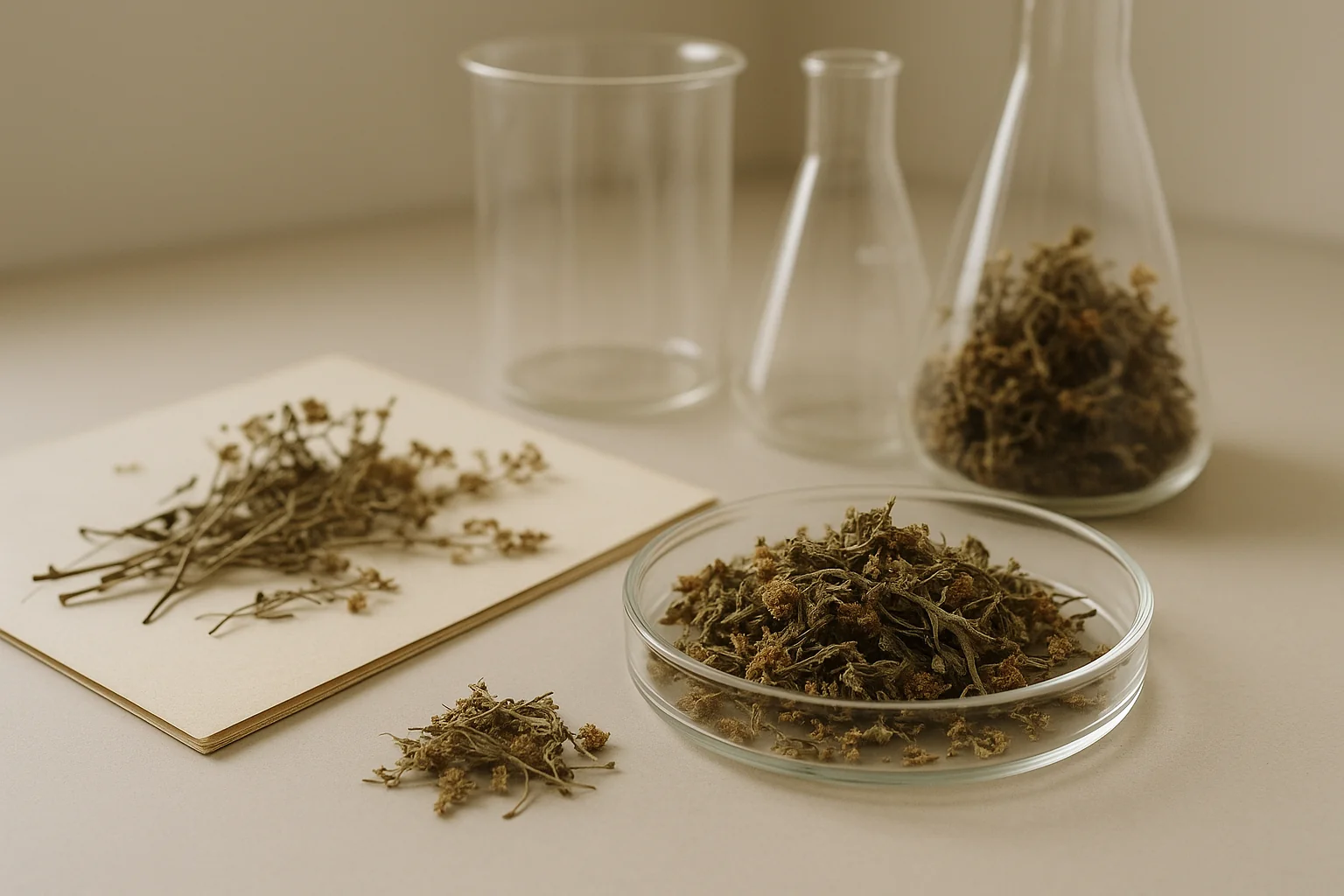

Anxiety and medical marijuana: a significant effect that disappeared after correction
Three meta-analyses on anxiety provide three different answers. We show what was measured in each of them, what publication bias is, and why, after correction, the anxiolytic effect ceased to be statistically significant.
What do studies say about hemp and anxiety?
Three things at once, and this is the main information here. A meta-analysis from 2020 found a very large reduction in anxiety symptoms, which ceased to be significant after correction for publication bias. A review from 2026 found no significant effect on anxiety. A study from 2025 observed moderate effects and itself labeled the evidence as low quality.
The oldest of these studies (PMID:32827809) is a systematic review with a meta-analysis of randomized studies in anxiety disorders: fourteen trials, one thousand five hundred forty-eight participants. The raw result is a reduction of symptoms by 1.85 standard deviations, with a confidence interval from minus 2.61 to minus 1.09 and no significant increase in adverse events. The authors themselves reported a significant publication bias, and after correction, the anxiolytic effect ceased to be statistically significant.
The review published in 2026 in The Lancet Psychiatry (PMID:41856154) included fifty-four randomized studies and two thousand four hundred seventy-seven participants. It did not show significant effects on anxiety at the endpoints. The study from 2025 (PMID:40956670) gathered twenty-one trials with placebo and divided them by preparation, as discussed below, and assessed the overall evidence as low quality.
| Work | Study model | What came out regarding anxiety | The boundary set by the authors |
|---|---|---|---|
| PMID:32827809 (2020) | systematic review with a meta-analysis of randomized studies, 14 studies, 1548 participants | reduction of symptoms by 1.85 standard deviations | significant publication bias; after correction, the result was not significant |
| PMID:40956670 (2025) | systematic review with a meta-analysis, 21 studies with randomization and placebo | moderate effect only in some subgroups | low quality evidence, small trials, heterogeneous study designs |
| PMID:41856154 (2026) | systematic review with meta-analysis of randomized studies, 54 studies, 2477 participants | no significant effects on anxiety | high risk of systematic error in 44 percent of studies |
This indicates that two major studies report different findings, and this discrepancy itself is informative. The latest meta-analysis found no significant impact on anxiety symptoms, while an older one found a very large effect that disappeared after correction for publication bias. The evidence that survived pertains to purified substances with known doses administered in a disorder diagnosed by a psychiatrist, not dried flower described by strain name. Anxiety can also be an adverse effect of the raw material itself, increasing with dosage.
What is publication bias and why did it change this result?
Publication bias is an unequal chance of publication: studies with positive results are published more frequently and quickly than those with null results. The collection available later in databases is skewed, and a meta-analysis averaging this collection inherits the bias along with it.
It is detected using statistical methods, and then an estimate is made of what the result would look like if the missing studies had been included. In the 2020 review, this procedure reversed the verdict: before correction, the effect was very large, after correction it ceased to be statistically significant. This does not mean that anyone was wrong or that something was hidden. It simply means that part of the material on which the number 1.85 stood probably was never published.
This is where the discrepancy between what is read online and what is stated in the publication comes from. The raw number is striking and easy to quote, while the statement about the correction lies a few paragraphs down and gets lost in the summary. So when a strain description promises anxiolytic effects and cites a meta-analysis, it usually repeats the first half of the same study without the second half. The authors themselves stated explicitly that routine use of these preparations is not justified by the available evidence.
What strain characteristics are important here?
No characteristic recorded in the strain name has been verified in these studies. They examined purified substances with known doses, not dried flower described by a trade name, so the differences visible in the results pertain to the chemical composition of the preparation, not the cultivar from which the pharmaceutical raw material comes.
The separation of preparations in the 2025 study (PMID:40956670) is the most interesting here. For preparations with pure or enriched cannabidiol, the overall result was not significant (minus 0.40, confidence interval from minus 0.84 to 0.03), and only the subgroup of pure cannabidiol yielded a moderate effect (minus 0.61, from minus 1.15 to minus 0.07). For preparations with a predominance of tetrahydrocannabinol, the result was minus 0.65 (from minus 1.06 to minus 0.24), and for mixtures of both compounds, it was not significant. All these numbers come from a systematic review with a meta-analysis of twenty-one trials with placebo, and their authors cautioned that the trials were small and the study designs heterogeneous.
At the raw material level, a sensible distinction ends at the chemotype, meaning which compound predominates in the composition. The terpene profile is sometimes associated with calming in strain descriptions, but none of the three discussed studies tested a single terpene or the entire profile. We write separately about linalool oraz o limonenie, and in both cases the clinical material regarding anxiety is scarce. Additionally, there is a measured aspect in this cluster: for the same strain, two Polish sources can provide different compositions, so the profile can be a feature of the description rather than a characteristic of the plant.
How to read the numbers from these meta-analyses?
Three concepts are sufficient. The standard deviation measures the effect size in units of result dispersion, the confidence interval shows the range within which the true value lies, and the odds ratio compares the risk in two groups. When the interval includes zero, the result is called statistically insignificant, and it cannot be ruled out that there is no effect.
In a 2025 study, the overall result for cannabidiol products reached 0.03 on the positive side of zero, so despite a negative average, it remained insignificant. The same principle explains why a correction in the 2020 study was enough to consider the effect insignificant, even though the average still indicated a reduction in symptoms. A number by itself says nothing until it is accompanied by an interval.
An odds ratio of 1.75 for adverse events translates in the 2026 review to one additional person with an event among seven treated. Such a conversion says more than the odds ratio itself because it describes the scale at which the difference appears in people. Additionally, there is the assessment of the certainty of evidence: low in the 2025 study, burdened by a high risk of systematic error in 44 percent of the studies included in the 2026 review, and publication bias in the 2020 study.
What does the doctor decide, and what does the patient decide?
Everything concerning treatment is decided by the attending physician. Dried flower is a pharmaceutical raw material dispensed by a doctor's prescription in the Rpw category, so the form, dose, and route of administration are determined by the prescription, not by the strain description, online ranking, or the patient's choice.
In this indication, there is also a diagnosis. The evidence mentioned above was collected from individuals with a diagnosis made by a psychiatrist, not from those who self-identified their condition as anxiety. Diagnosis is a medical act, and everything else starts from it: without it, the numbers from meta-analyses have nothing to refer to.
The patient has a role that no one can play for them. They know the complete list of medications taken, including sedatives, and they will notice that after a dose change, symptoms went in the opposite direction. Reporting an adverse effect also comes from them or from the pharmacist. None of this is a choice of therapy, but rather the material on which the doctor bases their choice.
This division also indicates what cannot be on the informational page. We describe the state of evidence along with its boundaries and do not indicate the strain, form, or method of administration. Pharmaceutical law does not allow addressing advertising messages about prescription medications to the general readership, and therapeutic advice requires examining a specific person by a doctor.
How quickly and how long does the raw material act when administered through different routes?
This is determined by the method of intake, not the cultivar. Inhalation through a vaporizer initiates effects measured in minutes and an episode contained within a few hours, while ingested raw material responds with a delay and lasts for a larger part of the day. In the case of anxiety, this difference weighs more than the name on the label.
The route of administration determines the course more than the variety itself. After vaporization, the substance passes from the lungs to the blood almost immediately, so the first sensations appear after a few minutes, the intensity increases for another ten to thirty minutes, and the whole effect lasts for two to four hours. After ingestion, the raw material first passes through the intestine and liver, so the first sensations are awaited from half an hour to two hours, and the episode can last six, sometimes eight hours. Hence the most common mistake with oral administration: anyone who thinks nothing is happening after thirty minutes and takes another dose will receive both doses at once. The above ranges describe the route of administration, not this variety; pharmacokinetic studies for a single cultivar have not been published.
In the case of anxiety, this discrepancy has practical consequences because tension prompts checking whether it is already working, and with oral administration, such checking happens too early. None of the three discussed studies compared routes of administration with each other, so the above intervals describe physiology, not the results of anxiety research.
What side effects have been reported with the use of cannabis for this indication?
Two out of three studies counted them directly, and they came up with different results. In the 2020 review, the increase in adverse events was not significant, while in the 2026 review, the odds ratio for any type of event was 1.75, meaning one additional person with an event among seven treated.
The number from 2026 comes from a systematic review with a meta-analysis of randomized studies, covering fifty-four trials and two thousand four hundred seventy-seven individuals; its confidence interval ranges from 1.25 to 2.46, and there was a high risk of systematic error in 44 percent of the included studies. The lack of significant increase from 2020 comes from a review of fourteen randomized trials conducted in anxiety disorders. The 2025 study mentions safety and tolerance among the studied endpoints, but does not provide numbers for them.
Separately, it stands that anxiety itself can be an adverse effect of the raw material and intensifies with the dose. In this indication, the same symptom thus stands on both sides: once as a reason to reach for the raw material, and once as a possible consequence of its administration.
Reports of adverse effects are collected for medicinal products with a batch number, not for the strain name, so the following pertains to hemp dried flower as a group of raw materials. The most frequently reported symptoms are dry mouth, red eyes, and increased heart rate. Dizziness upon rapid standing, daytime drowsiness, and temporary worsening of short-term memory are less frequently described, as well as anxiety that increases with dosage. A separate issue is medications taken concurrently, especially sedatives and those affecting coagulation: their assessment requires knowledge of the entire list of preparations, not just the description of the plant. We do not provide the frequency of these symptoms numerically, as public compilations for hemp dried flower in Poland do not separate them by individual products.
Why do strain descriptions promise more than studies show?
Because they describe a product, not the results of a study. The strain name is a trade label, not a variable measured in a clinical trial, so the effects attributed to it usually come from user reports and sales materials, not from a comparison with placebo conducted under blinded trial conditions.
Three different things carry the same name. In studies, purified substances with known doses were administered. In the pharmacy, dried flower described by the strain name is dispensed by prescription, the contents of which are not measured at the patient's bedside. In the store, however, there is hemp flower, sold over the counter and not covered by any of the discussed studies.
We maintain a list of strains available in Polish pharmacies in a separate entry and do not assign indications to strains there, as the register lists positions, not applications. The situation is similar with sleep, where the evidence is different from that for anxiety and requires its own discussion. The material is for informational purposes and does not replace medical advice.
The practical conclusion from this page is modest, and that is how it should be. When dealing with anxiety, it is worth checking whether the cited number comes from before or after correction, which product it pertains to, and how many individuals it was measured on. The three studies cited above answer these questions on their own, as each provides its limitations in the same place as the result.
Frequently Asked Questions
Does medical marijuana treat anxiety disorders?
Such evidence is lacking. The latest meta-analysis found no significant effect on anxiety symptoms, an older one found a very large effect that disappeared after correction for publication bias, and a third study describes moderate effects with evidence referred to as low quality.
Where does the number 1.85, repeated in strain descriptions, come from?
From the raw result of a meta-analysis from 2020, which included fourteen randomized studies and one thousand five hundred forty-eight individuals. However, the same study reports a significant publication bias, and after correcting for it, the effect ceases to be statistically significant.
What is publication bias?
An unequal chance of publication. Studies with positive results are published more frequently than those without results, so the collection available in databases inflates the average that the meta-analysis calculates. There are methods for estimating this distortion and correcting the result for it.
Can pharmacy-sourced dried flower increase anxiety?
Anxiety can be an adverse effect of the raw material itself and increases with dosage. Therefore, in this indication, the same symptom appears on both sides: as a reason to reach for the raw material and as a possible consequence of its administration.
Has any strain been tested for anxiety?
No. The discussed studies provided purified substances with known doses, not dried flower described by a trade name. Differences in results pertain to the chemical composition of the product, not the cultivar, and cannot be transferred to a single name from the pharmacy price list.
Did cannabidiol perform differently than tetrahydrocannabinol?
In the review from 2025, the overall result for cannabidiol products was not significant, and a moderate effect appeared only in the subgroup of pure cannabidiol itself. Products with a predominance of tetrahydrocannabinol yielded a moderate result, while mixtures of both compounds were not significant.
Who decides on the use of dried flower for anxiety?
The attending physician. The raw material is dispensed by prescription in the Rpw category, the diagnosis of anxiety disorder is made by a psychiatrist, and the form, dosage, and route of administration are determined by the prescription. The informational page does not replace any of these actions.
Editorial text of the service ubucha.pl, u Bucha editorial.