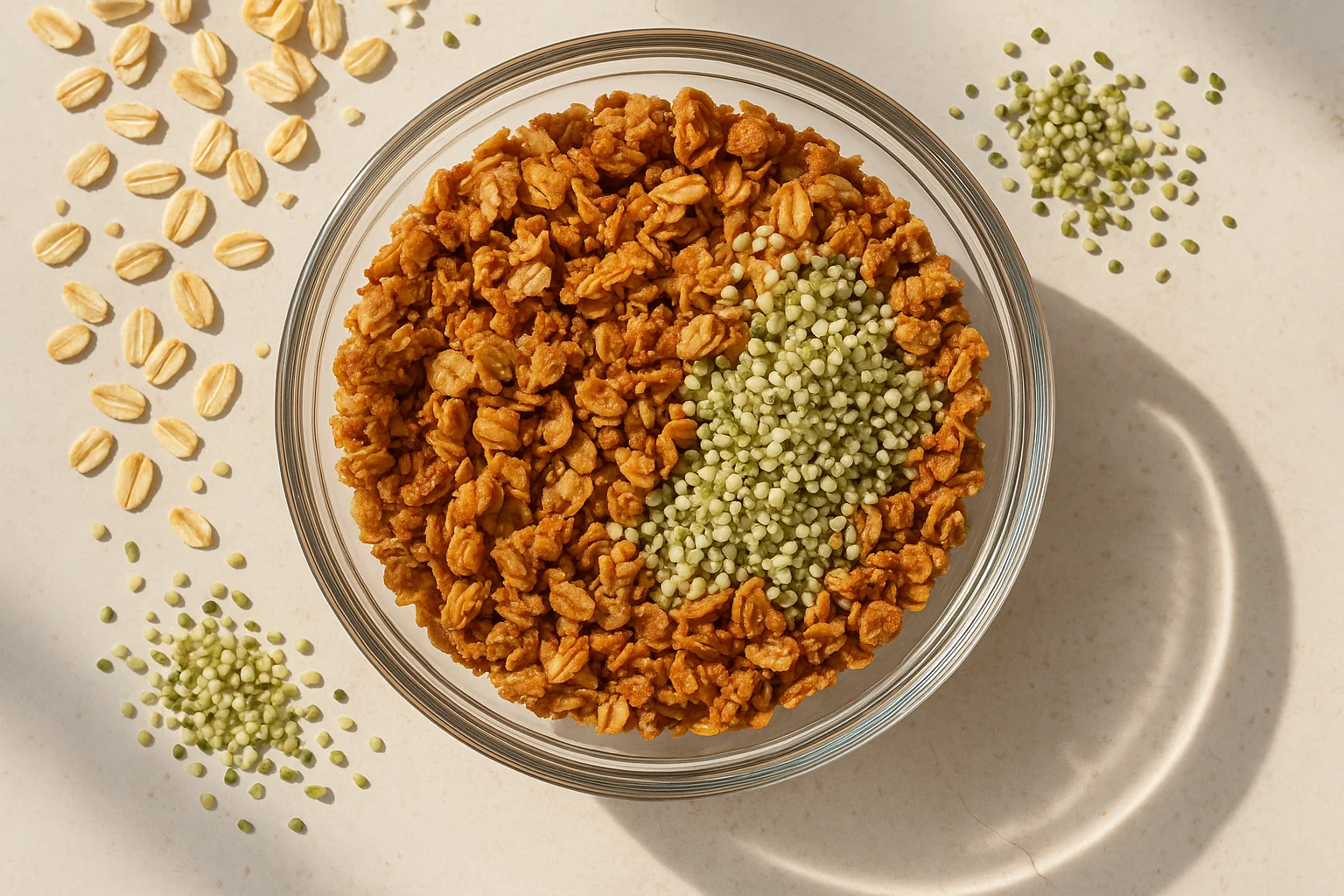

Homemade granola with hemp seeds – crunchy and sugar-free
Homemade granola with hemp seeds – crunchy and sugar-free. Step-by-step recipe, nutritional values, and tips. A healthy breakfast without glucose syrup and preservatives.
Store-bought granola has one major problem: the ingredient list starts with oats, followed closely by glucose-fructose syrup and palm oil. The homemade version with hemp seeds completely changes this picture. Hulled hemp seeds contain about 31 g of protein per 100 g and all 9 essential amino acids – a natural boost you won't find in supermarket granola. I will show you how to make crunchy granola in 40 minutes that will last a week of breakfasts and costs half of what premium store versions do.
KEY INFORMATION
• Hulled hemp seeds: about 31 g of protein/100 g with a complete amino acid profile, all 9 essential (House et al., Food Chemistry, 2010).
• Add hemp seeds after the granola has cooled – baking at 160°C destroys valuable omega-3 and omega-6 fatty acids.
• 50 g of hemp seeds (the amount in the recipe) provides about 15 g of protein, 21 g of PUFA fat, and 0.6 g of carbohydrates.
• Homemade granola without glucose syrup – sweetener can be honey or agave syrup in a controlled amount.
Why do hemp seeds fit better in granola than other superfoods?
Granola as a meal has one issue: it is dominated by carbohydrates from oats and sugars from syrup. Hemp seeds are the perfect complement – they provide protein and fats without any carbohydrates, balancing the macro profile of the entire bowl. House et al. (Food Chemistry, 2010) confirm the complete amino acid profile of hemp seeds: all 9 essential amino acids, including leucine, which is crucial for muscle protein synthesis.
A comparison with other popular granola additives shows the advantage of hemp seeds: chia has 17 g of protein/100 g and requires soaking, while flaxseed (18 g of protein) should be ground for good absorption. Hemp seeds – 31 g of protein, ready to eat without processing, soft, with a nutty flavor. The only condition: always add them after cooling, as baking temperature degrades omega acids.
From our experience, granola with hemp seeds tastes distinctly different from that with chia or flaxseed – the nutty, slightly earthy aftertaste of hemp seeds pairs better with cinnamon and coconut flakes than any of the popular substitutes. People trying hemp seeds for the first time in granola rarely return to their old habits.
Nutritional values – what does one serving of granola provide?
One serving (about 60 g of finished granola with hemp seeds) provides about 280 kcal, 9 g of protein, 13 g of fat, and 30 g of carbohydrates. Fiber from oats and flaxseed is about 5 g/serving – Threapleton et al. (BMJ, 2013) demonstrated that regular fiber intake reduces the risk of cardiovascular diseases by 9–29% in a meta-analysis of 22 studies. With plant milk (200 ml), the entire breakfast amounts to about 380–400 kcal with a good balance of macronutrients.
Ingredients – what do you need?
Proportions for about 500 g of finished granola (8 servings of 60 g):
- 300 g of rolled oats (not instant)
- 50 g of unsweetened coconut flakes
- 30 g of flaxseed (whole or ground)
- 50 g of hulled hemp seeds (added AFTER baking)
- 3 tablespoons of unrefined coconut oil
- 4 tablespoons of honey or agave syrup
- 1 teaspoon of ground cinnamon
- a pinch of sea salt
- optional: 50 g of nuts (almonds, walnuts), 50 g of dried fruits (cranberries, apricots) – added AFTER baking
How to prepare homemade granola – step by step?
Active preparation time: 10 minutes. Baking time: 25–30 minutes. Cooling time: 15 minutes. Total about 55 minutes, of which 40 is hands-off.
Safety: Cold-pressed hemp oil is not suitable for baking – use coconut or sunflower oil for this recipe. Add hemp oil only to the finished, cooled granola or to the bowl before serving.
Step 1. Preheat the oven. Preheat to 160°C, top and bottom heat, no fan. Line a large baking tray (40×30 cm) with parchment paper. A low temperature is the secret to crunchiness – at higher temperatures, the granola burns on the outside before drying out on the inside.
Step 2. Prepare the dry ingredients. In a large bowl, mix the oats, coconut flakes, flaxseed, cinnamon, and salt. Stir with a dry spoon until evenly combined.
Step 3. Melt the fat with the sweetener. In a small pot over low heat, melt the coconut oil with honey or agave syrup. Stir until combined. Do not boil – just heat to 50–60°C to melt the coconut oil. Pour the liquid mixture over the dry ingredients and mix thoroughly – each flake should be lightly coated with fat.
Step 4. Spread on the tray. Transfer the mixture to the prepared tray. Spread evenly with a spatula to a layer of about 1–1.5 cm. Do not compact – the granola should lie loosely, otherwise it won't be crunchy.
Step 5. Bake and stir once. Bake for 12–15 minutes. Remove, stir with a spatula, and level the layer again. Return to the oven and bake for another 12–15 minutes until golden brown. The granola is ready when it smells of caramel and nuts, and the flakes make a light sound when touched. Remove from the oven – it will look soft, which is normal. It will harden after 15 minutes of cooling.
Step 6. Add the hemp seeds. Allow the granola to cool completely on the tray. When the temperature drops to room temperature (about 25°C), add the hulled hemp seeds and gently mix. Now you can also add dried fruits and nuts. Transfer to a jar with a lid. Also check out our recipe for smoothie bowl with hemp seeds – granola with hemp seeds works great as a crunchy topping.
Tips and variations
Granola is a recipe that is easy to adapt to preferences and diets. A few directions:
Oat-free version. Replace oats with a mixture of toasted buckwheat, puffed amaranth, and millet flakes. The granola will be gluten-free with full certification and have a slightly different texture – lighter and crunchier.
Chocolate version. Add 2 tablespoons of raw cocoa to the dry ingredients before baking. After cooling, mix in hemp seeds and chopped 85% chocolate.
Version with hemp flour. Replace 30 g of oats with 30 g of hemp flour – the granola will be greener, denser, and have a higher protein content. Hemp flour adds a crunch similar to clusters in cluster-style granola.
The most common mistake. Too high baking temperature – granola browns quickly on the outside while remaining soft on the inside. Stick to 160°C without convection and check every 10 minutes through the oven window without opening the door.
Frequently Asked Questions
Why is homemade granola better than store-bought?
Store-bought granola often contains glucose-fructose syrup and palm oil. The homemade version with hemp seeds allows you to control every ingredient – and hemp seeds contain about 31 g of protein/100 g (House et al., Food Chemistry, 2010) which is an addition that is almost absent in store-bought versions.
When should you add hemp seeds to granola?
Always after cooling, not before baking. A temperature of 160°C for 30 minutes degrades omega-3 and omega-6 fatty acids, which are the main nutritional value of the seeds. Chilled granola (about 25°C) is safe – the seeds will retain their full nutritional profile.
How to get crunchy granola without clumps?
Three rules: low temperature (150–165°C), a thin layer on the baking sheet (max 1.5 cm), and one stir halfway through the time. Do not open the oven more often – temperature fluctuations cause uneven baking. Granola will harden after cooling, not during baking.
Can granola be made without honey?
Yes – replace honey with agave syrup (lower glycemic index), maple syrup, date syrup, or ground dates soaked in water (4–5 dates per 2 tablespoons of water). The flavor will be slightly less caramel-like, but the granola will be just as crunchy.
How long can you store granola with hemp seeds?
In an airtight glass jar at room temperature for up to 2 weeks, in the refrigerator for up to 4 weeks. Avoid damp places – granola absorbs moisture and becomes soft. Hemp seeds added after cooling do not shorten the shelf life of the granola.
This article is for informational and educational purposes and does not replace consultation with a doctor. If you are pregnant, breastfeeding, taking medications, or have chronic conditions, consult the use of supplements or herbs with a specialist.
Author: Michał Waluk · Published: 2026-05-04 · Updated: 2026-05-04