
5-HTP for sleep and mood: how does the serotonin precursor work and is it safe?
5-HTP action – a precursor of serotonin and melatonin. Dosage 100–300 mg/day. NOTE: do not combine with SSRI/SNRI. Safety, side effects, and when it helps.
5-HTP (5-hydroxytryptophan) is one of the most interesting natural supplements on the market – it acts directly on serotonin metabolism, and the effects are understandable and measurable. However, 5-HTP also has one of the most serious safety warnings among supplements: an absolute contraindication for combining with SSRI and SNRI antidepressants, as the combination can trigger a life-threatening serotonin syndrome. In this article, you will learn how 5-HTP affects serotonin, what it really helps with, how to dose it safely, and for whom it is absolutely forbidden.
KEY INFORMATION
• 5-HTP is a direct precursor to serotonin and melatonin – it converts to serotonin through AADC (aromatic amino acid decarboxylase) without intermediate conversion stages.
• DO NOT combine with SSRI/SNRI/MAOI/tramadol/triptans – risk of serotonin syndrome (potentially life-threatening).
• Birdsall (Alternative Medicine Review, 1998) described clinical applications of 5-HTP: depression, insomnia, migraine, fibromyalgia, obesity.
• Dosage: 50–300 mg daily, start with 50–100 mg at night.
Biochemistry of 5-HTP – why is it not the same as tryptophan?
Serotonin (5-hydroxytryptamine, 5-HT) is synthesized from tryptophan in two stages: tryptophan → 5-HTP (via tryptophan hydroxylase, TPH) → serotonin (via AADC). Supplementation with tryptophan is a step earlier than 5-HTP and has additional limitations: tryptophan competes for transport across the blood-brain barrier with other large amino acids (BCAAs, tyrosine), so with a protein-rich diet and BCAA supplementation, its absorption into the brain is limited. 5-HTP is transported to the brain by a different mechanism, does not compete with other amino acids, and is a direct substrate for the AADC enzyme – hence the higher concentrations of brain serotonin after 5-HTP supplementation compared to tryptophan at the same dose.
Serotonin in the brain modulates mood, sleep, appetite, pain, and sexual behavior. About 90% of serotonin in the body comes from the intestines (EC cells), but this serotonin does not cross the blood-brain barrier and primarily regulates gut motility. Brain serotonin regulates mood and sleep. Melatonin is synthesized in the pineal gland from serotonin by N-acetyltransferase and hydroxyindole-O-methyltransferase – this explains why increased serotonin from 5-HTP improves not only mood but also facilitates falling asleep through the indirect increase of melatonin.
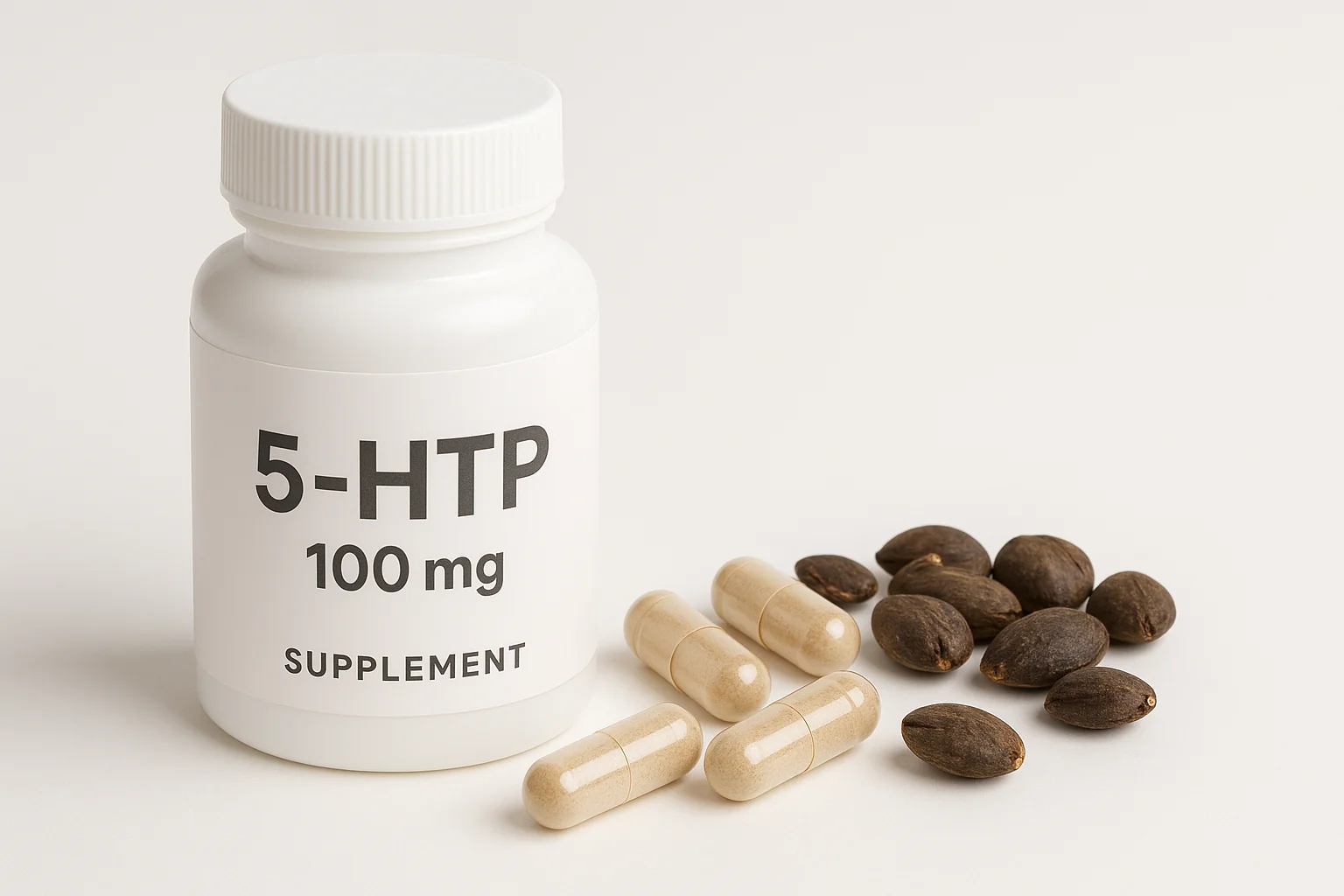
Our observations: 5-HTP from natural sources (extract from Griffonia simplicifolia seeds, an African plant) is an over-the-counter supplement available in Poland and the EU. This does not mean it is without risk – the serotonin effect of 5-HTP is real, and interaction with antidepressants is not a marginal case. In Poland, about 5–8% of adults use SSRI or SNRI. Always ask the patient/yourself about the medications being taken before reaching for 5-HTP.
Clinical evidence – what does 5-HTP really work for?
Birdsall (Alternative Medicine Review, 1998) is a key summary of clinical studies on 5-HTP up to the late 90s. In depression: several RCTs showed effects comparable to imipramine (a tricyclic antidepressant) and fluvoxamine in mild to moderate depression. The study by Pöldinger et al. (1991) on 34 patients with depression showed non-inferiority of 5-HTP vs fluvoxamine (SSRI) on the Hamilton Depression Scale after 6 weeks. 5-HTP had better tolerance (less nausea, fewer sexual dysfunctions). Dose: 300 mg daily.
Przy bezsenności: kilka badań wykazało skrócenie latencji zasypiania i wydłużenie fazy REM (snu marzeń sennych). Badanie Wyatt et al. (Psychopharmacologia, 1971) u zdrowych ochotników wykazało wzrost REM o ok. 25% po 5-HTP vs placebo. Mechanizm podwójny: serotonina konwertuje do melatoniny przez szyszynkę (co ułatwia zasypianie), a sama serotonina moduluje aktywność ciała migdałowatego (zmniejsza ruminacje i reaktywność na stresory nocne). 5-HTP może być szczególnie pomocny przy bezsenności z lękiem i „gonitwą myśli” – typowej dla stresu i zaburzeń lękowych, gdzie hipnotyki (benzodiazepiny, zolpidem) mają efekt, ale ryzyko uzależnienia. 5-HTP nie wytwarza uzależnienia fizycznego i nie powoduje tolerancji w typowym zakresie dawek. Dawka przy problemach ze snem: 100–200 mg 30–60 min przed snem. Można łączyć z melatoniną 0,5–1 mg dla synergistycznego efektu zasypiania, choć kombinacja nie jest klinicznie przebadana.
In migraine: the study by Titus and Dittrich (1994) showed that 5-HTP 400 mg/day for 6 months was as effective as methysergide (a preventive migraine medication) in reducing the frequency and severity of attacks, with fewer side effects. Mechanism: serotonin is an important mediator of headache – low levels of 5-HT correlate with migraine attacks. 5-HTP may stabilize serotonin levels, reducing the frequency of attacks.
Serotonin syndrome – the most important safety warning
Serotonin syndrome is an emergency condition caused by excess serotonin in the central and peripheral nervous systems. Clinical triad: mental changes (agitation, disorientation, anxiety), autonomic disturbances (fever, tachycardia, excessive sweating, tachypnea), and motor disturbances (tremors, myoclonus, hyperreflexia, rigidity). Severe cases: seizures, rhabdomyolysis, acute renal failure, disseminated intravascular coagulation (DIC), death.
Kombinacje wywołujące zespół serotoninowy: 5-HTP + SSRI (sertralina, fluoksetyna, paroksetyna, escitalopram, fluwoksamina) – synergizm serotoninergiczny przez hamowanie wychwytu zwrotnego serotoniny jednocześnie ze wzrostem jej produkcji. 5-HTP + SNRI (wenlafaksyna, duloksetyna) – identyczne ryzyko co z SSRI. 5-HTP + MAOI (fenelzyna, tranylcypromina, moklobemid) – najwyższe ryzyko, bo MAOI blokują degradację serotoniny. 5-HTP + tramadol (słaby inhibitor wychwytu serotoniny, często niedoceniany). 5-HTP + tryptany (leki na migrenę: sumatryptan, zolmitryptan) – agonizm receptorów 5-HT1 razem ze wzrostem endogennej serotoniny = ryzyko. 5-HTP + dekstrometorfan (składnik syropów na kaszel DXM) – inhibitor transportera serotoniny i NMDA. Przy stosowaniu SSRI/SNRI musisz zachować „wash-out” – okres odstawienia co najmniej 2 tygodnie (5 tygodni dla fluoksetyny, bo ma długi półokres eliminacji przez aktywne metabolity) przed suplementacją 5-HTP.
5-HTP and dopamine – depletion and how to prevent it?
Mało znany aspekt przewlekłej suplementacji 5-HTP: AADC (enzym przekształcający 5-HTP w serotoninę) jest tym samym enzymem, który przekształca L-DOPA w dopaminę. Przy długotrwałej suplementacji wysokimi dawkami 5-HTP, nadmierne nasycenie substratem może „zaciągać” AADC do produkcji serotoniny kosztem dopaminy, co paradoksalnie może prowadzić do deplecji dopaminy – objawiającej się zwiększeniem objawów depresji, apatią, zmniejszoną motywacją. Efekt ten jest bardziej prawdopodobny przy dawkach powyżej 200 mg/dzień stosowanych długoterminowo.
Solution: supplementation with L-tyrosine (a dopamine precursor) or L-DOPA (Mucuna pruriens) together with 5-HTP. Several neurochemical studies suggested that a ratio of 5-HTP:tyrosine of about 1:10 is potentially balanced (100 mg 5-HTP + 1000 mg tyrosine). However, this is biochemical speculation, not clinically grounded. A safer approach: using 5-HTP in doses up to 100 mg daily for periods no longer than 3–4 months, with a 4-week break for status assessment. Use beyond 6 months without a break requires medical consultation. GABA and sleep
5-HTP and appetite and obesity
Serotonin plays a key role in regulating appetite – activation of 5-HT2C receptors in the hypothalamus reduces food intake by increasing the feeling of satiety. Anti-obesity medications like lorcaserin (withdrawn) worked precisely through 5-HT2C agonism. 5-HTP, as a serotonin precursor, has a similar effect but with a lower risk profile. The study by Cangiano et al. (American Journal of Clinical Nutrition, 1992) on 20 overweight women showed an 18% reduction in calorie intake and a weight loss of 1.1 kg vs 0.1 kg in the placebo group after 6 weeks of 5-HTP 750 mg/day. The effect was particularly pronounced in reducing carbohydrate intake – serotonin suppresses the appetite for sugar.
Practically: 5-HTP 100 mg taken 30 minutes before meals may reduce hunger and snack cravings, especially in the evening. However, the dose of 750 mg used in obesity studies is higher than typical doses for sleep/mood and is associated with a higher risk of nausea. In cases of obesity and supplementation of 5-HTP at higher doses – an absolute medical consultation is necessary to rule out interactions and for monitoring. It is worth remembering that the appetite-reducing effect of 5-HTP is not permanent when used without changes in eating habits – serotonin regulation of appetite is one of the elements of comprehensive weight management, not a magic solution.
How to safely dose 5-HTP?
Starting dosage: 50 mg at night for the first 2 weeks. Gradually increase to 100 mg after 2 weeks with good tolerance. Therapeutic doses: for sleep 100–200 mg 30–60 minutes before bedtime, for mood 100–300 mg daily divided into 2–3 doses. Maximum safe dose without medical supervision: 300 mg daily. In case of nausea: take with food or reduce the dose. Effects on mood: noticeable after 2–4 weeks of regular use. Effects on sleep: from the first to the third night.
Duration of use: 5-HTP is not intended for continuous use without breaks. An 8–12 week cycle with a 4-week break is a reasonable protocol that allows for assessing effects and minimizes the risk of tachyphylaxis (reduced effect with continuous use) and dopamine depletion. Long-term supplementation beyond 6 months requires monitoring by a doctor. Indications for considering 5-HTP: transient sleep disorders with ruminations, mild or moderate depressive states (WITHOUT the use of SSRIs/SNRIs), migraine prevention in individuals without triptans, appetite and evening carbohydrate snacking. melatonin and sleep
5-HTP and fibromyalgia and chronic pain
Fibromyalgia is a chronic musculoskeletal pain condition associated with central sensitization – the brain perceives pain stimuli more intensely than it should. Serotonin plays an important role in pain modulation through descending pathways from the brain to the spinal cord. A deficiency of serotonin is one of the neurobiological correlates of fibromyalgia. The study by Caruso et al. (Journal of International Medical Research, 1990) showed that 300 mg of 5-HTP daily for 90 days reduced pain intensity, the number of tender points, sleep quality, and morning stiffness in 50 patients with fibromyalgia. Effects were noticeable after 30 days and increased over 90 days.
The study by Puttini and Caruso (Journal of International Medical Research, 1992) on 200 patients with fibromyalgia compared 5-HTP 300 mg/day with placebo for 90 days. Results: pain reduction of 43% vs 16% in placebo, improvement in sleep, reduction in anxiety, improvement in fatigue: effects on sleep and fibromyalgia pain may be the first visible effects of 5-HTP in new users, noticeable after just 2–3 weeks. In fibromyalgia with coexisting depression and SSRIs – 5-HTP is contraindicated for the reasons described earlier; alternatives may include pregabalin or duloxetine (which themselves have serotoninergic effects and are registered for fibromyalgia).
How to choose a good 5-HTP product?
5-HTP powinien być ekstraktem z nasion Griffonia simplicifolia – afrykańskiej rośliny będącej naturalnym źródłem 5-HTP. Unikaj preparatów syntetycznych lub bez podanego źródła. Certyfikat czystości (CoA) potwierdzający zawartość 5-HTP w kapsułce i brak zanieczyszczeń. Historyczny problem: w latach 90. USA wystąpił skandal z zanieczyszczeniem produktów L-tryptofanu przez „eosinophilia-myalgia syndrome” (EMS) związaną z toksynami z fermentacji. Produkty 5-HTP z renomowanych producentów z certyfikatem GMP są bezpieczne, ale jako konsument masz prawo wymagać dokumentacji czystości.
Serotonergic drugs – where to find information about interactions: Drugs.com database (Interaction Checker), Medscape Drug Interaction Checker, or direct pharmaceutical consultation. In Poland, a pharmacist can help assess potential interactions of 5-HTP with medications being taken – consult before purchasing, especially if you are taking any psychotropic, analgesic, or migraine medications. sleep supplements
Individual response to 5-HTP – why does not everyone react the same way?
Efekty 5-HTP są wyraźnie różne u poszczególnych osób. Jedni notują poprawę snu już pierwszej nocy i stabilizację nastroju po 2 tygodniach, inni nie czują niemal nic przy tej samej dawce. Za znaczną część tej zmienności odpowiadają polimorfizmy genu SLC6A4, kodującego transporter serotoniny (SERT). Wariant 5-HTTLPR – szczególnie allel „s” (short) – wiąże się z niższą ekspresją SERT, wyższym poziomem serotoniny w szczelinie synaptycznej i wyższą reaktywnością emocjonalną. Paradoksalnie, osoby z allelem „s” mogą być zarówno bardziej wrażliwe na efekty 5-HTP, jak i bardziej podatne na działania niepożądane (nadmiar serotoniny, nudności, niepokój). Niestety, testy farmakogenomiczne dla SERT nie są rutynowo dostępne w Polsce, ale warto mieć świadomość, że genetyczna zmienność istnieje i wyjaśnia rozbieżność doświadczeń użytkowników. Jeśli przy 50 mg 5-HTP pojawia się wyraźne uczucie niepokoju lub kołatanie serca, zamiast poprawy snu – może to sugerować wysoką wrażliwość serotoninergiczną i konieczność zrezygnowania z suplementu.
Frequently Asked Questions
Below are answers to questions that frequently arise about 5-HTP.
How does 5-HTP work?
5-HTP is a direct precursor of serotonin – it is converted to serotonin (mood regulation) through AADC and indirectly to melatonin (sleep regulation). Unlike tryptophan, 5-HTP does not compete for transport across the blood-brain barrier with other amino acids – it has a higher effective increase in brain serotonin at the same amount.
How to dose 5-HTP?
Start with 50–100 mg at night. With good tolerance, you can increase to 100–300 mg daily divided into 2–3 doses. For insomnia: 100–200 mg 30–60 minutes before bedtime. Effects on sleep from 1–3 nights, on mood after 2–4 weeks. Do not exceed 300 mg/day without medical consultation.
Can 5-HTP be combined with SSRIs or SNRIs?
ABSOLUTELY NOT. The combination of 5-HTP + SSRI/SNRI/MAOI can trigger a life-threatening serotonin syndrome: fever, tremors, confusion, tachycardia. This also applies to tramadol, triptans (sumatriptan), and dextromethorphan. Before supplementing with 5-HTP, provide your doctor with a complete list of medications.
What is 5-HTP used for?
Clinical evidence: improvement in sleep (latency, REM), alleviation of depression (comparable to imipramine in mild depression, Pöldinger 1991), migraine prevention (Titus and Dittrich 1994), reduction of appetite (especially for carbohydrates, Cangiano 1992), support in fibromyalgia and chronic pain.
When should 5-HTP not be used?
Absolute contraindications: SSRIs, SNRIs, MAOIs, tramadol, triptans, dextromethorphan. Relative: thyroid diseases (serotonin modulates the T3/T4 axis), Parkinson's disease (risk of dopamine depletion), pregnancy and lactation. Long-term use beyond 3–4 months requires medical supervision due to the potential for dopamine depletion.
This article is for informational and educational purposes only and does not constitute medical advice. Before starting the use of cannabis or CBD for therapeutic purposes, consult your doctor, especially if you are taking other medications, are pregnant, or breastfeeding.
Author: Michał Waluk · Published: 2026-05-04 · Updated: 2026-05-04