



Cannabinoids from hemp as natural pesticides?
Cannabinoids from hemp as natural pesticides?
Scientists at Cornell University are investigating the possibility of using hemp cannabinoids as ingredients in natural pesticides.
Previous research suggests that plants began biosynthesizing cannabinoids specifically to protect themselves from herbivorous animals and the insects that prey on them. Will this knowledge enable us to protect crops in an environmentally friendly way?
Cannabinoids protect plants from pests?
As an evolutionary strategy, cannabinoid biosynthesis almost certainly enhanced plant survival and growth. If it were not, natural selection would likely have abandoned this complex and energetically costly mechanism for plants rather than maintaining it for millions of generations.
The independent evolution of cannabinoids in several different plant lineages suggests important functionality. Although the adaptive value of cannabinoid production for plants is not definitively known, accepted theories include protection against herbivores, pathogens, or ultraviolet radiation.
Cannabis C. sativa is believed to have evolved in high-altitude environments, leading many researchers to postulate this latter function of cannabinoids. However, this theory cannot be said to have been scientifically proven.
Cannabinoids as protection against herbivores
There is evidence, however, that cannabinoids provide the cannabis plant with protection against herbivores. Some scientists hypothesize that cannabinoid production may have been an adaptive response by plants to the expansion of animals that threatened them.
The psychoactive nature of THC would be expected to discourage herbivorous mammals from consuming cannabis due to its effect on the nervous system (other mammals, like humans, have cannabinoid receptors that can be activated by compounds in cannabis). This would be expected to result in reduced harm to plants or a change in herbivores' preferences.
Cannabinoids as protection against insects
Although insects do not have endocannabinoid systems and, therefore, receptors to which plant cannabinoids could bind, it has been proven that these compounds can affect the insect body through other pathways.
Both individual Cannabis C. sativa plants and entire populations of these plants exhibit significant biochemical cannabinoid diversity. In other words, individual plants or groups of plants produce varying concentrations of various cannabinoids.
Differences in cannabinoid concentration have been observed to alter the consumption, growth, and behavior of some insect larvae on detached cannabis leaves. Larvae consumed less surface area on CBD-dominant leaves than on cannabinoid-free leaves.
The presence of cannabinoids reduces leaf consumption, even in the absence of other available food sources. The difference in cannabinoid concentration was the most significant variable (e.g., differences in nutrients were minimized). The effects were similar for acidic forms of cannabinoids, including CBDA and THCA.
Hemp pesticides
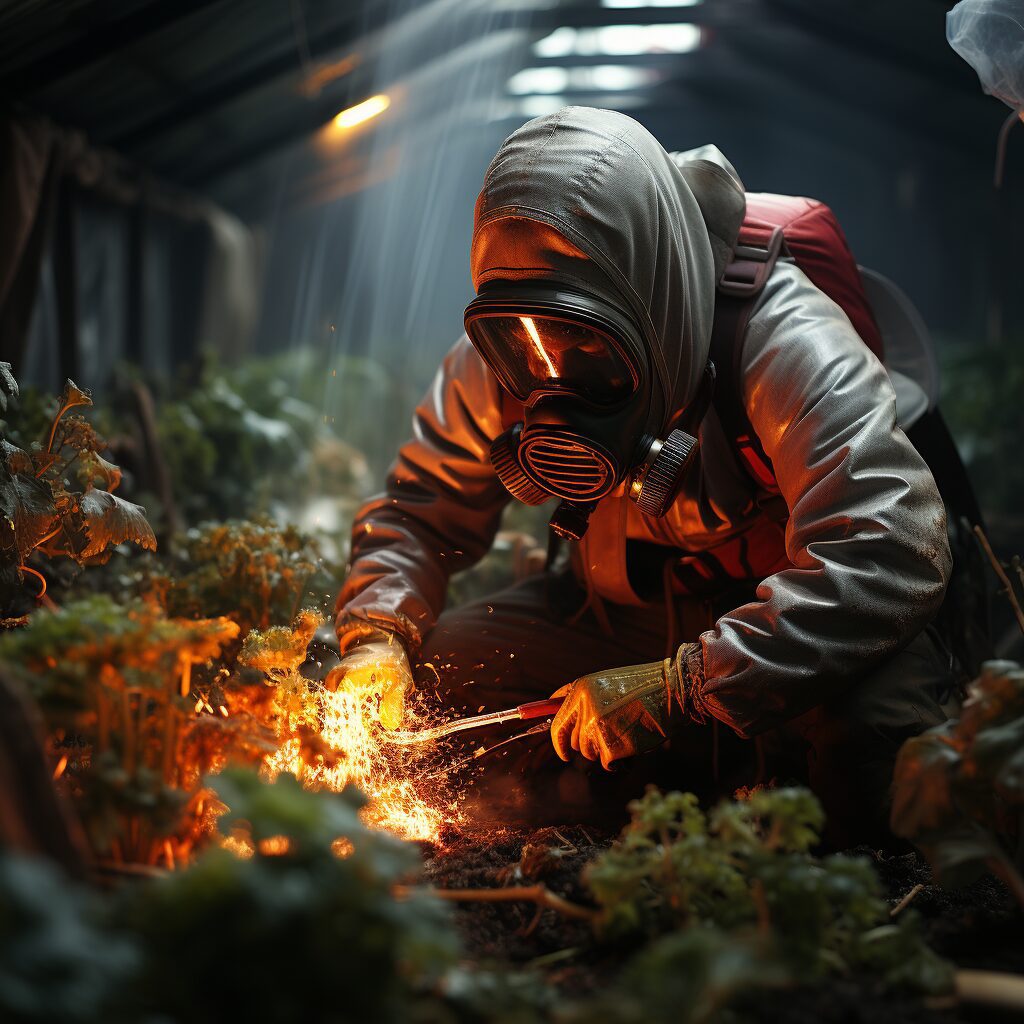
Scientists from Cornell University (Ithaca, New York) suggest that hemp-derived cannabinoids could provide a new basis for natural pesticides. They cite previous research:
Some researchers have shown that the butterfly Pieris brassicae can distinguish between leaves sprayed with THC and CBD and that exposure to cannabinoids affects its egg-laying behavior.
Meanwhile, other researchers found that CBD had larvicidal effects against two varieties of beetle and one variety of moth.
They also showed that they found that the larvae of a certain moth preferred to feed on leaves with lower levels of CBD, and that increasing the concentration of CBD reduced the size, weight, and survival of the larvae.
To balance things out, fruit flies favored leaves containing cannabinoids, while some ant colonies ignored the presence of THC in their food.
However, as a rule, the tendency of many insect species to avoid cannabis cannabinoids is so pronounced that research is being conducted into the possibility of using these compounds as ingredients of natural pesticides.
For this reason, the Faculty of Agriculture of the aforementioned Cornell University is conducting research on new, environmentally neutral plant protection products whose ingredients are to be hemp cannabinoids.